A Long Defeat: Reading J.R.R. Tolkien
“Actually I am a Christian,” Tolkien wrote
of himself, “and indeed a Roman Catholic, so that I do not expect ‘history’ to
be anything but a ‘long defeat’— though it contains (and in legend may contain
more clearly and movingly) some samples or glimpses of final victory” (Letters
255).
History as a long defeat – I can think of nothing
that is more anti-modern than this sentiment expressed by J.R.R. Tolkien. It is
a thought perfectly in line with the fathers and the whole of Classical
Christian teaching. And it’s anti-modernism reveals much about the dominant
heresy of our time.
We believe in progress – it is written into the DNA
of the modern world. If things are bad, they’ll get better. The “long defeat”
would only be a description of the road traveled by racism, bigotry, and all that
ignorance breeds.
And our philosophy of progress colors everything we
consider. The scientific concept of evolution (please do not jump on me for
mentioning the subject) only suggests that there is a change in living things
and that the change is driven by adaptation and the survival of those
adaptations that are generally advantageous. If such a theory is granted, it
says nothing about the direction of the process nor about the process as
improvement or progress. That “evolve” has come to mean “change for the better”
is a purely ideological assumption with no warrant in science.
But the metaphor of improvement remains a dominant
theme within our culture. A few years ago a survey of young Americans revealed
the utterly shocking conclusion that for the first time in recorded history,
the young did not expect to be as well off as their parents. It was a paradigm
shift in American progressive thought.
But Tolkien’s sentiment bears deeper examination.
For not only does it reject the notion of progress, it embraces a narrative of
the “long defeat.” Of course this is not a reference to steady declining
standards of living, or the movement from IPhone 5 back to IPhone 4 (perish the
thought!). It is rather the narrative of Scripture, first taught by the
Apostles themselves, clearly reflecting a Dominical teaching:
But know this, that in the last days perilous times will come: For men will be lovers of themselves, lovers of money, boasters, proud, blasphemers, disobedient to parents, unthankful, unholy, unloving, unforgiving, slanderers, without self-control, brutal, despisers of good, traitors, headstrong, haughty, lovers of pleasure rather than lovers of God, having a form of godliness but denying its power. …Now as Jannes and Jambres resisted Moses, so do these also resist the truth: men of corrupt minds, disapproved concerning the faith; but they will progress no further, for their folly will be manifest to all, as theirs also was. But you have carefully followed my doctrine, manner of life, purpose, faith, longsuffering, love, perseverance, persecutions, afflictions, which happened to me at Antioch, at Iconium, at Lystra– what persecutions I endured. And out of them all the Lord delivered me. Yes, and all who desire to live godly in Christ Jesus will suffer persecution. But evil men and impostors will grow worse and worse, deceiving and being deceived. (2 Timothy 3:1-13)
This is Tolkien’s warrant for the “long
defeat.”
And the thought is not that we wake up
one day and people are suddenly boasters, proud, blasphemers, etc. Rather,
“evil men and impostors will grow worse and worse, deceiving and being
deceived.”
It was a common belief among the Desert Fathers that
successive generations of monks would become weaker and weaker, unable to bear
the great trials of their predecessors. Indeed it was said that in the end, the
simple act of believing would take greater grace than all of the ascetic feats
of the earliest monks.
This is not a pessimistic streak within
Orthodox Christianity. If history tells us anything, it is that this is a very
honest, even prescient reading. The evils of the 20th century, particularly those unleashed during and after World War I,
are clearly among the worst ever known on the planet, and continue to be the
major culprits behind all of our current struggles. That war was not “the war
to end all wars.” It has rather been the foundation of all subsequent wars. May
God forgive our arrogance (“boasters, proud”…). But the Classical Christian
read on human life contains the deepest hope – set precisely in the heart of
the long defeat.
It is that hope that sets the Christian gospel apart
from earlier pagan historical notions. For the “long defeat” was a common
assumption among the ancient peoples. The Greeks and Romans did not consider
themselves to have exceeded the heroes who went before. They could model
themselves on Achilles or Aeneas, but they did not expect to match their like.
The Jews had no hope other than a “restoration of the Kingdom,” which was
generally considered apocalyptic in nature. All of classical culture presumed a
long decline.
The narrative was rewritten in the modern era –
particularly during the 19th century. The Kingdom of God was transferred from
apocalyptic hope (the end of the long defeat) to a material goal to be achieved
in this world. This was a heresy, a radical revision of Christian thought. It
became secularized and moderated into mere progress. It is worth doing a word
study on the history of the word “progressive.”
But Tolkien notes that within the long defeat, there
are “glimpses of final victory.” I would go further and say that the final
victory already “tabernacles” among us. It hovers within and over our world,
shaping it and forming it, even within its defeat. For the nature of our
salvation is a Defeat. Therefore the defeat within the world itself is not a
tragic deviation from the end, but an End that was always foreseen and present
within the Cross itself. And the Cross itself was present “from before the
foundation of the world.”
Tolkien’s long defeat, is, as he noted, of a piece with his Catholic, Christian faith. It is thoroughly Orthodox as well. For the victory that shall be ours, is not a work in progress – it is a work in wonder.
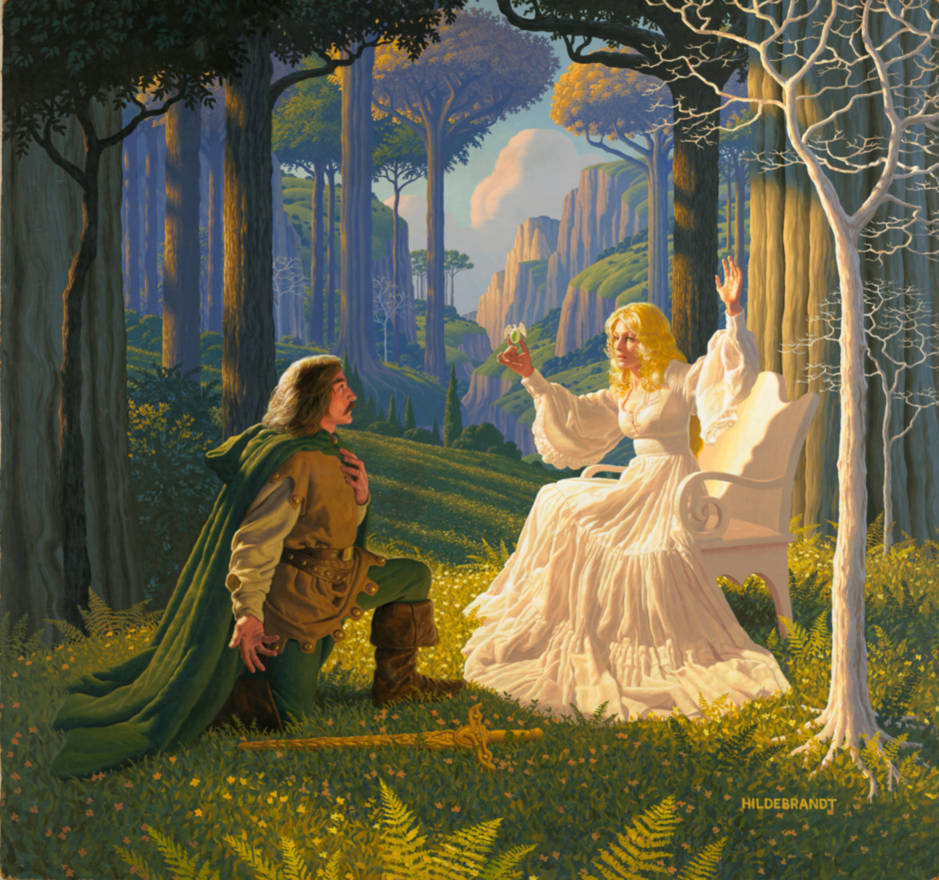
The photo shows, "The Gift of Galadriel," by the Hildebrandt brothers, painted in 1977.