Against The Normal
Within the Christianity of our time, the great spiritual conflict, unknown
to almost all, is between a naturalistic/secular world of modernity and the
sacramental world of classical Christianity. The first presumes that a literal
take on the world is the most accurate. It tends to assume a closed system of
cause and effect, ultimately explainable through science and manageable through
technology. Modern Christians, quite innocently, accept this account of the
world with the proviso that there is also a God who, on occasion,
intervenes within this closed order. The naturalist unbeliever says, “Prove
it.”
The sacramental world of classical Christianity speaks a wholly different
language. It presumes that the world as we see it is an expression of a greater
reality that is unseen. It presumes that everything is a continuing gift and a
means of communion with the good God who created it. The meaning and purpose of
things is found in that which is not seen, apart from which we can only reach
false conclusions. The essential message of Christ, “The Kingdom of God is at
hand,” is a proclamation of the primacy of this unseen world and its coming
reign in the restoration of all things (apokatastasis, cf. Acts 3:21).
The assumptions of these two worldviews could hardly be more contradictory.
The naturalistic/secular model has the advantage of sharing a worldview with
contemporary culture. As such, it forms part of what most people would perceive
as “common sense” and “normal.” Indeed, the larger portion of Christian
believers within that model have no idea that any other Christian worldview
exists.
The classical/sacramental worldview was the only Christian worldview for
most of the centuries prior to the Reformation. Even then, that worldview was
only displaced through revolution and state sponsorship. Nonetheless, the
sacramental understanding continues within the life of the Orthodox Church, as
well as many segments of Catholicism. Its abiding presence in the Scriptures
guarantees that at least a suspicion of “something else” will haunt some modern
Christian minds.
An assumption of the secular/naturalist worldview is that information itself
is “objective” in character: it is equally accessible to everyone. The
classical worldview assumes something quite different. “Blessed are the pure in
heart,” Christ says, “for they shall see God.” The Kingdom of God is not an
inert object that yields itself to public examination. The knowledge of God and
of all spiritual things requires a different mode of seeing and understanding.
St. Paul says it this way: “But the natural man does not receive the things of
the Spirit of God, for they are foolishness to him; nor can he know them,
because they are spiritually discerned” (1Co 2:14).
This understanding disturbs the sensibilities of many contemporary Christians.
Some go so far as to suggest that it is “gnostic” (by this they mean that the
very notion of spiritual knowledge that is less than democratic is
suspect). Sola Scriptura is a modern concept that posits the
Scriptures as subject to objective interpretation. The Scriptures thus belong
to the world of public, democratic debate, whose meaning belongs within
the marketplace of opinion. The Scriptures are “my Bible.”
The classical model is, in fact, the teaching found in the Scriptures. It
utterly rejects the notion of spiritual knowledge belonging to the same
category as the naturalistic/secular world. It clearly understands that the
truth of things is perceived only through the heart (nous) and that an
inward change is required. It is impossible to encounter the truth and remain
unchanged.
The classical model, particularly as found within Orthodoxy, demands
repentance and asceticism as a normative part of the spiritual life. These
actions do not earn a reward, but are an inherent part of the cleansing of the
heart and the possibility of perceiving the truth.
The rationalization (secular/rationalist) of the gospel has also given rise
to modern “evangelism.” If no particular change is required in a human being in
order to perceive the truth of the gospel, then rational argument and
demonstration becomes the order of the day. Indeed, modern evangelism is
largely indistinguishable from modern marketing. They were born from the same
American social movements.
The classical model tends to be slower in its communication, for what is
being transmitted is the fullness of the tradition and the transformation of
each human life. Evangelism, in this context, has little to no relationship
with marketing. The primary form for the transmission of the gospel is the
community of the Church. The Christian faith, in its fullness, is properly only
seen in an embodied community of believers living in sacramental union with God
through Christ by the Holy Spirit. In the early Church, the catechumenate
generally lasted for as much as three years. The formation that took place was
seen as an essential preparation for the Christian life. “Making a decision”
was almost beside the point.
The struggle between classical/sacramental Christianity and modernity
(including its various Christianities) is not a battle over information. The
heart of the struggle is for sacramental Christianity to simply remain faithful
to what it is. That struggle is significant, simply for the fact that it takes
place within a dominant culture that is largely its antithesis.
A complicating factor in this struggle is the fact that the dominant culture
(naturalistic/secular) has taken up traditional Christian vocabulary and
changed its meaning. This creates a situation in which classical Christianity
is in constant need of defining and understanding its own language in
contradistinction to the prevailing cultural mind. The most simple terms,
“faith, belief, Baptism, Communion, icon, forgiveness, sin, repentance,” are
among those things that have to be consistently re-defined. Every conversation
outside a certain circle requires this effort, and, even within that circle,
things are not always easy.
Such an effort might seem exhausting. The only position of relaxation within
the culture is the effortless agreement with what the prevailing permutations
tell us on any given day. Human instinct tends towards the effortless life –
and the secular mentality constantly reassures us that only the effortless life
is normal. Indeed, “normal, ordinary, common,” and such terms, are all words
invented by modernity as a self-description. Such concepts are utterly absent
from the world of Scripture. Oddly, no one lived a “normal” life until
relatively recently.
That which is “normal” is nothing of the sort. It is the purblind self-assurance
that all is well when nothing is well.
God have mercy on us.
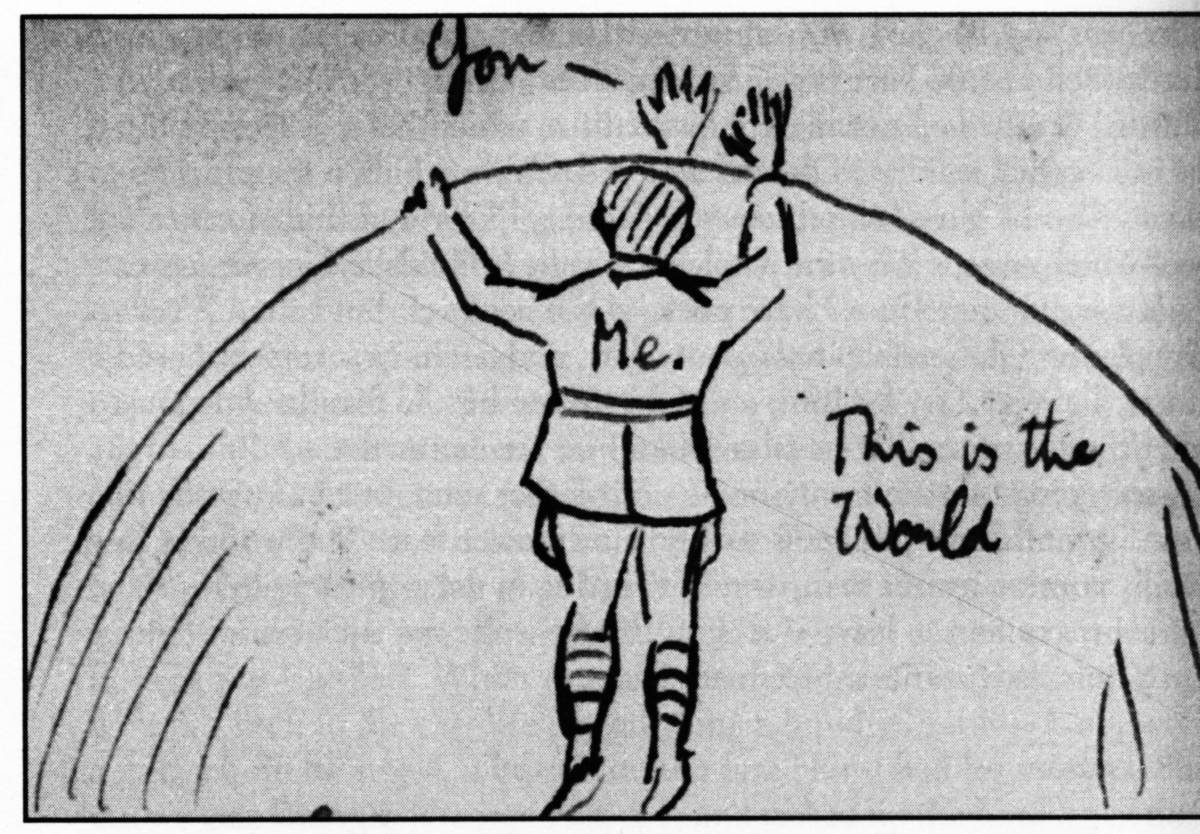
The photo shows a marginal pen-and-ink drawing from a letter by Olaf Stapledon, written to his fiance, dated October 3, 1918.