Early History Of Germany
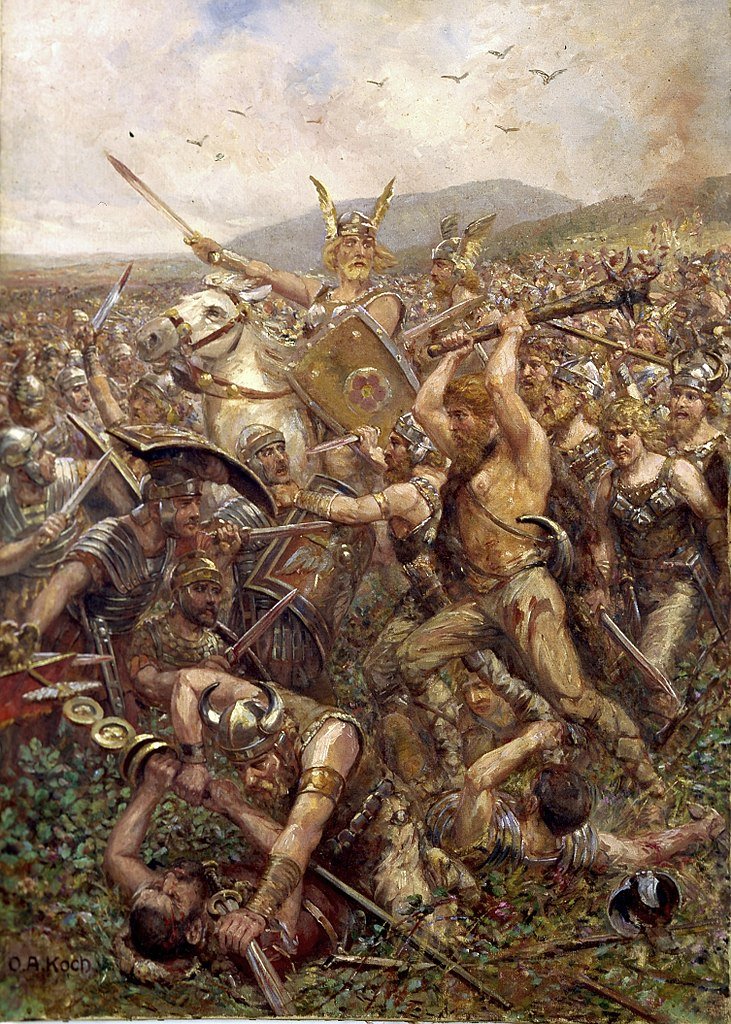
The Germanic tribes, which probably originated from a mixture of
peoples along the Baltic Sea coast, inhabited the northern part of the European
continent by about 500 B.C. By 100 B.C., they had advanced into the central and
southern areas of present-day Germany.
At that time, there were three major tribal groups: the eastern
Germanic peoples lived along the Oder and Vistula rivers; the northern Germanic
peoples inhabited the southern part of present-day Scandinavia; and the western
Germanic peoples inhabited the extreme south of Jutland and the area between
the North Sea and the Elbe, Rhine, and Main rivers.
The Rhine provided a temporary boundary between Germanic and Roman
territory after the defeat of the Suevian tribe by Julius Caesar about 70 B.C.
The threatening presence of warlike tribes beyond the Rhine prompted
the Romans to pursue a campaign of expansion into Germanic territory. However,
the defeat of the provincial governor Varus by Arminius at the Battle of the
Teutoburg Forest in A.D. 9 halted Roman expansion; Arminius had learned the
enemy’s strategies during his military training in the Roman armies.
This battle brought about the liberation of the greater part of Germany
from Roman domination. The Rhine River was once again the boundary line until
the Romans reoccupied territory on its eastern bank and built the Limes, a
fortification 300 kilometers long, in the first century A.D.
The second through the sixth centuries was a period of change and
destruction in which eastern and western Germanic tribes left their native
lands and settled in newly acquired territories. This period of Germanic
history, which later supplied material for heroic epics, included the downfall
of the Roman Empire and resulted in a considerable expansion of habitable area
for the Germanic peoples.
However, with the exception of those kingdoms established by Franks and
Anglo-Saxons, Germanic kingdoms founded in such other parts of Europe as Italy
and Spain were of relatively short duration because they were assimilated by
the native populations. The conquest of Roman Gaul by Frankish tribes in the
late fifth century became a milestone of European history; it was the Franks
who were to become the founders of a civilized German state.
Merovingian Rule, ca. 500-751
In Gaul a fusion of Roman and Germanic societies occurred. Clovis, a
Salian Frank belonging to a family supposedly descended from a mythical hero
named Merovech, became the absolute ruler of a Germanic kingdom of mixed
Roman-Germanic population in 486. He consolidated his rule with victories over
the Gallo-Romans and all the Frankish tribes, and his successors made other
Germanic tribes subjects of the Merovingian Dynasty.
The remaining 250 years of the dynasty, however, were marked by
internecine struggles and a gradual decline. During the period of Merovingian
rule, the Franks reluctantly began to adopt Christianity following the baptism
of Clovis, an event that inaugurated the alliance between the Frankish kingdom
and the Roman Catholic Church. The most notable of the missionaries responsible
for Christianizing the tribes living in Germany was Saint Boniface (ca.
675-754), an English missionary who is considered the founder of German
Christianity.
The Carolingians, 752-911
Charlemagne inherited the Frankish crown in 768. During his reign
(768-814), he subdued Bavaria, conquered Lombardy and Saxony, and established
his authority in central Italy. By the end of the eighth century, his kingdom,
later to become known as the First Reich (empire in German), included
present-day France, the Netherlands, Belgium, and Luxembourg, as well as a
narrow strip of northern Spain, much of Germany and Austria, and much of the
northern half of Italy. Charlemagne, founder of an empire that was Roman,
Christian, and Germanic, was crowned emperor in Rome by the pope in 800.
The Carolingian Empire was based on an alliance between the emperor,
who was a temporal ruler supported by a military retinue, and the pope of the
Roman Catholic Church, who granted spiritual sanction to the imperial mission.
Charlemagne and his son Louis I (r. 814-40) established centralized authority,
appointed imperial counts as administrators, and developed a hierarchical
feudal structure headed by the emperor. Reliant on personal leadership rather
than the Roman concept of legalistic government, Charlemagne’s empire lasted
less than a century.
A period of warfare followed the death of Louis. The Treaty of Verdun
(843) restored peace and divided the empire among three sons, geographically
and politically delineating the approximate future territories of Germany,
France, and the area between them, known as the Middle Kingdom. The eastern
Carolingian kings ruled the East Frankish Kingdom, what is now Germany and
Austria; the western Carolingian kings ruled the West Frankish Kingdom, what
became France.
The imperial title, however, came to depend increasingly on rule over
the Middle Kingdom. By this time, in addition to a geographical and political
delineation, a cultural and linguistic split had occurred. The eastern Frankish
tribes still spoke Germanic dialects; the language of the western Frankish
tribes, under the influence of Gallo-Latin, had developed into Old French.
Because of these linguistic differences, the Treaty of Verdun had to be written
in two languages.
Not only had Charlemagne’s empire been divided into three kingdoms, but the East Frankish Kingdom was being weakened by the rise of regional duchies, the so-called stem duchies of Franconia, Saxony, Bavaria, Swabia, and Lorraine, which acquired the trappings of petty kingdoms. The fragmentation in the east marked the beginning of German particularism, in which territorial rulers promoted their own interests and autonomy without regard to the kingdom as a whole. The duchies were strengthened when the Carolingian line died out in 911; subsequent kings would have no direct blood link to the throne with which to legitimate their claims to power against the territorial dukes.
Courtesy of German Culture.
The photo shows, "Battle of the Teutoburg Forest, or Varusschlacht," by Otto Albert Koch, painted in 1909.