Prayer As Erotic Language
The very heart of true prayer is desire, love. In
the language of the Fathers this desire is called eros. Modern usage has corrupted the meaning of “erotic” to only mean
sexual desire – but it is a profound word, without substitute in the language
of the Church.
I offer a quote from Dr. Timothy Patitsas of Holy
Cross in Brookline:
By eros we mean the
love that makes us forget ourselves entirely and run towards the other without
any regard for ourselves. Allan Bloom described eros as “love’s mad
self-forgetting.” (from Road to Emmaus, Vol. XV, No. 2, Spring, 2014).
Patitsas, in the same interview, offers this
observation on St. Maximus’ thought:
St. Maximus says that God was so good that His
goodness could not be contained within Himself. It poured forth “outside”
Himself in a cosmic Theophany over against the face of darkness [nothingness].
The appearing of this ultimate Beauty caused non-being itself to forget itself,
to renounce itself, to leave behind its own “self” – non-being – and come to
be. All of creation is thus marked by this eros, this movement of doxology,
liturgy, love, and repentance out of chaos and into the light of existence.
Creation is repenting from its first moment, for repentance does not require
the perquisite of sin. It simply means to put our attention still more deeply
upon Christ to love Him much, much more than we have before. Of course,
compared to that “more deeply,” the prior state looks like sin – but this is
partly relative for us.
This is a profound summary of the work of creation,
particularly in its use of Maximus’ imagery and thought. But this account of
creation , almost scandalous in its “erotic” content, goes to the heart of
worship, prayer and repentance. The language of prayer in Orthodoxy is
frequently deeply “penitential” and filled with extreme expressions. We
describe ourselves as the “worst of sinners,” etc. St. Basil’s language is
typical:
Although I have completely subjected myself to sin
and am unworthy of heaven, of earth and of this passing life, even though I am
a slave to delights and have disgraced Your image, yet I still do not lose hope
in salvation, wretched as I am, for You have made and fashioned me. I place my
hope in Your boundless mercy and approach You…
We pray with such extreme language, reflecting not a
vision of legal condemnation: rather, it is the recognition of Beauty itself,
in Whose Presence we appear broken, soiled, with nothing to recommend us. It is
the language of repentance – but not of morbid self-hatred. It is the language
of self-forgetting of leaving the self behind, of finding nothing within the
self to cling to.
There is another word for this self-forgetting: ecstasy.
Again, this word has been abused in modern language and now means an extreme
emotional state. But its Greek root means to “stand outside of oneself.” Thus
the Fathers will speak of God’s ecstasy – His going forth to us. But there is
also our ecstasy, as we forget ourselves and
rush towards Him.
It could be argued that the language of
self-deprecation in liturgical prayers is very much a “remembering” and
“dwelling” on the self. Within a legal metaphor this might be quite true. But
we must listen to the whole of the prayers.
O Lord, I know that my transgressions have mounted
higher than my head, but the greatness of Your compassion is incomparable and
the mercy of Your bounty is indescribable and free of malice. There is no sin
which surpasses Your love for mankind. Therefore, wondrous King and all
gracious Lord, show Your wondrous mercy to me a sinner; show me the power of
Your goodness; show me the strength of Your long-suffering mercy, and receive
me a sinner as I turn to You. (St. Simeon the Translator)
We see that our sins have driven us back towards
non-being and nothingness. But God in His great mercy continues to call us into
existence and to raise us up from the emptiness of our sin.
I want to say a few words about evil and non-being.
Non-being is not evil. It is not anything. We cannot say it is good nor can we
say it is neutral. It is nothing. The Fathers recognized a trinity of
existence: Being, Well-Being, Eternal Being. They also recognized another
trinity: Beauty, Goodness, Truth.
It is the teaching of the Fathers that being,
existence, is inherently good. It is the gift of the good God, who alone
has true Being (“Being Beyond All Being”). But we are created with a direction
or movement (kinesis). That movement is from being towards well-being
and eternal being. Eternal Being is true union with Christ (theosis).
Our call into existence is brought forth as we
behold the Beauty of God. Drawn towards Him, we see that He is not only
Beautiful, but that He is loving, self-emptying for the sake of all – that is –
we see that He is Good. As we pursue His Goodness we move ever towards our End
in Christ who is the Truth.
I have taken a few moments to set these things in
their proper perspective and order because we use these words casually, without
care for their proper meaning. Only in this context do we understand sin
as an “ontological” problem (having to do with being).
Sin is a movement away from being,
well-being, and eternal being. It is a distorted direction (hamartia:
“missing the mark”). It is equally the refusal of Beauty and Goodness, without
participation in the Truth.
I will try to put this into practical terms. A man
sees someone else in genuine need and has plenty to spare. But he considers the
matter and turns away. He has “increased” or “preserved” his wealth, but he has
impoverished his soul, diminished his own existence since his existence depends
utterly on his movement towards well-being and eternal-being. This he could
pursue by following the commandments and the example of Christ (which is
already the movement of grace within him). Christ’s self-emptying towards all
of creation is the perfection of generosity. To act on generosity is union with
Christ, a movement towards well-being.
When someone asks: “Is it a sin to withhold help
from someone in need?” The answer is yes – but not in a merely legal sense. It
is a sin – a movement towards non-existence – a movement away from the proper
direction of our lives.
And it is from the depths of our non-existence that
we cry out to God for mercy. Seeing His Beauty we forget ourselves (and our
money, etc.) and we call out to the One who has called out to us. In our
longing for His Beauty we love Him and are drawn to His Goodness. We give to
the one who has need: “my brother is my life.”
I would add, in light of an earlier comment, that
this forgetting of ourselves in the face of His beauty is true shame (not the
toxic form). It is the confessing of our emptiness, our non-existence, in the
face of true existence (which is Beautiful). Such a pure-hearted confession is
ecstatic, a movement out of the self towards the Other.
I will also add as an aside that all of this should
shed much light on the importance of beauty in Orthodox liturgy and Churches,
iconography, etc. It is essential – not a decoration or an afterthought. Much
of the modern world sees beauty as a luxury (which it so rarely affords). I
grieve deeply when I hear the modern sentiment directed towards a beautiful
Church “that money should have been given to the poor.” These are the words of
Judas. And those who say such things rarely give anything themselves. Beauty is
not a contradiction of generosity. The movement towards Beauty is a movement
towards Goodness (which contains generosity at its core).
The apprehension of Beauty is at the very heart of the preaching of the gospel. It is that which first touches the heart and draws us towards Truth. In our over-rationalized world we tend to think that it is reasoning and arguments that draw people to Christ. But this is something that comes much later. First the heart must be drawn – and this happens primarily through Beauty in its broadest sense. Many things serve this role.
For C.S.Lewis it was a picture in a book of Norse Mythology and the line, “Balder the Beautiful is Dead.” Mysteriously, it pierced his young heart and remained with him until he much later perceived Christ. I have always treasured Muggeridge’s book on Mother Teresa titled, Something Beautiful for God. If you cannot share the beauty of the gospel, then you have likely not understood it and clearly lack the requisite gifts as of yet. This is why St. Porphyrios said, “Whoever wants to become a Christian must first become a poet.”
These are the thoughts of the Fathers, and the doorways into greater perception of the mystery of the gospel. It is the absence of such depth that reveals the poverty of legal imagery – as well as its lack of beauty.
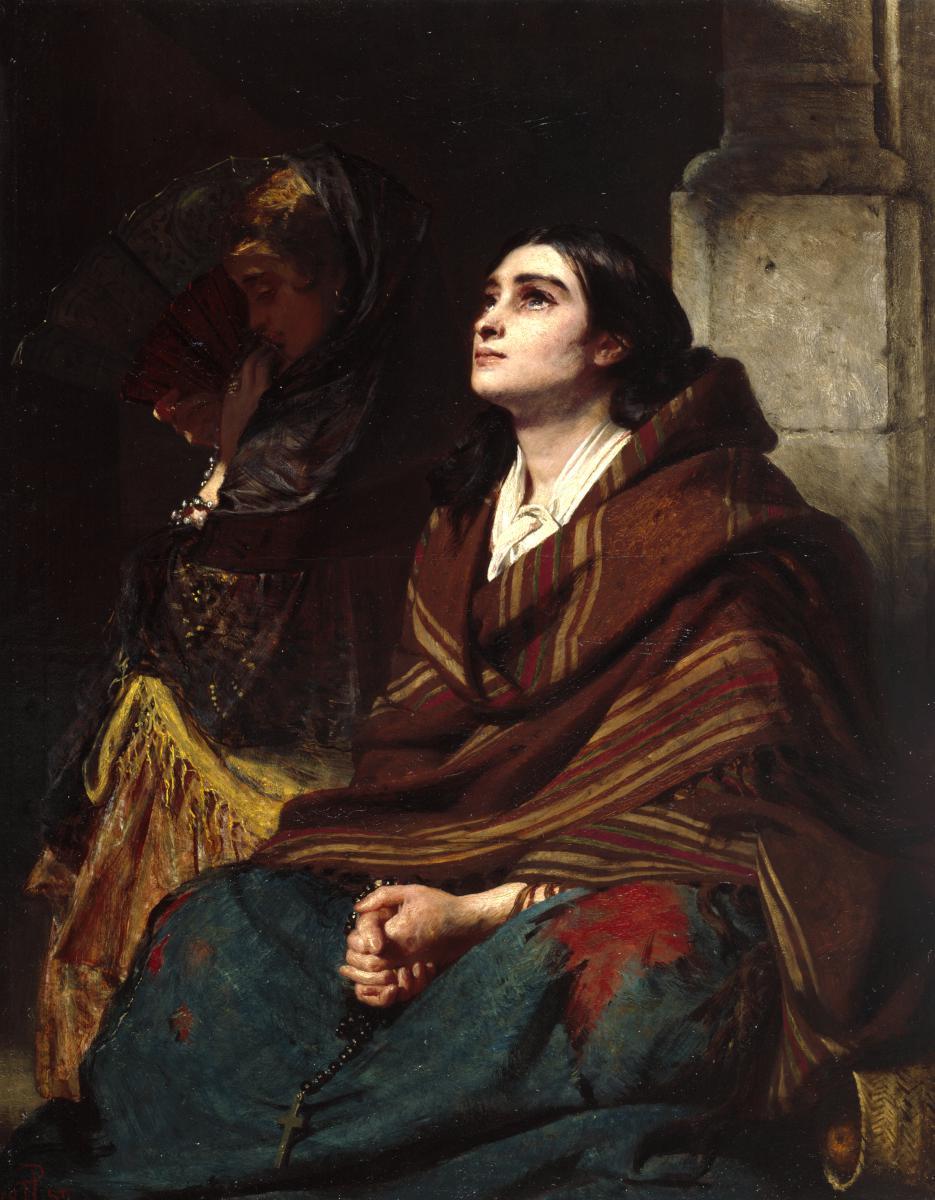
The photo shows, "A Woman Praying," by John Phillip, painted ca. 1860s.