The Last Will And Testament Of José Antonio Primo de Rivera
The last will and testament
of José Antonio Primo de Rivera y Sáenz de Heredia, thirty-three years of age,
single, attorney at law, born and current resident in Madrid, son of Miguel and
Casilda (may they rest in peace), as written and attested by himself, in the
Provincial Prison of Alicante, this eighteenth day of November, nineteen
hundred and thirty-six.
Condemned yesterday to
death, I pray God that if it does not please Him to spare me, may He then grant
me to preserve my dignity to that end which I now await, and when judging my
soul, may He apply, not the measure of my merits, but His infinite mercy.
It troubles me that my
compunction to give an account of some of my actions at this time may seem like
vanity and excessive attachment to the things of this earth. But, on the other
hand, I have drawn upon the faith of so many of my comrades, far in excess of
my own worth (so well do I know this that I write this phrase with the greatest
humility and sincerity), for I have compelled so countless many of them to face
enormous risks and responsibilities, and it would be inconsiderate ingratitude
on my part to leave everyone without even an explanation.
It is not necessary to
repeat now what I have said and written so many times about what the founders
of the Spanish Falange wished us to be. It astonishes me that even after three
years the vast majority of our compatriots persist in judging us without having
begun, by any means, to understand us, nor even seeking out and accepting the
least bit of information about us. If the Falange is consolidated into an
enduring thing, I hope that all will perceive with pain that so much blood was
spilled because we could not affect a peaceful gap between the cruelty of the
one side and the antipathy of the other. May that spilled blood forgive me for
the part that I played in provoking it, and may the comrades who have gone
before in sacrifice welcome me as the last among them.
Yesterday, for the last
time, I explained to the Tribunal, which was judging me, what the Falange is.
As in so many other occasions, I reviewed and submitted the old documents
concerning our doctrine. Once again, I observed that so many faces, which were
at first hostile, lit up, first with sympathy and then with amazement. In their
features, I seemed to read this phrase: “If we had known what this was, we
would not be here!” And, certainly, we would not be here, nor I before a
People’s Tribunal, nor all those killing themselves in the fields of Spain.
However, it was no longer time to prevent this, and all I could do was pay back
the loyalty and courage of my dear comrades, by earning for them the respectful
attention of their enemies.
To this I tended, and not
to win for myself the posthumous reputation of a hero by way of some tinseled
gallantry. I did not take responsibility for everything, nor try to cast myself
in some romantic stereotype. I defended myself with the best resources of my
legal profession, which I have loved and cultivated with so much assiduity.
There may well be no lack of posthumous commentators who might condemn me for
not preferring bombast. To each his own. As for me, apart from not being the
only actor in what is now occurring, it would have been monstrous and false to
give up a life, without defense, that could still be useful, which God did not
grant me to burn in a holocaust of vanity like a fireworks display. Further, I
did not descend to using some reproachable ruse, nor compromising anyone with
my defense; and, yes, I did help to defend my brother Miguel and Margot [his
wife], who were on trial with me and threatened with very severe penalties. However,
my duty to defend urged me to not only be silent about certain things but to
make certain accusations, based on suspicions that I was isolated deliberately,
in the midst of a region that had been subdued. I declare that this suspicion
has not been proven by me, in any way, and if I sincerely nourished it in my
spirit, being greedy for explanations in my solitude, now, in the face of
death, I say that it cannot and must not be upheld.
Something else remains for me to rectify. The absolute isolation from any communication, in which I have lived since shortly after these events began, was only broken by a North American journalist who, with the permission of the authorities here, asked me for statements at the beginning of October.
Until five or six days ago,
when I came to know the indictments against me, I had not heard of the
statements being attributed to me, as I had no access to newspapers, or anything
else, which published them. Now that I read them, I must declare that among the
various paragraphs that are attributed to me, unequally faithful, which seek to
interpret my thinking, there is one that I reject completely: The one that
shames my comrades of the Falange of cooperating with “mercenaries brought in
from outside,” during the movement to insurrection.
I have never said anything
like that, and yesterday I bluntly said so before the Tribunal, although such a
declaration did me no favor. I am incapable of insulting those military forces
which have rendered heroic service to Spain, in Africa. Nor am I capable of
hurling reproaches at some comrades, from here, for I do not know if they are
now wisely or wrongly led. But surely, as always, they are endeavoring to
interpret, in best faith and despite the lack of communication that separates
us, my instructions and tenets. May God grant that their ardent integrity never
be exploited in any other way than in that of service to greater Spain, such is
the dream of the Falange.
Would mine were the last Spanish bloodshed in civil strife.
If only the Spanish people, so full of good and lovable qualities, could come
to find the fatherland, bread and justice in peace.
I think nothing else matters to me, as concerns my public
life. As for my impending death, I await it without bravado, for it is never
joyful to die at my age, but I await it without protest. May Our Lord God
accept the elements of sacrifice it contains in insufficient compensation for
what selfishness and vanity there has been in much of my life. I forgive with
all my heart all those, without exception, who may have harmed or offended
me, and I ask all those to forgive me to whom I may owe the reparation of some
wrong, be it great or small. Upon compliance thereof, I now proceed to put in
order my last will, as follows:
CLAUSES
–
First. I wish to be interred conforming to the
rites of the Catholic, Apostolic, Roman religion, which I profess, in blessed
ground, and under the protection of the Holy Cross.
Second. I appoint as my
heirs my four brothers and sisters, Miguel, Carmen, Pilar and Fernando Primo de
Rivera y Sáenz de Heredia, each with equal share, with the right to distribute
said share among the survivors, if any die without offspring before me. If
there be offspring, the share that pertains to my predeceased sibling will be
equally divided, per stirpes. This deposition will reman valid though my
sibling be predeceased prior to the writing of this will.
Third. I leave no other legacy, nor impose a
legally binding burden on my siblings, but I would request that:
A) They attend, with my
estate, to the comfort and needs of our aunt, María Jesús Primo de Rivera y
Orbaneja, whose maternal self-denial and affectionate courage, in the
twenty-seven years that she has been in our care, we shall never be able to
repay with treasures of gratitude;
B) They give, in memory of me, some of my personal
effects and belongings to my colleagues, especially to Rafael Garcerán, Andrés de la Cuerda and Manuel Sarrion, so
loyal, from year-to-year, so helpful and patient, despite my incommodious
company. I thank them and everyone else, and I beg
them to remember me without undue anger;
C) They distribute my other personal effects among
my best friends, whom they know very well, and most assuredly among those who
have shared with me the joys and adversities of our Spanish Falange. They and
some other comrades now occupy a fraternal position in my heart.
D) That they reward the oldest servants of
our house, whom I thank for their loyalty, and beg their pardon for any
inconvenience I brought upon them.
Fourth. I name as my testamentary executors,
jointly and severally, for a period of three years, and with all the usual
prerogatives, my dear and lifelong friends Raimundo
Fernández Cuesta y Morelo and Ramón Serrano Suñer, whom I request especially:
A) That they review my private papers and
destroy all those of a very personal nature, as well as those that contain
merely literary works and those that are simple drafts and projects in early
stages of elaboration, or any work prohibited by the Church, or otherwise
pernicious, that may be found in my things.
B) That they collect all my speeches, articles,
circulars, prologues to books, etc., not for publication – unless they deem it
indispensable – but to use as justification when discussing this period of
Spanish politics in which my comrades and I have intervened.
C) That
they urgently find my replacement in the direction of the various professional
matters entrusted to me, with the help of Garcerán,
Sarrión and Matilla, and to collect some of the fees that are due me.
D) That, as quickly and effectively as possible, they send to the
aggrieved persons and entities, referred to in the introduction of this will,
the solemn rectifications that it contains.
For all of which I thank them cordially, from now on.
And with these terms, I leave my last will and testament, on this
eighteenth day of November, one thousand nine-hundred and thirty-six, at five
in the afternoon, on three other pages, besides this one, all foliated, dated
and signed in the margin.
José Antonio Primo de Rivera
Aftermath
The trial of José Antonio Primo de Rivera took place on November 14th and 17th, 1936. The Tribunal, or People’s Court, consisted of a President (Iglesias Portal), two other assessor judges (with votes), and fourteen members of the jury. The jury was entirely made up of members of the Popular Front, or unions of similar political affiliation. According to various testimonies, the deliberations dragged on and on, with the members of the jury nearly coming to blows. The death sentence for José Antonio was finally handed down, after four hours, because of threats from the Communist jury members.
José Antonio conducted his own defense, as well as that of his brother, Miguel, and his sister-in-law, Margarita de Larios. Miguel was sentenced to life-imprisonment, while Margarita received a six-year prison term. Two years later, in April 1938, both husband and wife were exchanged for Captain Miaja (the son of General José Miaja). José Antonio’s younger brother, Fernando, had been murdered earlier in prison, in August 1936.
Miguel was given a few minutes to say goodbye to his brother, at 6:00 AM, on November 20th. When Miguel came into his prison-cell, José Antonio, fearing that he might be overcome with emotion, whispered to him in English, so the guards would not understand, “Miguel, help me die with dignity.”
José Antonio was then taken out to the small courtyard of Alicante prison, along with two Falangists and two Requetés (Carlist, Catholic-traditionalists), who were shot with him.
José Antonio heartened his four comrades and then addressed the militiamen: “Is it really true that you want me to die? Who has told you that I am your adversary? Whoever told you had no reason to say so. My dream is of a fatherland, of bread and of justice for all Spaniards, especially those who are left out of the fatherland because they have neither bread nor justice. He who is about die does not lie. And I tell you, before you tear apart my breast with bullets from your rifles – that I was never your enemy.”
At 6:30 AM, the shots rang out. The militiamen fired several
rounds at close range (just 3 yards away), without even being ordered to do so.
A few days after the execution, the British Foreign Office asked
the government of the Popular Front for a death certificate of the Falangist
leader. José Antonio was buried in a mass grave in the cemetery at Alicante.
His friend, Elizabeth Asquith (according to some historians, his secret love), the daughter of a former British prime minister, who was married to Prince Bibesco, the Romanian ambassador in Madrid, had used all her connections to save his life. Having failed, she demanded reliable proof of his death. An official from the British Embassy went to the cemetery, accompanied by Judge Federico Enjuto, and had the body of José Antonio unearthed. Thus began the curious journey of José Antonio’s remains.
His body was exhumed from the mass grave a second time by the government of the Popular Front, and given an individual burial within the cemetery (lot number 515). The third exhumation was carried out in 1939, just after the end of the Civil War, when the body was transferred from Alicante to the Royal Monastery of San Lorenzo de Escorial, near Madrid. A fourth removal followed on March 31, 1959, when his remains were transferred to the Basilica of Valle de los Caídos, also near Madrid.
José Antonio would remain in the heart of Elizabeth Asquith. Her last novel, The Romantic, published in 1940, begins with a dedication to him: "To Jose Antonio Primo de Rivera. I promised you a book before it was started. It is yours now that it is finished – Those we love die for us only when we die –"
Among the personal effects of José Antonio, left in his cell, was found
a telegram, signed, “Elizabeth,” and dated, February 29, 1936. It read, “I am
thinking of you. Love.”
But it would appear that José Antonio’s great love was Pilar Azlor de Aragón y Guillamas, Duchess of Luna. Pilar’s father, a fervent monarchist, had formally opposed their relationship.
Epilogue
One last anecdote is worth remembering. It is not without importance, as
it shows that pardon and the spirit of reconciliation animated some Spaniards
during the Civil War and under the Franco regime.
It is a fact revealed for the first time in 1968, by the filmmaker José Luis Sáenz de Heredia (first cousin of José Antonio), and again by the latter, on television, in 1981 (in the program, “The Clave”). Then, the same fact was disclosed another time, by the journalist Enrique de Aguinaga in 2016; and finally, quite recently, in the biography by Honorio Feito, Iglesias Portal, el juez que condenó a José Antonio ["Iglesias Portal, the Judge that Condemned José Antonio"], (2019).
This is the unusual, generous and touching "abrazo"
(hug) given by José Antonio to his judge, Iglesias Portal, who just a few
minutes earlier had handed down the verdict and the death sentence. The
daughters of Iglesias Portal testified to this embrace in a letter, dated
January 30, 1955, addressed to Miguel Primo de Rivera (who himself had been sentenced
to life imprisonment in the same trial as José Antonio, and who was then the
Spanish ambassador in London). The daughters wrote to ask Miguel to intercede
to have their father, in exile in Mexico, repatriated.
Iglesias Portal had been a career magistrate since 1908. He was appointed to the Supreme Court in 1932 by his friend and fellow political ally, the radical-Socialist, Álvaro de Albornoz, then Minister of Justice. Iglesias Portal had also investigated the case of the assassination of Calvo Sotelo in July 1936. Also in 1936, as the president of the Special Court, he was charged with purging the justice administration (this was the executive body responsible for the repression of the Republicans, during the Civil War). Later, in 1937, he became the president of the Central Tribunal of Espionage and Treason in Barcelona (and in this capacity he led the trial against the "Trotskyist" leaders of the POUM).
The letter of the two daughters of Iglesias Portal began with these
words:
Most Distinguished Sir:
Although we personally have not had the pleasure of meeting you, yet we
make bold to direct this letter to you that you might attend to our plea. We
are daughters of the Supreme Judge who, as Your Excellency well knows,
unfortunately, was present and part of the Court in which your brother, José
Antonio, was judged (may be rest in peace).
As your excellency was present at the trial, you will remember that at
the end, when receiving the sentence, your brother took the stand and hugged
our father and told him that he felt that the difficult times had pushed
through his case, for we do not know if you are aware that our father and he
were good friends…
The letter then continued to request for intercession for the
repatriation of their father.
Here is the reply of Miguel Primo de Rivera:
Miss Loli Iglesias Arcos
Avda. de Felipe II, 11,
Madrid
Distinguished Miss:
I have received your letter of March 11, dated in
Mexico. I am sorry that I could not answer earlier, due to the many preoccupations
that weighed upon me. In replying today I want to reiterate what I wrote in my
previous letter, dated February 8, stating, unequivocally that, as far as I am
concerned, I do not at all oppose your father’s return to Spain and that, on
the contrary, I am willing to ensure that this happens, by helping you in
everything that may be deemed convenient...
I know that under normal circumstances, and acting
according to the dictates of his conscience, Judge Eduardo Iglesias Portal
would never have been directly responsible for a sentence issued against José
Antonio, of whom he was not an enemy. Don Eduardo Iglesias had the bad fortune
of seeing himself, like many others in those uncertain days, involved and
participating, with due responsibility, in what was in all ways decided by the
true enemies of Spain.
I want, if necessary, that this letter serve as my
statement, declaring that, for my part, I have nothing to oppose the return of Mr.
Eduardo Iglesias Portal to his country and to Spanish society.
I take this opportunity to reiterate that I remain yours
sincerely,
Signed: The Duke of Primo de Rivera.
It would be another year before the Council of Ministers, chaired by Franco, conceded the amnesty to Magistrate Iglesias Portal, on July 27, 1956. The judge returned to Spain on March 12, 1959, after receiving a telegram from the Director General of Security, permitting him to return to Spain. Portal retired to his house in Aguilar de la Frontera (Cordoba), where he lived with his wife and children, until his death in 1969, at the age of 84.
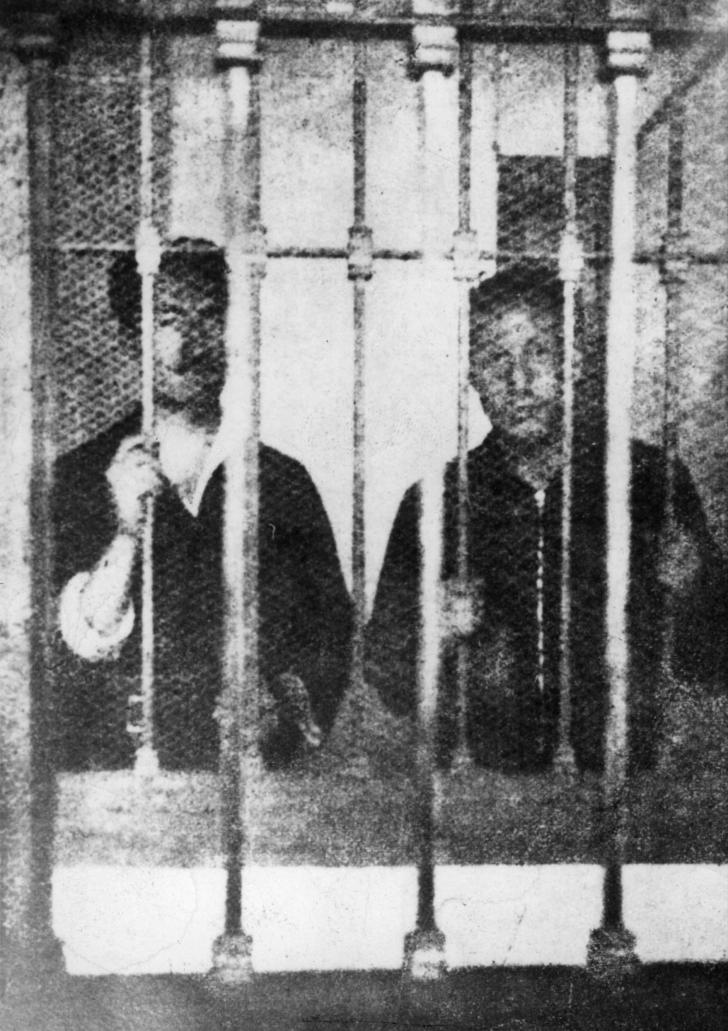
The photo shows José Antonio, and his brother Miguel, in Alicante prison, sometime after June, 1936.