A Beacon in the Darkness: Francesca Albanese’s Monumental Act of Witness
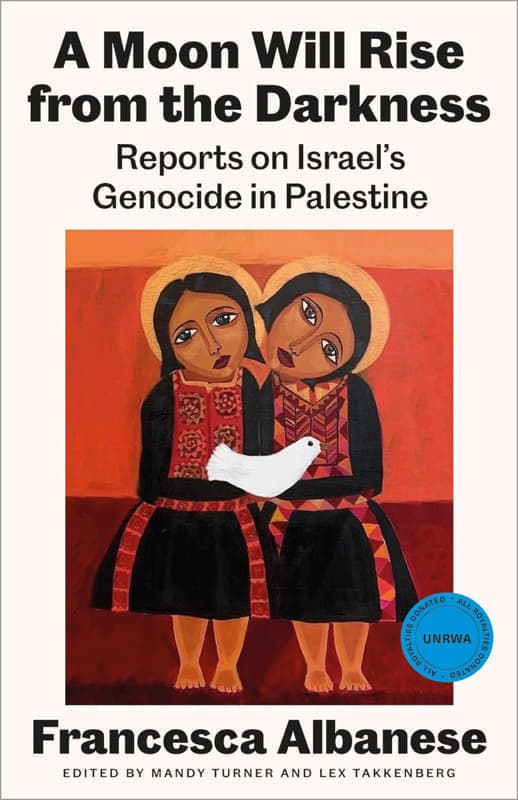
Francesca Albanese’s A Moon Will Rise from the Darkness: Reports on Israel's Genocide in Palestine is more than a book; it is a searing, necessary, and profoundly documented seismic event in the landscape of contemporary human rights literature. As the UN Special Rapporteur on the situation of human rights in the occupied Palestinian territory, Albanese has already distinguished herself as one of the most courageous, clear-eyed, and ethically consistent voices speaking out against the brutal realities of colonial oppression, apartheid structures, and genocidal violence. This latest work, however, transcends even her formidable prior contributions. It is a magnum opus that functions simultaneously as meticulous reportage, rigorous legal analysis, and a deeply moving human testament—all woven together with an unflinching sense of justice and a profound historical consciousness. It is a work that does not merely describe a crisis but anatomizes it, holding a piercing light to the mechanics of destruction and the enduring resilience of the human spirit.
A Human Rights Record That Cannot Be Ignored: The Architecture of Atrocity
The book’s primary power lies in its function as an indelible record. Albanese meticulously assembles a chilling narrative of systematic destruction, constructing her case with the precision of a master archivist and the moral clarity of a prophet. She presents a devastating catalogue of evidence drawn from a vast array of sources: United Nations reports, declassified intelligence documents, eyewitness testimonies from medical workers and journalists, and the raw data of body counts and destroyed infrastructure. The narrative she lays bare is one of an almost methodical dismantling of life: the wholesale annihilation of neighborhoods in Gaza, the relentless demographic engineering and settlement expansion in the West Bank, the calculated policies of siege and starvation, and the grinding, multi-generational dispossession that defines the Palestinian experience.
Her commanding expertise in international law elevates the work from a mere chronicle of suffering to a forensic indictment. Every assertion, every harrowing account, is buttressed by the pillars of international legal precedent. She deftly applies the frameworks of the Genocide Convention, the Geneva Conventions, and the Rome Statute of the International Criminal Court, demonstrating how the documented policies and actions align, point by painful point, with the legal definitions of atrocity crimes. When she discusses the intentional destruction of university libraries, agricultural land, and cultural heritage sites, she frames it not as collateral damage but as evidence of an intent to destroy a people’s cultural and physical existence. When she details the restrictions on food, water, and medical supplies, she presents it through the lens of the Geneva Conventions’ prohibitions on using starvation as a weapon of war. This legal scaffolding transforms the book from an emotional appeal into an incontrovertible brief, one that challenges the reader—and the international community—to confront the evidence on its own rigorous terms. Yet, Albanese’s prose, while precise, is never dry or detached. It carries a moral gravity that underscores the irreducible human stakes of what she methodically argues is a genocide in progress.
The Balance of Documentation and Humanity: Giving Flesh to the Statistics
What truly distinguishes A Moon Will Rise from the Darkness and elevates it to the realm of essential literature is Albanese’s masterful ability to harmonize the impersonal force of legal fact with the intimate power of individual stories. She understands that a million is a statistic, but one is a tragedy. Throughout the book, the vast, abstract numbers of the dead and displaced are given names, faces, and histories. She recounts, with heartbreaking specificity, how entire family lineages—grandparents, parents, children—have been erased in an instant beneath the rubble of their own homes, their stories terminated not by accident but by precise targeting. She introduces us to children who have known nothing but the trauma of blockade, bombardment, and loss, their childhoods sacrificed on the altar of perpetual conflict.
These are not anecdotal diversions; they are the very heart of her argument. By centering these human experiences, Albanese situates individual tragedies within the overarching structure of a system deliberately designed to maintain domination and, ultimately, to erase a people’s claim to their land and future. The reader is forced to move beyond the numbing effect of daily headlines and bear witness to the concrete consequences of political decisions and military doctrines. When she describes a doctor operating without anesthesia or a poet burying his manuscripts in a desperate attempt to preserve his culture, these acts become powerful testimonies of resistance and humanity in the face of an apparatus designed to dehumanize. Each page, therefore, conveys not just evidence for the court of international law, but a profound appeal to the conscience of the world.
Excavating History Through Present Crimes: The Long Arc of Colonial Logic
One of the book’s most critical contributions is its refusal to treat the current crisis as an isolated event. Albanese skillfully and convincingly situates the violence in Gaza and the systemic oppression in the West Bank within a deep and continuous historical arc of colonial logic. She traces a direct line from the ethnic cleansing of 1948—the Nakba—through the decades of military occupation that began in 1967, to the present-day realities of fragmentation and siege. This historical depth is not an exercise in academic blame-setting; it is a crucial diagnostic tool. It reveals how the present “genocidal moment,” as she terms it, is not an aberration but the logical, perhaps even inevitable, culmination of a long-standing project of displacement and replacement.
Without ever lapsing into polemic, Albanese meticulously deconstructs the dominant narratives that have long shielded this project from accountability. She exposes how the language of “security” and “counterterrorism” has been systematically weaponized, serving as a moral and legal camouflage for a vast, bureaucratic machinery of dispossession. She demonstrates how laws are twisted, international humanitarian law is selectively applied or ignored, and language itself is co-opted to obscure the brutal realities on the ground. The apartheid wall becomes a “security barrier”; illegal settlements become “neighborhoods”; the killing of civilians becomes “collateral damage.” By excavating this history, Albanese prevents her book from being merely a chronicle of present suffering. Instead, it becomes an anatomy of impunity—a detailed study of how systems of oppression are rationalized, institutionalized, and perpetuated over time, and how the international community has too often been complicit through its inaction and double standards.
A Work of Moral Courage in an Age of Censorship
Though written with a clarity that makes it accessible to a broad audience, A Moon Will Rise from the Darkness is destined to become a crucial reference text for scholars, activists, journalists, and policymakers for generations to come. It earns its place in a small and vital canon of works—alongside Hannah Arendt’s analyses of totalitarianism, Raphael Lemkin’s conceptualization of genocide, and Edward Said’s critiques of imperialism—that manage to combine searing immediacy with intellectual rigor and universal moral appeal.
What lends the text its uncompromising authenticity is the context of its creation. Albanese has written not only from her privileged vantage point as a UN Special Rapporteur but from the much more perilous position of a truth-teller operating under immense political pressure. She has faced relentless, often bad-faith, attacks from well-funded lobbying groups and powerful governments seeking to discredit her person and her message. To research, write, and publish such an unflinching account while navigating this storm of manufactured controversy underscores a profound personal courage. This courage imbues every page, reminding the reader that this is not an abstract exercise but a hard-won testimony, paid for with personal and professional risk. In an era where speaking truth to power often carries a heavy cost, Albanese’s steadfastness is a powerful testament to her integrity and a damning indictment of the forces that seek to silence uncomfortable truths.
Why the Title Matters: The Dialectic of Hope and Despair
The poetic and resonant title, A Moon Will Rise from the Darkness, is itself a profound statement of the book’s philosophical core. It gestures not toward a facile or sentimental hope, but toward a hope that is wrested from the very jaws of devastation. It is a hope rooted in Palestinian sumud—steadfastness—and in the global solidarity movements that refuse to look away. Albanese wisely leaves space for this possibility of justice and human renewal, but she makes it clear that such a future is contingent upon a rigorous and unsparing confrontation with the present.
Her closing sections are a powerful meditation on the responsibility of the international community, delivering a stark warning against the moral bankruptcy that accompanies silence and complicity in the face of atrocity. The hope of the “moon” is not guaranteed; it is conditional. It depends entirely on courageous witness, on the relentless pursuit of accountability, and on a collective commitment to the principles of international law that were established precisely to prevent such darkness from falling. This book, in its exhaustive documentation and its moral fervor, is that very act of witness. It is the work of holding the line, of insisting that light—like the moon rising—can and must pierce the darkness of willful ignorance and political expediency.
Conclusion: An Enduring Beacon
Francesca Albanese has produced not just a book but a landmark act of moral testimony. A Moon Will Rise from the Darkness is an uncompromising, profoundly humane, and toweringly significant work that demands to be read by anyone who wishes to understand the true nature of the Palestinian struggle. It meticulously details the reality of their suffering, anatomizes the structures of violence that perpetuate it, and forces a reckoning with the legal terminology—apartheid, genocide, crimes against humanity—that the world can no longer afford to avoid through euphemism or political cowardice.
For the reader, this book will not be an easy journey. It will provoke discomfort, anguish, and righteous anger. But it is an essential one. In an age of information overload and manufactured consent, Albanese has cut through the noise with the sharp blade of truth. She has illuminated the darkness of complicity and denial, and in doing so, has given us a work that will endure far beyond the immediate headlines of the present crisis. It is a beacon for all who stubbornly believe that law, justice, and human solidarity must remain the guiding lights of our shared global community.