The Global Sumud Flotilla and the Israeli Culture of Cruelty
On a calm Mediterranean night in late April 2026, hundreds of unarmed humanitarian volunteers from across the globe set sail for the besieged Gaza Strip. Their vessels carried baby formula, medicine, and food—supplies desperately needed in a territory shattered by years of blockade and war. Their intention was peaceful, their cargo was life-saving, and their location was international waters. Yet, instead of delivering aid, they found themselves delivered into a nightmare. The interception of the Global Sumud Flotilla by Israeli forces has since emerged as a flashpoint for what human rights groups and survivors describe not as an isolated incident of excessive force, but as a reflection of a deeply embedded culture of impunity, where torture, sexual violence, and cruelty have become normalized tools of state policy.
Part I: A Catalog of Horrors—Survivor Testimonies from the Flotilla
In April and May 2026, the Global Sumud Flotilla’s 58-vessel convoy, carrying 428 participants from 44 countries, was violently boarded by Israeli commandos in international waters, approximately 250 nautical miles from Gaza. After the operation, activists were transported to Israeli detention centers and a converted naval vessel that they would later call the "Torture Boat." The testimonies gathered from the survivors—now submitted to the International Criminal Court (ICC) in The Hague—paint a picture of systematic abuse that fits the legal definition of war crimes and crimes against humanity.
The "Torture Boat" and the Beating Container
Central to the allegations is the INS Nahshon, a naval landing craft built by an American shipyard and financed under the US Foreign Military Financing (FMF) program. According to multiple accounts, the Nahshon was converted into a floating torture chamber. Detainees were processed through a darkened, repurposed shipping container, where groups of three to five soldiers systematically brutalized each individual while those waiting outside listened to the screams. "All of a sudden I hear, 'Welcome to Israel.' And I start getting hit, like first hit on the head, second hit in the ribs, then I fall, then they kick me," recounted participant Yassine Benjelloun. "What lasts maybe three or five minutes seems like a lifetime." One participant described being zip-tied in a “torture position” that inflicted severe pain and lasting physical damage. A coalition medical team documented that at least 30 participants were injured severely enough to require hospitalization, with at least 36 requiring hospitalization after the first interception.
Sexual Violence as a Weapon of Degradation
Perhaps the most harrowing allegations involve the systematic use of sexual violence. Freed activists from Australia, Poland, the United States, and other nations reported that sexual assault was not an anomaly but a deliberate tactic employed to humiliate, terrorize, and degrade. Organizers of the flotilla have publicly stated that there were “at least 15 cases of sexual assaults, including rape.” Other sources cite between 12 and 15 cases of sexual assault, with some survivors recounting specific acts of “forcible penetration by a handgun.” Australian filmmaker Juliet Lamont, speaking publicly while still wearing the grey tracksuit issued by the Israel Prison Service, told CNN that she was beaten and sexually assaulted by five men in a shipping container aboard the Israeli “prison boat.” She described a “relentless” and “planned campaign of violence.” The removal of Muslim women’s hijabs was also reported as a deliberate act of degradation and cultural humiliation.
Physical Torture and Medical Abuse
The physical brutality inflicted upon the activists was matched by a cruel disregard for their medical wellbeing. Dr. Jihan, a Malaysian physician on board, documented 35 participants with fractures, including broken ribs, shoulder dislocations, and a humerus fracture. She also recorded severe head injuries, concussions, eye and ear trauma, and at least two individuals forcibly injected with unidentified substances that left them drowsy and disoriented. Other participants reported being shot with rubber bullets at close range in enclosed spaces, a violation of the weapons’ own safety guidelines. Upon their deportation to Turkey, an Australian participant, Zack Schofield, stated that many had not eaten for days and were denied water for two days. Another activist claimed he was denied treatment for what he believed was a broken spine.
Public Humiliation and Official Gloating
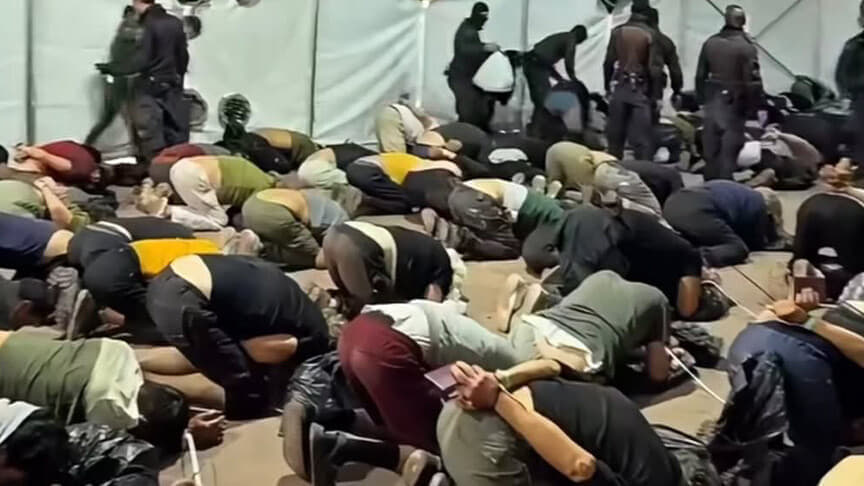
The abuse was not confined to interrogation rooms. It was performed as a spectacle. Israeli National Security Minister Itamar Ben-Gvir posted videos on social media showing dozens of handcuffed activists kneeling on the floor with their heads down and hands bound behind their backs. As survivors walked free, the US Treasury, under the Trump administration, announced sanctions against four people associated with the flotilla, labeling them as associates of “pro-Hamas” groups, a move seen by activists as a further attempt to delegitimize their humanitarian mission.
Part II: The Grim Picture—Normalization and Impunity in Israeli Culture
The brutal treatment of the Global Sumud Flotilla cannot be dismissed as the actions of a few "rogue soldiers." The scale of the operation—coordinated, involving high-ranking ministers, and utilizing state assets built with foreign aid—points to a systemic issue. The flotilla episode is a vivid symptom of a broader illness: the normalization of extreme violence within the Israeli military establishment, where the protection of the state has become a justification for systematic human rights abuses.
A Systematic Culture of Violence
The behaviors exhibited during the flotilla interception—mass detention, physical beatings, sexual assault, and enforced nudity—mirror patterns documented by Israeli and international human rights organizations for decades. The Israeli human rights group B’Tselem has described a systematic policy of abuse and torture against Palestinian detainees, documenting widespread sexual, physical, and psychological abuse in detention centers. The conversion of prisons into “a network of torture camps” is not a metaphor but a finding of human rights investigators. Arab News, commenting on Israel’s conduct, described an “institutionalized violence that is tolerated, even celebrated, within Israel’s military and political establishment,” arguing that these are “not isolated cases of misconduct by rogue soldiers, they are the symptoms of a systemic policy that normalizes abuse and dehumanization.”
The Policy of Impunity
A key enabler of this culture is a near-total policy of impunity. Despite widespread accusations of prisoner abuse, the Israel Defense Forces (IDF) has been documented as having launched only a handful of criminal investigations into serious allegations, with convictions even rarer. In one notable case, Prime Minister Benjamin Netanyahu himself publicly praised soldiers accused of rape as “heroic fighters” and criticized the investigation against them. This political and military leadership sends a clear message: that violence, particularly against those perceived as enemies or threats, will not be punished. The flotilla activists, mostly Western citizens, were subjected to this same culture of impunity, highlighting its reach extends beyond the Palestinian population.
The Apex of Cruelty: State-Sanctioned Spectacle
The posting of the humiliating video by National Security Minister Itamar Ben-Gvir represents the apex of this normalization. In most societies, a senior security official filming themselves gloating over bound and kneeling prisoners would be cause for immediate dismissal and prosecution. In Israel, while it drew some international condemnation, the incident served as a political rallying point. Ben-Gvir’s refusal to apologize, and the initial delay in distancing the government from his actions, underscores how cruelty has become a performance of strength within the political mainstream. The Israeli Foreign Ministry’s dismissal of the entire humanitarian mission as a “PR stunt” at the service of Hamas further illustrates a dehumanizing paradigm where any challenge to policy is met with criminalization and brutality.
Historical Precedent and Escalation
The 2026 flotilla is not the first to be met with Israeli violence. The 2010 Mavi Marmara incident, in which Israeli commandos killed nine Turkish activists in international waters, was a chilling preview of the methods deployed today. Human rights lawyer Bernadette Zaydan, presenting the flotilla case to the ICC, argued that the violence against the Global Sumud Flotilla “isn’t just about the violent interception… it’s about the thousands of Palestinians who have lived and died under the same system of abuse, impunity and violence.”
Conclusion: The Witness of the Wounded
The survivors of the Global Sumud Flotilla, their bodies bearing the scars of broken bones and their memories haunted by sexual assault, have performed a vital ethical service. They have smuggled out a testimony from a closed system of violence. While Israel’s embassy dismisses their claims as "baseless allegations" in a "smear campaign," the medical documentation, the consistent witness accounts, and the video of a minister gloating over kneeling prisoners tell a different story.
This is the grim picture that emerges: a military culture so saturated with impunity that the torture of unarmed civilians in international waters is not only unpunished but televised. It is a culture where a state, born from the trauma of persecution, has adopted the tactics of its former oppressors—humiliation, sexual violence, and torture—as normalized tools of security. The ethical call of the flotilla survivors is urgent: to look unflinchingly at their broken bones and stolen dignity, and to recognize that a state that institutionalizes such cruelty does not merely endanger its captives, it corrodes the very foundations of international law and human decency. The question the world must answer is not whether the violence occurred, but whether the international community will continue to provide the diplomatic cover that sustains this culture of impunity.
The obvious point that the brave Flotilla members always is this: if this is the horrific abuse handed out to foreigners who are eventually deported—what unimaginable hell do Palestinian prisoners live in, for whom there is no deportation and repatriation, let alone international attention? The deep culture of cruelty that the Flotilla briefly experienced has been scientifically crafted to bring maximum harm, suffering and degradation to Palestinians.