Imagining Muhammad
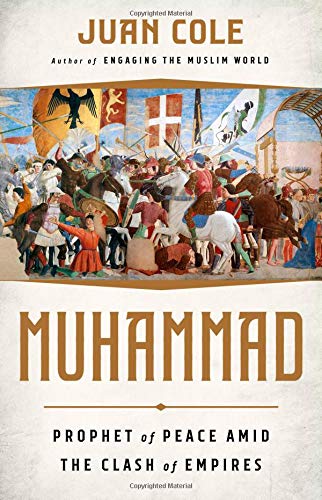
Cole presents Muhammad as a contemporary Western statesman devoted to peace,
tolerance, multiculturalism, and gender equality, and sympathetic to Christian
Byzantium. To support this portrait of Muhammad—which the author admits
“differs significantly from the picture of the Prophet in most Muslim
commentary”—Cole rejects mainstream Islamic historiography, relying instead on
select Qur’anic verses, unsourced “folk memories,” plenty of academic
conjecturing, and heavy use of the verb “would.”
For example, on the war between Rome and Persia, he writes, “Muhammad would
have watched with horror”; on the Persian siege of Jerusalem in 614, “Muhammad
would have listened with horror to the reports of travelers”; or “Muhammad …
would have been acquainted with Roman law, culture, and languages”; and
“Muhammad would have sent envoys seeking good relations with the new imperial
authorities.”
Why the subjunctive tone? Because there is zero textual evidence for these
statements. There is, however, plenty of contrary evidence. For example, the
only record of relations between Muhammad and Byzantine emperor Heraclius found
within the Islamic tradition—the Prophet’s order that the emperor abandon
Christianity and submit to Islam or face war—is not mentioned. Instead, Cole writes,
“Muhammad had allied with Constantinople and went to his grave that way in 632”
even though no evidence of any such alliance exists.
Because Cole is at pains to present Muhammad within the Western tradition,
the best he admits to is that “Muhammad was occasionally forced into a
defensive campaign” and that the “Qur’an allows warfare only in self-defense.”
Long quotes from Roman statesmen, church fathers, and European philosophers,
asserting that defensive war is just, typically follow such assertions, as if
to say the violence Muhammad is often accused of was exclusively
defensive—which, after all, Western authorities permit. In Cole’s view, even
the “Arabic notion of jihad, or exertion for the sake of virtue, was paralleled
in Aristotle, Plotinus, and the New Testament.”
While Cole associates Islam with classical and early Christian notions of
war, he frequently presents Islamic principles as more humanitarian. Thus,
whereas St. Augustine’s rationale for war alluded to combatting vice, “the
Qur’an gives Lockean grounds for warfare.” Moreover, “Christian law helped
create the endogamous Christian ‘race’ or ‘nation,’ whereas the law of the
Qur’an creates a rainbow race of Abrahamians.” This is because the “Qur’an …
celebrates gender and ethnic diversity as an enrichment of human experience.”
No mention is made that the Qur’an permits husbands to beat their wives and own
sex slaves (4:34 and 4:3).
Mainstream Islamic historiography flatly contradicts Cole’s revisionism. It
maintains that most of Muhammad’s wars were not defensive but offensive while
coercing non-Muslims to embrace Islam often on pain of death was the norm. It
also maintains that Muhammad engaged in any number of atrocities that would
seem to contradict just-war sensibilities: assassinating elderly men and women
who mocked him or torturing a Jewish man with fire until he revealed his
tribe’s hidden treasure—and then having him decapitated and marrying his
beautiful wife.
Cole dismisses all such unflattering but widely accepted anecdotes. Despite
much documentation, he asserts that “the Qur’an does not mention anything about
a mass slaying of the [Jewish] men of Khaybar and rather suggests that deaths
occurred during a battle but that the Believers offered the enemy quarter and
took prisoners.” Similarly, Cole suggests that Muhammad’s well-known expulsion
of Jews is a later archetype based on “Christian expulsion of Jews in late
antiquity.” Muhammad’s biographers, Cole posits, must have projected this trope
back onto him since “the few details in the Qur’an do not support” it.
This is a radical departure from how Muslims ascertain Muhammad’s biography.
Because the Qur’an is notoriously ambiguous, unchronological, and mostly
poetic, from the start, Muslims needed to turn to other sources (chiefly
the sira and hadith) to piece together their
prophet’s life.
Even Cole’s exclusive reliance on the Qur’an does little to prove that
Muhammad’s wars were purely defensive. Mainstream Islamic exegesis maintains
that the Qur’an was revealed in three phases: 1) Muhammad’s earliest years in
Mecca when he was vulnerable and outnumbered during which he preached religious
tolerance (e.g., 2:256); 2) Muhammad’s transitional years when he began making
alliances outside of Mecca and preached self-defense (e.g., 22:39); and 3)
Muhammad’s last decade (622-32) when his forces became stronger than and
overwhelmed his Meccan rivals during which he preached going on the offensive
(e.g., 9:29).
Cole regularly quotes Qur’anic verses from the first two phases while
ignoring or reconfiguring those from the third to conform to his thesis.
Consider his approach to 9:29, which reads: “Fight those who do not believe in
Allah or in the last day, and who do not consider unlawful what Allah and His
Messenger have made unlawful, and who do not adopt the religion of truth from
those who were given the scripture until they give thejizyah [tribute]
willingly while they are humbled.”
Although Islamic exegesis always interprets “those who were given the
Scripture” as Jews and Christians, Cole tells readers that this verse is
actually talking about fighting pagan Arabs; the notion that it is referring to
Christians and Jews, he believes, is “frankly bizarre.” He fails to mention
that the very next verse, 9:30, makes perfectly clear that 9:29 is talking about
Jews and Christians, as it names them, before adding “may Allah destroy them!”
Cole later confesses in an obscure endnote on his claim that the verse is not referring to Christians and Jews, “I should warn readers that I am engaged in a radical act of reinterpretation here.” The vast majority of readers will be ignorant of this important caveat tucked away in the back.
Moreover, in the main text he writes: “In my reading, Qur’an 9:29 does not have anything to do with a poll tax on Jews and Christians [as Islamic exegesis has always understood it] but rather demands reparations from pagans guilty of launching aggressive wars.”
Here is the most Cole will admit to concerning the third phase of Muhammad’s life when, according to traditional Islamic history, the Prophet launched approximately nine raids per year in search of power, plunder, and slaves.
He writes, “In one of the great ironies of history, Muhammad, who had preached returning evil with good and praying for peace for one’s enemy, had violent conflict thrust upon him in the last third of his prophetic career. The Qur’an maintains that he waged even that struggle, however, in self-defense and in the interests, ultimately, of restoring tranquility, the late-antique definition of just war.”
Cole presents Muhammad’s conquest of and entry into Mecca “as more
resembling the Reverend Martin Luther King, Jr.’s 1963 march on Washington than
a military campaign”—somehow overlooking that King did not turn up with
ten-thousand armed men threatening the denizens of D.C. with a bloodbath if
they did not submit to his rule.
Cole also whitewashes the early Arab conquests (632-750), most of which
occurred over Christian territory. Although eyewitnesses and early chroniclers
all write of devastation and atrocities from Syria to Spain, Cole dismisses
them as “exaggerated” and “hyperbolic,” unjustly causing Islam to suffer from a
“black legend.” He suggests that if excesses were committed, these were
introduced by Christian converts to Islam, who “brought into the new religion
their own long-standing practices of religious violence.”
Cole’s book is a massive distortion meant for Western consumption and catering to Western sensibilities. To validate his thesis, which is the antithesis of what Muslims believe about their prophet, he either ignores or manipulates the entirety of Islamic historiography and Qur’anic exegesis.
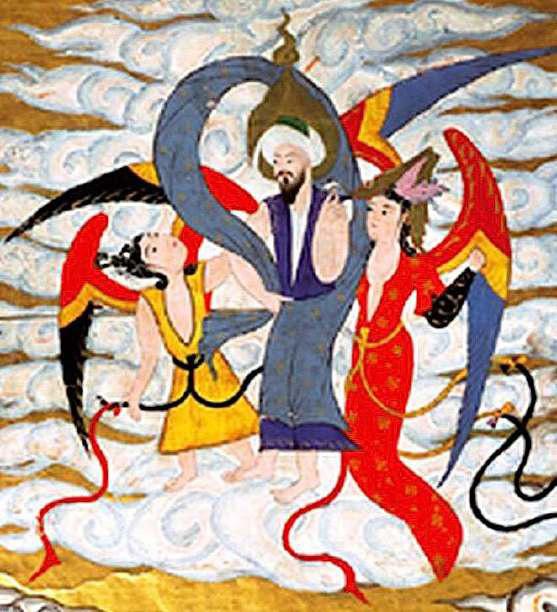
The photo shows Mohammad in paradise, with houris. Detail from a 14th-century Turkish manuscript.