NAZA and Israeli Society's Complicity
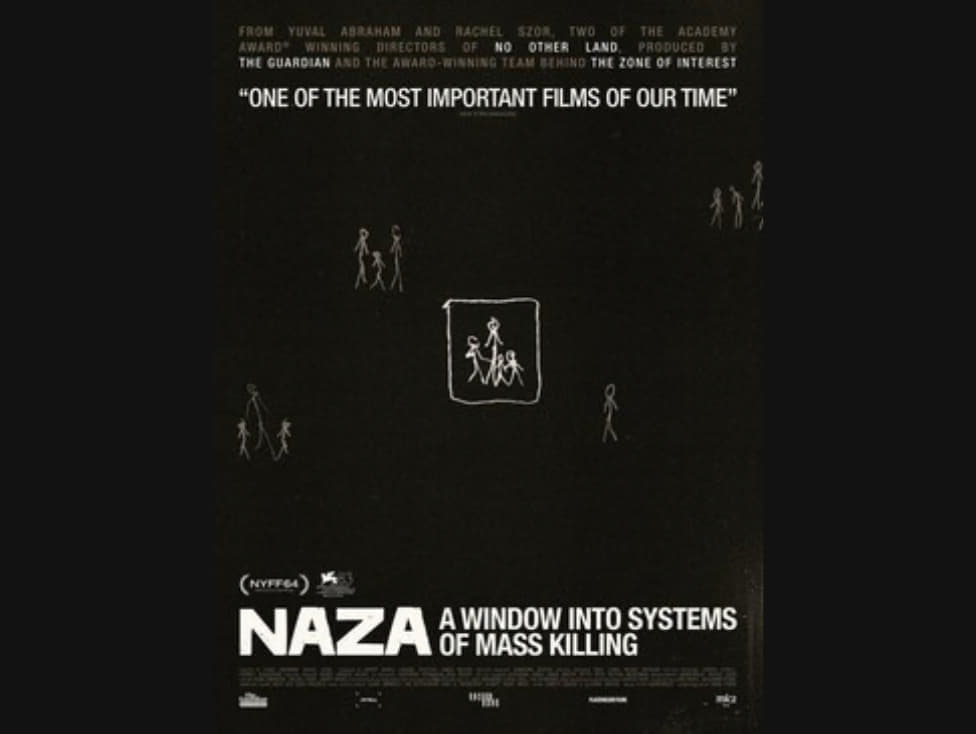
NAZA is a film about complicity. Its testimony comes from within Israel—twenty-four intelligence officers and soldiers who participated in the surveillance, targeting, and strike-execution systems in Gaza, speaking from Tel Aviv rooftops at night, their voices and faces digitally altered. This internality grants the film a testimonial weight that external accusation cannot achieve: it is not a Palestinian account of what Israel did, but an Israeli account of what Israel did. Yet the film reveals something more unsettling than the actions of twenty-four individuals. These operators are not isolated monsters. They are products of a society that elected its government, sustained its silence, and normalized its atrocities through the routines of daily life. Acknowledging this tension—that the film simultaneously documents both the machinery of killing and the society that permits it—is more honest than simply praising or condemning.
1. From Within: Testimony as Declaration
NAZA is directed by Yuval Abraham and Rachel Szor, two of the filmmakers behind No Other Land, which won the 2025 Academy Award for Best Documentary Feature. Produced by The Guardian, with James Wilson as producer and Jonathan Glazer (The Zone of Interest) as executive producer, the film runs eighty minutes and received the Special Jury Prize at the 83rd Venice Film Festival, following a twenty-five-minute standing ovation—reportedly the longest in the festival's history.
The title NAZA derives from the Hebrew military acronym nezek agavi, meaning "collateral damage." In Israeli military usage, it refers to the number of Palestinian civilians that the system calculates, in advance of approving a strike, as expected to be killed. This definition contains the film's entire argument: within Israel's targeting logic, civilian death is not an accident but a figure that is pre-calculated, assessed, and authorized.
The film is built upon testimony from twenty-four Israeli Defense Forces intelligence officers and soldiers who participated in the surveillance, targeting, and strike-execution systems in Gaza. All interviews were conducted at night on the rooftops of Tel Aviv buildings, with respondents' faces, voices, and appearances digitally altered to protect their identities.
This testimonial structure has legal and evidentiary significance. A declaration against interest—a statement by someone that contradicts their own legal or personal interests—carries unusual credibility precisely because the speaker has no incentive to lie. No one fabricates a confession at such cost. As Abraham stated at the Venice press conference, some interviewees spoke with remorse, some with indifference, and some with pride. The film does not seek to present them as monsters or heroes. It presents them as operators within a system, and allows their words to speak.
2. The Sanitizing Language: From "NAZA" to Video Game
The film's most disturbing revelation is not any single killing, but the operation of a linguistic system that renders killing manageable.
In Israeli military discourse, killing is decomposed into technical procedure. Targets are located by hacking phones; intelligence systems mark suspected Hamas affiliates; an AI program called Lavender generates recommendations from surveillance data. One interviewee mentions a 15 percent permitted error rate for the system. Another describes an expected NAZA rate of twenty civilians for each action. In one case presented in the trailer, a respondent claims knowledge of approval for a strike expected to kill five hundred people; the Israeli military has labeled this claim "completely false," noting that the respondent himself acknowledges no official count was made.
The cultural consequences of this calculation are revealed by the interviewees themselves. One intelligence officer describes remote strikes as "like a video game." Another uses the phrase "insanely fun" to describe bombing Gaza. These are not rhetorical exaggerations. They are faithful descriptions of a psychological state: when killing is mediated through screens, data, and algorithms, it no longer triggers ordinary moral response.
One officer is silent when Abraham asks him directly why he killed. His answer is: "I don't know." This silence is more damning than any confession. It demonstrates that the system is designed not only to kill efficiently, but to ensure that operators need not confront what they are doing. The sanitizing language is the first step in this process: when "five hundred civilians dead" is called "NAZA," when bombing a family in their home is called "striking a target," killing becomes manageable, even executable.
3. Israeli Society's Complicity
The film's most substantial implication is not about twenty-four individuals. It is about the society to which they belong.
Survey data from Pew Research Center, conducted in March and April 2024, reveals that 39 percent of Israelis considered the military response in Gaza to be "about right," while 34 percent believed it had "not gone far enough." Only 19 percent believed it had "gone too far." Among Jewish Israelis specifically, only 4 percent held the view that the response was excessive, compared to 74 percent among Arab Israelis.
These figures describe not a society held hostage by an extremist government, but a population that supports or acquiesces in its military's actions. The system the film documents is the system that this society elected, sustained, and normalized. The far-right government did not appear from nowhere; it was democratically elected. Support for the war has remained substantial even as casualty figures rose.
The reaction to NAZA within Israel reinforces this observation. As the CBC reported, many Israelis interviewed about the film had not seen it, as it was still on the festival circuit. One Jerusalem resident stated that the directors should be "in jail for betraying the country, betraying the army, betraying Jewish people all over the world." Another said: "What they said is not true. They lie. All the soldiers, they didn't do anything." These are not responses to the film's content. They are responses to the film's existence.
In Israel, criticizing the military carries severe social costs, a point noted in AFP reporting. The near-universal condemnation of NAZA by Israeli political figures—from Netanyahu to opposition leader Gadi Eisenkot, who denounced "moral blindness, a detachment from reality, and harm to the State of Israel"—demonstrates the breadth of the consensus. The film's offense is not that it is factually wrong, but that it refuses the framework within which Israeli military actions are discussed.
4. The Logic of the Reaction: Why the Film Provoked Fury
If NAZA were merely a marginal accusation, Israel's official response might have been dismissive. Instead, it was intense and repressive.
Prime Minister Netanyahu called the film "shocking" and "intolerable," announcing plans to introduce legislation—which he called the "NAZA laws"—to revoke citizenship from anyone who "defames IDF soldiers" and to increase statutory damages for defamation twentyfold. "Their place is not among us," he stated. Culture Minister Miki Zohar accused the directors of "treason against the state" and requested that the internal security service investigate both the filmmakers and the soldiers who testified. IDF Chief of Staff Eyal Zamir ordered military lawyers to explore legal action against the directors and an investigation into the "unauthorized disclosure of classified materials." National Security Minister Ben-Gvir called them a "disgrace."
The reactions extended beyond official channels. Right-wing activists gathered outside the home of Rachel Szor's parents in Savyon, with some chanting "Death sentence for traitors" and holding signs reading "Betrayal of IDF fallen." A graffiti mural in Ashdod depicted the directors with red targets and the word "TRAITORS." One protester threatened to track the directors down: "Wherever they go, we'll chase them, legally… we'll block them everywhere in the country."
This intensity itself is diagnostic. When allegations of genocide move from an external "other" to an internal "self," they open a space in which Israeli voices might confront and challenge their own normalization—and this could lead to accountability. The film provokes such fury precisely because it comes from within. External criticism can be dismissed as antisemitic incitement. Internal testimony—from those who operated the system—cannot be dismissed in the same way.
5. Limitations and the Inescapable Tension
Honest evaluation requires acknowledging the film's limitations. The identity of the twenty-four witnesses cannot be independently verified; the Israeli military's objection that anonymous sources cannot be confirmed to have had direct knowledge of operations is legitimate. The Guardian itself noted this flaw: "if no-one can be persuaded to put their name and face to their words... then the impact of this as testimony is lessened."
But this limitation should not be used to dismiss the film's central findings. Abraham and Szor had previously published related investigations in +972 Magazine, Local Call, and The Guardian The film's contribution is to visualize and personalize this evidence, and to place it within a broader ethical framework. The NAZA calculation system, the Lavender AI, the authorization of strikes with expected civilian deaths—these are not the film's inventions. They are documented practices that the film presents from within.
More fundamental is the tension of the film's internality. On one hand, the testimony comes from within Israel, granting it unique credibility. On the other hand, as critics have asked, can a film made by Israelis about their state's crimes inadvertently serve as a form of "whitewashing," presenting Israeli society as containing both good and evil, thereby allowing Western audiences to identify with "good Israelis" while maintaining fundamental identification with the Israeli state?
NAZA provides no such comfort. It does not present "good Israelis" versus "bad Israelis." The officers and soldiers who testify are not heroes or villains. They are parts of a system, and that system depends on the acquiescence of a larger society. When the film finally shows the lives that were "calculated away," it refuses to allow the audience to locate responsibility solely in twenty-four individuals, or in a distant government. Responsibility is diffuse. It belongs to every person who chose not to see, not to ask, not to break the silence.
6. Conclusion: A Film as Reckoning
NAZA does not scream, does not sensationalize, does not simplify. It simply opens a door, lets the viewer into the Tel Aviv night, and allows those who operate the system to describe their work. The viewer then realizes that the world described by those sitting in the darkness is the world we all inhabit.
The film's achievement is not merely to document what happened in Gaza. It is to reveal how a society can produce the conditions in which such things become possible—through language that sanitizes killing, through elections that authorize it, through silence that permits it to continue. When Netanyahu threatens to revoke the directors' citizenship, when protesters call for their death, when Israelis condemn the film without watching it, the film's argument is confirmed by the reactions it elicits.
NAZA is not only a film about Gaza. It is a film about Israel—about how a society elects its government, maintains its silence, and normalizes its atrocities. The title NAZA is an acronym, a military term, a technical word used to make killing manageable. The film makes the word heavy again. It forces those who use it to face its meaning. And it compels the viewer to understand that behind the arithmetic are names, families, and lives that were calculated away.
A film that can do this is no longer merely cinema. It is a reckoning. And the reckoning is not only with twenty-four individuals, or with a government, but with the larger silence that made it all possible.