A Monument of Witness: An Indictment of Israel's Genocide in Gaza
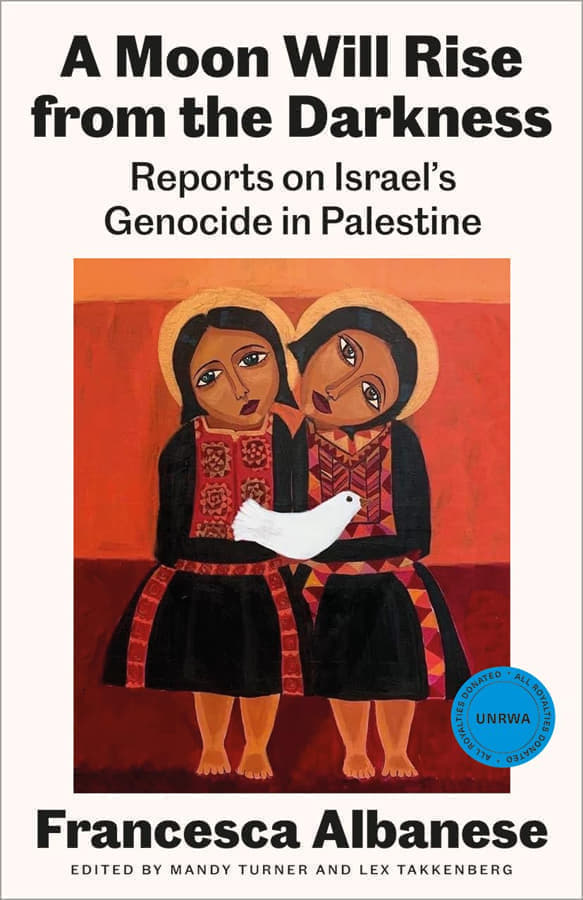
In the vast and often cacophonous landscape of literature on the Israeli-Palestinian conflict, where narratives are fiercely contested and objectivity is frequently claimed but seldom achieved, the emergence of a work of singular moral and legal clarity is a seismic event. A Moon Will Rise from the Darkness: Reports on Israel’s Genocide in Palestine by Francesca Albanese, the UN Special Rapporteur on the situation of human rights in the Palestinian Territory, is precisely such a work. This profoundly impactful and indispensable volume is far more than a mere compilation of reports; it is a meticulously constructed legal, historical, and human tapestry that documents, with unassailable rigor, what Albanese frames as an ongoing genocide against the Palestinian people, set within the broader, enduring context of settler colonialism. The book does not simply shed light on what may well be the darkest chapter in Palestinian history; it systematically illuminates the architecture of destruction and the circuitry of international complicity that enables it. By marrying expert legal analysis with a clear, unwavering moral voice, Albanese has crafted a vital resource that not only indicts the perpetrators but also calls upon the conscience of the world, demanding urgent attention and accountability.
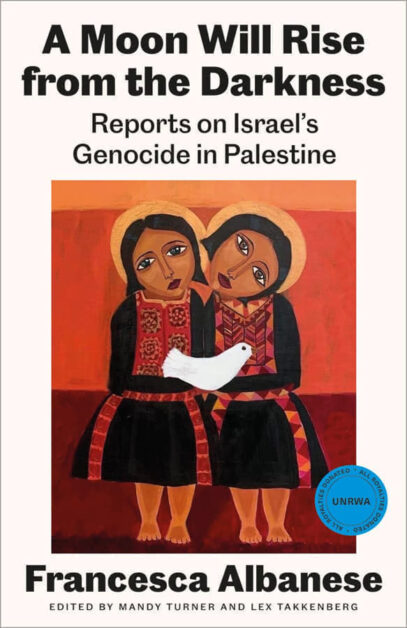
The title itself, drawn from the poetry of the late, revered Palestinian poet Mahmoud Darwish, serves as a guiding ethos for the entire project. “A moon will rise from the darkness,” Darwish wrote, offering a metaphor that is at once fragile and formidable. It is a testament to the resilience of hope, the persistence of life, and the emergence of light from the deepest abyss of suffering. This poetic sensibility is woven throughout the legal and factual fabric of the book, reminding the reader that beneath the cold, hard statistics and the precise language of international law lie the beating hearts of a people whose endurance defines their existence. This spirit is visually echoed in the poignant cover artwork, "Children of Gaza Dreaming of Peace," by the immensely talented young Palestinian artist from Gaza, Malak Mattar. Her work, born from the very crucible of the conflict, connects the personal to the political, the dream of a child to the demand for a future, grounding Albanese’s legal treatise in the raw, human reality it seeks to protect. From its very cover to its concluding arguments, the book is an act of compassionate scholarship, a document of indictment that is simultaneously a call to solidarity and a tribute to the unyielding human spirit.
The Architectonics of Truth: Legal Rigor as a Moral Imperative
One of the most striking and consistent strengths of A Moon Will Rise from the Darkness is Albanese’s formidable capacity to articulate a complex, harrowing, and politically charged reality with crystalline clarity and intellectual rigor. In an era of misinformation and “both-sides” obfuscation that often serves to muddy the waters of moral responsibility, her commitment to the framework of international law provides a solid, unmovable foundation. The book is anchored firmly in the 1948 Convention on the Prevention and Punishment of the Crime of Genocide, and Albanese meticulously demonstrates how the actions and statements of the Israeli state and its officials meet the legal threshold for genocidal acts and intent.
This is not a casual or polemical accusation. Albanese, a distinguished legal scholar, builds her case with the painstaking care of a prosecutor presenting evidence before the world’s highest court. She systematically dissects the language of the Genocide Convention, Article II of which defines genocide as acts committed with "intent to destroy, in whole or in part, a national, ethnical, racial or religious group." The book documents these acts with chilling detail: the massive and indiscriminate killing of Palestinians; the infliction of conditions of life calculated to bring about their physical destruction, including through a comprehensive siege that denies food, water, medicine, and fuel; the imposition of measures intended to prevent births; and the mass forced displacement and systematic destruction of housing, hospitals, universities, and cultural heritage. Each of these pillars is supported by a wealth of data from credible international and Palestinian human rights organizations, UN agencies, and on-the-ground reporting.
However, what elevates Albanese’s analysis beyond a simple catalog of horrors is her masterful handling of the crucial element of "genocidal intent." This is often the most difficult element to prove in international law, as it requires demonstrating a specific state of mind. Here, Albanese turns the Israeli state’s own words against it. She compiles and analyzes a devastating portfolio of public statements from high-ranking political leaders, military officials, and influential cultural figures. These statements, which have called for a "second Nakba," referred to Palestinians as "human animals," and openly advocated for their wholesale eradication from Gaza, are presented not as isolated inflammatory rhetoric but as evidence of a "pattern of conduct" that reveals a state-level policy. This legal strategy is devastatingly effective. It forces the reader to confront the reality that the violence is not merely a series of tragic wartime "mistakes" or collateral damage, but a purposeful project of dehumanization and destruction, articulated at the highest levels of power and executed with terrifying efficiency.
Beyond the Immediate Catastrophe: The Settler-Colonial Frame
Perhaps one of the most indispensable contributions of this volume is its refusal to treat the events following October 2023 as an isolated episode. Albanese provides a comprehensive historical grounding, situating the current genocide within the long arc of the Nakba—the catastrophic displacement of hundreds of thousands of Palestinians in 1948—and the subsequent 75-year history of occupation, settlement, and systemic discrimination. This contextualization is not an ancillary point; it is central to her argument. By framing the crisis within the broader structure of settler colonialism, she reveals the current violence not as a rupture, but as an acceleration and intensification of a pre-existing, sustained pattern of oppression.
The book deftly outlines how the logic of settler colonialism—which necessitates the displacement and replacement of an indigenous population by a settler society—has informed Israeli state policy for decades. The ongoing expansion of illegal settlements in the West Bank, the fragmentation of Palestinian territory, the discriminatory legal system, and the long-standing blockade of Gaza are all presented as interconnected facets of this single, overarching project. This historical lens is crucial for understanding the genocidal moment. It demonstrates that the intent to destroy Palestinians as a distinct national group is not a new phenomenon born solely from the atrocities of October 7, but rather a latent potential within the Zionist settler-colonial project that has been activated and unleashed with unprecedented ferocity. This framing breaks the cycle of ahistorical media narratives that often begin the story on October 7, 2023, and in doing so, it restores a vital historical truth: that Palestinian suffering has a deep and continuous lineage, and that justice cannot be achieved without addressing its root causes.
This enriched historical perspective is further amplified by the book’s structure, which includes reflections from Albanese’s predecessors in the role of UN Special Rapporteur. The contributions of figures like Richard Falk and John Dugard add a powerful dimension of continuity. They highlight how, for years, these independent experts have been warning the international community of the escalating dangers and the systematic violations of international law, only to be met with indifference or outright hostility. Their voices, woven into the narrative, create a chorus of expert condemnation that underscores the profound and long-standing failure of the international political system to hold Israel accountable. This multi-generational perspective not only validates Albanese’s current findings but also paints a picture of a resilient Palestinian people whose endurance in the face of decades of international abandonment is, in itself, a form of steadfast resistance.
Naming the Enablers: The Systemic Critique of International Complicity
If the first half of Albanese’s moral indictment is directed at the perpetrator, the second, equally crucial half, is aimed at the system of international enablers without whom such a project of destruction would be impossible to sustain. This is where A Moon Will Rise from the Darkness moves from being a vital document of record to a brave and necessary act of political dissent. Albanese’s explicit and unsparing documentation of state and corporate complicity is one of the book’s most significant and courageous contributions.
Her critique dismantles the façade of the so-called "rules-based international order," exposing it as a selectively applied set of principles that often serves to protect powerful states rather than vulnerable populations. She meticulously details the role of major Western powers, with the United States at the forefront, in providing the diplomatic cover, financial aid, and military hardware that fuel the genocide. The book documents the flow of arms, the repeated shielding of Israel from accountability at the UN Security Council through the use of the veto, and the economic partnerships that reward and reinforce Israel’s impunity. This analysis breaks through the platitudes of "Israel’s right to self-defense" by demonstrating how this rhetoric is weaponized to legitimize a campaign of collective punishment and annihilation.
Furthermore, Albanese turns her gaze to the multinational corporations profiting from the occupation and the current violence. She names the companies involved in supplying weapons, building settlement infrastructure, and developing surveillance technology used in the subjugation of Palestinians. This moves the discussion of complicity beyond the abstract realm of statecraft and into the concrete world of boardrooms and shareholder profits. It empowers civil society, activists, and ethically-minded citizens to identify pressure points and engage in targeted boycott, divestment, and sanctions (BDS) campaigns, transforming helpless outrage into strategic action.
Albanese’s own personal experience lends immense credibility to this critique. Her discussion of the political blows she has endured for her work, including U.S. sanctions imposed on her, is not presented as a grievance but as a case study in the price of truth-telling. It exemplifies the very mechanisms of silencing and intimidation that she describes in her reports. That she continues her work with undiminished resolve, in the face of such powerful opposition, underscores the profound importance of principled, independent voices within international institutions. Her courage stands in stark contrast to the timidity of many of the governments and diplomats she critiques, making her not just an author, but a testament to the enduring power of conscience.
The Human Dimension: Law Animated by Compassion
While the book’s legal and political arguments are formidable, its power ultimately derives from its unflinching connection to the human dimension of the catastrophe. Albanese never allows the reader to forget that the legal principles she elucidates—the prohibition on genocide, the laws of armed conflict, the rights to self-determination and return—are not abstract concepts. They are the last line of defense for millions of people living under bombings, siege, and the constant threat of death.
Throughout the reports, the dry language of legal documentation is punctuated by harrowing statistics that represent individual human beings: the number of children killed, the hospitals rendered inoperable, the percentage of the population facing catastrophic hunger. These are not footnotes; they are the heart of the matter. Albanese skillfully uses these figures to convey the scale of the destruction while implicitly demanding that we see the humanity behind each number. She gives voice to the victims by centering their experience as the ultimate arbiter of truth, in contrast to the distant, often dehumanizing discourse of geopolitical analysis.
This compassionate humanity is the thread that connects the legal scholar to the poet Mahmoud Darwish and the artist Malak Mattar. It is the understanding that the law, at its best, is an instrument of human dignity. When Albanese details the destruction of Gaza’s universities, libraries, and archives, she is documenting not just a violation of the Hague Convention for the Protection of Cultural Property, but a calculated assault on Palestinian memory, identity, and future. When she reports on the targeting of doctors, journalists, and their families, she is exposing a strategy to extinguish the very sources of light and testimony that could bear witness to the crime. In this sense, the book itself becomes an act of preservation—a repository of truth against the relentless tide of destruction and denial.
The metaphor of the moon rising from the darkness is thus perfectly chosen. It acknowledges the profound, almost unbearable darkness of the present moment—the mass graves, the orphaned children, the leveled cities. Yet, it insists on the inevitability of light. This light is not a passive hope, but an active one, forged in the resilience of Palestinians who continue to life, to love, and to resist their erasure. It is the light of international solidarity movements that are growing in strength and determination. And it is the light of principled advocates like Francesca Albanese, who use the tools of law and language to hold a mirror to the world’s conscience.
A Cornerstone for Justice and a Call to Conscience
In conclusion, A Moon Will Rise from the Darkness is a monumental achievement. It is a work of careful research, unassailable legal reasoning, moral clarity, and fearless engagement with one of the most contentious and urgent issues of our time. Francesca Albanese has produced a volume that will undoubtedly stand as a cornerstone of contemporary human rights literature, a primary source for historians, and a crucial tool for activists, scholars, and policymakers for years to come.
The book’s greatness lies in its synthesis of multiple forms of truth-telling: the legal, the historical, the political, and the deeply human. It does not merely inform; it demands a response. It calls upon its readers to move beyond passive grief or outrage and toward a renewed commitment to justice and accountability. It challenges us to scrutinize the actions of our own governments, to question the sources of our news, and to align ourselves with the cause of human dignity over geopolitical expediency.
In a world where power too often dictates reality, A Moon Will Rise from the Darkness is a powerful assertion that law and morality must ultimately prevail. It is a difficult book to read, for it forces us to confront the very worst of which humanity is capable. Yet, it is also a hopeful one, for it demonstrates that even in the face of overwhelming power and complicity, the determined voice of truth can rise, clear and unwavering. Like the moon in Darwish’s poetry, this book casts its own indispensable light, piercing the darkness of willful ignorance and complicity, and guiding the way toward a future where justice, for the Palestinian people and for all oppressed peoples, is not merely a dream, but a realized promise. It is, in every sense, an indispensable volume for our age.