The America of Trump: Murder as Diplomacy
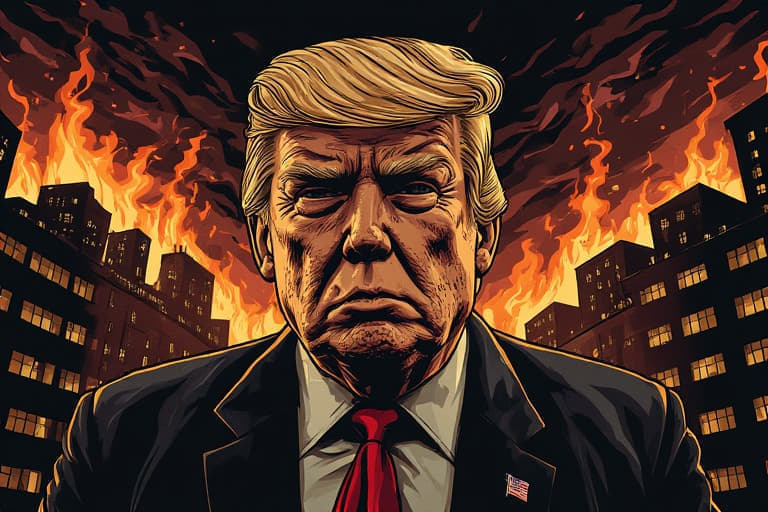
In the world of Donald Trump, diplomacy has become an anachronism—a relic of a softer, more deliberative age that this administration has actively conspired to bury. Dialogue, negotiation, and compromise—what used to be the hallmarks of American foreign policy, painstakingly constructed over decades of postwar institution-building—have been progressively crowded out by a more primal, more dangerous logic: the elimination of problem-people by force or the threat of force. What we are witnessing is not merely a coarsening of American politics, not simply a descent into "gangsterism" as previous critics have charged, but something far more systematic and pernicious: the transformation of U.S. foreign relations into a regime in which murder or the threat of murder is the default solution to the complexity of the world. This is the sinister modern cut of the Gordian Knot: faced with intricate geopolitical knots, the Trump-era United States reaches not for subtlety, patient negotiation, or even traditional coercive diplomacy, but straight for the knife.
The Gordian Knot of the Modern World
The image of Alexander the Great cutting the Gordian Knot is often invoked in management literature and military doctrine to praise decisive action in the face of seemingly insoluble problems. In legend, Alexander's slash separated string from knot with a single, violent stroke, supposedly demonstrating that boldness can triumph over complexity. But in geopolitical reality, there are no such clean cuts—a truth that every American president from Harry Truman to Barack Obama understood, however imperfectly they applied it. The "knots" of the twenty-first century—sectarian divides that span millennia, historical grievances soaked in blood, institutional decay that no single election can reverse, great-power rivalries that predate the United States itself—are not structures that can be cleanly severed without pulling the entire fabric of international order apart.
Traditionally, diplomacy has been the slow, frustrating, often thankless work of loosening, untangling, and reweaving: sanctions paired with offers, summits accompanied by back-channel talks, military posturing calibrated with careful de-escalation. It is clumsy, maddeningly incremental, and frequently incomplete, precisely because it respects the multidimensionality of the world. Diplomacy acknowledges that other nations have histories, grievances, and aspirations that cannot be bombed or sanctioned out of existence. It is the art of managing unresolvable tensions, not the science of eliminating them.
Trump's approach represents a fundamentally different aesthetic and ethic. Complexity, in his view, is not a reason for restraint but a sign of managerial failure; the persistence of intractable conflicts is not proof that the world is genuinely hard but that previous leaders were weak, foolish, or corrupt. When Trump speaks of "decimating" Iran's leadership or "mowing the grass" in the Middle East—a phrase borrowed from Israeli military doctrine that reduces human beings to vegetation requiring periodic trimming—he is not talking about the incremental management of a problem. He is talking about the surgical or semi-surgical erasure of the people who personify the problem. The knot is not untied—it is burned, along with the hand that tied it and anyone who might tie another.
From Rhetoric to Elimination: The Enablers
This turn from diplomacy to elimination did not appear from nowhere, nor is it the product of a single disordered mind. Trump has surrounded himself with enablers, amplifiers, and true believers who have transformed his darkest instincts into actionable policy. Pete Hegseth, the Fox News personality turned Secretary of Defense, has long evangelized for a more militaristic, less legally constrained American posture, framing restraint as weakness and assassination as merely "targeted justice." Marco Rubio, once a conventional Republican internationalist who spoke of American leadership and alliance management, has remade himself into Trump's compliant Secretary of State, using his position to dress up eliminationist policies in the language of national security while abandoning any pretense of diplomatic creativity. JD Vance, the Yale-educated populist who once expressed skepticism about endless wars, has revealed himself as an enthusiastic convert to the murder-solution, arguing in closed-door administration meetings that leadership decapitation is the only language that "authoritarian regimes" understand—a conveniently self-serving justification for abandoning the very diplomacy he claimed to champion. Lindsey Graham, perhaps the most brazenly cynical of the enablers, has evolved from John McCain's sidekick to Trump's most vocal senatorial defender, praising the administration's assassination-and-delegation strategy on Sunday shows while dismissing concerns about international law as "elitist hand-wringing."
These figures, along with other acolytes like Mike Waltz, Bill Hagerty, and Tom Cotton, have constructed an intellectual scaffolding around Trump's visceral impulses. They produce white papers, deliver floor speeches, and appear on friendly media outlets to argue that assassination is not merely permissible but preferable—that the United States has been "handcuffed" by self-imposed legal restrictions while its enemies operate without such scruples. This is revisionist history of the most dangerous kind. The United States has never been handcuffed; it has chosen, through successive administrations of both parties, to accept certain constraints because it understood that a world without those constraints would be more dangerous for everyone, including Americans. The enablers around Trump have systematically dismantled that understanding, replacing prudential restraint with performative brutality.
Trump's early sanctions, maximum-pressure campaigns, and maximalist demands toward Iran, North Korea, and Venezuela already signaled a preference for coercive clarity over negotiated ambiguity. But what marks the second Trump presidency—and what his enablers have worked tirelessly to legitimize—is the ease with which that rhetoric slides into the logic of assassination. When Trump amplifies a Washington Post columnist who openly calls for killing Iranian leaders who oppose an American-led deal, he is not merely engaging in hyperbole or venting frustration; he is publicly endorsing the proposition that the most efficient way to remove a political obstacle is to remove the person. When Pete Hegseth appears on Fox News to discuss "kinetic solutions" to diplomatic impasses, he is not speaking in jargon—he is signaling that violence has become the administration's primary negotiating tool.
The February 28, 2026, decapitation of Iran's Supreme Leader, Ayatollah Ali Khamenei, and the subsequent killing of other senior Iranian officials crystallizes this shift in practice. The strikes were carried out by Israel, but they were enabled by detailed U.S. intelligence, real-time coordination, and an administration that had already reframed the Iranian leadership as a "terror regime" rather than a political adversary. In this script, the United States does not "directly" assassinate; it third-party-delegates the assassination. That distinction allows the United States to maintain plausible deniability about violating its own executive-order bans on political assassination—bans that Trump and his enablers have consistently sought to undermine—but it does not change the moral or political reality that the United States is now a full-time partner in the assassination-state of the twenty-first century.
Marco Rubio's State Department dutifully issued statements praising Israel's "right to self-defense" while carefully avoiding any admission of U.S. involvement in the targeting process. JD Vance appeared on CBS's "Face the Nation" to argue that "no serious person" could mourn Khamenei's death, as if the morality of assassination turned solely on the character of the victim rather than on the precedent being set. Lindsey Graham, never one for subtlety, told reporters that "the world is safer tonight" and that the administration deserved "credit, not criticism, for having the backbone to finally do what needed to be done." These are not the words of reluctant warriors accepting a grim necessity; they are the words of enthusiasts celebrating a new normal.
The "Israelization" of American Foreign Policy
Many commentators have long spoken of the "Israelization" of American foreign policy, but under Trump and his enablers that process has become explicit, accelerated, and proudly advertised. Put simply, Israel's way of war—preemptive, deniable, routinely extralegal, and oriented toward the elimination of leaders and networks—has become America's default playbook. Israel has long treated high-value individuals as primary targets, not just because removing them is militarily useful, but because they are understood as the nodes that give coherence to the enemy system. Kill the leader, this logic runs, and the organization fragments; kill the financier, and the pipeline dries up; kill the ideologue, and the ideology loses its voice.
Trump's embrace of this logic—enthusiastically supported by Hegseth's Pentagon and Rubio's State Department—suggests that the United States now sees the world less as a web of institutions, treaties, and evolving trends, and more as a constellation of personified threats who can be surgically removed. This is seductively simple. It requires no understanding of Persian poetry, no appreciation of Shiite eschatology, no grasp of the economic interests that shape Iranian decision-making. It requires only targeting data and a weapons system. And that, for Trump and his circle, is precisely its appeal: it transforms the messy, intellectually demanding work of statecraft into a series of targeting decisions.
What is unique to the Trump-era version of this "Israelization" is its rhetorical brazenness. Earlier administrations shrouded targeted killings in careful legal-speak about "lone wolves," "imminent threats," and "non-combatants," even as critics questioned whether the United States had become a global assassination-state. Those administrations at least understood that assassination was legally and morally controversial; they at least felt the need to construct arguments, however strained, for its exceptional necessity. Trump, by contrast, does not bother to prettify the action. He speaks of "enemy from within," of "traitors" deserving execution, and of blowing up Iran's leadership as if he were discussing the removal of a corporate board. This is not the careful, bureaucratic euphemism of drone-warfare memos; it is the public celebration of the murder solution as the most attractive and natural way to resolve complex international quarrels.
JD Vance, who fashions himself an intellectual defender of this approach, has argued in speeches and op-eds that "liberal regimes" have been systematically outmaneuvered by "illiberal ones" because they refuse to adopt the same ruthless methods. This is an argument as old as Thucydides—the Melian Dialogue reduced to cable-news sound bites. But Vance conveniently ignores what the Melian Dialogue also teaches: that the strong may indeed do what they can, but the weak also suffer what they must, and that the resort to pure power politics often produces long-term instability precisely because it eliminates any basis for trust or future cooperation. By advocating for the adoption of assassination as a routine tool, Vance is not making America safer; he is making America more feared, which is not the same thing, and he is exhausting the reservoir of international goodwill that has protected U.S. interests for generations.
Murder as the Most Attractive Solution
The central claim here is not that Trump is the first American leader to use assassination. That would be historically illiterate. The United States has long blurred the line between warfare and assassination, from the ambiguous deaths of foreign leaders in the Cold War—Patrice Lumumba, Rafael Trujillo, perhaps others whose files remain classified—to the drone-killing campaigns of the 2000s and 2010s under both George W. Bush and Barack Obama. What is new is the systematic normalization of this tool as the most attractive solution, rather than a reluctant, last-resort option reserved for genuinely extraordinary circumstances. Under Trump, assassination is not an exception to the rule of diplomacy; it is the rule that diplomacy has to justify not using.
This is precisely why Trump's practice is more than mere "gangsterism" as some critics have charged. Gangsterism implies brute, episodic violence within a still-recognizable framework of law and politics—the occasional murder that shocks precisely because it deviates from expected norms. Trump's method is deeper and more corrosive: it reprograms the mental architecture of statecraft, turning the American state into a problem-solving machine that measures success by the number of problem-people removed, not by the number of conflicts resolved. The assassination of Khamenei and his inner circle is not framed as a deviation from policy driven by unusual circumstances, but as the fulfillment of policy—the decisive act that finally breaks the deadlock with Iran. Complexity, in this optic, is not a condition to be managed patiently over decades, but a pathology to be excised violently in an afternoon.
Pete Hegseth has been particularly important in institutionalizing this shift. As Secretary of Defense, he has streamlined targeting processes, reduced legal review requirements, and expanded the list of individuals considered legitimate military targets to include political figures previously understood to be off-limits. His Pentagon has reinterpreted the Authorization for Use of Military Force to cover essentially any individual the administration deems a threat to U.S. interests, a legal fiction so broad as to be meaningless. Hegseth's public statements make clear that he views these changes not as necessary evils but as long-overdue corrections to an overly legalistic national security apparatus. In his telling, the lawyers have been running foreign policy, and it is time for the warriors to take back control.
The Moral and Legal Fog
Trump's approach thrives in the fog of legal ambiguity, and his enablers have proven adept at manufacturing and maintaining that fog. Executive Orders 11905 and 12333 formally ban political assassination by U.S. government employees, but they do not by themselves criminalize a president who steers the state toward assassination-like operations through third parties, intelligence sharing, or covert planning. When Israel's jets drop the bombs on Iranian leadership, and the United States supplies the targeting data and political cover, Washington can claim with a straight face—or at least with a legally straight face—that it has not "directly" carried out the assassination, even as it has functionally enabled it.
This legal sleight-of-hand mirrors the moral sleight-of-hand practiced daily by Rubio, Vance, Graham, and others. Trump does not need to sign a formal assassination order to be treated by many analysts and foreign governments as the co-author of assassinations. The distinction between "planning" and "executing," between "authorizing" and "merely enabling," begins to collapse under the weight of the facts. What remains is the image of a president who has turned the United States into a shoot-first, talk-only-if-necessary power, where the default is not negotiation but elimination, not patient coalition-building but sudden, shocking violence.
Marco Rubio has been particularly adept at performing this moral gymnastics. On the one hand, he assures European allies that the United States remains committed to international law and the rules-based order; on the other hand, he green-lights intelligence sharing that makes targeted assassinations possible. He speaks of "targeted strikes" as if precision eliminates moral content, as if the fact that the bomb hit only the intended target—and not the neighbors, not the children, not the innocent bystanders—somehow transforms killing into something other than killing. This is the moral logic of the hitman, dressed up in the language of statecraft.
Lindsey Graham, never burdened by consistency, has been perhaps the most vocal senatorial defender of the administration's assassination policy, appearing on every network to argue that "these people are not statesmen, they're terrorists, and you don't negotiate with terrorists." This is a convenient but fraudulent framework. The Iranian government, whatever its many crimes and abuses, is recognized by virtually every country on earth as a sovereign state. Its leaders, however odious, are not terrorists in any meaningful legal sense; they are officials of a hostile power with which the United States has chosen not to maintain diplomatic relations. By rhetorically reclassifying them as terrorists, Graham provides the semantic cover for their assassination—just as the administration has rhetorically reclassified any number of its adversaries as legitimate targets.
Cutting the Knot, Unraveling the World
If the classical Gordian-Knot story celebrates decisive action as a virtue, the Trump-era version is a darker fable for darker times: a world that is being cut, rather than untied, with the naive expectation that the pieces will fall into harmonious order on their own. But in international politics, there is no clean cut. The assassination of Iran's leadership does not produce a stable, American-friendly regime in its place; it produces a power vacuum, a cascade of retaliatory violence, and a new generation of leaders raised in the cult of martyrdom who have every incentive to escalate rather than de-escalate. The knot of the Middle East is not loosened by the removal of Khamenei; the entire fabric is torn and rewoven under conditions of permanent crisis, with threads now stained in blood.
This is what JD Vance and his intellectual fellow travelers refuse to acknowledge. They present assassination as a shortcut to stability, but every historical example suggests the opposite. The Israeli assassinations of Hamas and Hezbollah leaders, conducted over decades, have not produced peace; they have produced more skilled, more ruthless, and more decentralized successor organizations. The American drone campaigns against Al-Qaeda and ISIS leadership have not ended those groups; they have dispersed them, transformed them, and in some cases made them more dangerous. The idea that killing Khamenei will solve the Iranian problem is not strategy; it is magical thinking dressed up in military jargon.
Trump's form of cutting the Gordian Knot is not only morally dangerous—though it is certainly that, representing as it does a frontal assault on centuries of international legal development—it is also strategically short-sighted in ways that will harm American interests for decades to come. By turning assassination into the most attractive solution, America forfeits the patient, messy, but often more durable work of diplomacy: building coalitions, negotiating trade-offs respecting the legitimate interests of other nations, and cultivating long-term relationships that transcend individual leaders. The United States may eliminate a few Iranian generals, a few Iranian politicians, even a supreme leader, but it cannot assassinate the underlying conditions—regional rivalries that predate the Islamic Republic, ideological ferment that no single death can quell, economic inequality that generates recruits for anti-American movements—that make Iran a persistent challenge in the first place. Complexity returns, like a knot re-tied in the dark, because the root of the knot was never diplomacy; it was the world itself, with all its irreducible messiness.
The enablers around Trump, from Hegseth to Rubio to Vance to Graham, have convinced themselves—and have tried to convince the American public—that they are being tough, that they are finally doing what previous administrations were too weak or too cowardly to do. But toughness without wisdom is not strength; it is merely violence. And violence, as a sustained instrument of statecraft, has demonstrated again and again that it produces blowback, escalation, and long-term instability. The assassination of Archduke Franz Ferdinand did not produce peace; it produced world war. The assassinations of the Roman Empire did not secure its borders; they accelerated its decline. The assassinations of the twentieth century's various strongmen did not produce democratic transitions; they produced power struggles, civil wars, and in many cases new strongmen who were worse than the old ones.
Beyond Gangsterism, Toward a New Normal
That is why Trump's approach must be understood as something more than gangsterism. Gangsterism is episodic, theatrical, and still recognizable as a deviation from the norm. It operates in the shadows because it knows it cannot survive the light. Trump's method is norm-subverting on a far more dangerous scale: it is the steady, calculated substitution of murder for diplomacy, the normalization of the elimination of political opponents as a legitimate instrument of statecraft. When a sitting president publicly endorses a columnist who calls for the killing of Iranian leaders, when he brags about decimating a rival regime, when he frames assassination as the most efficient way to get a "deal," and when his senior advisors—Hegseth, Rubio, Vance, Graham, and others—compete to outdo each other in praising this approach, he is not just behaving like a gangster. He is rewriting the playbook of American power for a generation that may not remember that America was once capable of something better.
The America of Trump is not merely a country that sometimes uses assassination as a reluctant last resort; it is a country that has come to see assassination as one of its most attractive and natural tools, precisely because it promises to bypass the exhaustion, the uncertainty, the frustration, and the sheer hard work of diplomatic engagement. In this mental and political economy, killing becomes the most seductive solution to the complexity of the world precisely because it feels like action. It feels decisive. It feels strong. It gives the president something to announce at a press conference, something his enablers can cheer on cable news, something that generates a surge of approval ratings before the inevitable consequences arrive.
But the consequences always arrive. They arrived in Tehran within days, as the expected power struggle began. They arrived along the Israeli-Lebanese border, as Hezbollah announced a new wave of retaliatory strikes. They arrived in the Strait of Hormuz, as Iranian naval forces began harassing commercial shipping with renewed aggression. And they will continue arriving for years, even decades, because the assassination of a leader does not end a conflict—it merely transforms it, often into something more diffuse, more unpredictable, and harder to manage through the very violence that created it.
The Gordian Knot of the twenty-first century cannot be cut. It can only be untied, slowly, patiently, by hands that understand that complexity is not an enemy to be destroyed but a condition to be managed. Trump and his enablers have rejected that understanding in favor of something simpler and more seductive. They have chosen the knife. And the world—including, eventually, the United States itself—will bleed from the cut for generations to come.