Are We a Plutocracy?
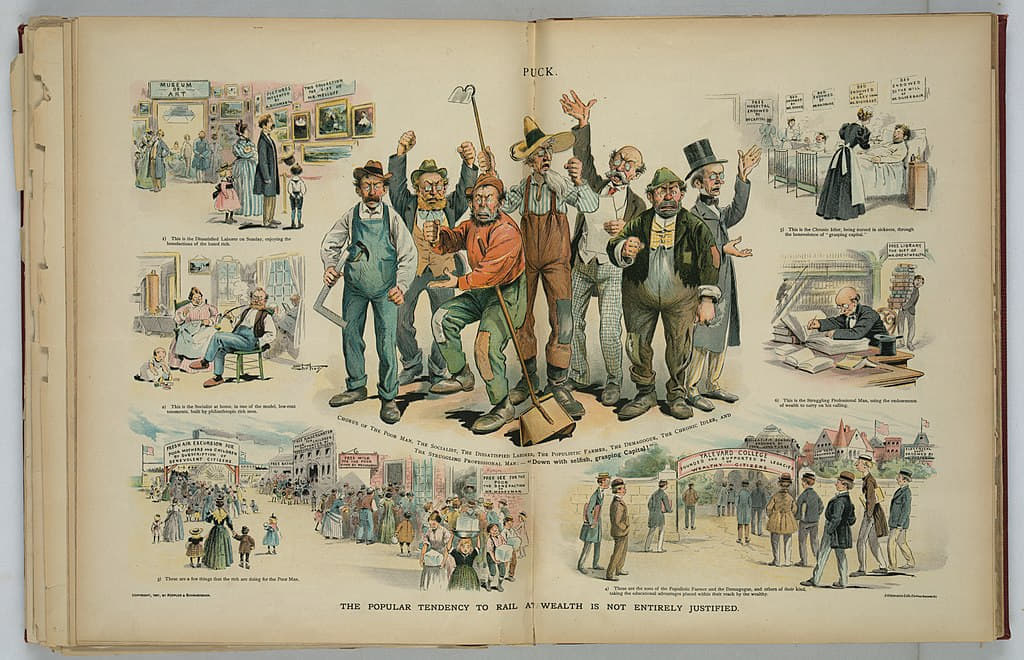
The god from whom the supremacy of the moneyed class has its modern name was said by the Greeks, who invented him, to be "blind and lame, injudicious, and mighty timorous. He is lame because large estates come slowly," they said. "He is fearful and timorous, because rich men watch their estates with a great deal of fear and care." He is in lineage only a half-god, or a three-quarters god at most, and some think him little better than an allegory. There are others who hold that this Plutus is the same as Pluto, who rules in Hades; but this is probably an error of those who do not understand the real nature of capital. It is no doubt through some such error that his name has hitherto been used to stigmatize, but it is not too late to ask that it should be used to characterize. At any rate, it seems to me that one may inquire without offence whether the term plutocrat will justly characterize not only all the rich people, but the infinitely greater number of the poor people in this republic.
I.
I know that some will object to the word, and scent in it a certain odor of incivism, but I do not know why it should aggrieve anyone who is not ashamed of making money. I do not say earning money, for that is a very different thing; and to the few among us who feel it right to earn money, but wrong to make it, I might well offer my excuses if I called them plutocrats or imagined them willingly consenting to a plutocracy. None others need be afflicted either by. the name or the notion, unless they are at heart afflicted by the thing, or have dimly or distinctly a bad conscience in it. The question for each one to answer himself, before he rejects or accepts the name or the notion of plutocracy, is whether it is just for him to profit by another man's labor, or, in other words, to pay another man a wage for doing or making a thing which shall be less than the value of the thing done or made, that he may have some margin of gain for himself from it, without having helped do it or make it.
I am aware that this is the whole question of private capitalism, but I am not for the present dealing with it except as a test of plutocracy. The man who follows a trade or practises an art, does so to make a living; the man who goes into business, does so to make money. These are broad distinctions, and they do not give all the colors of motive in either case; but their general truth cannot be gainsaid. No one makes money at a trade, or in the same sense at an art; properly speaking, money is not made at all in the trades or in the arts, though in the arts a great deal more money may sometimes be earned than is made in business. But business is the only means of making money, and in these days it may be fairly said that no man gets rich by his own labor, that no man gets rich except by the labor of others. Whether he gets rich or not, however, the man who pays wages with the hope of profit to himself is a plutocrat, and the man who takes wages upon such terms, believing them right, is in principle a plutocrat; for both approve of the gain of money which is not earned, and agree to the sole arrangement by which the great fortunes are won or the worship of wealth is perpetuated. I am not saying that the worship of wealth is wrong, or that the love of money is the root of all evil, or that the rich man shall hardly enter into the kingdom of heaven, or any of those things: I am merely trying to find out whether this cult is not so common among us that our state is not rather a plutocracy than a democracy. The fact of any man's plutocracy is not affected by his having the worst of the bargain, and it is not affected by his failure to turn it to account if he has the best. The ninety-five men who fail in business and get poor are as much plutocrats as the other five who prosper and get rich, for the ninety -five meant to get rich, with as worshipful a mind for Mammon as the five had, and they believe in Mammon quite as devoutly. So I think it unjust to devote certain millionaires among us, or all millionaires, to the popular hate, and to bemoan the immense mass of would-be millionaires who failed in the same conditions that the others prospered in. One may indeed blame the conditions which mean failure for so many and success for so few, but one can no more blame the good lnck of the few than one can blame the bad luck of the many.
II.
For much the same reason only a qualified compassion can be given to the wage-takers so far as they believe that it is right for the wage-givers to get rich on their wages, while they themselves remain poor on them. A great deal of sympathy is asked, and a great deal more is offered unasked, in their behalf, which might better be kept and used in the cooler form of reason. If the wage-taker believes the system is wrong, that it is wrong for him to work for any employer but the state, which cannot allow itself to exploit him or make a profit on his wages, one may, of course, call him a miscreant or a fanatic, but one cannot deny him a logic which is lacking to the others in their discontent. Any other sort of wage-taker is ready at the first chance to become a wage-giver, and to prosper as far as he can upon a margin in the value of the thing he gets someone else to make beyond the wage he gives for making it; and with this hope in his heart, he is as thoroughly a plutocrat as any present millionaire of them all. Perhaps he is even more a plutocrat, for it is said that great riches oftener inspire great loathing of riches in those who have them than in those who have them not.
Since I believe that the vast mass of our wage-takers, either because they have thought about it or because they have not, are in this position, and so are potential moneyed men and potential millionaires, I find it hard to be of their side always in their struggles with the actual wage-givers. I have, indeed, always a crude preference for the man who wants to make a better living, over the man who wants to make more money; but when I begin to scrutinize my preference, I begin to distinguish. I begin to ask myself why I should be in the wage-takers' camp, rather than the wage-givers', if they are themselves ready to go over to the enemy #s soon as they have money enough. This question saves me from much intense feeling concerning strikes, which I might otherwise wish to see carried by the wage-takers. At the end of the ends, the wage-payers seem to be doing only what the wage-takers would do if they had the chance, and I do not see why I should espouse their cause, simply because I know that the great multitude of them will never have the chance. A strike for higher wages does not at all reach the plutocratic principle and is never against it. If the wage-takers do not like the plutocratic principle, if they do not like the chances of the fight which must go on under this principle, why do they perpetuate the fight?
In asking the question, I am not saying that the fight is wrong. I know too well that a multitude of my fellow-citizens, so great that it is hardly worthwhile to count the few others, think that the fight is a holy war, and that, if it does not make for virtue, it makes at least for character, and if not for blessedness at least for manliness. I believe it is recommended on this account to the working classes, who are invited to consider whether, if they gave up their chances of getting worsted in the fight, they might not have to give up the fight itself; and these classes, for the present, seem unwilling to forego their peculiar disadvantages, though by this time they must know that in the actual conditions it will be with them to the end as it has been from the beginning. In the meantime it is interesting to consider how long the great mass of the American people have constituted the American nation a plutocracy and not a democracy.
III.
This, after a vast deal of talking, is still a very nice question, which one cannot handle too delicately or too diffidently. On the economic side, unless we are the more deceived by appearances, one might say that there was really no such question, and never had been; but that here as everywhere else, the conditions always forbade a democratic management. Up to the present moment no business enterprise in the United States seems to have been carried on by universal suffrage, any more than in Russia, or the other parts of Christendom where universal suffrage is unknown. Our wage-takers are in precisely the case of wage-takers all over the world, and have not only not a controlling voice in the management of affairs that concern them far more vitally than they concern our wage-givers, but they have no voice at all. This may be right, or it may be wrong, but it is certain that financially, industrially, economically, we are not a nation, a people, a solidarity, but a congeries of "infinitely repellent particles." Politically, we stand before the world as Americans against England, or France, or Spain, whichever threatens our pride or our prosperity; but economically we are all at war one with another, quite as ruthlessly as we are at war with Englishmen, Frenchmen, Spaniards. Politically, we can agree upon what is to our advantage by a popular vote, but economically we can never agree by that means, because politically our advantage is always individual, and economically it is always several. The fact does not need illustration; it illustrates itself from every man's experience to every man's reason. It is clear that business can never be democratically transacted, but must always fall to the control of one strong head, or long head, in the present economic conditions. Every private business is at war not only with every like private business, but it is at war within itself between the employer and the employee, the wage-giver and the wage-taker; and this state of double warfare can only be despotically maintained. If the employees were suffered to canvass any project they might find that their advantage lay apart from their employer's with the employees of some other employer, and they can no more be suffered to do this or to vote upon such a canvass than the subordinates of an army could be suffered to reason and to act upon their reason in the presence of an enemy, with the chances of a final fraternization.
IV.
The question that remains is, How far has business characterized our politics? Has business come into control of the government, or is the government still in the hands of the people? Do parties or persons bribe voters in New Hampshire or New York? Do firms or corporations corrupt legislatures? Have United States Senators bought seats in the most august assembly in the world? Have trusts and syndicates darkened counsel in the judiciary? Have large contributors to election funds received high office from the executive? Have contractors even tempted aldermen, and have the bosses behind the thrones found their account in tacitly growing rich in a private station?
I affirm none of these things, and until I have found some journalist who admits the guilt of his own party while accusing his esteemed contemporary's, or some boss who confesses that he is not so poor as his affluence makes him appear, I do not think it would be safe to do so. The proof in all such cases has as little weight with the impartial mind as the overwhelming evidence, say, that there are veridical phantoms. Still, it must be owned that there are vast numbers of people who believe that these things are so; not so vast as the number that believe in ghosts: but a majority of the Americans so great that their vote would not leave a single elector to the partisans of an opposite theory in a presidential election. It is hard to believe that there is no truth in them, just as it is hard to believe that the spirits of the departed have not upon some emergent occasions revisited the earth. I can account for their acceptance by supposing that the minds of the whole people have been poisoned by bad men, who have instilled into them a suspicion of guilt in others which every American knows himself personally incapable of.
Or is there here and there an American who secretly, and quite within the fastnesses of his heart, realizes that, being perplexed and wrought upon in the extreme, he would give or take a bribe? Or, if not quite that, is there some American who is conscious that, as a matter of business merely, he might apply business principles to politics? We all know how very common business principles are with us, and the thing is not so wholly impossible. We need not inquire very nicely what business principles are; some business men will do what other business men will not do; but if the popular notion that business is business be correct, and if in this sense business is a thing not wholly indistinct from righteousness, it can be easily seen that the passage from an axiom to an action need traverse no great moral space. If we once admit that business principles have been applied in procuring statutes, decisions, contracts, and appointments, as most Americans believe, then it might certainly be said that we have a plutocracy, and not a democracy.
In certain forms, indeed, we have grown more democratic. We have no longer that distinctly plutocratic form, the property qualification of the suffrage. But if votes are bought and sold, the spirit of money-making, of plutocracy, arrives in our politics all the same; and if there is a change in the motive of those who seek public office, if men have come to desire it for the profit rather than the honor, we are more plutocratic than we were when we were less democratic. For a plutocracy is not so much, or not so merely, the rule of the moneyed class as it is the political embodiment of the money-making ideal; and the mass who have no money at all may cling as fondly and worshipfully to this ideal as the class who have millions of money. In fact, if we have ceased to be a democracy and have become a plutocracy, it is because the immense majority of the American people have no god before Mammon; though they may have gods besides him, he is the first. If we have really come to the pass in election, legislation, and administration that so many believe we have reached, we have come to it not because any limited number of men have pushed us on, but because the way that we were mostly going led to it. We may plead that our opportunity of prosperity, transcending any prosperity known before, tempted us beyond our strength; but if the student of our status is to sympathize with any one of us rather than with any other, it must be through that humanity which commiserates misfortune because it is misfortune, and will not ask itself whether it may not be merited misfortune. To this humanity riches may be pitiable, too, and a millionaire may inspire as tender a compassion as a pauper. Perhaps too little has been made of the sufferings of the rich; no one but they can know how hard the life of luxury, the life of satiety, or even the life of fashion may be.
V.
The mere absence of statistics on such a point will not keep us from speculating as to the truth in the case; and a certain obscurity attending this whole inquiry piques rather than blunts the curiosity. It cannot be supposed that a great people would have voluntarily become a plutocracy without finding their account in it, and it would be very interesting to know what this is. If a plutocracy is a decline 'from a democracy, the study of the fact will have something of the pathetic and poignant charm that clings to ruin. If it is a rise, the contemplation of it must stir the patriotic heart with pride, and impress the alien with the grandeur of the spectacle.
In either case, when did we begin to pass from the democratic to the plutocratic stage of our existence as a people? There was no dramatic moment which history could lay her finger upon with confidence, and the transition was not the effect of any conscious purpose. But I suppose the impulse toward it was always latent in us, not perhaps more tightly coiled than the same spring in any other nation, but having more effect because from the first hour of our national life the business spirit was supreme with us. We came into being at a time in the world's life when this spirit was entering upon its dominion, and there was no tradition or institution to hinder it or to hamper it with us. We had neither prince, nor priest, nor patrician to stand against the trader, the manufacturer, the business man, and it was only a question of very little time when these should rule. Of course, no one clearly foresaw this, and even in the retrospect there are appearances that cloud a perfect vision. The chief men in the new state were apparently the statesmen, and for a long time nearly all men were so poor in it that it seemed destined forever to be the free domain of an equal manhood. The poet, when he imagined that
"God said: I am tired of kings,
I suffer them no more,"
figured him further as proclaiming:
"I will divide my goods;
Call in the wretch and slave:
None shall rule but the humble,
And none but Toil shall have.
"I will have never a noble,
No lineage counted great;
Fishers and choppers and ploughmen
Shall constitute a state."
But when it came down to business, as our phrase is, and there was a call to go and " cut down trees in the forest, and trim the straightest boughs " for the wooden house which was to be the capitol of the new state, not only the digger in the harvest-field was summoned, not only the hireling, but "him that hires," too; and, without doubt, the business man, the moneyed man, the capitalist, was early on the ground to charge the market price for the timber used, and bid off the contract for building the temple of our liberties. Even at that day he must have begun to feel himself a public benefactor because he "made work" for the choppers and ploughmen at wages which secured him a handsome profit. He was the first-born of Laissez-faire, and as an eldest son he took over the whole property, so that he should be able to provide for the brood of artisans, operatives, miners, stokers, sailors, stevedores, laborers, who came after him. These little brothers of his, though they hate him, envy him his power of using their work to his advantage, and would mostly like to be in his place. They declare that he has never provided fairly for them, but they conceive nothing better than the part he plays in civilization; and I venture to say that if I were to speak lightly of him I should seem to most of my fellow-citizens, of all classes and callings, little better than one of the wicked. But I have no wish to speak lightly of him or otherwise than historically, or, at the worst, analytically; and I hope that I may say, without offence, that during the whole period of our generous youth, before the triumphant close of the great civil war gave us our full growth and solidified and hardened us, he was comparatively in abeyance. There was still thought to be some good, which, if we had not a very definite vision of it, was a better good than the material good which he sought as the supreme blessing. There were always, of course, mighty men before Agamemnon, but before the war the large fortunes were such as would have seemed little fortunes after the war; the greatest crimes against the suffrage, the legislature, the judiciary, would have seemed small crimes, and political life was not yet so low in the popular esteem that a high-minded man might not make it his career without the misgiving of his friends. It was still ennobled by the question of slavery, by the highest interest that ever divided a people, or parted the just from the unjust. When that question had its answer in the last reason of kings and passed from our politics, our politics lost the motive that had carried them upward and onward. They became, in a sense, business affairs, with no question but the minor question of civil-service reform to engage the idealist's fancy or the moralist's conscience. After the war we had, as no other people had in the world, the chance of devoting ourselves strictly to business, of buying cheap and selling dear, and of marketing our wares at home and abroad.
VI.
I need not tell the tale of our material achievements: it is so familiar and, upon the whole, it is so tedious. With us, Plutus may have remained blind, but if he remained lame he has proved himself a very active cripple. He has gone far and he has gone fast; but there are those who doubt whether he has arrived everywhere. They say that the defects of our advantages are so terrible that the wealth we have heaped us is like witch's gold in its malign and mocking effects. If we have built many railroads, we have wrecked many; and those vast transcontinental lines, which, with such a tremendous expenditure of competitive force, we placed in the control of monopolies, have mostly passed into the hands of receivers, the agents of an unconscious state socialism. The tramps walk the land like the squalid spectres of the laborers who once tilled it. The miners have swarmed up out of their pits, to starve in the open air. In our paradise of toil, myriads of workingmen want work; the water is shut off in the factory, the fires are cold in the foundries. The public domain, where in some sort the poor might have provided for themselves, has been lavished upon corporations, and its millions of acres have melted away as if they had been a like area of summer clouds.
It is true that we still have the trusts, the syndicates, the combinations of roads, mines, and markets, the whole apparatus. If there is much cold and hunger, the price of food and fuel is yet so high as to afford a margin to the operators in coal and grain and meat. The great fortunes in almost undiminished splendor, remain the monuments of a victory that would otherwise look a good deal like defeat, and they will be an incentive to the young in the hour of our returning prosperity. The present adversity cannot last forever; and if there are many thousands of men and women who cannot outlast it, or live to see the good time which is coming back, this has been the order of events from the beginning of the world, and we must not shut our eyes to the gain because it involves a great deal of loss.
If the owners of these great fortunes are often, or sometimes, men of low civic ideals and small civic uses, it must be allowed, on the other hand, that men of no fortune at all are often, or sometimes, no better. Whether a close scrutiny of their respective qualities and characters would tell more for the rich, or more for the poor, in the regard of the moralist, is by no means certain, and is perhaps beside the main question. But there is no doubt that they imply one another; that in our system they must both exist, that neither can exist without the other. There must always be this contrast, it appears, for it is said by the statisticians, by the ready reckoners whose figures cannot lie, that if all the wealth of the nation were equally divided, we should none of us have above six hundred dollars; and it ought to he plain how much better it is that one should have twelve hundred, and another none; or one should have several millions, and several millions should have none. Such points need no argument with any man who has money — say, money enough to buy this copy of the Review; to the man who has not money enough for that purpose, I cannot suppose that I am addressing myself, and I cannot stay to convince him. If I must address him, I would rather spend the time in persuading him that it is he and such as he who are responsible, or chiefly responsible, for the perpetuation of a plutocracy among us, if we have a plutocracy.
I should be ashamed to use the word to stigmatize any class of my fellow-citizens, even the poorer class whom no one need be afraid of offending, but I wish to use it only to characterize, as I said in the beginning. In this truer use, indeed, it will characterize the status in the whole civilized world; and perhaps it will characterize the status with us only a little more strictly, a little more closely. The plutocratic spirit is a bond uniting all the modern nations, otherwise so discordant and antipathetic: Englishmen, Germans, Frenchmen, Italians, Americans, we are alike brothers in that solidarity. But with some of the peoples whom it joins, it seems not to be the first thing. Even England, so long the chief, and still the first, to make the plutocratic principle in the industries a cult and a creed, has shown of late a shrinking from the full effect of its logic. It may strike the reader as rather a droll notion that the English should be thought the earliest to acknowledge the opposite principle of humanity, but a little study of the facts will make it look less grotesque. It is among the inventors of Laissez-faire that the inhumanity of Laissez-faire has repeatedly met its severest rebukes. It is the English who have finally realized, in the forms of law or in legal usage, the wrong of paying the workman the least he will take for his work, and in their imperial contracts have stipulated that the contractor shall pay his hands the trades-union rates of wages; while the War Office has adopted the eight-hour rate without decrease of pay. It is the English who have rejected the contract system altogether in some of their municipal dealings with labor, and have gone directly to the workingmen for the work that they wanted done. It is the English who have built decent public tenements where the poor may be housed at cost, and need not pay landlords ten, and twenty, and a hundred per cent, for shelter in dens and styes. It is English public opinion which has recognized the principle that the miner's wages must never go below a certain sum, no matter how low the price of coal may fall. These things are the effect of a larger humanity than is yet active among us, and are a confession that business is not the supreme English ideal. Is business, is money-making, the supreme American ideal?
VII.
If the poor American does not like it, or if he does not prefer a plutocracy to a democracy, he has the affair in his own hands, for he has an overwhelming majority of the votes. At the end, as in the beginning, it is he who is responsible, and if he thinks himself unfairly used, it is quite for him to see that he is used fairly; for, slowly or swiftly, it is he who ultimately makes and unmakes the laws, by political methods which, if still somewhat clumsy, he can promptly improve. It is time, in fine, that he should leave off railing at the rich, who are no more to blame than he, who are perhaps not so much to blame, since they are infinitely fewer than the poor, and have but a vote apiece, unless the poor sell them more. If we have a plutocracy, it may be partly because the rich want it, but it is infinitely more because the poor choose it or allow it.