Bruno Manz - Strange Portrait
There are numerous autobiographical testimonies about World War II
and the Third Reich. The memoirs of former generals or soldiers engaged in
telling their hardships and feats from a heroic perspective abounded for a time
in German language.
Many of these authors were perfectly willing to accept that Hitler
was a tyrant who dragged Germany to disaster, but not to give up pride in their
exploits during the war, which they considered legitimate. Giving up their
pride would have meant accepting the terrible absurdity of the adversities they
had passed through. Is it not too high a price for those who had left the best
youth in the battlefield? After all, our psyche requires us to be able to give
meaning to our suffering, even if this meaning has to be fabricated.
With the advent of May 1968, the European mentality experienced a
turning point that ended this attitude. Thereafter, the former heroic
testimonies could only be self-published or appear in small publishing houses
with a more than questionable political affiliation.
The heroic discourse was gradually becoming a stale and
reactionary attitude, which was inappropriate in the new times. In return, the
victims’ testimonies, a genuine literary genre with its own rules which had
been formerly unnoticed, proliferated and spread more than ever. A new desire to be
a victim, which was replacing the old pride of being a hero,
began to emerge: in some extreme cases impostors appeared describing in great
detail stories of survival in the concentration camps which they had never
experienced. I may return to this in a future entry.
But the kind of testimony that has always shone eloquently for its
absence is the unrepentant Nazi, despite the fact that a high percentage of the
German population of 1945 consisted of them. The reasons for this absence are
in and of themselves and are undoubtedly related to an unacknowledged feeling
of shame.
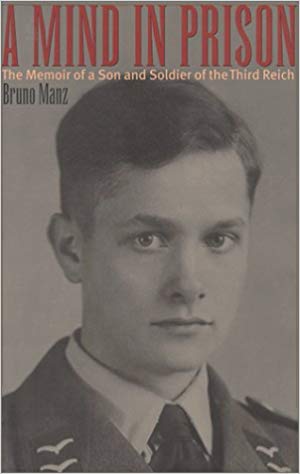
However, we can barely count with direct testimonies of someone who recognizes himself as being deeply convinced of the truth of the Nazi worldview. It amazes me all the more that one of the most valuable testimonies of this type rarely appears in the endless bibliographies about Nazism and still does not even have a German translation. I’m referring to A Mind in Prison, the extraordinary memoirs of the German-born physicist Bruno Manz, published in 2000.
As the
title suggests, Manz’s mind was imprisoned by the ideological and propaganda
machine of the Third Reich, but also by the strong convictions held in his
home. His father had always been an assured Nazi, and the deep love that the
child felt for him facilitated inoculation of his ideological venom. It was
easy for the Hitler Youth to do the rest. Later, the handsome soldier Manz ended
up becoming an enthusiastic teacher who was responsible for, among other
things, the indoctrination of Wehrmacht soldiers in Nazi ideology.
Apparently, Manz was lucky not to be directly involved in violent
crimes; however, he was undoubtedly an ideological criminal, a truth about
himself that he finally accepted with all its bitterness. The book also
describes with unusual honesty the disturbing ideological liberation process he
had to face after 1945.
Among other things, and though it took him several months, he
ended up being forced to accept that the death camps were not a mere invention
of Allied propaganda. Finally freed from his mental prison, in 1957 Manz
emigrated to The United States and settled in the country of the former enemy,
taking American citizenship. Ironically, he worked as a physicist in the
missile development program of his new country.
Manz said that, as in many other German homes, in the entrance of
his house in Dortmund there was a kind of domestic altar. Set in the middle was
the Nazi flag; on top, a portrait of Hitler, and on either side pictures of
Goebbels and Göring. Is there any better proof of how the National Socialism
was a political religion?
Well,
now let’s have a look at the valuable testimony of Manz:
The
picture that represented the Führer was a technically inferior photograph of
his profile that my father had bought at Nazi headquarters. From the very
beginning my father was unhappy with this picture, but he put up with it for
want of a better one. The stumbling block was the Führer’s shaggy hair, which
was dotted with mysterious spots that looked quite unnatural and created the
impression that the photograph had been tampered with. […] Apparently the Goebbels
propaganda was also unhappy with the Hitler photograph, for it suddenly ordered
the picture to be withdrawn from all shops and showcases. But no explanation
was given, and that’s when the rumors started. The Stürmer, we heard by the
grapevine, had launched an investigation, yet its findings were so sensitive
that they could not be printed. They could only be transmitted by word of
mouth, and then only to the most trustworthy. In this way, we eventually
learned the “truth”. The pathetic photograph of Hitler was a sinister
fabrication of the Jews. With great technical skill, they had woven all sorts
of Jewish faces into Hitler’s shaggy hair, thus putting him on notice that they
were still calling the shots. Now our eyes had been “opened.” Turning the
picture around and viewing it from all angles, we “saw” a whole array of Jewish
faces laughing and scoffing at us.
I
was stunned. I am not sure whether my father took the affair as seriously as I
did, but it was he who dug even deeper into the sinister plot. As the commotion
was already cooling down, he surprised us at the dinner table with a view that
tingled my spine. Turning Hitler’s profile upside down, he showed that his ear
became a Jewish nose, his lower jaw turned into a bald forehead, a strand of
hair was transformed into puffy lips, and so on. Now I was really frightened.
If the Jews could penetrate the inner sanctuary of the National Socialist
Party, was there anything they could not to?
The sudden withdrawal of Hitler’s photograph, which had a strong
impact on the German population, was with no doubt due to image control
measures of the Ministry of Propaganda. Trade with Führer portraits had become
a big business, so images of poor quality proliferated. This was to be avoided
at all costs. Moreover, Hitler’s personal photographer, Heinrich Hoffmann, had
exclusive photographic rights to the dictator. Any of these reasons amply
explains the confiscation of the image referred to by Manz, without resorting
to a conspiracy theory.
But in modern western civilization, conspiracy theories always had a big success. The extraordinary effectiveness of their argumentative mechanism has always fascinated me. By constructing false causal links, a conspiracy theory allows us to mark as true something that is nothing but a prejudice, a fear, an irrational hatred or mere suspicion.
There is always a conspiracy theory that will allow us to claim a rational attitude and a logical scrutiny to cover feelings that would embarrass us if we showed them in all their naked irrationality and primitivism. Conspiracy theories even allow us to be proud of our superior intelligence. After all, it was us who knew how to see Jewish faces in the image, where other ignorant mortals only see mere spots formed by chance.
Rare and valuable testimonies like these, though anecdotal, allow us to come closer to the mental mechanisms of horror. What matters is not so much to be aware of the tragic consequences of barbarism, but the simple and effective cognitive mechanisms that, at any given time, can make us a barbarian. In this sense, Manz has given us a priceless testimony.
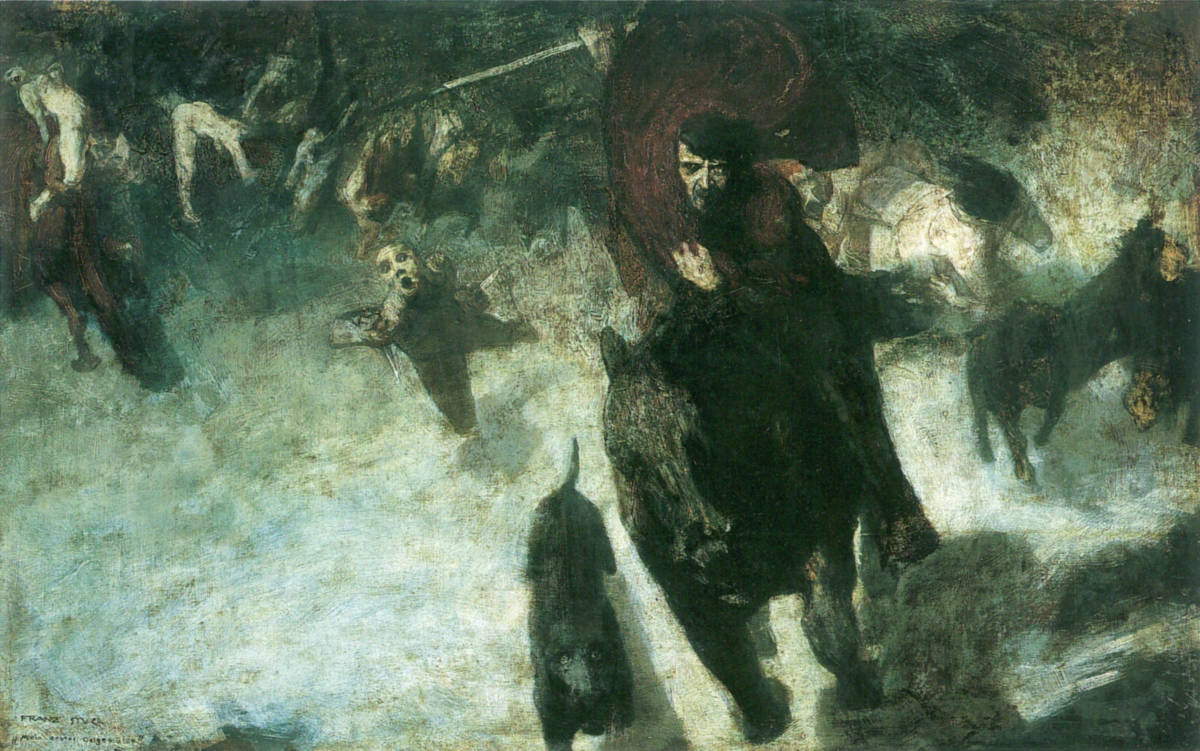
The photo shows, "Das Wilde Jahd," by Franz von Stuck, painted in 1889.