Christanophobia in Israeli Jewish Society
In the global conversation about religious intolerance, the plight of Middle Eastern Christians is often framed through the lens of persecution in Muslim-majority nations. This narrative, while valid, obscures a more complex and less examined phenomenon occurring in the world’s only Jewish state: a growing undercurrent of Christanophobia within segments of Israeli Jewish society. This is not the state-sanctioned pogroms of history, nor the genocidal ideology of modern jihadist groups. It is a quieter, more insidious prejudice, woven from the threads of ultra-nationalism, religious zealotry, and a deep-seated historical trauma that mistakenly identifies the local Christian presence as a fifth column of foreign influence. To expose this reality is not to engage in unfair criticism of Israel, but to hold a light to an uncomfortable truth that challenges the state’s democratic self-image and threatens the fragile fabric of its society.
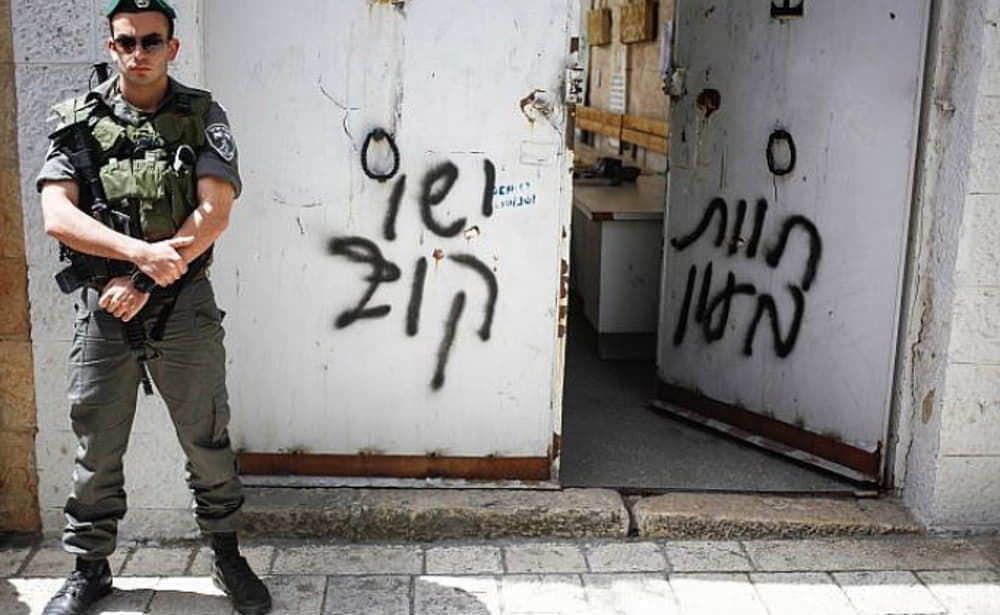
At its most visible and violent, this prejudice manifests in the actions of a radical fringe, often embodied by the “Hilltop Youth” and extremist factions within the religious Zionist and Haredi communities. These groups operate on a creed of “Price Tag” attacks—a strategy of vandalism and intimidation originally directed at Palestinians but increasingly targeting Christian properties. Churches, from the historic Benedictine Monastery in Abu Ghosh to the Church of the Multiplication at Tabgha on the Sea of Galilee, have been desecrated with Hebrew graffiti declaring “Death to Christians,” “Jesus is a monkey,” and “May his name be obliterated.” Crosses have been broken, cemeteries defiled, and holy books burned.
The psychological impact of these acts is profound. They are not random acts of hooliganism but calculated messages of hate intended to terrorize a minority and assert Jewish dominance over the land. For the small Christian communities, many of whom are Arabic-speaking Palestinians who have lived in the region for centuries, these attacks are a chilling reminder of their precarious position. They are caught between the tectonic plates of a larger national conflict, their ancient churches and monasteries becoming proxies in a territorial and spiritual war they did not choose. The response from the state has often been tepid, with arrests rare and convictions even rarer, leading to widespread accusations of impunity and a two-tiered system of justice where crimes against Jewish property are pursued with far greater vigor than those against Christian holy sites.
Yet, to focus solely on physical attacks is to miss the deeper, more systemic nature of the issue. The ideological underpinning of this Christanophobia is a potent and toxic blend of messianic Judaism and ultranationalism. In this worldview, the Land of Israel, Eretz Yisrael, in its biblical borders, belongs exclusively to the Jewish people. Any non-Jewish presence, particularly one with deep historical roots and international connections like the Christian churches, is seen as an obstacle to redemption and a stain on Jewish sovereignty. This is not merely a political stance; it is a theological one. Certain rabbis, influential within the settler movement, have issued religious rulings (psak din) that label Christianity as outright idolatry (avodah zarah), drawing upon medieval Jewish polemics. This theological condemnation, when married to a radical political agenda, dehumanizes Christians and provides a pseudo-religious justification for their harassment.
This ideological venom is not confined to radical outposts. It seeps into the mainstream through the utterances of elected officials, normalizing hostility. In 2023, then-Minister of National Security Itamar Ben-Gvir, long before his ascension to the cabinet, was recorded telling a group of police officers that a prominent Christian ally of Israel, the Evangelical TV channel GOD TV, should be banned from the country, stating, “We have no need for this whole culture of missionaries.” While opposition to proselytizing is a legitimate concern for any community, Ben-Gvir’s rhetoric consistently blurs the line between opposing missionary activity and vilifying the Christian faith itself. Similarly, in 2022, a member of the Jerusalem city council from Ben-Gvir’s party launched a campaign against a Christian “prayer event” near the Knesset, framing it as a “provocation” and a threat to the city’s Jewish character.
This political rhetoric reinforces a societal suspicion that often paints all Christian activity with the broad brush of missionary conspiracy. The vast majority of Christian clergy and institutions in Israel, from the Greek Orthodox Patriarchate to the Catholic Franciscan Custody, scrupulously avoid proselytizing to Jews, focusing instead on serving their own flocks and maintaining their holy sites. Yet, the fear of conversion is a powerful trigger, rooted in centuries of persecution where forced conversions were a tool of Christian anti-Semitism. The tragic irony is that this historical trauma is now being weaponized against a local Christian community that bears no responsibility for those past crimes and is itself a minority seeking only to live in peace.
The institutional manifestations of this prejudice are often subtle but deeply felt. The Israeli education system, for instance, does little to foster understanding. Jewish Israeli students learn about Christianity, if at all, as a historical relic or as the faith of their European persecutors. The living, breathing community of Palestinian Christians—their neighbors, their doctors, their classmates—remains an invisible entity. This ignorance breeds distrust. Furthermore, bureaucratic hurdles for churches are legion, from difficulties in obtaining visas for clergy and workers to complex and often discriminatory property and tax laws that have led to high-profile confrontations, such as the attempted expropriation of church lands near Jaffa Gate in Jerusalem.
Perhaps the most poignant victims of this environment are the Hebrew-speaking Christians, a tiny but growing community comprised mostly of Messianic Jews and immigrants from the former Soviet Union. They face a unique form of double persecution. From the ultra-Orthodox and nationalist Jews, they are seen as the ultimate traitors—Jews who have embraced the faith of the oppressor. Organizations like Yad L'Achim, an anti-missionary group, actively harass and demonstrate against them, their rhetoric often spilling over into outright incitement. Yet, they are also often viewed with suspicion by the traditional Arab Christian communities, with whom they have little cultural or linguistic connection. They exist in a liminal space, their very identity a challenge to the rigid sectarian categories that define Israeli life.
To expose this reality is not to equate Israeli Christanophobia with the existential threats faced by Christians under regimes like ISIS or the Taliban. The context is fundamentally different. Israel is a democracy with a independent judiciary and a free press, where Christians, by and large, enjoy religious freedom and civic rights unparalleled in the region. They serve in the Knesset, excel in academia and medicine, and their holy days are recognized by the state. Yet, it is precisely this democratic framework that makes the rising tide of prejudice so alarming. It represents a corrosion from within, a failure of the state to protect all its minorities from the poison of extremism.
The international dimension cannot be ignored. Israel’s strongest allies, particularly in the United States, are home to tens of millions of Evangelical Christians whose unwavering political support is often rooted in a theological commitment to the Jewish state. The spectacle of churches being vandalized and clergy being spat upon in the streets of Jerusalem creates a significant public relations crisis, undermining this crucial support base. It exposes a stark contradiction: a state that relies on Christian political support while tolerating elements within its society that despise the Christian faith.
In conclusion, the Christanophobia festering within parts of Israeli Jewish society is a multi-faceted crisis. It is the product of a radical nationalist ideology that views non-Jews as a demographic threat, a theological fundamentalism that revives ancient polemics, and a political failure to consistently enforce the rule of law. It is fed by the legitimate, but often indiscriminately applied, fear of proselytism, and it is exacerbated by a profound ignorance of the other. For the future of its democracy and the soul of the Jewish state, Israel must confront this unspoken prejudice. It requires not only robust law enforcement but a profound educational and cultural shift—one that recognizes the Christian community not as a foreign implant or a political pawn, but as an integral, if small, thread in the ancient and diverse tapestry of the Holy Land. To remain silent is to be complicit in the unraveling of that tapestry, one burnt cross and one hateful slogan at a time.