The Church of Saint Jacob of Nisibis
Introduction
Situated in the modern Turkish town of Nusaybin, on the border with Syria, the Church of Saint Jacob of Nisibis—known in Turkish as Mor Yakup Kilisesi—stands as one of the most significant, yet enigmatic, surviving monuments of early Christianity in the Middle East. In scholarly and popular discourse alike, it is celebrated as the oldest standing baptistery in the world, a claim that places it at the very origin of Christian monumental architecture. However, this structure is far more than a simple archaeological curiosity; it is a tangible witness to a turbulent and culturally fertile period in Upper Mesopotamia. Emerging in the wake of the Roman Empire's recognition of Christianity, this building has survived for over 1,600 years, transformed from a baptistery into a church, outlasted the fall of empires, and today serves as a symbol of a multicultural heritage. This essay provides a detailed analysis of the Church of Saint Jacob of Nisibis, examining its origins in the 4th century, its innovative architectural design as a baptistery, the rich archaeological findings from its surrounding complex, and its lasting legacy as a site of coexistence. The evidence demonstrates that while its original function was a baptistery, its continuous and layered history reflects the complex religious and political identity of the borderland city of Nisibis.
Historical Context: The Bishop, the Borderland, and the School
The foundation of the building is inextricably linked to its namesake, Jacob of Nisibis (Mor Yakup), a seminal figure in Syriac Christianity. A native of Nisibis, Jacob was consecrated as the city’s bishop around 309 AD, a period of transition for the Christian faith within the Roman Empire. He is recorded as a signatory to the First Council of Nicaea in 325 AD, where he reportedly opposed the Arian heresy, cementing his reputation for theological orthodoxy and piety. Beyond his ecclesiastical role, Jacob was a key intellectual founder. Around 350 AD, he established the famous School of Nisibis, a theological academy that would rival the School of Edessa and become a primary intellectual engine for the Syriac-speaking Christian world, producing scholars such as Saint Ephrem the Syrian.
The church building dedicated to him was constructed against the backdrop of Nisibis's precarious position as a frontline city. Located on the boundary between the Roman (later Byzantine) and Sasanian Persian Empires, it was a site of constant military and political tension. According to tradition, Jacob began the construction of what was intended to be his city’s cathedral complex between 313 and 320 AD. However, the surviving structure today is not that original cathedral. Rather, it is the cathedral's baptistery, which has been preserved largely intact as an independent building, while the cathedral itself has been lost to history.
The fate of Nisibis was sealed by geopolitical misfortune. In 363 AD, following the disastrous defeat of Emperor Julian the Apostate, his successor Jovian was forced to cede Nisibis to the Sasanian Shah Shapur II as part of a peace treaty. The city fell under Persian rule, and the Christian population was subjected to increasing pressure. The Church of Saint Jacob, however, remained a site of veneration and pilgrimage, becoming a powerful symbol of Christian identity in a foreign land.
Architecture and Function: The World’s Oldest Standing Baptistery
The most remarkable and debated aspect of the Church of Saint Jacob is its original function as a baptistery. The structure is known for its "Late Roman and Early Byzantium architecture." Early 20th-century scholars like Ernst Herzfeld and Gertrude Bell recognized its singular importance, with Bell including the church in her seminal study of Tur Abdin churches. A Greek inscription found on the building's middle frieze has been crucial to its interpretation. The inscription reads, "This baptistery was built with the contribution of priest Akepsyma in 571 (359/360), when Volagesus was metropolitan." This inscription dates the construction of the existing baptistery to the 6th century (571 AD), though it may repurpose an earlier 4th-century foundation. Despite the inscription, the site as a sacred space was founded in the 4th century by Jacob himself. This is why the entire complex is often understood as a 4th-century foundation.
The architectural plan of the Mor Yakup baptistery is unique within the region, as it appears to function as a prototype for the later three-aisled baptistery plan. The scholar Sebastian Ristow noted the difficulty in definitively categorizing Nusaybin’s baptistery, placing it among structures whose dating and function are debated. However, the clear Greek inscription and ongoing research suggest that its role as a baptistery is beyond reasonable doubt.
The building’s design is practical and symbolic. Early reconstructions by Sarre and Herzfeld imagined a cuboid core with a tent-like roof, supported by two columns on the western facade. The Church of Saint Jacob consists of two main sections. The southern building is particularly notable, comprising two separate parts and featuring two opposite buttresses. Its thick walls, small windows, and robust construction reflect the uncertain conditions of the frontier. The structure houses the tomb of its founder, Saint Jacob, making the building both a memorial and a functional liturgical space.
The structure was originally the baptistery for a much larger cathedral. This cathedral complex, probably dating to the 4th century, was a major religious center that has since been almost completely obliterated. The baptistery survived, in part, because it was eventually converted into a church, with the main baptismal pool being repurposed. The building was converted into a full church in the 8th century, at which point it received the name of Mor Yakup. The building was later buried under accumulated earth and debris, and underwent a heavy-handed restoration in 1872, including a rebuilt roof and western facade.
Archaeological Findings: Uncovering the Cathedral Complex
Extensive archaeological excavations carried out between 2000 and 2016 have fundamentally reshaped our understanding of the site. The goal of the Mardin Museum and academic partners such as Dr. Elif Keser-Kayaalp of Mardin Artuklu University has been not just to study the standing baptistery, but to reconstruct the entire cathedral complex. These excavations have uncovered thousands of artifacts, revealing the daily life and funerary practices of the Syriac Christian community.
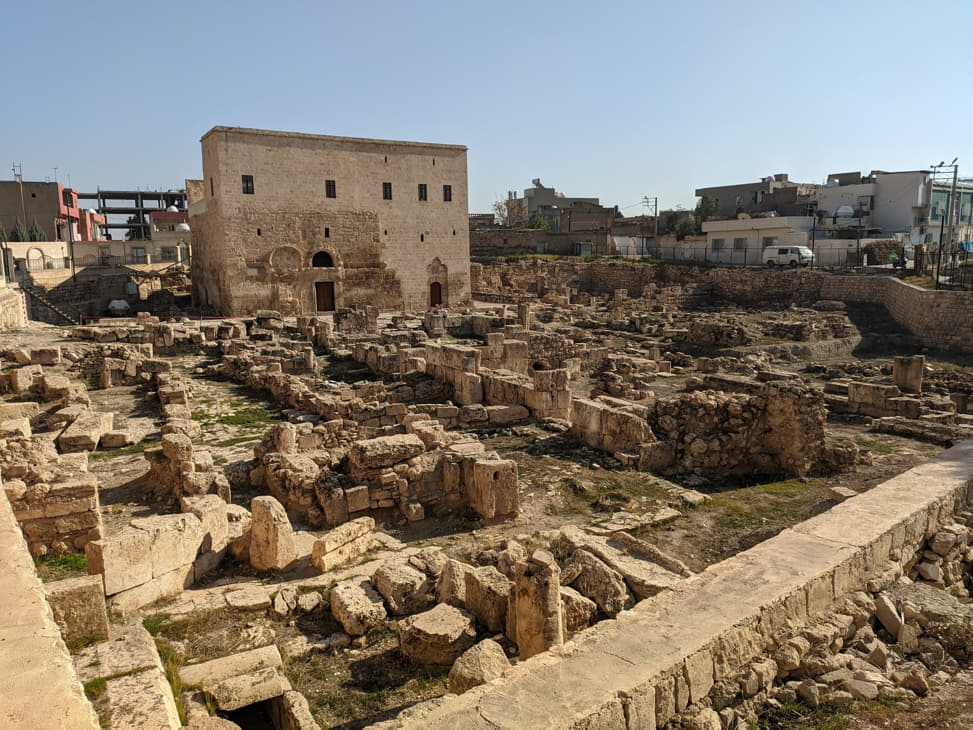
One of the most significant findings has been the discovery of the cathedral’s lost foundations. The excavations have unearthed the ruins of a substantial cathedral building adjacent to the baptistery. According to museum director Nihat Erdoğan, the site includes a large courtyard, and the baptistery, cathedral, and later sanctuaries coexist in a single archaeological area, highlighting their deep historical interconnectivity.
The artifacts discovered are remarkably diverse. Among them are glazed ceramics, many featuring human and animal figures, which are now preserved in the Mardin Museum. The excavations have also unearthed a significant cemetery adjacent to the church. In the cemetery area, skeletal remains of 44 individuals were found, including infants, children, youths, and adults, indicating long-term, active use of the burial ground. The burials, oriented east-west in simple earth graves, stone graves, and cist graves, provide valuable data on the demographic and health profiles of the ancient population of Nisibis.
Inscriptions found on the site are of paramount importance. Besides the Greek inscription on the baptistery itself, the eastern and southern facades of the church feature a palimpsest of inscriptions in Greek, Syriac, and Arabic. These layers of text chart the linguistic and religious evolution of the site, as Christian communities interacted with new Islamic rulers and their languages. The baptistery’s association with a Greek inscription dated 359 indicates a complex history of patronage linking the 4th, 6th, and subsequent centuries.
Legacy: UNESCO, Dialogue, and Future Prospects
The Church of Saint Jacob of Nisibis has entered a new phase of its long life as a site of global heritage. In 2014, the "Zeynel Abidin Mosque Complex and Mor Yakup (Saint Jacob) Church" was added to the UNESCO World Heritage Tentative List. The Turkish government has promoted the "Nusaybin Cultural Belief Park Project," aiming to fully excavate and restore both the church and the adjacent Zeynel Abidin Mosque. The goal is to present the complex as a unique model of inter-religious dialogue, where two faiths share a common courtyard and a shared past.
The church is still under the jurisdiction of the Syriac Orthodox Church, which continues to maintain its claim to the site. The survival of the structure is partly attributed to the respect Muslims held for Saint Jacob, a venerated figure in local Islamic tradition as well. Today, the church and mosque complex functions as a "cultural park of religions," a space for understanding the multicultural layers of Anatolian history. As the Mardin Museum director has argued, the area represents a "cradle of cultural civilizations," highlighting a shared history between Muslims and Christians.
Conclusion
The Church of Saint Jacob of Nisibis is more than a historical relic; it is a palimpsest of early Christianity. Its construction in the early 4th century by Bishop Jacob represents the first flowering of Christian architecture after the Edict of Milan. As the surviving baptistery of a lost cathedral, it is the oldest standing structure of its kind in the world. It embodies the theological transition from a secretive, persecuted faith to an institutionalized, public religion. Its architectural design influenced later baptisteries, and its conversion into a church in the 8th century demonstrates the adaptive reuse of sacred spaces.
The archaeological excavations of the last two decades have revealed the full scope of this Christian center, uncovering the cathedral's foundations, a vast cemetery, and thousands of artifacts that narrate the daily lives of its congregation. The church’s presence on the Turkish-UNESCO Tentative List signals its recognition as a monument of global significance. The Church of Saint Jacob of Nisibis remains a resilient testament to the faith, learning, and multicultural existence that has persisted in Upper Mesopotamia for over sixteen centuries, offering a unique lens through which to view the complex and intertwined histories of the region.