“Ave Maria Ancilla Trinitatis”: Devotion and Musical Expression in the Middle Ages
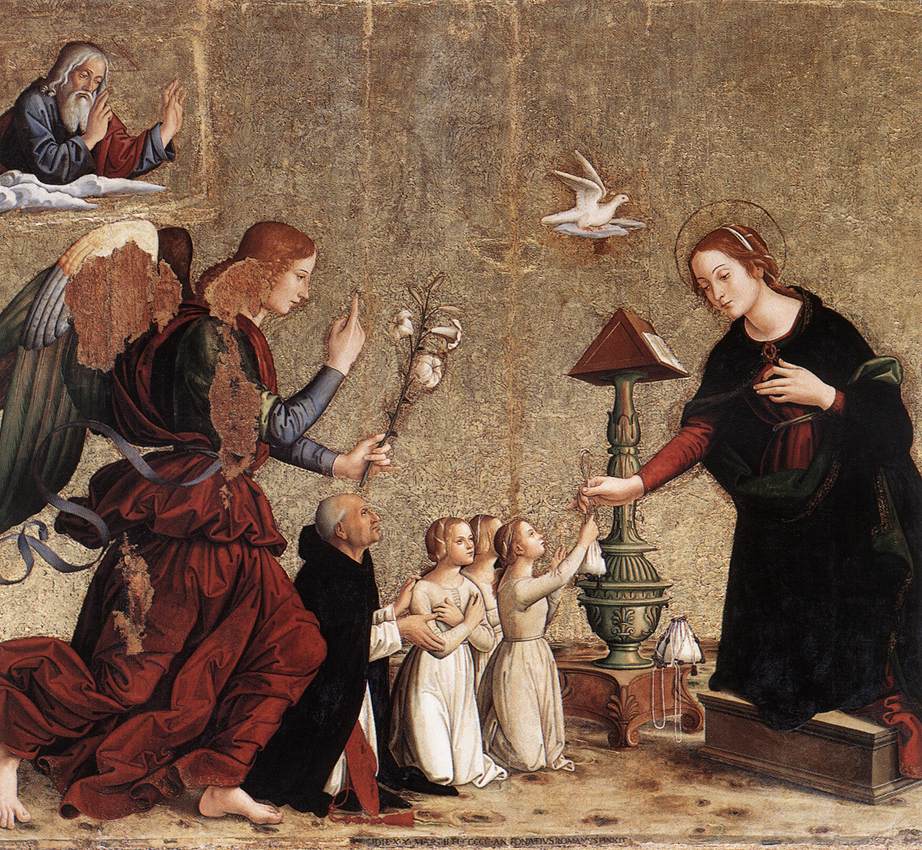
Among the many treasures of late medieval piety, the prayer Ave Maria Ancilla Trinitatis (“Hail Mary, Handmaid of the Trinity”) occupies a distinctive place at the intersection of Marian devotion, Trinitarian theology, and liturgical music. This prayer, which first appeared in fifteenth-century primers and devotional books, represents a remarkable synthesis of the biblical salutation to Mary with a carefully structured litany of superlative praises, culminating in a personal petition for the Virgin’s intercession. Its history, though fragmentary, reveals much about the devotional culture of late medieval Europe – a world in which the written prayer, the spoken word, and the polyphonic antiphon converged to create a richly textured experience of faith. This essay traces the history of Ave Maria Ancilla Trinitatis from its manuscript origins through its musical settings by English composers of the Tudor period, arguing that the prayer’s unique theological framing of Mary as the “handmaid of the Trinity” reflects both the high medieval flowering of Mariology and a distinctive English tradition of affective piety.
The Prayer and Its Structure
The text of Ave Maria Ancilla Trinitatis follows a distinctive formal pattern. Each line opens with the salutation “Ave Maria” addressed to the Virgin, followed by a superlative epithet, and concludes with a personalized petition for her intercession. This structure, as scholars have noted, “begins with the salutation ‘Ave Maria’, ending with a superlative, and supplemented at the very end with a personalized petition for Mary’s mediation”. The prayer thus combines the familiar opening of the Angelical Salutation with an original devotional elaboration, transforming the simple biblical greeting into an extended meditation on Mary’s exalted virtues and her role as mediator between the faithful and the Trinity.
The full text, as preserved in musical settings and manuscript sources, can be reconstructed in three main sections. The first section praises Mary as “ancilla Trinitatis” (handmaid of the Trinity) and “humillima” (most humble), celebrating her willing acceptance of the divine will. The second section hails her as “doctrix apostolorum” (teacher of the apostles), recognizing her role in instructing and inspiring the early Church. The final portion, beginning “Et impetra nobis omnium” (and obtain for us all things), moves from praise to petition, asking the Virgin to secure for the supplicant the grace of a holy life and a blessed death. Each of these sections, in turn, is composed of multiple lines beginning with “Ave Maria,” creating a rhythmic, almost litanic effect that was well-suited both to private recitation and to polyphonic musical setting.
Origins in Fifteenth-Century Primers and Devotional Manuscripts
The earliest known witnesses to Ave Maria Ancilla Trinitatis are found in fifteenth-century primers and prayer books, particularly those associated with English devotional practice. The Hyperion Records documentation notes that the prayer is “based on a prayer found in some fifteenth-century primers”. Primers – vernacular prayer books that served as the lay equivalent of the monastic Office – were among the most widely produced devotional texts of late medieval England, and they frequently included supplementary prayers and hymns to the Virgin.
One such manuscript, Oxford Bodleian Library MS. Douce 1, a prayer book in Latin and English dating to approximately 1460, contains “two versions of the hymn ‘Ave Maria ancilla sancte trinitatis’” among its contents. The manuscript, a small portable book intended for personal devotion, includes the prayer alongside other Marian hymns such as Stabat Mater dolorosa and various prayers to saints, suggesting that it was part of a larger repertoire of Marian devotion accessible to literate laypeople. The presence of two distinct versions within the same manuscript points to the prayer’s fluid textual tradition – a characteristic common to many devotional texts of the period, which were often adapted and expanded by scribes and users to suit local preferences or personal piety.
Further evidence of the prayer’s circulation comes from Continental sources. A German prayer book from Nuremberg, Cod. St. Georgen 40 dating to the late fifteenth century, includes the prayer under the attribution “Ps.-Bernhard von Clairvaux: ‚Ave Maria ancilla sancte trinitatis’”. The ascription to Pseudo-Bernard – that is, to a tradition of prayers falsely attributed to the great twelfth-century Cistercian abbot, St. Bernard of Clairvaux – is significant. Bernard’s sermons and writings on Mary had shaped Marian devotion across Europe, and the attribution of prayers to him served as a mark of spiritual authority and devotional authenticity. The appearance of Ave Maria Ancilla Trinitatis in a German manuscript under Bernard’s name suggests that the prayer, though perhaps of English origin, circulated widely and was regarded as part of the Bernardine devotional tradition.
An even more remarkable witness to the prayer’s diffusion is preserved among Icelandic manuscript fragments. A recent survey of Latin fragments in Icelandic bindings identified “the pseudo-Bernardine prayer Ave maria ancilla trinitatis (Holm papp 2 8vo, reinserted fragment)” as one of the liturgical texts preserved in the National Library of Sweden. The presence of this prayer in an Icelandic context – a fragment reused as binding material for another manuscript – testifies to the wide geographic reach of late medieval devotional texts and to the secondary lives that such texts often led in the centuries following the Reformation. The Icelandic fragment also reinforces the prayer’s association with the Bernardine tradition, linking English, German, and Scandinavian manuscript cultures through a shared devotional inheritance.
Theological Dimensions: Mary as Handmaid of the Trinity
The epithet “ancilla Trinitatis” (handmaid of the Trinity) represents a distinctive theological move that sets this prayer apart from more conventional Marian invocations. While Mary is frequently addressed as “handmaid (ancilla) of the Lord” in reference to her response to Gabriel (“Ecce ancilla Domini” – Luke 1:38), the expansion of this title to encompass the entire Trinity – Father, Son, and Holy Spirit – elevates and intensifies the praise. Mary is not merely the willing servant of the divine will in the moment of the Annunciation; she is the perpetual handmaid of the triune God, serving the economy of salvation in all its dimensions.
This formulation reflects the high medieval development of Trinitarian devotion, which saw a growing emphasis on the Trinity as the proper object of Christian worship, alongside an intensification of Marian piety. The two currents met in prayers like Ave Maria Ancilla Trinitatis, which presented Mary as the privileged mediator through whom the faithful could approach the triune God. The prayer thus participates in what scholars have called the “Marianization” of Trinitarian devotion – a phenomenon particularly pronounced in late medieval England, where the cult of the Virgin reached an extraordinary fervor.
The superlative epithets that follow each “Ave Maria” – “humillima” (most humble), “doctrix apostolorum” (teacher of the apostles), and others – build upon this Trinitarian foundation. Mary’s humility enables her to receive the Trinity’s grace; her teaching confirms the apostolic witness to the Trinity; her intercession secures for the believer a share in the Trinity’s life. The prayer thus moves from praise through meditation to petition, drawing the supplicant into an ever deeper engagement with the mysteries of faith.
Musical Settings: The Peterhouse Partbooks and Tudor Polyphony
The most significant surviving evidence for the prayer’s use and transmission comes not from manuscript primers but from musical settings composed at the turn of the sixteenth century. Three English composers of the Tudor period set Ave Maria Ancilla Trinitatis to polyphonic music: Hugh Aston (c.1485–1558), Nicholas Ludford (c.1490–1557), and Edmund Sturton (fl. c.1500–1520). Their settings, preserved in the Peterhouse partbooks and the Lambeth Choirbook, represent some of the finest examples of late medieval English votive antiphons – elaborate polyphonic works sung at the conclusion of Compline, the final office of the day.
The Peterhouse partbooks (Cambridge University Library, Mss 471–474) are a collection of manuscript partbooks dating from the early sixteenth century that once belonged to Peterhouse, Cambridge. Despite the loss of the tenor book, the surviving parts have allowed modern editors to reconstruct several of Ludford’s Marian works, including Ave Maria Ancilla Trinitatis. The partbooks also contain works by Hugh Aston, including his own setting of the same prayer.
Nicholas Ludford’s setting is particularly notable for its expressive treatment of the text. According to the Hyperion Records notes, “Ludford decorates certain apposite words with extended melismas and emphasizes the imploration of the text by varying vocal combinations for every two or three lines”. In a striking symbolic gesture, “Ludford first joins the full choral force at the text ‘angelorum’ (of the angels), introducing a cantus firmus also found in his Missa Inclina cor meum Deus”. The use of full chorus at the mention of the angelic host creates a vivid musical representation of the heavenly court, inviting the listener to imagine the angels joining in the prayer to Mary.
Hugh Aston’s setting, edited by Nick Sandon in 2004, is scored for five voices (treble, mean, contratenor, tenor, and bass), with the treble and tenor parts reconstructed by the editor from the incomplete Peterhouse sources. Aston’s setting, like Ludford’s, treats the prayer as a votive antiphon suitable for liturgical performance on Marian feasts. The musical complexity of these works – with their intricate counterpoint, varied vocal textures, and extended melismatic passages – suggests that they were performed by skilled choirs in collegiate or cathedral settings, not merely recited by individual devotees.
A third setting, by Edmund Sturton, is preserved in the Lambeth Choirbook (Lambeth Palace Library MS 1). Sturton’s setting is for six voices (SATTBB – soprano, alto, tenor, tenor, bass, bass), making it the most expansive of the surviving polyphonic treatments. The Lambeth Choirbook, also known as the Arundel Choirbook, is a major source of early Tudor polyphony, and Sturton’s inclusion alongside composers such as Robert Fayrfax and Nicholas Ludford testifies to the prayer’s prominence in the repertoire of early sixteenth-century English church music.
The Prayer in Icelandic Fragmentary Context
The survival of Ave Maria Ancilla Trinitatis as a binding fragment in an Icelandic manuscript provides a fascinating glimpse into the afterlife of medieval devotional texts in the post-Reformation period. The fragment, catalogued as Holm papp 2 8vo, was “reinserted” into its host volume, suggesting that it had been removed and later returned to its original context. Such fragmentary survivals are not uncommon for liturgical and devotional texts from the Middle Ages; parchment was a valuable commodity, and obsolete manuscripts were often dismantled and reused as binding material for newer books.
In the case of the Icelandic fragment, the survival of the prayer is intertwined with the history of the Reformation in Scandinavia. After the introduction of Lutheranism, Catholic liturgical manuscripts were frequently “palimpsested” – scraped and rewritten – to adapt them to Protestant use, or simply dismembered for their parchment. The persistence of a Catholic prayer like Ave Maria Ancilla Trinitatis as a fragment in a post-Reformation binding thus represents a kind of material resistance to religious change, a remnant of pre-Reformation piety preserved in the very structures designed to contain new forms of worship.
Comparison with Other Marian Prayers
The structure of Ave Maria Ancilla Trinitatis – a series of salutations each beginning with “Ave Maria” – belongs to a broader genre of medieval Marian devotions known as “Golden Aves” or “Salutations.” These prayers expanded the simple biblical greeting into increasingly elaborate sequences of praise, often enumerating Mary’s virtues, titles, or roles in salvation history. The most famous example of this genre is the “Golden Ave” associated with St. Mechtilde of Hackeborn (1241–1298), a German mystic of the Helfta convent. William C. McDonald has identified the “Marian Prayer-Type” in Mechthild von Magdeburg’s Das fließende Licht der Gottheit that corresponds to the Ave ancilla trinitatis tradition, suggesting a possible German connection for the prayer’s origins.
Unlike the familiar Ave Maria (Hail Mary) used in the Rosary, which consists of the Angelic Salutation and Elizabeth’s greeting with a later petition added, Ave Maria Ancilla Trinitatis is an entirely original composition. It does not quote the biblical text but rather uses the opening salutation as a refrain-like device to structure an extended meditation. In this respect, it resembles other late medieval devotional forms such as the “Jesus Psalter” or the “Fifteen Oes” of St. Bridget of Sweden – prayers that systematize and amplify the language of praise to facilitate prolonged meditation.
Devotional Use and Lay Piety
How would a layperson in fifteenth-century England have used the prayer Ave Maria Ancilla Trinitatis? The presence of the prayer in primers like MS. Douce 1 suggests that it was intended for private devotional reading, likely as part of the daily round of prayers that comprised the layperson’s “Little Office of the Virgin.” The prayer’s structure – a series of short, repeated salutations – made it suitable for recitation either in private or in small groups, and its concluding petition grounded the praise in a personal request for Mary’s intercession.
The musical settings by Aston, Ludford, and Sturton, on the other hand, suggest a more public and ceremonial use. Votive antiphons like Ave Maria Ancilla Trinitatis were sung at the end of Compline, the final office of the day, usually on Marian feasts or on Saturdays, which were traditionally dedicated to the Virgin. In cathedral, collegiate, and monastic settings, these elaborate polyphonic works would have been performed by professional or semi-professional choirs, offering the lay congregation a rich auditory experience of Marian devotion.
The combination of private prayer book and public polyphonic setting reflects the characteristic double life of late medieval devotional texts. The same words that a devout layperson might whisper in the privacy of their chamber could also be sung by a choir of trained voices in the resonant space of a great church. In both contexts, the prayer served the same essential purpose: to draw the believer closer to Mary, and through Mary to the triune God she served as “ancilla Trinitatis.”
Conclusion
Ave Maria Ancilla Trinitatis is more than a footnote in the history of medieval piety. Its careful structure, its theological ambition, and its rich musical legacy make it a valuable lens through which to examine the devotional culture of late medieval England and Europe. From its origins in fifteenth-century primers to its polyphonic settings by Tudor composers, from the manuscript workshops of England and Germany to the fragmentary survivals in Icelandic bindings, this prayer traces a path through the religious landscape of the later Middle Ages.
The prayer’s enduring insight is its fusion of the Marian and the Trinitarian: Mary honored not only as the Mother of God but as the handmaid of the Triune God, serving the divine will in complete humility and openness. In an age that often portrays late medieval piety as either excessively sentimental or mechanically repetitive, Ave Maria Ancilla Trinitatis stands as a witness to the theological sophistication and affective depth of pre-Reformation devotion. Its survival – in manuscripts, in musical scores, and in the unexpected spaces of fragment collections – reminds us that the history of prayer is never merely a history of words on a page. It is a history of voices raised in praise, of hearts lifted in petition, and of a people reaching, through Mary, toward the mystery of the Trinity.