Donald J. Trump: Jewish "messiah"
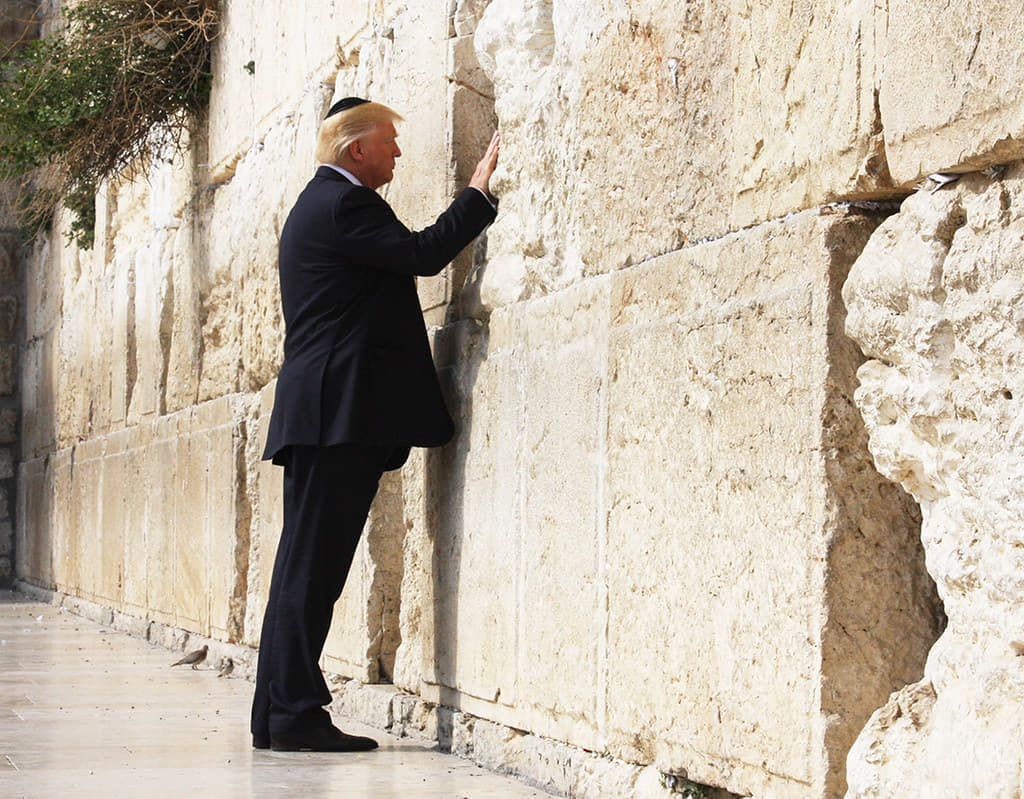
Prologue: The Number of the Beast (and the President)
In the esoteric world of Jewish mysticism, numbers are not mere quantities; they are cosmic signatures. The numerical value, or gematria, of a name can reveal the soul of a person and their role in the divine drama of history. For a small but vocal cadre of rabbis on the fringes of religious Zionism, the numbers are undeniable. The Hebrew spelling of "Donald Trump" (דונלד טראמפ) yields the number 424. In Jewish tradition, 424 is the exact numerical value of "Mashiach ben David"—the Messiah, Son of David .
To the rational observer, this is a coincidence of alphanumerics, a curiosity of linguistics. To Rabbi Isser Zalman Weisberg of Toronto, it is a prophetic thunderclap. He is not alone. Across the ideological landscape of the Jewish right, a theological movement has quietly crystallized, one that seeks to place Donald J. Trump into the sacred lineage of biblical redemption. This essay is an investigation into that phenomenon—an examination of the men who, with straight faces and sacred texts, posit that a reality television star and thrice-married casino magnate is the modern incarnation of the Persian King Cyrus, the "anointed one" of God, or even the reincarnation of Esau assisting the final redemption. This is not merely a political endorsement; it is an act of canonization. And it demands a polemical response that treats their arguments with the seriousness they crave, while exposing the theological and political abyss into which they stare.
This is the story of how Donald Trump became the Gentile messiah.
1. Rabbi Isser Zalman Weisberg: The Non-Jewish Messiah and the Pierced Ear
Our investigation must begin with the most explicit of the claimants. Rabbi Isser Zalman Weisberg, a Chabad-affiliated lecturer in Toronto, has articulated a theology so audacious that it reframes the very nature of American history . Weisberg looks at the assassination attempt on Trump in Butler, Pennsylvania, and does not see a security failure or a political moment; he sees a brit, a covenant.
Weisberg draws a direct line from the bullet that grazed Trump’s ear to the Torah portion in Exodus 21:6, where a servant who wishes to remain with his master forever has his ear pierced against a doorpost with an awl . According to Weisberg, the failed assassination was a divine ritual. The bullet that nicked Trump’s ear was God’s awl, marking him as the Eved Hashem—the eternal servant of the Jewish people. "President Trump’s right ear was grazed in a symbolic gesture," Weisberg argues, "where the Torah states that a servant who wants to remain with his master needs to have his right ear pierced" .
This is not metaphor to Weisberg. It is physics and metaphysics colliding. He declares Trump to be the "second non-Jewish Messiah," a title bestowed only once before in history, upon Cyrus the Great . The original Cyrus, the Persian king, issued the decree allowing the Jews to return to Zion and rebuild the Second Temple. Weisberg sees Trump fulfilling the same function for the Third Temple. But Weisberg’s vision is not merely one of political alliance; it is one of abject subservience. He posits that the "Make America Great Again" movement has misread its own destiny. America, he argues, was never meant to be great on its own. Its greatness will only be realized when President Trump, as the leader of the West, leads the United States to Jerusalem to bow before the Jewish Messiah.
In Weisberg’s eschatology, the United Nations will be dissolved and replaced by a "real United Nations" based in Jerusalem, with the Jewish Messiah as its sovereign . Trump’s role is to be the first head of state to kneel. This is a theological vision that, if taken seriously by its adherents, renders the sovereignty of the United States merely a temporary holding pattern until the American president can hand the keys of history over to the Davidic king. It is a stunningly radical re-imagining of American purpose, and it is being preached from an amud (pulpit) in Toronto.
2. Rabbi Mendel Kessin: The Reincarnation of Esau and the Secret of 424
If Weisberg provides the political framework, Rabbi Mendel Kessin provides the mystical machinery. Kessin, a popular lecturer in the "Torah Thinking" shiurim, does not merely suggest Trump is like Cyrus; he suggests Trump is the gilgul (reincarnation) of specific souls destined to aid the Messiah . His framework is dizzying in its complexity, rooted in the teachings of the Ramchal (Rabbi Moshe Chaim Luzzatto).
Kessin identifies Trump with the biblical figure of Esau. In the standard Jewish exegetical tradition, Esau is the archetype of Rome, of Edom, of the oppressive Western empire. He is the brother who sold his birthright and sought to kill Jacob. However, Kessin performs a startling act of theological legerdemain. He proposes that Trump represents the "good part" of Esau doing teshuva (repentance) . According to Kessin, Esau’s original mission was to fight evil and protect Jacob (the Jews). It was a mission Esau failed. But in Trump, the soul of Esau has returned to rectify that failure.
To bolster this, Kessin reaches into the Talmudic era, drawing a parallel between Rabbi Judah the Prince (Rebbe), the compiler of the Mishnah, and the Roman Emperor Marcus Aurelius. He recounts the legend that Marcus Aurelius’s mother saved Rebbe’s life, and that Marcus allowed the Jews to compile the Oral Law. Kessin posits that Trump is the reincarnation of Marcus Aurelius, and therefore of Esau, destined to protect the Jewish people in their divine mission .
Kessin views the legal persecution of Trump—the indictments, the trials, the convictions—not as the consequences of alleged financial fraud or obstruction of justice, but as a divine "refining process." He compares Trump’s legal woes to the imprisonment of Joseph in Egypt; it is a necessary descent before the ascent to viceregal power . And then, Kessin returns to the number. He confirms that the gematria of Donald Trump equals Mashiach ben David (424), but he refines the theology: Trump is not the Messiah, but his soul number aligns with the messianic energy required for the redemption . In Kessin’s world, voting for Trump is not a political act; it is a mystical participation in the repair of the world, the Tikkun Olam of the soul of Esau.
3. Rabbi Shmuel Eliyahu: The Tzfat Sanhedrin and the Divine Decree
Moving from the mystical fringes of America to the religious establishment of Israel, we encounter Rabbi Shmuel Eliyahu, the Chief Rabbi of Tzfat (Safed). Unlike Weisberg and Kessin, who operate as independent lecturers, Eliyahu is a figure of institutional power. He is the son of the legendary former Sephardic Chief Rabbi Mordechai Eliyahu, and his words carry weight in the national-religious community.
On Inauguration Day in January 2025, Rabbi Eliyahu issued a public blessing to Donald Trump. It was not a generic wish for success. It was a declaration of divine appointment. "The Holy One, blessed be He, watches over him," Eliyahu stated, "and He chose him and put it in people’s hearts to choose him, and he has a divine mission" .
Eliyahu explicitly invokes the Cyrus paradigm, reminding Trump that he is a "king who rules over many kings," but that he must always remember there is a "King of Kings above" . This blessing was not issued in a vacuum. Eliyahu was a key organizer of a letter signed by some 250 Israeli rabbis—including Chief Rabbi Yitzhak Yosef—thanking Trump for recognizing Jerusalem as the capital . That letter told Trump that "prophecies are being fulfilled" because of his actions.
The investigative implication here is profound. Rabbi Eliyahu and his signatories are mainstream enough to command respect, yet radical enough to frame a foreign president’s policy as the fulfillment of Isaiah. They are essentially drafting Trump into the Jewish liturgical narrative. When they cite Isaiah 62:1—"For Zion’s sake I will not keep silent"—and apply it to Trump’s embassy move, they are not merely praising a politician; they are performing an act of canonization . They are weaving Trump into the fabric of the Haftarah.
V. Rabbi Yosef Berger: The Temple Mount and the King of the West
If Rabbi Eliyahu provides the institutional heft, Rabbi Yosef Berger provides the apocalyptic endpoint. Berger, a prominent figure associated with the Temple Mount movement and the disciples of the late Rabbi Yitzchak Kaduri, is perhaps the most unambiguous in linking Trump to the geula (redemption) .
Berger’s theology centers on the Temple. He believes that the Third Temple must be built, and that it will be built by a non-Jew. "Just like the Second Temple, the Third Temple will be built by non-Jews," Berger argues . He sees Trump as the spiritual descendant of the Roman Emperor, the leader of the Western world, who has the unique capacity to "rectify the sin Rome committed with destroying the second temple" .
Berger adds another layer to the Moses typology. He compares Trump’s political career to the life of Moses: hidden as a child, revealed in his first success (entering the White House), hidden again (losing in 2020), and revealed a second time for his ultimate function . For Berger, Trump’s reelection in 2024 is the "second coming" of Moses, the moment when the leader is finally positioned to fulfill his function: facilitating the construction of the Holy Temple on the Temple Mount, a site currently home to the Dome of the Rock.
This is not merely messianic rhetoric; it is a political program with the potential for catastrophic real-world consequences. The rebuilding of the Temple would require the removal or destruction of the Al-Aqsa Mosque, an act that would almost certainly ignite a world war. Yet, for Rabbi Berger, Trump is the agent destined to make this happen. "Trump’s election is a necessary element of the geula,[redemption]" he insists .
5. Rabbi Hillel Weiss: The Sanhedrin, the Coin, and the Choice
Finally, we turn to Rabbi Hillel Weiss, the former spokesman of the nascent Sanhedrin—a modern-day attempt to recreate the ancient Jewish high court. Weiss has been consistent in his messianic framing of Trump since 2017. Before Trump’s first visit to Israel as president, Weiss issued a statement that captures the essence of this entire movement: "President Trump can choose to be a part of a process to bring the Messiah" .
Weiss and the Sanhedrin group took the unprecedented step of minting a commemorative coin featuring Trump’s profile superimposed on the image of Cyrus the Great . The coin was a physical manifestation of the theological merger they were attempting to perform. It declared, in metal, that the American president was the Persian king reborn.
Weiss’s language is one of invitation and warning. Trump has a choice. He can be Cyrus, or he can be just another politician. But in the Weissian worldview, the stakes are cosmic. By inviting Trump to ascend the Temple Mount, they are inviting him to accept his role in the "blessing of Solomon," a blessing reserved for foreign kings who recognize the God of Israel . The investigation reveals that for Weiss, Trump is a vessel of free will standing at the crossroads of history, and the Sanhedrin sees itself as the celestial signpost directing him toward the Temple.
6. The Idolatry of the Useful Idiot
Now, we must stop reporting and start arguing. This phenomenon—this Trumpian Cyrus theology—must be subjected to a rigorous polemic. It is, in its essence, a profound theological error disguised as piety.
First, let us address the idolatry of power. These rabbis look at the American president and see the hand of God. But in their haste to see divine providence in the White House, they risk committing the most ancient of Jewish sins: avodah zarah (foreign worship). They are not bowing to a statue, but they are bowing to a concept. They are bowing to the idea that raw political power, exercised by a non-Jew on their behalf, is the vehicle of redemption. This is a betrayal of the prophetic tradition. Isaiah, Jeremiah, and Amos spent their careers warning the Jewish people not to rely on the horses and chariots of Egypt (or Assyria, or Rome). They warned that reliance on foreign empires leads to moral corruption and national destruction. Yet here are modern rabbis, cheering for the horses and chariots of America, and calling the driver "Messiah."
Second, the gematria argument is intellectually vapid. The notion that the numerical value of "Donald Trump" equals 424 is treated as a smoking gun of prophecy. But gematria is a hermeneutic tool, not a divining rod. If we apply the same mystical numerology to "Adolf Hitler" (עדולף היטלר) we can find equally disturbing or "prophetic" alignments. The number proves nothing. It is a Rorschach test for those desperate to see their political preferences reflected in the cosmos.
Third, and most critically, this theology strips the Jewish people of their agency. In the worldview of Weisberg and Berger, the Jews are passive recipients of redemption, handed to them by a gentile strongman. The Messiah will not come from the House of David; he will be ushered in by a billionaire from Queens. This is a complete inversion of the traditional messianic hope. The Mashiach was supposed to be the ultimate expression of Jewish sovereignty and Jewish spiritual greatness. To suggest that he will arrive only after an American president bows down to him is to suggest that Judaism is incapable of saving itself without the permission of the West.
7. The Geopolitical Repercussions: Apocalypse Soon
The danger of this theology is not merely theological; it is geopolitical. These rabbis are not just praying in their study halls; they are lobbying in the corridors of power. The Temple Mount movement, buoyed by the rhetoric of rabbis like Berger and Weiss, has become increasingly active. The desire to build the Third Temple is the stated goal of these men.
If they truly believe that Donald Trump is the Cyrus of the age, then every action of his administration will be viewed through that lens. The Abraham Accords were not just peace deals; they were steps toward the geula. A potential war with Iran is not a geopolitical conflict over nuclear proliferation; it is the apocalyptic war of Gog and Magog.
The most terrifying implication is that these rabbis, and the Christian evangelicals who share their Cyrus theology, will encourage the Trump administration to facilitate the construction of the Temple. They will push for greater Israeli control over the Temple Mount. They will push for the red heifer sacrifice. They will push for the moment when the Dome of the Rock is replaced by a third Jewish temple. This is not a fringe fantasy; it is a funded, organized, and politically connected movement.
If they succeed, they will not bring the Messiah. They will bring a firestorm. The Muslim world will not stand idly by while the Al-Aqsa Mosque is threatened. The result would be a conflagration that could consume the entire Middle East and draw in the world.
Conclusion: The Grazed Ear and the Deafened Conscience
Rabbi Weisberg looked at the blood on Donald Trump’s ear in Butler, Pennsylvania, and saw the piercing of a servant. He saw a man dedicated to the service of the Jewish people and the Jewish Messiah. But perhaps we should look at that same image and see something else: a warning.
The bullet that grazed Trump’s ear was millimeters from ending his life. It was a moment of profound human vulnerability. Yet, in the hands of these messianic rabbis, that moment of vulnerability was transformed into a divine endorsement. It was not a near-tragedy; it was a consecration.
In their fervor to see redemption, these rabbis have lost the ability to see the man. They see a number (424) instead of a human being. They see a reincarnation (Esau) instead of a politician. They see a king (Cyrus) instead of a real estate developer. They have projected onto Donald Trump the sum total of two thousand years of Jewish longing for redemption. And in doing so, they have created a theological idol that bears little resemblance to the man who inhabits the White House.
The Talmud teaches that the Messiah will come either in a generation that is wholly righteous or wholly guilty. Perhaps this generation is not worthy of the Messiah. Perhaps the desperation to find him—to see his face in the features of a foreign leader—is proof of our unworthiness. For in searching for the Messiah in the wrong places, we risk missing him entirely, deafened by the roar of the crowd, blind to the still, small voice of God.