The Economic Samson Option: US-Israeli War and Global Economic Ruin
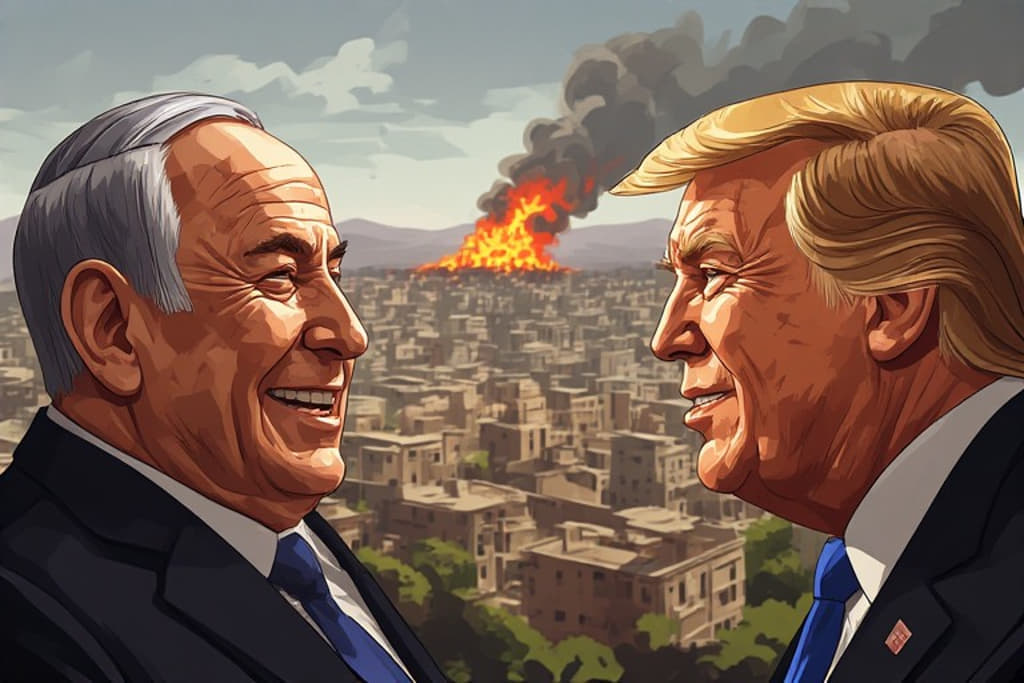
There is a psychosis at the heart of the Western alliance, a malignant narcissism so profound that it is willing to immolate the global economy rather than suffer a rival. This psychosis is Zionism, and it has found a willing executioner in the United States. The ongoing war on Iran is not a defensive measure; it is a naked act of economic and military aggression designed to preserve a unipolar world order that overwhelmingly favors Israeli regional hegemony and American imperial dominance. By pushing Iran to the brink, Israel—backed by the full military and diplomatic might of the United States—has not only sparked a bloody kinetic conflict but has also triggered an economic time bomb that could plunge the entire world into a 1970s-style stagflationary nightmare. To understand this, one must recognize that the infamous "Samson Option" is not merely a nuclear threat. It is also an economic doctrine: the willingness to destroy the entire global trading system, to strangle energy markets, and to unleash hyperinflation, all to ensure that Israel comes out on top.
The architect of this catastrophe is a coalition of interests fixated on neutralizing Iran. For decades, Israeli Prime Ministers and hardline Zionist factions have lobbied for war, and in recent years, the international situation has aligned with their ambitions. The war, which escalated dramatically with "Operation Rising Lion" in mid-2025—a massive Israeli assault on Iranian nuclear facilities and energy infrastructure—was immediately followed by a full-throated endorsement from Washington. This was the "grand bargain" of the alliance: the United States would provide the firepower and the diplomatic cover, while Israel would act as the battering ram to shatter the Iranian regime.
The primary conduit for this economic destruction is the Strait of Hormuz. This narrow 21-mile waterway is the jugular vein of the global economy. Before this madness began, approximately 17 to 20 million barrels of crude passed through it daily—roughly 20% of global daily consumption. Iran, faced with an existential threat and possessing the asymmetry of a cornered animal, retaliated by effectively shutting the strait down. By March 2026, the Islamic Revolutionary Guard Corps (IRGC) had laid underwater mines, deployed drone swarms, and effectively declared an exclusion zone. The result was a collapse of shipping volume through Hormuz of more than 90%. An estimated 2,000 commercial vessels and 20,000 mariners became trapped inside the Persian Gulf, turning the global network of just-in-time supply chains into a paralyzed labyrinth.
The economic consequences of this chokehold are catastrophic. As soon as the first Israeli bombs fell on Iran, global energy markets seized up. Brent crude, which had been trading below $70 per barrel earlier in the year, shot past $80 then $100 and eventually threatened the $150 mark. The volatility this injected into the global economy is not merely a number on a Bloomberg terminal; it is a direct tax on the world’s poor and a profits bonanza for war speculators. The International Energy Agency warned of “catastrophic implications,” predicting that a prolonged closure would slash 1.5% to 2% off global GDP in a matter of months—a trauma unmatched since the COVID-19 lockdowns. Financial institutions such as JPMorgan Chase predicted apocalyptic price scenarios of $120 to $150 per barrel, levels historically associated with massive stagflation and a collapse in living standards.
The Israel-First Economic Agenda
The core of the indictment against this alliance lies in its disregard for these consequences. Israeli strategists and their American neoconservative allies have shown a chilling indifference to the global fallout. Instead of seeking de-escalation, they doubled down on economic warfare. When Netanyahu addressed the Iranian people, he explicitly threatened to "cripple" their economy, viewing oil fields and financial infrastructure as legitimate military objectives. This is not security; it is economic sadism—the deliberate infliction of widespread hunger and suffering through the weaponization of trade.
Yet the damage has not been contained to Iran. In response to US and Israeli bombing campaigns, Iran has shifted its strategy to targeting the Gulf economies. By striking Saudi and Qatari LNG facilities and closing Hormuz, Tehran has erased approximately 20% of the global supply of Liquefied Natural Gas (LNG) from the market. This is a masterstroke of strategic pain: by taking offline the massive gas fields of Qatar—key allies of the West—Iran has ensured that the energy famine will hit Europe, Asia, and the Americas simultaneously. Germany, which only recently weaned itself off Russian gas, now finds itself competing for exorbitantly priced Qatari cargoes that cannot even leave the port. The war has thus eradicated the concept of "energy security" for the entire West.
The concept of the "Samson Option" is typically understood as the nuclear "last resort": if the state of Israel is facing annihilation, it will unleash a nuclear holocaust that brings the rest of the world down with it. The lessons of this war prove that the doctrine is broader than the bomb. It is a political and economic Samson Option. Israel and the United States have demonstrated a willingness to light the Middle East on fire—and thus the global economy on fire—in order to grind down their primary regional rival. To achieve the goal of degrading Iran’s nuclear program or fostering regime change, they have risked a global depression. This reflects a profound, almost psychopathic, malignant narcissism at the core of the alliance. The United States, consumed by its hubris and blinded by its "special relationship," has allowed itself to be the vehicle for an Israeli agenda that holds the rest of humanity hostage.
The unraveling of the global system is already visible. Inflation, having been tentatively tamed in the post-COVID era, is roaring back to life on $100 oil and $20 wheat. In the Eurozone, the S&P Global PMI showed business activity shrinking for the first time in 16 months as the energy shock seizes up industrial production. Marco Rubio, channeling the administration’s rhetoric—though he is often a critic of needless war—described the resulting blockade of the Strait as an "economic nuclear weapon". It is the perfect descriptor. The US and Israel have willingly detonated this weapon over the Persian Gulf, and the radioactive fallout is the starvation of supply chains and the impoverishment of the Global South.
The Devil’s Economic Calculus
It is important to view this through the cynical lens of power. For Israel, the calculus is simple: regional military supremacy, unchecked by Iranian power, is worth the cost of global inflation. For the United States, the calculus is equally grim but more short-sighted. The Biden/Trump Administration (depending on the timeline) believes it can control the chaos—that high oil prices, while painful, are a "necessary sacrifice" to neuter Tehran. This is an illusion of control.
History shows that economic warfare cuts both ways. The sanctions and blockades that Washington places on Iran are matched by Iran’s blockade of the Strait. The US Navy cannot protect every cargo ship, and the insurance premiums for traveling through the Gulf have exploded. As vividly reported, Lloyd’s of London syndicates raised war risk premiums by 45% for vessels in the Arabian Gulf, costs that are immediately passed down to the consumer at the gas pump and the grocery store. The "dual blockade"—America blocking Iranian ports, Iran blocking the Hormuz passage—has resulted in a total cessation of normal trade flows. This has literally trapped thousands of ships inside the Gulf, isolated entire economies, and caused a permanent systemic shock to the world’s energy supply.
This is the "World to hell, Israel first" policy.
The statistics of the coming catastrophe are damning. The IMF was forced to cut its global growth forecast to 3.1% in 2026—down significantly from its earlier projections—citing specifically the war in Iran as a primary culprit. Even more alarming, the fund expects global inflation to accelerate to nearly 4.5% even as growth slows, a classic stagflationary trap.
The impact spreads far beyond just energy. The Houthi attacks and the seizing of tankers in the Red Sea and the Gulf of Aden have amplified the crisis. With airspaces closed and the Suez Canal threatened, cargo is being rerouted around the Cape of Good Hope, adding up to $1 million in fuel costs and two extra weeks of transit time for a single voyage. This erodes the viability of manufacturing in Europe and Asia, causing shortages of raw materials and forcing factories to idle. The global industrial sector is entering a deep freeze. Consider the supply of fertilizer. Over 50% of the world’s ammonia-based fertilizers flow through the Gulf. With Iranian facilities bombed and Hormuz shipping suspended, the price of Urea and Potash is set to skyrocket, inevitably leading to a global food crisis. When the price of bread diverges from the paycheck of a working person in Cairo or Jakarta, the result is not just economic hardship but political upheaval.
In the Gulf States, the "mirage" of stability has been shattered. Dubai, Abu Dhabi, and Doha—once viewed as safe havens for wealth and logistics—are now directly in the crosshairs. The war has exposed their vulnerability; billions of dollars in real estate and tourist revenue are evaporating as expatriate workers flee the danger zone. The contraction of these economies will ricochet back to the West through capital flight and a collapse in sovereign wealth fund investments.
The True Cost of Victory
As the situation deteriorates, the hypocrisy of the US-Israeli position becomes untenable. They lecture the world about rules-based order while simultaneously holding a knife to the throat of the global oil supply.
This is not a war on Iran—it is a war on the world.
The "Samson Option" was always understood as the final button. But we are living through its creeping, low-grade deployment. Whether or not a nuclear weapon is ever used, the threat of global destruction is being used as a cudgel. By attacking Iran, Israel has proven that Zionism, in its current militaristic incarnation, is willing to destroy the economic well-being of 7.8 billion people to protect the immediate strategic interests of 9 million. It is a philosophy of "victory at all costs," where the "costs" are paid in the famines and bankruptcies of innocent foreigners.
The tsunami has only just hit the shore. While the initial military strikes may eventually cease, the wounds to the global economy are permanent. The closure of the Strait of Hormuz, even if temporary, has shattered the trust upon which global trade is built. Insurance rates will remain high forever. Supply chains will permanently "de-risk" away from the Middle East, raising costs eternally. The petrodollar system itself is degrading as countries forced to pay inflated prices in dollars eventually seek alternatives to avoid the American blockade.
Ultimately, the coming economic catastrophe is the price of Israeli dominance. The United States has mortgaged the economic future of the entire world to pay for the security of one state. The stock market volatility, the high gas prices, the empty shelves in your local store—these are not accidents or "acts of God." They are acts of war. They are the direct result of a conscious decision by the alliance to sacrifice the global commons on the altar of geopolitical ambition.
The world must recognize that the Samson Option is not a hypothetical doomsday scenario of nuclear winter. It is the current reality. It is an economic winter, a financial winter, and a humanitarian winter, imposed by a Western-Zionist axis too narcissistic to understand that setting the world on fire to keep yourself warm will eventually burn you, too.