First Fruits And Harvest
There
are seven main Feasts God outlined for the Jewish people to commemorate in the
Old Testament as listed in the book of Leviticus. They are; the feast of
Passover, of Unleavened Bread, First fruits, Feast of Trumpets, Day of
Atonement, Feast of Tabernacles, Feast of Pentecost.
These
Jewish feasts are clearly related to Israel’s spring and Autumn harvests and
the agricultural seasons. Why were they given to the Israelites in the first
place you may ask? They were given to remind the Israelites each year of God’s
protection and provision. And What we do for our Thanksgiving/Harvest time has
been drawn from these ancient feasts. They are connected.
One of these Feasts is the Feast of Pentecost which
simply means the Festival of Harvest. The books of Exodus, Leviticus, Numbers
and Deuteronomy all make reference to it which was held 50 days after Passover.
Passover being the event where God’s angel Past Over the homes of the
Israelites in Egypt as they prepared themselves to journey to the promised
land.
Almost
everything we eat today has been at least partially prepared by someone else. But
in ancient Israel the cycle of sowing and reaping was absolutely central to the
very existence of the Jewish people. The agricultural cycle was part of everyday
life.
The
Feast of Pentecost was an important marker in that cycle of harvest. It
commemorated the ending of the barley harvest and the beginning of the wheat
harvest in the land. And as the ancient
Israelites and ourselves celebrate Thanksgiving/Harvest with gratitude we do so
with joy.
Deuteronomy
tells us in ch 26; ‘bring the first fruits of the soil that you O lord, have
given. Place the basket before the Lord
your God and bow down before him. You shall rejoice in all the good things the
Lord your God has given to you and your household.’ It takes place irrespective
of whether we have a bumper harvest or a poor harvest.
It
may seem strange that God would have to command his people to be joyful. But
which one of us does not get weighed down by the cares and troubles of this
world. Or having a poor harvest. We often forget the things for which we ought
to be grateful to God for. Gratitude and joy go hand in hand. So what God does
is this; he comes to us in his word and through festivals like this and says, Stop.
Stop
your preoccupation with the cares of this life.
Stop
with all the worries that weigh you down. Stop thinking about problems that may
never happen. Stop thinking about yourself and your family.
Instead
Be happy about what you have AND FOR THE SAKE OF God have a good time. That’s
what a festival is about.
A lot of people think of religion in general and Christianity in particular as being a sour, dull, unhappy way to live. People have said; I don’t want to follow Jesus because I’ll have to stop having fun. Really.
If only they could understand God’s heart for his people. He commanded us to Rejoice. What is more, this rejoicing is a community event. It is not something that we’re supposed to experience alone, but with all of God’s people such as today. And Secondly, we are to remember where we came from. Where did we come from?
Remember that you were once slaves in Egypt. Remember your bondage as slaves, your mistreatment, the way Pharaoh mistreated you. Remember that once you were strangers and aliens. But now things have changed; you have been set free from slavery; this is what it means to Rejoice.
This event that took place where God led the
Israelites out of Egypt from slavery, to freedom and a new life is a picture of
what God can do to an individual today, because We were all at one-time slaves
to sin. Sin had control over us, living lives that were ungodly, and selfish,
being held captive by the things that God detests.
But
God in his grace and mercy gives us the faith to believe in him. It is only God
who is able to break the chains of bondage to sin and releases us from our slavery
to it. He redeems us, through Jesus dying on the cross while at the same time
granting us new life; a new way to live, think and behave. An exchange takes
place where Jesus takes our sin and we receive his righteousness.
Because
our sin impacts greatly on God’s holiness a penalty must be paid as God cannot
let sin go unpunished. The penalty for sin was paid by Christ and was received
and accepted by God the father.
When
a person accepts and believes what Christ has done for them, they no longer
stand condemned. Instead They receive forgiveness, a future, and eternal life.
Heaven is assured because of what Jesus has done for all of humanity. This is
the message Christ came to tell us.
Tragically Satan has great influence over the whole
world as we see and hear continually. But God the Father has delivered us from
the dominion of darkness and transferred us to the kingdom of his beloved Son.
God through his love and mercy is able to save anyone, anywhere, at any time.
Scripture tells us ‘everyone who calls on the name of the Lord will be saved.’
Are you ready to take that step of faith by
believing that Jesus died on the cross thereby releasing you from the power of
sin and making your future secure? He is more than able to save us. We are to
rejoice in the Lord for his provision, and rejoice in our deliverance,
remembering where we came from.
Thirdly we don’t come empty handed to the Lord.
Presenting first fruits to God is something that the OT speaks about regularly. It’s not a one-off thing as most people think. The idea of first fruits from the harvest is connected to the principle of presenting the first born in scripture. In the same way Mary and Joseph presented their child Jesus by bringing him to the temple in Jerusalem. In the same way as God claims the first born, he tells his people that the first fruits of the ground also belong to him.
Pentecost,
this Festival of the Harvest speaks to us of the importance of dedicating our
first and our best to the glory of God. Scripture promises a direct connection
between our dedication and God’s provision. Proverbs tells us; ‘Honour the Lord
with your possessions, and with the first fruits of all your increase; so your
barns will be filled with plenty’.
However,
this passage and principle should not be used to raise false hopes that
prosperity is attainable in proportion to what you give. It would be foolish to
calculate one’s giving based on what one expects to receive in return.
Giving that is motivated by what one will receive
back, is not giving at all. The key to this verse is not what will I get back
based on what I give; it is Honouring the Lord. This is our motivation. What
does it mean to honour God? It’s not so much the giving it’s the honouring.
When
we acknowledge that all we have including the clothes we wear, the food in our
cupboards, the car we drove to church, our homes, the money in our pockets
& purses/ ALL belongs to God, then we honour him.
When
we dedicate ourselves to serving God and serving others; we honour him.
When
we choose to repent from our sin and turn to God, we honour him.
When
we seek to carry out justice, feed the poor, fend for the widow and orphan, we
honour him.
When we trust that giving our first fruits for his special use will not leave us destitute, we honour the Lord.
In
the summer Israelites harvested figs, dates, pomegranates, honey, nuts. In
Autumn they gathered in olives and grapes. The first fruits brought before the
Lord were the choicest, the best without blemish. Not the left overs.
What do our first fruits include? Apples, wine, plums, turnips, potatoes, cabbages, wheat, barley. But you say well I don’t have any of those things so how can I give them. And You would be right.
But what about other, monetary first fruits like; a
pay rise, an increment, an inheritance, a rebate. Are they out of bounds? Are
they out of God’s reach? Remember who gave you them in the first place?
God blesses us because we are to acknowledge that we
and all we have are rightfully his and he blesses us because in giving back first
fruits, we show our trust that he intends to continue to provide for us.
Honouring the Lord with our first fruits not just at Thanksgiving/Harvest time,
is part of the dedication and trust he expects and deserves.
Most
of us have seen the film Lord of the Rings written by JRR Tolken who was a
Christian and close friend of CS Lewis. Frodo Baggins along with his companions
sets out on a journey to destroy the ring forged by the evil Sauron. They meet
with all kinds of dangers as well as interesting friends.
But
the impact of the book hinges on the fact that at each step of the way, the
reader can see that the hobbits are part of a larger story of cosmic
redemption.
So, it was with Israel and with us. We are part of a
bigger picture, on the road to greater events than we can possibly imagine. To
thank God for a good crop is one thing. To thank him because we recall how he
delivered us, and because each year’s crop is a link in a story leading up to a
promise of final deliverance; well that’s something else.
What
we read in Deuteronomy is not something we ignore because it happened so long
ago. The past is still our story today; the story of thanksgiving, of
redemption, and freedom.
For
example, the worshippers at Pentecost in the New Testament include themselves
in the events of the what happened although they were not physically present at
the Exodus and crossing the Red Sea 1500 years earlier.
By looking and applying what we read in the bible to
ourselves, we see that God’s salvation story is not only the story of people
who lived long ago, it is our story as well. Every lesson that Israel learnt,
is for OUR benefit. It is a lesson that we need to remember for ourselves. The
God whom Israel came to experience is our God as well. He hasn’t changed.
Likewise,
when we read in the New Testament that Jesus died and rose again to take upon
himself the sins of the world, we are to realise that it is our sin that
brought him to the cross.
First
fruits and Pentecost connected us, not only to our history that is our
redemption, but also to our future destiny, which means claiming and living out
the promises of Almighty God as written in the bible.
In
closing. It is natural for human beings to trust something or someone, but we
find it difficult to trust what we cannot see. The Israelites whilst in Canaan
the land of milk and honey, were surrounded by pagan nature gods like Baal. As
a result, it was easy for them to succumb to these visible graven images.
But
through linking harvest celebrations like Pentecost they were to remember that
the God to trust now, with our crops, land, wind, and rain, is the same God who
rescued them from slavery.
The Canaanite approach is the forerunner of how
modern life is lived Today. There was no history with it, and no destiny
either; only the yearly cycle; then another, followed by another. Their pagan
rites did not look back to a past redemption or forward to a future with God,
but only to the annual cycle of rain and growth. This is the way of the
unbeliever.
We
see this in our time where people live only for today with little regard for
history and little sense of destiny. Living only for today is all-consuming.
Sadly, this generation distrusts the past and despairs of the future.
However, this is a very different viewpoint for the Christian, because he or she knows where they came from, and where they are going. Their future is assured.
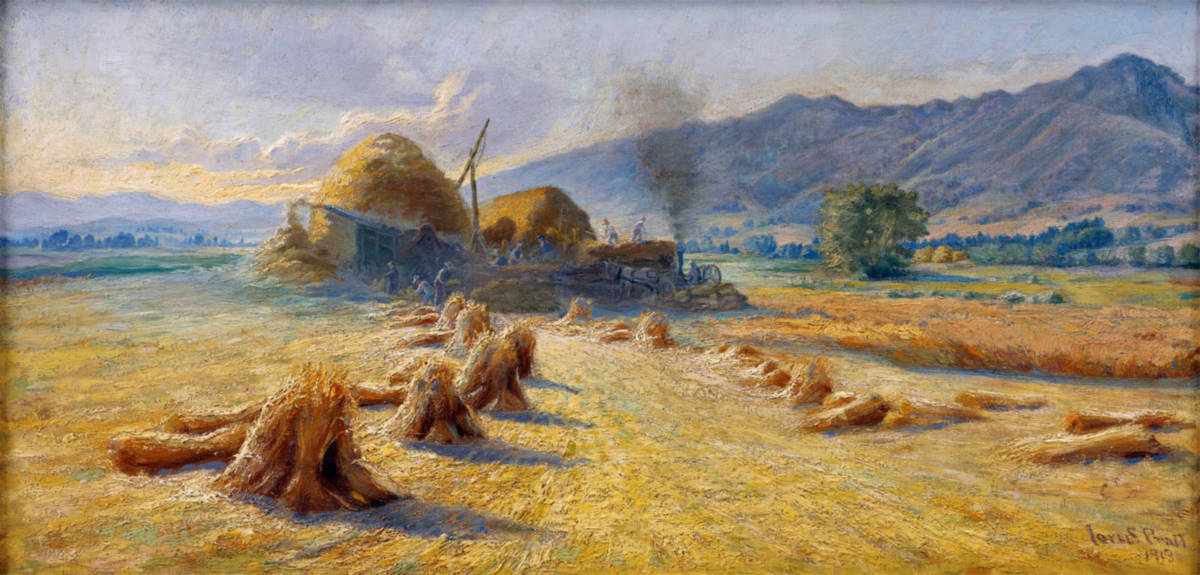
The photo shows, "Harvest Time in Cache Valley," by Lorus Bishop Pratt, painted in 1913.