Israel: Theo-Ethnocracy
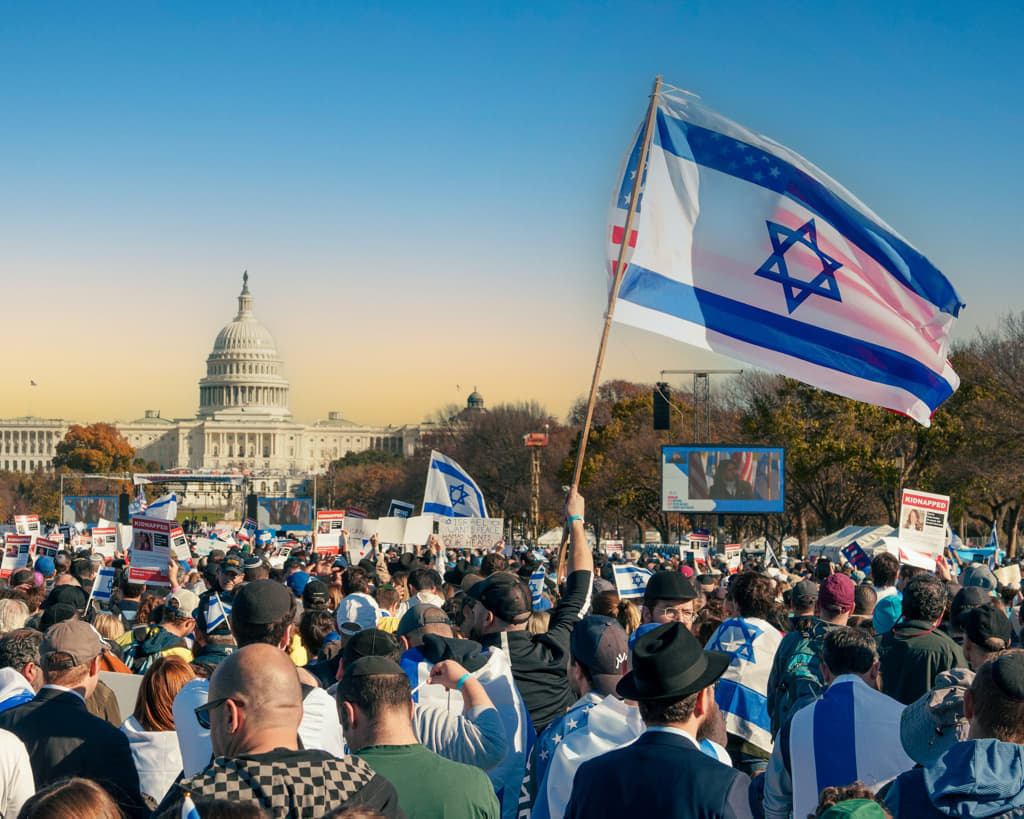
Israel’s ethnonationalist ideologies are primarily rooted in Zionism, which is an ethnic nationalist movement aimed at establishing and maintaining a Jewish nation-state. This ideology emphasizes Jewish ethnic supremacy and the demographic dominance of Jews within Israel, often at the expense of Palestinian rights and equality for non-Jewish citizens.
Zionism shares parallels with other ethno-nationalist movements, including foundational myths, prioritizing ethno-religious groups, and utilizing violence to achieve its goals.
Thus, Zionism favors one ethno-religious group (the Jews) over others. This creates an exclusionary-marginalization dynamic, an “us versus them,” where Jews are pitted as superior, or better, preferred citizens, over others (Arab Palestinians) who are therefore marginalized. An ethnicity demands geography, which legitimizes a "Jewish state," in a territory inhabited by non-Jews (Palestinians) which necessitates displacement, mirroring settler colonialism.
Being an ethno-nationalist ideology, Zionism relies on militarization, domination, and displacement. Mobilizing citizens around militarized conceptions of nationhood and justifying violence become central to maintaining control.
Then, Zionism uses foundational myths and the construction of an "Other" to maintain ethnic homogeneity and supremacy. Zionism thus uses Jewish anxieties to justify violence and cruel policies. This creates a political system within Israel that demands and thrives on fear, and operates through mass surveillance control.
Bolstering this ideology is theo-ethnocracy, or religious nationalism, which intertwines Jewish religious identity with the political and national identity of the state. Its origins trace back to the founding of Israel in 1948, when Jewish religious and political leaders strategically linked Judaism with the emerging Israeli state and nationalism, partly motivated by the Holocaust to conclude that only a Jewish state could ensure Jewish survival.
A significant component of religious nationalism in Israel is embodied by the Religious Zionist community, also called the "national religious" sector, which constitutes about 12 percent–16 percent of the population. This group identifies with both Orthodox Judaism and modern Israeli-Jewish national identity, seeing an organic connection between the Jewish people, their religion, and the land of Israel (Eretz Yisrael). For many in this community, the full realization of these ties is linked to a messianic vision of Redemption. This religious nationalism has given rise to politically active groups that form a major part of the Israeli right-wing, including support for settlement activity in the West Bank.
Religious nationalism in Israel centers on the belief that the Jewish people have a divinely ordained right to the land of Israel, based on biblical covenants, particularly the covenant God made with Abraham. This theological perspective is deeply embedded in the identity of the Israeli state, which is defined as a Jewish state with a significant political-theological dimension that includes apocalyptic and messianic elements. Zionism itself, while often seen as a nationalist movement, also has a religious aspect that ties Jewish national aspirations to biblical prophecy and messianic expectations. This intertwining of religion and nationalism shapes Israeli identity and politics, with the religious narrative affirming Jewish claims to the land and influencing the state's policies and self-understanding. Thus, national leaders should share the Jewish faith, and that Jewish sacred texts should influence laws, even overriding popular will when in conflict.
In recent years, religious nationalism has become increasingly influential in Israeli politics, especially among younger voters and right-wing parties such as the Religious Zionist Party and Otzma Yehudit. These parties advocate for maximalist policies regarding the Jewish state and settlements, often resisting compromise in the Israeli-Palestinian conflict. This trend reflects a broader entrenchment of religious nationalist ideology in Israeli society, influenced by thinkers like Yoram Hazony, who promote a form of integral nationalism that combines religion and state.
Israeli theo-ethnocracy is deeply entwined with evangelical Protestantism, which aggressively supports the Jewish people's right to return to Israel, based on their (mis)interpretation of prophecy in the Bible.
Christian Zionists believe that the return of Jews to Israel is a fulfillment of God's covenant with Abraham and a necessary precursor to the Second Coming of Jesus Christ. They interpret both Old and New Testament scriptures as foretelling the restoration of Israel and view the establishment of the modern state of Israel in 1948 as a significant prophetic event.
Therefore, Christian Zionism rejects the traditional Christian view, which is "Replacement Theology," which holds the Church has replaced Israel in God's plan, instead affirming the ongoing spiritual and national significance of Israel. Christian Zionists combine their spiritual beliefs with political support for Israel and active advocacy and prayer for the Jewish state.
Thus, Christian Zionism plays a significant role in supporting Israeli theo-ethnacracy, particularly its expansionist and authoritarian agenda. Christian Zionists form a powerful political base, especially in the United States, that actively lobbies for far-right Israeli policies, including permanent Israeli control over all territories they consider "biblical Israel," which extends beyond Israel's internationally recognized borders to include parts of the West Bank, Gaza, and even neighboring countries. Organizations such as Christians United for Israel (CUFI), with millions of members, are influential in advocating for policies like moving the U.S. embassy to Jerusalem, opposing the Iran nuclear deal, and supporting Israeli settlements in the West Bank, which are illegal under international law.
Christian Zionists raise millions of dollars to support Israeli settlements and settler militias, thereby directly enabling the expansion and consolidation of Israeli control over contested areas. They justify their support by a belief that God promised the land to the Jewish people, making any Israeli concession to Palestinians unacceptable. This theological stance leads Christian Zionists to oppose Israeli government plans involving territorial compromises or disengagement.
Prominent Christian Zionist leaders have framed Israeli political decisions to cede land as divine punishment, reinforcing hardline stances within Israel and among their supporters abroad.
Christian Zionism is closely linked with American Christian nationalism and has been a backbone of U.S. pro-Israel policy, especially under conservative administrations like that of President Trump. Their influence helped shape policies such as the embassy move to Jerusalem and a more aggressive stance toward Iran and Palestinian issues.
Christian Zionists are closely aligned with the Israeli government and Right-Wing Nationalists, and Christian Zionists contribute to and promote narratives portraying Israel as vulnerable amid hostile neighbors, often employing racist and Islamophobic tropes that align with some Israeli nationalist rhetoric. Their support extends to endorsing military actions, such as the Israeli assault on Gaza in 2023, and they often malign critics of Israeli policy as opposing their god’s plan.
Christian Zionism supports Israeli theo-ethnocracy by providing a large, politically active, and financially supportive constituency, especially in the US; by lobbying for expansionist policies and opposing territorial concessions to Palestinians; by theologically justifying Israeli control over contested lands as divinely mandated; by influencing U.S. foreign policy to favor Israel’s right-wing government agendas; and by supporting military actions and settlement expansion that reinforce Israeli dominance in the region.
Therefore, Israeli society is a deeply racist one, which was recently borne out in a poll conducted by Penn State University in March 2025.
This poll reveals overwhelming support among Jewish Israelis for the forced expulsion of Palestinians from Gaza and Israel, as well as high levels of support for genocidal actions.
Here is what this poll found:
82 percent of Jewish Israeli respondents support the forced expulsion of Palestinians from the Gaza Strip
56 percent support the forced expulsion of Arabn citizens of Israel from within Israel itself.
47 percent of respondents agree that the Israeli army should act like the biblical Israelites did when conquering Jericho—by killing all inhabitants of a conquered enemy city—reflecting support for the ongoing genocide.
Over 65 percent believe in a modern-day incarnation of "Amalek," a biblical enemy, and among them, 93 percent believe the biblical command to "wipe out Amalek" applies today, indicating genocidal intent.
Support for expulsion and extreme measures is found across different Jewish communities, including secular, traditional, religious, and ultra-Orthodox groups, with higher support among the more religious communities but significant backing even among secular Jews.
Compared to a similar poll in 2003, support for expulsion has increased substantially (from 45 percent to 82 percent for Gaza expulsion, and from 31 percent to 56 percent for expulsion of Palestinian citizens of Israel).
Only 9 percent of Jewish men under 40, who make up most of the soldiers, were fully opposed to expulsion and transfer of Palestinians.
The poll reflects the deep-seated ethno-nationalist mindset of ordinary Israelis, with the media and education systems cited as factors nurturing these extremist views over decades. These attitudes coincide with recent military operations in Gaza and political rhetoric supporting "cleansing" Gaza of all Palestinians.
This means just one thing—Israelis are committed to violence and regard genocide as the only guarantee of their own survival. In this bloody agenda, they are aided and abetted by American evangelicals, who regard such slaughter of an entire ethnicity as part of their god’s plan.
This raises the obvious question—should Israel even continue to exist in its present form?