Israel's Genocide Economy
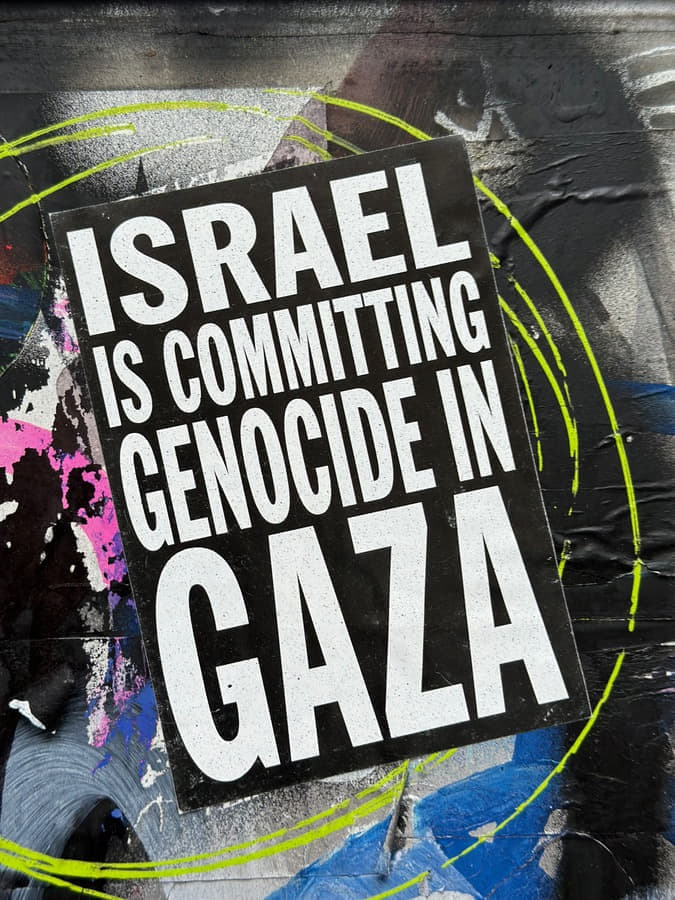
In the sprawling industrial parks of the West Bank, the whir of machinery seldom stops. In the high-rises of Tel Aviv, stock market tickers flash updates on defense contracts. In the corridors of international finance, bonds are traded with the confidence of a nation hailed as the "start-up nation."
Yet beneath this veneer of innovation lies a darker, more foundational reality: an economy built upon the subjugation of an entire people.
For decades, Israel has been framed by its allies as the "only democracy in the Middle East"—a beacon of technological progress in a turbulent region. But a critical, investigative lens reveals a different narrative: an economic system that does not merely tolerate the occupation of Palestinian territories but requires it for survival. This is not an economy that exists despite the conflict; it is an economy that thrives because of it.
International legal experts and human rights organizations are increasingly using the term "apartheid" to describe the legal reality in the territories. However, the economic dimension of this regime is arguably more damning. It represents a "genocide economy"—a system where profit is extracted not just from occupied land, but from the systematic denial of Palestinian rights, the exploitation of captive labor, and an international arms trade that feeds on perpetual regional instability.
The Architecture of Control
At its core, the economy of the occupation is an economy of acquisition. The Oslo Accords—once heralded as a step toward peace—effectively fractured the West Bank into Areas A, B, and C, granting Israel control over the most resource-rich areas. Area C, comprising over 60% of the West Bank, became the backbone of an extractive economic system.
Land Seizure: This control has facilitated the systematic seizure of Palestinian land for the expansion of illegal settlements—illegal under international law per the Fourth Geneva Convention. This is not merely a political or territorial issue; it is a massive real estate transfer. The settlements, subsidized heavily by the Israeli government, provide high-quality housing at a fraction of the cost inside the Green Line, acting as a subsidy for the military presence required to protect them.
Water Theft: In the Jordan Valley—a key agricultural region—Israeli settlers consume far greater quantities of water per capita than their Palestinian neighbors. Mekorot, the national Israeli water company, controls the supply, leaving Palestinian farmers with limited access to irrigation. The result? The systematic starvation of the Palestinian agricultural sector to subsidize Israeli agri-business exports.
The Control of Movement: Perhaps the most visible element of economic suffocation is the permit regime. The West Bank is dissected by checkpoints and the Separation Wall—not a security measure in isolation, but an economic fragmentation machine. The permit system allows Israel to dictate the terms of Palestinian labor, creating a captive, cheap workforce with no rights and no bargaining power. The deduction of "insurance" and "taxes" from their wages by the Israeli state, without providing them the social services citizens receive, constitutes a direct transfer of wealth from a stateless population to the state treasury.
The Military-Industrial Complex
Israel's reputation as a tech hub is deeply interwoven with its military. The Israeli Defense Forces serve as a testing ground for technology. Cyber-security, drone technology, and missile defense systems developed for occupation duties are quickly spun off into private sector companies.
Testing in Gaza: The densely populated Gaza Strip is often referred to by military analysts as the "world's largest open-air laboratory." Every military operation serves as a real-time, high-intensity field test for new weapons systems. The Iron Dome—presented as a defensive wonder—generates billions in revenue for its manufacturer, Rafael Advanced Defense Systems, and relies on components sourced from global arms dealers.
The Pillar of Exports: Israel is consistently one of the world's top ten arms exporters, with defense exports regularly exceeding $10 billion annually. For a small country, this is staggering. The primary clientele often includes regimes with questionable human rights records, further highlighting the moral bankruptcy of an economy that profits from global violence. The war in Ukraine has only accelerated sales, as Western allies look to Israel for technologies proven in urban warfare—technologies honed in the streets of Gaza and Jenin.
The Settlement Industry: The "settlement industry" is not just about ideology; it is big business. Major Israeli construction and infrastructure firms—some publicly traded on the Tel Aviv Stock Exchange—are deeply involved in building and maintaining settlements in the West Bank. These companies often have international subsidiaries or are listed on foreign stock exchanges. For instance, companies building the railway connecting Jerusalem to the settlement of Ariel are effectively profiting from a system that international courts have deemed illegal.
The infamous "cyber hub" in the Barkan Industrial Zone, deep in the West Bank, houses dozens of Israeli tech companies. These companies rely on the military to secure their premises, and they employ Palestinian workers—often without equal rights or benefits—to fill low-tier positions. It is a microcosm of the apartheid economy: security and funding provided by the state, labor extracted from the occupied, and profits flowing to the occupier.
The Suffocation of Gaza
Since the imposition of the strict blockade in 2007, Gaza has been transformed into an open-air prison. The economic impact has been catastrophic. The blockade restricts not just the movement of people, but the import of essential goods: construction materials, medical supplies, and even food.
The "Economy of the Tunnel": In response to the suffocation, a shadow economy of tunnels between Gaza and Egypt emerged. While Hamas taxed this trade to survive, it also allowed for the import of essential goods, creating a parasitic relationship where survival itself became a commodity.
De-development: The World Bank and the UN have long documented the "de-development" of Gaza. The economy is systematically regressed to the point where the population is almost entirely dependent on international aid. This is not an accident of war; it is a policy of deliberate degradation, ensuring the population remains too weak and too hungry to resist.
The "Erez Crossing" System: The management of crossings is a tool of economic warfare. By restricting the movement of people for "security" reasons, Israel has effectively prevented a generation of Gaza's intellectuals, doctors, and students from seeking better opportunities abroad, strangling the region's human capital.
Fishing Zone: The arbitrary restriction of the Gaza maritime fishing zone has decimated the fishing industry—a primary source of protein for the enclave. Shrinking the zone based on "security" whims eliminates livelihoods and exacerbates food insecurity, pushing the population closer to famine conditions. This fits the legal definition of using starvation as a method of warfare—a war crime.
International Complicity as Business Model
The genocide economy extends far beyond Israel's borders. Multinational corporations like Airbnb, Booking.com, and Expedia list properties in illegal settlements, normalizing the occupation for millions of tourists and generating revenue for settlers. Banks, pension funds, and investment firms around the world hold shares in Israeli companies complicit in the occupation.
The UN Database: The United Nations has published a database of over 200 companies doing business in the settlements. The existence of this database is a testament to the complicity of the private sector. However, political pressure from the US and Israel often prevents these lists from being used to impose sanctions or divestment.
Pension Fund Activism: Increasingly, activists and NGOs are pressuring global pension funds to divest from companies linked to the occupation. While successful in some European cases, the political stigma attached to the word "Boycott" often deters investors, highlighting the powerful lobbying apparatus that protects the occupation economy.
The "Lawfare" Approach: Israel has weaponized the legal system to protect the economic interests of the occupation. The "Anti-Boycott Law" targets individuals and organizations that advocate for a boycott of Israel—including settlements—effectively criminalizing solidarity with Palestinians. This law is designed to protect the economic flow into the settlements by suppressing criticism, creating a chilling effect for journalists and NGOs attempting to expose the link between finance and human rights abuses.
The Human Cost
Behind the abstract data of GDP and share prices is the daily degradation of the Palestinian worker. The "3 AM" line at checkpoints, where workers wait for hours to be allowed into Israel, is a daily ritual of humiliation. Their permits can be revoked arbitrarily, stripping them of their livelihood without cause.
Israeli employers often deduct social security and health taxes from Palestinian wages. The Palestinian Authority receives these funds and distributes them, but the workers are not entitled to the benefits Israeli citizens receive. This is a direct transfer of funds from the Palestinian labor force to the Israeli state budget.
In the West Bank, olive trees—a symbol of Palestinian identity—are often uprooted or burned by settlers with impunity. This is not vandalism; it is economic warfare. It is the destruction of a family's primary source of income over generations, pushing them further into poverty and forcing rural communities to abandon their land.
Demolishing Palestinian homes is an economic issue. It destroys the family's primary asset—their home—forcing them into debt and dependence on UNRWA aid. The reason given is often "lack of permits," which are nearly impossible for Palestinians to obtain. This bureaucratic system facilitates ethnic cleansing through economic strangulation.
The Moral Hazard
The genocide economy operates on a fundamental principle: the maintenance of Jewish supremacy requires the economic degradation of the "other." It is a system where the military, the state, and the private sector are symbiotically linked to perpetuate a regime that many are now willing to call apartheid.
For the international community, the complicity is undeniable. Western governments provide the diplomatic cover and the military hardware. Corporations provide the revenue and the normalization. Pension funds provide the investment that sustains the companies on the ground.
The logic of capitalism dictates that we chase profit. But the genocide economy demands we ask: Profit at what cost? When economies are built on the denial of basic rights, the extraction of resources, and the exploitation of a captive population, they cease to be simply "economies." They become systems of organized crime.
The international community faces a choice: continue to subsidize the occupation through trade and aid, or use the tools of economic pressure—divestment, sanctions, and boycotts—to dismantle the infrastructure of apartheid.
The ledger of this economy is not written in dollars and shekels alone. It is written in the uprooted olive trees, the demolished homes, the children in Gaza suffering from malnutrition, and the despair of a people denied their future. History will judge not just the soldiers on the front lines, but the investors, the CEOs, and the politicians who kept the machine running.
Until the economic engine of the occupation is dismantled, the hope for justice will remain a footnote to the profit of the oppressor.