Jean Bourdichon and French Court Painting
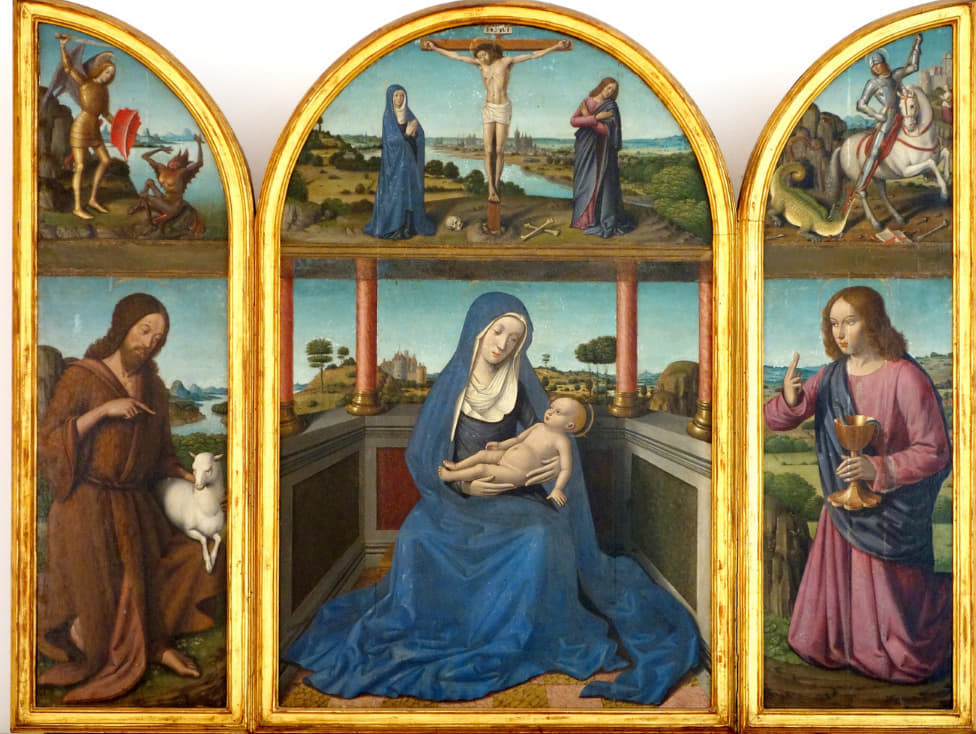
Jean Bourdichon occupies a crucial position in the history of French painting because his work demonstrates that manuscript illumination remained a highly ambitious and innovative court art at the beginning of the sixteenth century. Active principally in Tours and at the French court during a period of profound artistic transition, Bourdichon served four successive French monarchs—Louis XI, Charles VIII, Louis XII, and François I—and produced some of the most magnificent illuminated manuscripts of the late medieval and early Renaissance periods. His surviving works, particularly the Hours of Louis XII and the Grandes Heures of Anne de Bretagne, reveal an artist who transformed the devotional book into a unified instrument of piety, dynastic identity, natural knowledge, and courtly magnificence.
The chronological uncertainty surrounding Bourdichon's life—his birth is generally placed around 1457–1459, with his death recorded in 1521—reflects the fragmentary nature of documentary evidence for French artists of this period. Yet the documentation that does survive, especially his royal commissions and court appointments, establishes him as far more than a mere illustrator of devotional texts. Bourdichon was a court painter and valet de chambre, a position that placed him within the intimate administrative and ceremonial world of the French monarchy. His importance lies in his ability to combine the prestige and devotional function of the illuminated manuscript with the visual innovations of Renaissance court art, developing a distinctive language of intimate religious drama, sophisticated illusionism, naturalistic botanical imagery, and carefully staged royal identity.
This essay argues that Bourdichon's significance can be understood through three interconnected claims: first, he was a leading court painter who served successive French monarchs; second, he expanded the expressive and technical possibilities of manuscript illumination; and third, he helped connect the traditions of French Gothic illumination with emerging Renaissance modes of space, naturalism, portraiture, and courtly display. Through careful analysis of his major surviving works, attention to the distinction between documented facts and scholarly attributions, and consideration of his place within the broader development of French Renaissance painting, this essay will demonstrate that Bourdichon's achievement was not merely his skill in painting miniature scenes but his transformation of the book of hours into a sophisticated Renaissance luxury object that could carry the same ideological weight as panel painting, portraiture, and ceremonial art.
Biographical Background
Birth, Training, and Connection with Tours
The documentary evidence for Bourdichon's early life is notably sparse, and art historians have approached his early career with appropriate caution. He was likely born in Tours, or at least established his professional activity there, around 1457–1459. Tours had been an important center of manuscript illumination since the mid-fifteenth century, largely due to the patronage of the French royal court, which frequently resided in the Loire Valley. The city's artistic culture was profoundly shaped by the career of Jean Fouquet (c. 1420–1481), the most celebrated French painter of the fifteenth century, who had worked for Charles VII and Louis XI and whose influence permeated the Tours school of illumination.
The traditional art-historical literature has often discussed Bourdichon's style in relation to Fouquet, and some scholars have proposed that Bourdichon was Fouquet's pupil. However, this claim must be treated as a scholarly attribution or art-historical hypothesis rather than a securely documented fact. The evidence for a direct teacher-pupil relationship remains circumstantial, based primarily on stylistic similarities and the geographical proximity of their careers. What can be stated with greater confidence is that Bourdichon inherited and developed the traditions of the Tours school, including its interest in coherent spatial settings, naturalistic observation, and the integration of text and image. The early biographical record is less secure than the documentation for his later court career, and the essay must distinguish carefully between what is known and what has been plausibly inferred.
Service to the French Monarchy
Bourdichon's service to the French monarchy is one of the most securely documented aspects of his career. He served four successive French kings—Louis XI, Charles VIII, Louis XII, and François I—a remarkable continuity that demonstrates the importance of manuscript illumination within royal patronage and suggests that his workshop or artistic practice adapted to changing royal tastes. The Getty's scholarly exhibition catalogue on the Hours of Louis XII identifies Bourdichon as court painter to these four monarchs and places his work for Louis XII around the king's coronation in 1498. This long tenure at court indicates that Bourdichon was not an isolated manuscript specialist but a central figure in the visual culture of the French monarchy.
His court title, recorded in relation to the commission for Anne of Brittany's manuscript, was painter and valet de chambre. This position was not merely honorary but placed him within the intimate administrative and ceremonial world of the monarchy, rather than treating him as merely a commercial artisan. The valet de chambre was a trusted household officer who had access to the king's private chambers, and the combination of this title with the role of court painter suggests that Bourdichon's work was closely integrated with the personal and dynastic concerns of the royal family. The documentary record of his commissions, salaries, and payments provides a firm foundation for understanding his professional status, even as it leaves many details of his artistic training and early career obscure.
The Court Context
To understand Bourdichon's achievement, it is necessary to situate him within the broader context of the French court around 1500. The reigns of Charles VIII (1483–1498), Louis XII (1498–1515), and François I (1515–1547) were periods of significant political, cultural, and artistic change. The French monarchy was consolidating its power, expanding its territorial claims, and engaging increasingly with Italian Renaissance culture. Charles VIII's invasion of Italy in 1494 had exposed French patrons to Italian art and architecture, and subsequent French kings would bring Italian artists to France and sponsor the construction of Renaissance châteaux in the Loire Valley.
Within this context, royal books of hours functioned simultaneously as personal devotional objects, expressions of dynastic identity, luxury objects designed to display wealth and cultural refinement, and portable images of royal piety. These manuscripts were not simply books to be read but were material embodiments of power and status, meant to be seen and admired by courtiers and foreign dignitaries. The patronage of Anne of Brittany, who was queen successively to Charles VIII and Louis XII, was particularly important because she commissioned exceptionally elaborate manuscripts and maintained a strong association with devotional and dynastic imagery. As Duchess of Brittany in her own right, Anne was acutely aware of the political significance of visual representation, and her manuscripts reflect her need to assert her dual identity as French queen and independent Breton ruler. Bourdichon's work for Anne represents the fullest surviving expression of his mature art and provides the richest material for understanding his artistic language and its significance.
Major Works and Commissions
The Hours of Louis XII
The Hours of Louis XII is one of Bourdichon's most important surviving commissions and provides crucial evidence for his early work for the French monarchy. The manuscript was made for Louis XII around the time of his coronation in 1498, and its creation marks the beginning of Bourdichon's documented work for the king who would become his most important royal patron. The original manuscript is now dispersed, but sixteen known miniatures were reconstructed for a major exhibition organized by the J. Paul Getty Museum and the Victoria and Albert Museum in 2005. This reconstruction, published as A Masterpiece Reconstructed: The Hours of Louis XII, has significantly advanced scholarly understanding of the manuscript's appearance and significance.
The Hours of Louis XII provides a royal counterpart to the later Grandes Heures of Anne de Bretagne and reveals Bourdichon's ability to integrate personal patronage with elaborate devotional imagery. The manuscript is characterized by dramatic narrative composition, sophisticated lighting, and an interest in illusionistic effects that would be developed further in the Grandes Heures. One particularly significant miniature, the Bathsheba scene, exemplifies the intersection between biblical narrative, courtly taste, and the emerging representation of the female nude in French painting. The Getty catalogue specifically treats this image within the context of Louis XII's preferences and the developing genre of the female nude, suggesting that Bourdichon was responding to his patron's tastes while also contributing to broader artistic developments.
The Hours of Louis XII also demonstrates Bourdichon's interest in creating a relationship between the miniature and the viewer that goes beyond mere illustration. His compositions often use dramatic close-up effects, presenting sacred figures at half-length or in intimate proximity to the viewer, creating a devotional immediacy that distinguishes his work from earlier manuscript illumination. This technique, which would become a hallmark of his mature style, suggests that Bourdichon was consciously developing a more psychologically engaging form of devotional art.
The Grandes Heures of Anne de Bretagne
The Grandes Heures of Anne de Bretagne, preserved in the Bibliothèque nationale de France as BnF, ms. Latin 9474, is Bourdichon's most important surviving work and the fullest expression of his mature artistic language. Produced approximately between 1503 and 1508, the manuscript represents the culmination of Bourdichon's career and provides the richest material for understanding his achievement. The documentary importance of the payment order of March 1508 cannot be overstated: Anne ordered payment of 1,050 livres tournois to Bourdichon, and the document described the manuscript as "richly and sumptuously" illustrated and illuminated. This evidence firmly connects Bourdichon with the manuscript and establishes its importance as a royal commission.
The physical and visual scale of the work is extraordinary. The manuscript comprises approximately 238 folios and includes twelve calendar miniatures, forty-seven full-page illuminations, a royal portrait and heraldic pages, and numerous floral and vegetal borders. The opening portrait depicts Anne kneeling in prayer, accompanied by her patron saints, including Saint Anne, Saint Ursula, and Saint Margaret or Saint Helen, depending on the precise identification used. Her initials, arms, and portrait make her ownership and patronage unmistakable, and the manuscript as a whole constructs royal identity through the conjunction of portraiture, personal devotion, dynastic heraldry, patron saints, and a lavish material and pictorial setting.
The calendar miniatures are particularly notable for their depiction of the occupations of the months and their accompanying zodiac signs, continuing a tradition of calendar illustration that had been central to the book of hours since the thirteenth century. However, Bourdichon's calendars are distinguished by their attention to landscape, their naturalistic observation of seasonal activities, and their integration of the calendar cycle with the broader themes of the manuscript. The full-page illuminations depict scenes from the life of Christ and the Virgin, as well as images of saints, and they are characterized by Bourdichon's distinctive approach to sacred narrative, which emphasizes dramatic intimacy, emotional immediacy, and sophisticated lighting effects.
The Lost Book of Hours for François I
Bourdichon retained his position under François I, who succeeded Louis XII in 1515. A book of hours made for François I has been lost, but documentary evidence indicates that it was intended to contain rich, varied, and lifelike scenes, together with different flowers, trees, and ornamental motifs on its pages. This lost work cannot be analyzed directly, but it nevertheless suggests that Bourdichon's reputation and courtly formulas remained influential after the accession of François I. The documentary record of this commission also indicates that Bourdichon's methods, particularly his integration of naturalistic botanical imagery with devotional content, had become a recognizable and sought-after style. The loss of the manuscript is a significant gap in the surviving corpus of Bourdichon's work, but the documentary evidence for its existence demonstrates the continuity of his royal service and the ongoing prestige of manuscript illumination at the French court.
Bourdichon's Artistic Language
Dramatic Intimacy
One of the most distinctive features of Bourdichon's mature style is his tendency to bring sacred events close to the viewer. His compositions frequently use tightly cropped figures or "dramatic close-up" effects, presenting characters at half-length or in close view. This technique, which appears in both the Hours of Louis XII and the Grandes Heures of Anne de Bretagne, has a significant devotional consequence: the reader is not merely observing a distant biblical event but is placed emotionally and visually within the sacred drama. The Kiss of Judas, the Lamentation, and the Annunciation to the Shepherds provide excellent case studies for this approach. In these scenes, Bourdichon reduces the distance between the sacred event and the viewer, creating a sense of intimate participation that distinguishes his work from the more hieratic or distant treatment of biblical subjects in earlier manuscript illumination.
The Lamentation in the Grandes Heures exemplifies this approach. The figures of the Virgin, Saint John, and the mourners are depicted in close view, their expressions of grief rendered with careful attention to individual emotion. The composition is tightly cropped, eliminating extraneous background detail and focusing attention on the human drama of the scene. This treatment of sacred narrative reflects broader developments in late medieval and early Renaissance devotional art, including the emphasis on emotional identification with the suffering of Christ and the Virgin that characterized the devotio moderna movement. Bourdichon's contribution was to translate this devotional emphasis into a visual language of dramatic intimacy that could be integrated into the luxurious context of the royal book of hours.
Light and Atmosphere
Bourdichon's use of artificial and nocturnal illumination is another defining feature of his mature style. Night scenes allow him to create strong contrasts between darkness and light, a heightened emotional atmosphere, and a visual suggestion of divine revelation. In the Grandes Heures, nocturnal scenes such as the Kiss of Judas and the Annunciation to the Shepherds use light to intensify drama or suggest the divine character of the event. The Kiss of Judas is set against a dark background, with the figures illuminated by torches that cast dramatic shadows and create a sense of nocturnal chaos. The Annunciation to the Shepherds, by contrast, uses light to suggest divine presence: the angel appears in a burst of radiance against the dark sky, creating a stark contrast that emphasizes the supernatural nature of the event.
This interest in dramatic lighting is also evident in the Crucifixion, which is described as being plunged into darkness, making the scene particularly stark and emotionally severe. The darkness that envelops the scene creates a visual analogue for the theological significance of the Crucifixion—the darkness that covered the land at the death of Christ—while also intensifying the emotional impact of the scene. Bourdichon's treatment of light and darkness reveals his engagement with the broader artistic developments of his period, including the growing interest in naturalistic lighting effects and the emotional power of chiaroscuro. It also demonstrates his ability to adapt the techniques of panel painting to the miniature format, creating compositions that rival the dramatic intensity of larger works.
Illusionistic Framing
The painted wooden frames that surround the full-page miniatures in both the Hours of Louis XII and the Grandes Heures of Anne de Bretagne represent one of Bourdichon's most innovative contributions to manuscript illumination. These frames create the impression that the sacred image is a separate object inserted into the manuscript, as if the reader were looking at a panel painting mounted within the pages of the book. The device appears in the Hours of Louis XII and is developed further in the Grandes Heures, where the frames are more elaborate and more consistently integrated with the overall design of the page.
The illusionistic framing technique encourages the viewer to think of the miniature both as a window onto a sacred event and as a precious panel painting contained within a luxury book. This double reading reflects the broader cultural status of the illuminated manuscript around 1500, when the book of hours functioned simultaneously as a devotional object and a display of wealth and taste. The placement of the miniatures opposite the text creates a carefully controlled relationship between image and prayer, with the reader's experience oscillating between the verbal and the visual, the textual and the pictorial. The frames thus serve not merely as decorative borders but as devices that structure the reader's experience of the manuscript, creating a dialogue between the sacred image and the prayers it accompanies.
Naturalism in the Borders
The botanical borders of the Grandes Heures of Anne de Bretagne are among Bourdichon's most distinctive achievements and represent one of the most significant innovations in early Renaissance manuscript illumination. More than three hundred plant species are represented in the margins, many identified by names in Latin and French. These borders should not be dismissed as decorative filler; rather, they function on multiple levels, imitating the authority of a botanical catalogue, displaying close observation of the natural world, creating a visual rhythm across the manuscript, and establishing a relationship between scientific knowledge, luxury, and devotion.
The symbolic role of plants is particularly important. The white lily, for example, accompanies the Annunciation and functions as a Marian symbol, linking the Virgin's purity with the flower's whiteness. Other plants carry symbolic meanings derived from biblical exegesis or traditional iconography, creating a complex network of associations that enriches the devotional experience of the manuscript. The insects and animals inhabiting the margins, including small monkeys, provide further evidence that the borders form an animated natural world rather than a merely ornamental frame. These details create a sense of the natural world as a living, dynamic environment that mirrors and amplifies the sacred events depicted in the miniatures.
The naturalism of the borders also raises questions about Bourdichon's sources and methods. Does this naturalism represent direct observation, the influence of contemporary botanical culture, the visual prestige of collecting and classifying nature, or a symbolic extension of the religious imagery? The answer is likely a combination of all these factors. The Grandes Heures was produced during a period of growing interest in natural history and botanical illustration, and Bourdichon's borders reflect this broader cultural context. At the same time, the precision and variety of the plant representations suggest that Bourdichon was working from direct observation, possibly with the assistance of botanical specimens or garden sources. The borders thus represent a convergence of scientific curiosity, artistic skill, and devotional symbolism that is characteristic of the Renaissance.
Bourdichon and the Transition from Gothic to Renaissance Art
Continuity with French Manuscript Tradition
Bourdichon's art must be understood in relation to the traditions of French manuscript illumination that preceded him. The lavish books of hours, gold backgrounds, ornamental borders, courtly patronage, and dense integration of text and image that characterize his work all have roots in the manuscript culture of the fifteenth century. Bourdichon did not abandon the manuscript tradition in favor of panel painting; instead, he made the manuscript itself a highly sophisticated Renaissance luxury object, adapting and transforming the inherited forms of illumination to meet the tastes and expectations of his royal patrons.
His relationship to the Tours school of illumination, particularly the legacy of Jean Fouquet, is complex and requires careful treatment. While some scholars have seen Bourdichon as Fouquet's pupil or direct successor, the evidence for this relationship is circumstantial. What is clearer is that Bourdichon inherited and developed certain features of the Tours tradition, including its interest in coherent spatial settings, its attention to naturalistic detail, and its integration of portraiture with devotional imagery. He also shared with Fouquet a concern for the material and visual quality of the manuscript as an object, treating the book not merely as a vehicle for text and image but as a work of art in its own right.
Renaissance Developments
At the same time, Bourdichon's work incorporates features that signal artistic change around 1500. These include more coherent spatial settings, greater interest in landscape, naturalistic plants and animals, carefully observed facial expressions, illusionistic frames, dramatic lighting, and portraits tied to individual patronage. The Grandes Heures contains landscapes with mountains and fortifications, as well as compositions that adapt earlier models while introducing changes in setting, expression, and emotional intensity. These features demonstrate Bourdichon's engagement with the broader artistic developments of his period, including the growing interest in naturalism and the influence of Italian and Flemish art.
It is important to avoid presenting Bourdichon as simply "medieval" or "Renaissance." His importance lies precisely in the coexistence of both modes, in his ability to synthesize the traditions of French manuscript illumination with the innovations of Renaissance art. His work demonstrates that the transition to the Renaissance was not a simple replacement of Gothic art by Italian forms but a complex process of adaptation, transformation, and synthesis. French artists could modernize manuscript painting through naturalism, spatial experimentation, portraiture, emotional immediacy, and technical refinement, without abandoning the traditional forms and functions of the illuminated book.
Relationship to Other Artistic Centers
Comparison with Flemish manuscript illumination is instructive for understanding Bourdichon's place in the broader artistic culture of his period. Flemish artists were admired for detailed naturalism, atmospheric settings, and convincing representation of the visible world, and their work had a significant influence on French manuscript painting in the late fifteenth and early sixteenth centuries. Bourdichon adapted comparable interests within a specifically French courtly and devotional context, creating works that reflect Flemish influence while maintaining a distinctive French identity.
The Grandes Heures has been studied in relation to contemporary Flemish illumination, particularly in terms of the changing representation of the environment. However, the comparison should be analytical rather than reductive: Bourdichon was not simply imitating Flemish art but developing a distinct Touraine-based visual language. His work reflects the particular concerns of French royal patronage, including the emphasis on dynastic identity, the integration of portraiture with devotion, and the use of the manuscript as a vehicle for political as well as religious meaning. The botanical borders, in particular, represent a departure from Flemish practice and a distinctive contribution to the art of illumination.
Why Bourdichon Matters as a Painter
He Was a Court Painter, Not Merely a Book Decorator
Bourdichon's long service to the French monarchy places him within the central institutions of royal culture. His commissions demonstrate that manuscript illumination could carry the same ideological weight as portraiture, architecture, ceremonial objects, and panel painting. His work participated in the representation of kingship, queenship, dynastic continuity, and Christian legitimacy, serving not merely as decoration but as an active agent in the construction of royal identity. The Grandes Heures of Anne de Bretagne, with its integration of portraiture, heraldry, personal devotion, and dynastic symbolism, exemplifies this ideological function, presenting Anne as a pious queen whose devotion to the saints and to the Virgin reinforces her legitimacy and her connection to the divine.
The status of Bourdichon as valet de chambre further emphasizes his integration into the court hierarchy. This was not a marginal or subordinate position but one that placed him at the center of royal patronage and cultural production. His long tenure under four kings suggests that he was valued not merely for his technical skill but for his ability to respond to the changing tastes and requirements of royal patronage. His career thus challenges the notion of the manuscript illuminator as a mere artisan, revealing instead a figure of considerable status and influence within the royal household.
He Expanded the Expressive Power of Illumination
Bourdichon's miniatures are not static illustrations of texts but dynamic images that manipulate scale, viewpoint, lighting, gesture, facial expression, and the relation between image and page. The result is a more immediate and psychologically engaging form of devotional art that anticipates the emotional intensity of later Renaissance painting. His use of dramatic close-up effects, nocturnal illumination, and illusionistic framing creates a sense of intimate participation in sacred events that distinguishes his work from the more hieratic or distant treatment of biblical subjects in earlier manuscript illumination.
The devotional consequence of this expressive power is significant. Bourdichon's manuscripts are designed not merely to be read but to be experienced, creating an environment in which prayer is surrounded by the natural world, royal identity is integrated into sacred history, and the book becomes an intimate space of meditation and display. The reader is not merely a spectator but a participant, drawn into the sacred drama through the immediacy of the images and the integration of text and image. This devotional function is inseparable from the material and visual qualities of the manuscript, which work together to create a unified aesthetic and spiritual experience.
He United Image, Object, and Reader
Bourdichon's manuscripts should be understood as total works of art, in which painted scenes, text, borders, parchment, heraldry, and binding work together. In the Grandes Heures, the reader encounters an environment in which prayer is surrounded by the natural world, royal identity is integrated into sacred history, and the book becomes an intimate space of meditation and display. The integration of botanical borders with the liturgical text, the placement of full-page miniatures opposite the prayers they illustrate, and the use of illusionistic frames to structure the reading experience all contribute to this unified effect.
This conception of the manuscript as a total work of art reflects the broader cultural status of the book of hours around 1500. These books were not merely functional objects but were investments in cultural capital, displays of wealth and taste, and expressions of personal and dynastic identity. Bourdichon's achievement was to create books that fulfilled all these functions while also serving as vehicles for devotion and meditation. The Grandes Heures is thus not simply a collection of images and texts but a carefully constructed environment that shapes the reader's experience and constructs a particular relationship between the reader, the text, and the sacred.
He Developed an Influential Model
The botanical borders of the Grandes Heures were influential and found echoes in the work of later artists, including the Master of Claude de France. This indicates that Bourdichon's importance extended beyond his own commissions and that his methods became part of the visual vocabulary of later French manuscript illumination. The combination of naturalistic observation with symbolic meaning, the integration of the borders with the overall design of the page, and the use of the margins as a space for the display of knowledge and taste all represent innovations that shaped the subsequent development of French manuscript painting.
The influence of Bourdichon's botanical borders can be seen not only in manuscript illumination but also in other media, including tapestry and panel painting. The interest in naturalistic plant representation that characterizes his work reflects broader cultural developments, including the growing importance of botanical studies and the collecting of exotic plants. Bourdichon's contribution was to integrate this interest into the devotional context of the book of hours, creating a model that was both aesthetically innovative and culturally significant.
He Represents a Transitional Moment in European Art
Bourdichon demonstrates that the transition to the Renaissance was not a simple replacement of Gothic art by Italian forms. French artists could modernize manuscript painting through naturalism, spatial experimentation, portraiture, emotional immediacy, and technical refinement. His career therefore complicates narratives that treat manuscript illumination as a declining medieval medium after the invention of printing. Bourdichon's manuscripts show that illumination remained a vibrant and innovative art form well into the sixteenth century, capable of absorbing the visual, devotional, and intellectual energies of the Renaissance.
This transitional character is evident in both the form and the content of his work. The Grandes Heures reflects the persistence of traditional forms of devotion—the hours of the Virgin, the penitential psalms, the office of the dead—while also incorporating features that signal artistic change, including the naturalistic borders, the illusionistic frames, and the emphasis on emotional immediacy. Bourdichon's art thus represents a synthesis of old and new, a fusion of the Gothic and the Renaissance that is characteristic of French court culture around 1500.
Conclusion
Jean Bourdichon's biography remains fragmentary, but his surviving works and royal documentation establish his importance as one of the most significant French painters of the late fifteenth and early sixteenth centuries. His career demonstrates that manuscript illumination at the turn of the sixteenth century was not a declining medium awaiting replacement but a flexible and prestigious court art capable of absorbing the visual, devotional, and intellectual energies of the Renaissance.
The contrast between the Hours of Louis XII and the Grandes Heures of Anne de Bretagne illuminates the arc of Bourdichon's career: the first demonstrates his ability to serve a king, while the second presents the fullest surviving expression of his mature art. In both works, Bourdichon developed a distinctive language of intimate religious drama, sophisticated illusionism, naturalistic botanical imagery, and carefully staged royal identity. His achievement was not only his skill in painting miniature scenes but his transformation of the book of hours into a unified instrument of devotion, dynastic identity, natural knowledge, and courtly magnificence.
Jean Bourdichon's art matters because it reveals manuscript illumination at the height of its ambition: not as a surviving medieval craft awaiting replacement, but as a flexible and prestigious court medium capable of absorbing the visual, devotional, and intellectual energies of the Renaissance. His work challenges us to reconsider the place of illumination in the history of European art and to recognize the creativity and sophistication of French court painting around 1500.