Kamāl ud-Dīn Behzād and the Humanization of Persian Miniature Painting
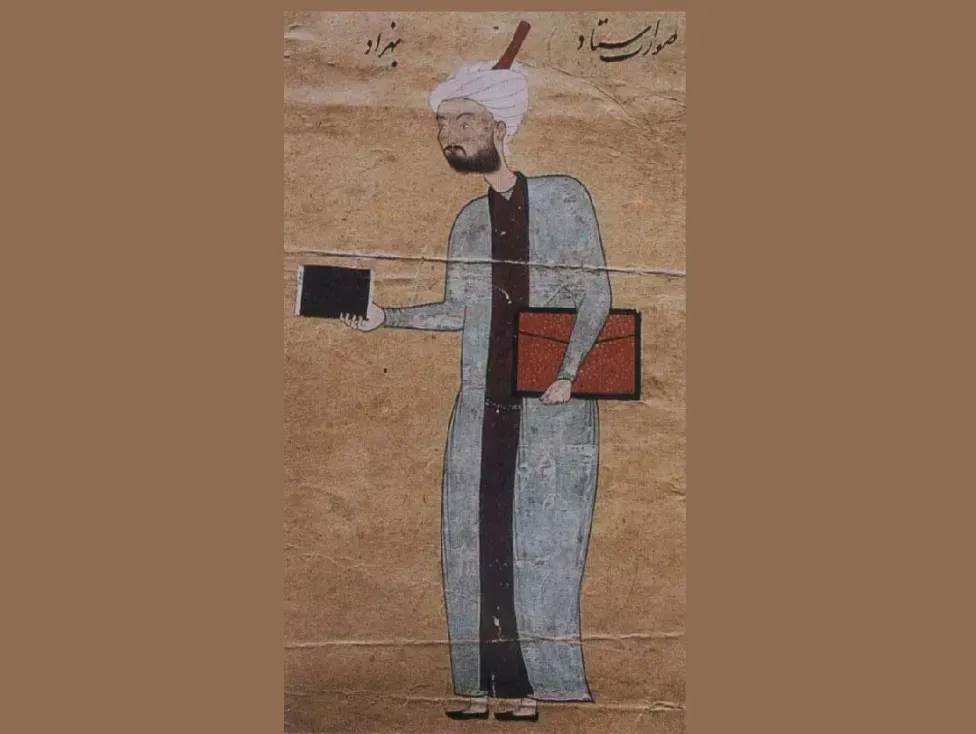
Kamāl ud-Dīn Behzād (ca. 1450–1535), the most celebrated master of Persian miniature painting, worked at the intersection of two great dynastic epochs: the twilight of Timurid Herat and the dawn of Safavid Tabriz. While traditional art historical narratives have often framed Behzād as a solitary genius who single-handedly liberated Persian painting from rigidity, a closer examination reveals a more nuanced figure—one whose innovations in figural movement, expressive physiognomy, and compositional dynamism emerged from the sophisticated workshop culture of the late Timurid court and were subsequently codified as the classical standard of Safavid art. This essay argues that Behzād's enduring significance lies not in radical rupture but in his transformation of inherited conventions into a visual language capable of conveying psychological interiority and narrative complexity. Through an analysis of his attributed works—particularly the 1488 Būstān illustrations and the 1494–95 Khamsa of Niẓāmī—alongside the historiographical problems of attribution and the ideological uses of his legacy, this study situates Behzād within the broader trajectory of Turco-Persian manuscript production and reassesses his role as a pivot between medieval and early modern Persianate visual culture.
Introduction: The Problem of Behzād
Few figures in Islamic art history carry as heavy a burden of attribution and idealization as Kamāl ud-Dīn Behzād. Born in Herat around 1450 and dying in Tabriz some eighty-five years later, Behzād witnessed the collapse of Timurid power, the brief interregnum of the Uzbek conquest, and the consolidation of Safavid rule under Shāh Ismāʿīl I and his son Ṭahmāsp . His career spanned the two most formative periods of Persian manuscript illumination, and his name became synonymous with the highest achievements of the Herat school. Yet the documentary record is frustratingly thin: Behzād signed few works, and only a handful of miniatures—perhaps thirty-two at most—can be confidently attributed to his hand, all datable between 1486 and 1495 . The rest of the vast corpus associated with his name reflects the collaborative nature of the kitābkhāna (manuscript workshop), the imitative practices of his students, and the later connoisseurial habit of assigning works of exceptional quality to the master himself.
This evidentiary problem has shaped the historiography of Behzād in profound ways. As early as the sixteenth century, the Ottoman writer Muṣṭafā ʿĀlī and the Safavid chronicler Qāḍī Aḥmad celebrated Behzād as the supreme master of Persian painting, a figure whose work surpassed that of all predecessors and contemporaries . The Mughal emperor Bābur, himself a connoisseur of no small discernment, praised Behzād in his memoirs, though not without acknowledging certain limitations in the artist's treatment of animal forms and the stiffness of his figures' feet . This combination of extravagant praise and occasional criticism suggests that even in his own century, Behzād was understood as a historical figure whose achievement required assessment rather than mere veneration.
The task of the modern art historian, therefore, is to navigate between hagiography and hyper-skepticism. Behzād's undoubted importance lies in his transformation of the miniature from a decorative accompaniment to a text into a self-sufficient pictorial entity capable of emotional and psychological depth. But this transformation was neither sudden nor solitary. It emerged from the particular conditions of late fifteenth-century Herat—a city that, under the patronage of Sulṭān Ḥusayn Bāyqarā and his brilliant vizier Mīr ʿAlī Shīr Navāʾī, had become the most sophisticated cultural center of the Persianate world . Behzād's genius was to synthesize the achievements of the Herat school—its refined palette, its command of Chinese-derived landscape conventions, its intricate architectural settings—into a new visual syntax organized around human action and emotion.
The Herat Context: Patronage, Workshop, and the Late Timurid Aesthetic
To understand Behzād's innovations, one must first appreciate the institutional and aesthetic environment in which he worked. The Herat school of painting had flourished under the Timurid princes, particularly Shāh Rukh (r. 1405–1447) and his son Bāysunghur Mīrzā, whose kitābkhāna attracted the finest calligraphers, illuminators, and painters from across the Persianate world . By the reign of Sulṭān Ḥusayn Bāyqarā (r. 1469–1506), Herat had become a city of extraordinary artistic density, its court serving as a magnet for poets, musicians, and manuscript producers. The workshop that Behzād eventually directed was not a solitary atelier but a complex institution involving specialists in calligraphy, illumination (tadhhib), border decoration, and figural painting, all collaborating on the production of deluxe manuscripts destined for royal and aristocratic libraries.
The aesthetic that prevailed in Herat before Behzād's maturity was characterized by what might be called "courtly restraint." Figures were typically slender and somewhat stylized, arranged in compositions that privileged clarity of narrative over psychological depth. The landscape elements—rocky formations, flowering meadows, stylized trees—derived ultimately from Chinese models transmitted through the Ilkhanid period, but had been assimilated into a distinctly Persian idiom of flat, bright color and decorative patterning . Architecture was rendered with meticulous attention to tilework and textile patterns, but the spatial relationships between buildings and figures remained largely schematic. The miniature was conceived as an illustration: its purpose was to visualize a moment from a well-known text, not to interpret that moment through the subjective vision of the artist.
Behzād's earliest training came from Mīrak Naqqāsh, a painter of the previous generation who had enjoyed Timurid patronage and whose style represented the established conventions of the Herat school . The young artist's early works, including signed illustrations for a manuscript of Saʿdī's Gulistān, already show a distinctive sensibility: a willingness to depart from the standard repertory of gestures and poses, a sharper observation of individual physiognomy, and a more confident handling of spatial depth . But these works also reveal their debts to the workshop tradition—the same palette of lapis blue, vermilion, and gold; the same conventions for depicting rocks and trees; the same reliance on architectural framing to organize the composition.
What distinguished Behzād from his contemporaries was not a rejection of these conventions but a reanimation of them. The art historian T. W. Lentz has argued that Behzād's achievement was to "change worlds"—to shift the miniature from a mode of illustration to a mode of painting, in which the pictorial surface becomes a site of autonomous visual interest rather than a transparent window onto a text . This shift was enabled by Behzād's extraordinary technical facility: his control of line allowed him to render figures in motion with a fluidity that earlier painters could not achieve, while his sensitivity to color enabled him to create atmospheres of emotional resonance rather than mere decorative splendor.
The 1488 Būstān: Narrative, Gesture, and the Birth of Psychological Painting
The five miniatures that Behzād contributed to the 1488 manuscript of Saʿdī's Būstān, now preserved in the National Library in Cairo, are widely regarded as the finest surviving examples of his art and as the works in which his mature style first becomes fully evident . The Būstān, a didactic poem composed of moral tales and ethical maxims, offered Behzād a series of narrative situations that demanded careful psychological characterization. Unlike the epic Shāhnāma, whose heroes are defined by their actions, the Būstān is concerned with interior states—with hypocrisy, generosity, lust, repentance—and its illustrations therefore require a visual language capable of expressing what the text describes as inward.
The most famous of these miniatures depicts the seduction of Yūsuf (Joseph) by Zulaykhā, a scene that had been treated by earlier painters but never with the emotional complexity that Behzād brings to it. The composition is organized around the tension between the two figures: Zulaykhā, depicted in a garden pavilion, reaches toward Yūsuf, who flees toward the door. But what distinguishes Behzād's treatment is not the narrative moment itself—which is prescribed by the text—but the way in which the surrounding architecture and landscape participate in the drama. The pavilion's intricate tilework and the garden's flowering plants are rendered with the same attention to detail that earlier painters had lavished on such elements, but here they are subordinated to a larger compositional purpose: the creation of a space that feels both enclosed and permeable, a stage for the unfolding of desire and resistance.
Behzād's figures in this miniature are not the interchangeable mannequins of earlier Herat painting. Yūsuf's face, turned in profile as he moves toward the door, registers both fear and determination; Zulaykhā's gesture is not merely one of pursuit but of desperate longing. The artist achieves these effects through subtle manipulations of posture and physiognomy: the angle of a head, the position of a hand, the tension in a shoulder. These are the techniques of a painter who has studied human behavior with the eye of an observer rather than the mind of an illustrator.
Equally significant is Behzād's handling of the composition's empty spaces. Unlike many earlier miniatures, which fill every available surface with decorative incident, the Būstān paintings use emptiness as a compositional tool. Areas of unmodulated color—a courtyard, a stretch of wall—create pauses in the visual rhythm and direct the viewer's attention toward the figures whose gestures and expressions carry the narrative burden . This use of negative space was not unprecedented in Persian painting, but Behzād employs it with a deliberateness that suggests a new understanding of the picture surface as a field of forces rather than a container for discrete elements.
The 1494–95 Khamsa: Architecture, Landscape, and the Sublime
If the Būstān miniatures demonstrate Behzād's mastery of psychological narrative, the illustrations he produced for the 1494–95 manuscript of Niẓāmī's Khamsa, now in the British Library, reveal his command of what might be called the "environmental" dimensions of painting. The Khamsa is a collection of five epic romances whose scenes range from the intimate (Laylā and Majnūn's doomed love) to the cosmic (Alexander's travels to the ends of the earth). Behzād's illustrations for this manuscript, particularly the scenes from Laylā va Majnūn and Haft Paykar, show a painter at the height of his powers, capable of orchestrating complex multi-figure compositions within landscapes and architectural settings of astonishing richness .
The Haft Paykar ("Seven Portraits") provides Behzād with an opportunity to depict the Sasanian king Bahrām Gūr visiting the seven princesses in their seven pavilions, each dedicated to a different planet and a different color. The subject is inherently decorative—seven buildings, seven princesses, seven colors—and earlier painters had treated it as an exercise in chromatic variety and architectural fantasy. Behzād's version, however, transforms the scene into something stranger and more evocative. The pavilions are rendered with a geometric precision that suggests a profound interest in the mathematics of perspective, yet they are set within a landscape whose rocky formations and flowering meadows derive from the Chinese-inflected conventions of the Herat school. The princesses are individualized not merely by their costumes and attributes but by their postures and expressions, which suggest distinct personalities and emotional states.
What is most remarkable about the Khamsa illustrations is their handling of spatial depth. Persian painting is conventionally described as "flat" or "two-dimensional," and this characterization has a certain truth: the miniature does not employ the single-point perspective of post-Renaissance European art, and its spatial relationships are often ambiguous. But Behzād's compositions are not flat in any simple sense. They create depth through overlapping planes, through the scaling of figures according to their position in the pictorial space, and through the use of architectural elements to frame and define zones of action . The result is a pictorial space that is neither the homogeneous space of Euclidean geometry nor the decorative surface of pure pattern, but something in between: a space that is legible as a stage for human action while remaining visibly constructed, visibly artificial.
This construction of pictorial space is closely linked to Behzād's interest in landscape. The rocky formations that populate his miniatures are not mere backdrops but active participants in the composition, their jagged contours and varied textures creating rhythms that echo and counterpoint the movements of the figures. The flowering plants that appear in almost every Behzād miniature—the irises, the tulips, the blossoming trees—are rendered with a botanical precision that suggests direct observation, yet they are arranged according to principles of decorative harmony rather than ecological realism . This combination of observation and artifice is characteristic of Behzād's approach: he looks at the world with the eye of a naturalist, but he composes with the sensibility of a courtier.
The Safavid Transition: From Herat to Tabriz
The political upheavals of the early sixteenth century transformed Behzād's career as decisively as they transformed the Persianate world. In 1506, Sulṭān Ḥusayn Bāyqarā died, and the Timurid court at Herat dissolved into factional strife. The city was briefly occupied by the Uzbek leader Muḥammad Shaybānī Khān, and Behzād is said to have entered his service—an episode that later Safavid sources, anxious to claim the master for their own dynasty, preferred to forget . By 1510, Shāh Ismāʿīl I had conquered Herat and established Safavid rule over Khurasan. When Ismāʿīl's son Ṭahmāsp was appointed governor of Herat in 1514, Behzād entered the orbit of the Safavid court. In 1522, according to a decree that has been the subject of considerable scholarly debate, he was appointed director of the royal kitābkhāna in Tabriz, a position he held until his death .
The significance of this transition for Behzād's art is difficult to assess with precision, precisely because so few works can be securely dated to his Safavid period. What is clear is that his presence in Tabriz transformed the artistic culture of the Safavid capital. The students who trained under him—Qāsim ʿAlī, Mīr Sayyid ʿAlī, Āqā Mīrak, Muẓaffar ʿAlī—became the founders of the Tabriz school, whose fusion of Herat refinement with new Safavid energy produced some of the most spectacular manuscripts of the sixteenth century . Behzād's role in this development was less that of an active painter than that of a teacher and administrator: he established the standards of excellence that his students emulated, and his compositions served as models for the next generation of Safavid artists.
Yet the Safavid period also saw the beginnings of Behzād's transformation from a historical painter into a cultural icon. The Safavid chroniclers, eager to establish their dynasty as the rightful heir to Timurid cultural prestige, constructed a narrative in which Behzād willingly abandoned the collapsing Timurid court to serve the rising Safavids . The Ottoman writer Muṣṭafā ʿĀlī, writing in 1587, circulated an anecdote in which Behzād and the calligrapher Maḥmūd Nīshāpūrī hid in fear after the Ottoman victory at Chaldiran (1514), an episode whose historicity is doubtful but whose function is clear: to associate Behzād with the Safavid cause while implicitly acknowledging the military superiority of the Ottomans . These later narratives reveal more about the ideological needs of their authors than about Behzād's actual biography, but they also testify to the extraordinary prestige that his name had acquired.
The Historiography of Behzād: Attribution, Ideology, and the Canon
The problems of attribution that plague Behzād studies are not merely technical; they are symptomatic of deeper issues in the historiography of Islamic art. The traditional method of attribution—based on stylistic comparison with a small number of signed or securely documented works—assumes that Behzād's style was a stable and identifiable entity, capable of being recognized across a career that spanned more than half a century. But Behzād's style was not static: it evolved in response to changing patronage, changing workshop conditions, and changing artistic intentions. The young painter who illustrated the Būstān in 1488 was not the same artist as the elderly director of the Tabriz kitābkhāna in the 1520s, and the assumption that all works of a certain quality and character can be attributed to the master himself obscures the collaborative nature of manuscript production.
Moreover, the very concept of the "individual artist" is problematic in the context of the Persianate kitābkhāna. Manuscripts were produced by teams of specialists, and the boundary between the work of the master and that of his students was often fluid. Behzād's students imitated his style so closely that their works have sometimes been mistaken for his own; conversely, works of exceptional quality by unknown artists were often attributed to Behzād by later collectors and connoisseurs who lacked any basis for their attributions beyond a general impression of excellence . This is not to say that Behzād did not exist or that his achievements were illusory, but rather that the "Behzād" of art history is a composite figure, constructed from a small number of securely attributed works, a larger number of workshop productions, and a vast penumbra of legends, anecdotes, and attributions.
The ideological uses of Behzād's legacy are equally revealing. In the twentieth century, Iranian nationalist historiography celebrated Behzād as the supreme representative of a distinctly Persian artistic genius, a figure who transcended the limitations of Islamic aniconism and anticipated the humanism of the European Renaissance. This narrative, while understandable as a response to Orientalist denigrations of Islamic art, distorts Behzād's achievement by measuring it against inappropriate standards. Behzād was not a proto-Renaissance painter; he was a master of the Persian miniature, working within a tradition whose conventions of representation were fundamentally different from those of post-medieval Europe. His "naturalism" was not the naturalism of anatomical accuracy and linear perspective but a naturalism of gesture, expression, and psychological truth—a naturalism that operated within, rather than against, the decorative and poetic conventions of Persian painting .
A more recent strand of scholarship, exemplified by the work of Shadabeh Azizpour, has emphasized the continuity between Behzād's compositional innovations and the later development of Safavid painting, particularly the single-leaf works of Riżā ʿAbbāsī . This approach has the merit of situating Behzād within a longer trajectory of Persianate visual culture, rather than treating him as a solitary genius whose achievement died with him. It also opens up new questions about the relationship between court patronage, workshop practice, and artistic identity in early modern Iran—questions that remain central to the field.
Conclusion: Behzād's Legacy and the Limits of the "Master" Narrative
Kamāl ud-Dīn Behzād's achievement, then, is best understood not as a revolutionary rupture with the past but as a consummation of possibilities latent within the Herat school. His genius lay in his ability to take the inherited conventions of Persian miniature painting—the stylized figures, the decorative landscapes, the geometric architecture—and to animate them with a new sense of human presence. The figures in his miniatures move with a fluidity that earlier painters had not achieved; their faces register emotions that earlier painters had not attempted; their gestures create narratives that earlier painters had not imagined. At the same time, Behzād remained deeply traditional: his palette, his compositional structures, his reliance on literary texts, all place him firmly within the continuum of Persianate manuscript production.
The paradox of Behzād is that his very success in transforming the miniature made him a model for subsequent artists, and this modeling has obscured his historical specificity. The "Behzād style" became a brand, as it were—a marker of quality and prestige that was applied to works by his students, his imitators, and his later admirers. The result is that the historical Behzād is difficult to recover from beneath the layers of attribution, anecdote, and ideological appropriation that have accumulated around his name. Yet this difficulty is itself historically significant: it testifies to the extraordinary esteem in which Behzād was held by successive generations of Persianate artists and patrons, and to the enduring power of his visual imagination.
For the contemporary art historian, Behzād offers a case study in the possibilities and limits of the "master" narrative. He was undoubtedly a great painter, but his greatness was not the greatness of solitary genius; it was the greatness of a workshop director, a teacher, and a synthesizer who worked within a collaborative tradition and whose influence was transmitted as much through his students as through his own hand. To recognize this is not to diminish Behzād but to understand him more fully—as a figure whose art emerged from, and in turn transformed, the rich and complex visual culture of late Timurid and early Safavid Iran.