Mark Carney: From Davos Iconoclast to Obedient Lieutenant
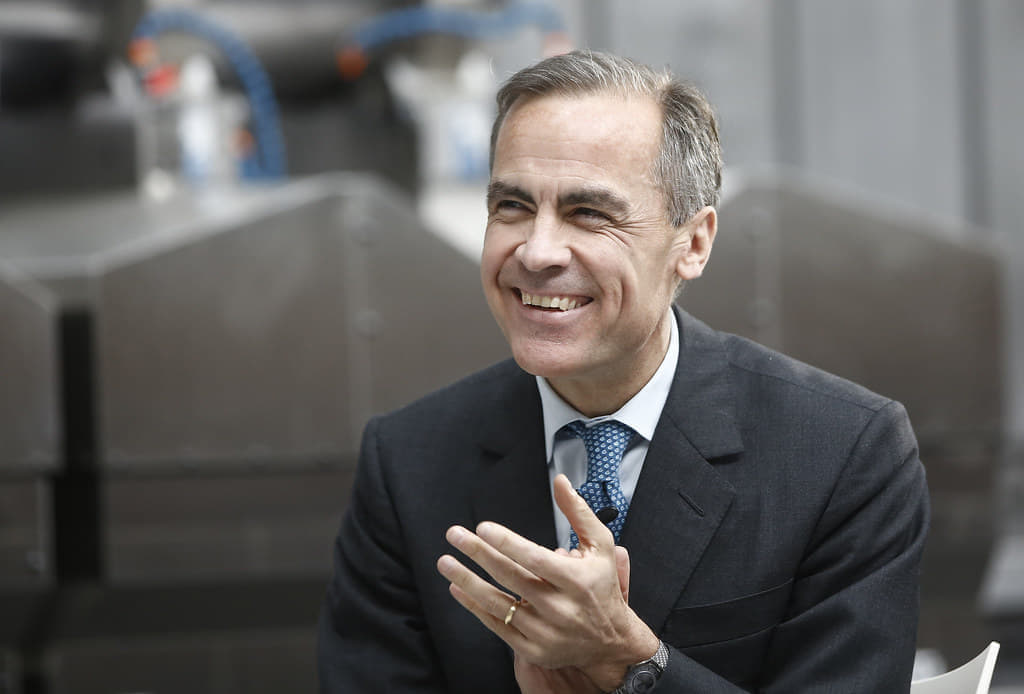
Mark Carney's embrace of Donald Trump's war on Iran marks a profound moral and intellectual collapse—all the more damning because it comes from a man who only weeks ago styled himself a truth-teller about the "lie" of the rules-based order he now dutifully serves. His decision to line up behind an openly illegal campaign of regime change, dressed up as non-proliferation policy, reveals not statesmanship but a calculated reconciliation with the very fiction he once decried. In endorsing airstrikes that have already killed civilians—including, according to Iranian state media, at least 80 people at a school in southern Iran, leaving a "pink backpack leaning on the rubble … splattered in blood" —Carney has traded whatever remained of his credibility for the fleeting comfort of alliance with power.
The Davos Diagnosis: Seeing through the Lie
At the World Economic Forum in Davos in January 2026, Carney delivered what some called the "most consequential" speech by a Canadian prime minister in nearly eighty years . With a candour unusual for such corporate liturgies, he admitted that "the story of the international rules-based order was partially false"—that the strongest exempted themselves, that trade rules were enforced asymmetrically, and that international law applied with varying rigour depending on the identity of the accused . He warned his peers in a remarkable phrase: "You cannot live within the lie of mutual benefit through integration when integration becomes the source of your subordination."
This was not mere rhetoric. Carney was describing a pathology he understood intimately: an order in which the strong claim legitimacy while reserving the right to violate its strictures whenever convenient. He spoke of "American hegemony" as a double-edged sword—underwriting open sea lanes and financial stability, yes, but at the price of an unspoken threat of force and the structural subordination of weaker states . The implication was clear: a leader who recognized this lie would at least refuse to perpetuate it, and might even resist its most violent expressions.
That promise now reads as a cruel joke. For when Donald Trump launched his "major combat operations in Iran"—a campaign experts immediately condemned as violating international law and lacking congressional authorization —Carney did not hesitate. He released a statement from Mumbai declaring that "Canada supports the United States acting to prevent Iran from obtaining a nuclear weapon." He recycled Washington's talking points verbatim, calling Iran the "principal source of instability and terror throughout the Middle East" and insisting it "must never be allowed to obtain or develop nuclear weapons." Nowhere in his statement was there any acknowledgment of the UN Charter's prohibition on the use of force. Nowhere was there a call for de-escalation—merely the ritual performance of allied endorsement that makes naked aggression look like policing.
Endorsing an Illegal War
The illegality of Trump's campaign is not a matter of partisan dispute. Ali Vaez, the Iran project director at the International Crisis Group, stated flatly: "This is a deliberate war that violates international law, and is also illegal under US law." President Trump had neither justified the operation before Congress nor offered a credible casus belli. The administration's own stated rationale shifted constantly—from eliminating a nuclear program the US had previously claimed was already "obliterated" in earlier strikes, to preventing Iran from someday restarting enrichment, to the openly declared goal of regime change .
Human Rights Watch documented that the Trump administration had systematically "rolled back legal oversight and mechanisms to mitigate harm to civilians" in the months preceding the attack, placing "fewer constraints on military operations." The 2026 US National Defense Strategy had even omitted "civilian harm mitigation as an explicit policy consideration." These were not accidental omissions but deliberate choices—signals that the administration intended to wage war unconstrained by law.
And yet Carney chose this moment to issue his endorsement. He could have aligned Canada with European voices urging restraint. The leaders of France, Germany and the United Kingdom had called for a return to negotiations . Spain's prime minister explicitly "rejects the unilateral military action of the United States and Israel." But Carney chose instead to isolate Canada from its traditional allies, positioning Ottawa as the most obedient and least critical partner in Trump's coalition.
The consequences of this war are already devastating. Beyond the school strike that killed scores of children, the conflict threatens to spiral into a "regional conflagration." Iran has prepared for this moment and is ready to "strike back massively and hard." The US military's own leadership warned Trump that attacking Iran risked "overtaxing the American military, depleting its reserve of air defence munitions, sucking America into another protracted conflict—and that it might not work." General Dan Caine, the chairman of the Joint Chiefs, was reportedly a "reluctant warrior" on Iran . But Carney, from the safety of a trade mission in India, felt no such reluctance.
Living within the Lie
Carney's Davos speech diagnosed a pathology with precision. He understood that the "rules-based order" was a fiction that enabled the strong to exempt themselves while demanding compliance from the weak. He recognized that international law was applied "with varying rigour depending on the identity of the accused or the victim." He warned that middle powers negotiating bilaterally with a hegemon would "negotiate from weakness," would "accept what's offered," would compete "to be the most accommodating"—that this was not sovereignty but "the performance of sovereignty while accepting subordination."
Trump's Iran campaign is a textbook instance of this pathology. The strikes violate international law, yet are justified in the language of non-proliferation. They aim to topple a government the US finds intolerable, yet are framed as defending "international peace and security." The nuclear rationale is a pretext—as Secretary of State Marco Rubio inadvertently revealed when he admitted that Iran might "return to enrichment one day," not that it currently possessed a weapon or an active programme . This is precisely the asymmetrical enforcement, the instrumentalization of legal rhetoric, the violence veiled by diplomatic language that Carney claimed to abhor.
To support such a campaign while still mouthing the vocabulary of "global peace and security" is to "live within the lie" he once urged others to reject. Wesley Wark, a senior fellow at the Centre for International Governance Innovation, called Carney's statement a "terrible mistake" and his "first significant foreign policy error," noting that Carney was "simply echoing talking points from the Trump administration." More damningly, Wark observed: "It seems we still struggle to unhook ourselves from thought and policy dependency on the United States, despite a brave speech in Davos."
This is the crux of the betrayal. Carney understood the dependency. He diagnosed it publicly, with a clarity rare among Western leaders. He proposed an alternative: that middle powers band together, negotiate collectively, refuse to compete to be "the most accommodating." But when the test came—when the hegemon demanded obedience, when the bombs began to fall—he reverted instantly to the oldest pattern in Canadian foreign policy: uncritical endorsement of American action, regardless of its legality or wisdom.
The Abdication of Moral and Intellectual Responsibility
What makes Carney's conduct so objectionable is not naïveté but lucid betrayal. He cannot plead ignorance of how "collective security" has been used to dress up wars of choice; he has publicly acknowledged that "the strongest would exempt themselves when convenient" and that this double standard was baked into the system from its inception . When he now presents Trump's strikes as necessary steps to prevent Iranian nuclear weapons, he is not correcting a misunderstanding. He is consciously reinforcing a narrative he has already identified as structurally dishonest.
There were alternatives. Carney could have used his Davos rhetoric as a mandate to push for a genuinely multilateral, law-anchored process that treated Iranian security concerns as something other than criminality. He could have echoed the International Crisis Group's warning that "a collapse of Iran as a state could trigger radicalization, new waves of refugees and instability, extending as far as Europe." He could have insisted, as Human Rights Watch did, that "all parties to the conflict are obligated to respect international humanitarian law" and that attacks on civilian infrastructure must be investigated . Instead, he offered a statement that reads as if drafted in Washington—complete with the designation of Iran as the singular source of Middle Eastern turmoil, as if the region's many armed actors, including those armed by the United States, bore no responsibility for its agonies.
The contrast between Carney's words at Davos and his actions in Mumbai could not be starker. At Davos, he warned that the old order was "not coming back" and that nostalgia was "not a strategy." In Mumbai, he embraced the most violent expression of that old order: the hegemon's prerogative to bomb at will, to claim legal cover it has not earned, to demand allied endorsement as tribute. At Davos, he insisted on "honesty about the world as it is." In Mumbai, he repeated fictions about non-proliferation that the war's own architects do not bother to maintain consistently.
The Bleakest Reading of the Present Moment
In endorsing Trump's war, Carney has confirmed the bleakest reading of our political moment: that even those who see through the lie of the order will, when summoned, still fly to its defence. The Davos speech now appears not as a declaration of independence but as a luxury—a rhetorical flourish permitted precisely because it would never be allowed to alter policy. Carney could afford to diagnose the pathology because he never intended to treat it.
This is not a regrettable misstep but a revealing act of complicity. It demonstrates that for all his talk of rupture and honesty, Carney remains captive to the very dependencies he diagnosed. When the choice was between aligning with European allies who urged restraint and endorsing an American war of choice, he chose America. When the choice was between the uncomfortable work of building a genuine multilateral alternative and the ease of repeating Washington's talking points, he chose ease. When the choice was between protecting civilians—including the eighty dead at that school in southern Iran—and protecting Canada's standing with a hegemon that has repeatedly threatened Canadian economic interests, he chose the hegemon .
The lie Carney identified at Davos was that the rules-based order offered mutual benefit when in fact it offered subordination. His endorsement of Trump's war proves that he is not merely a diagnostician of that lie but its willing instrument. He has chosen to live within the lie, to enforce it, to lend it his authority at the very moment when its costs are being paid in Iranian blood.
This is the measure of his collapse. A man who understood the system's injustices has become their apologist. A leader who promised honesty has delivered obfuscation. An intellectual who diagnosed the pathology has volunteered to carry its instruments. Mark Carney's support for Trump's war on Iran deserves to be named for what it is: not statesmanship, not prudence, not realism—but betrayal, plain and damning.