Is Elon Musk Creating an AI Deep State?
While all red-blooded Trump fans are cheering and jumping up and down over the devastation being wrought by Elon Musk’s DOGE, with shouts of “the Deep State is being destroyed,” or the “Swamp” is being drained—few seem to want to know why Musk is actually doing all this? Because he is a free speech absolutist? Because he is such a nice guy who cannot sleep at night thinking about John Q. Public who does not know how to buy food and pay rent at the same time? Because he is a selfless anthropologist whose sole, burning ambition in life is to put a chicken in every American’s pot, and gosh-darn it, make America great again?
Let us not try to answer these rhetorical questions and instead seek to understand what is going on. Why is it that Musk is emptying the American bureaucracy? Just to have a small government, which is a libertarian fantasy (hint: a small government first requires a solid—and common—moral base in the population, which is impossible at this late stage of Western civilization. But let us not digress.
Rather, it would seem that Musk is pursuing something else—he wants to create and establish an AI deep state, which will include the judiciary and most of government.
Tech Ambitions
It has long been known that Musk suffers from a spate of technological optimism. Back in 2022, he published an essay, entitled, “Believing in Technology for a Better Future.” It was published in China Cyberspace, the flagship magazine of the Cyberspace Administration of China (CAC). In it, Musk outlined his vision for technology and a new humanity, covering topics such as sustainability, the Tesla Bot, Neuralink's focus on medical rehabilitation, and SpaceX's ambitions for space exploration and interplanetary colonization.
In this essay, Musk explains his vision for the future of humanity.
First, technology will create a bright future for humanity, and it must be approached with urgency. The quicker we get technologizing humanity, the better, because for Musk technology is a "self-fulfilling prophecy," meaning that it is humanity’s true and final destiny
Second, Musk advocates for accelerating the transition to green energy, highlighting the need for solar and wind power, battery storage, and electric vehicles. He envisions a future where clean energy solutions mitigate "climate change," reduce water shortages, and improve environmental conditions globally.
Third, he predicts that AI and robotics will usher in an era of "extreme abundance," where goods and services are plentiful, potentially eliminating scarcity. Musk sees robots as essential to creating this abundance, enabling people to lead more fulfilling lives. In other words, AI will be fully integrated into human life. Musk predicts that AI will eventually surpass human intelligence, with biological intelligence accounting for less than 1 percent of total intelligence. Yes, just that small. He foresees a world where AI and robots provide all necessary goods and services, making traditional jobs optional and turning work into a hobby. He also emphasizes the potential for AI to bring universal high income and thus eliminate scarcity.
Fourth, through Neuralink, Musk aims to enhance human capabilities by merging biology with technology. He envisions applications in treating neurological disorders and advancing human intelligence to keep pace with AI (because AI will become far more intelligent than humanity).
Fifth, Musk underscores the importance of making humanity a multi-planetary species through SpaceX. He believes interstellar exploration is critical for the long-term survival of humanity and advancing "civilization" beyond Earth.
Sixth, Musk invites "like-minded" partners, particularly from China, to join efforts in advancing clean energy, AI, robotics, and space exploration. He recognizes the global nature of these challenges and opportunities
The publication of the essay in a Chinese state-run magazine was seen at the time as a significant endorsement of Musk's views by Chinese authorities.
This technological optimism is a recurring theme in Musk’s public statements and writings, where he envisions a future shaped by advancements in artificial intelligence (AI), robotics, clean energy, and space exploration. He believes that technology, when harnessed correctly, will lead to a future of abundance and prosperity. Technology is the only hope that humanity has, and he is here to help provide both to the people of the world.
Pulp Fiction Dreamworld
It is also well known that Musk derives all his ideas from pulp science fiction of the mid-twentieth century, the golden age of such fantastical dreams, from which emerged the iconic TV series Star Trek.
For example, his ambition to colonize Mars and make humanity a multi-planetary species echoes themes from classic science fiction works like Isaac Asimov's Foundation series and Robert A. Heinlein's The Moon is a Harsh Mistress. These novels depict humanity spreading across the cosmos, overcoming challenges, and establishing new "civilizations."
Musk's concerns about AI and his advocacy for its ethical development parallel themes in works like Philip K. Dick's Do Androids Dream of Electric Sheep? (the basis for Blade Runner), which explores the implications of advanced AI and robotics on society.
Musk's ventures, such as Neuralink (brain-computer interfaces) and The Boring Company (underground transportation), resonate with the speculative technologies found in pulp science fiction. For example, the concept of neural interfaces can be traced back to works like William Gibson's Neuromancer, which popularized the idea of cyberspace and human-machine integration.
And there is Iain M. Banks' Culture series, which inspired SpaceX's droneship names.
Musk has cited Asimov's Foundation series as a major influence on his thinking about humanity's future. The series explores the decline of a galactic empire and the use of "psychohistory" to minimize chaos during its fall. This aligns with Musk's urgency to make humanity a multi-planetary species, as he views space colonization as a way to ensure the survival of civilization in the face of potential existential threats.
Musk’s “philosophy” derives from Douglas Adams' The Hitchhiker's Guide to the Galaxy, a satirical novel, especially in regards to asking the right questions rather than just finding answers. This approach resonates with Musk's new AI company, xAI, which aims to understand the "true nature of the universe." Musk even referenced the book's famous "42" answer in xAI's launch date.
Then, there is Cyberpunk and Futuristic Aesthetics. His Neuralink project, focused on brain-computer interfaces, reflects themes from cyberpunk works like Deus Ex.
Such is Musk’s worldview—disruptive innovation and an optimistic futurism. In other words, humanity is best understood and managed by way of paradigms entirely derived from pulp science fiction. We are in the realm of a very adolescent dreamscape, in which all human problems are solved by technology. Just think of any Star Trek episode, and you will understand the mind of Musk. He forever dreams of a technological Utopia.
But as we also know, there is another genre of pulp science fiction—dystopia, where technology is only good at building a hell on earth. Musk’s luxury colonies on other planets are gilded prisons for those stupid enough to volunteer.
Musk also imagines that civilization is cyclical and everything will collapse soon, and that is why we all have to escape to other planets. Such an adolescent explanation is truly frightening, given that Musk will become the world’s first trillionaire, and he is also the unelected president of the United States. There is no moral center to the man—only an endless hall of mirrors populated by fictional fantasy, and a haphazard "philosophy."
From his essay, and from the sci-fi literature that animates his imagination, we have a near-trillionaire who has concluded that he knows how best to run the world, a world emblazoned by sci-fi heroics (Captain Kirk)—all housed in a technocratic society, i.e., a humanity dominated by technology. And now he has been handed the United States of America to give it all a go.
Meet Optimus
Optimus is a humanoid robot developed by Tesla, first announced in 2021.It is designed to perform menial and dangerous tasks—and address labor shortages and improve workplace safety. Standing at 5'8" and weighing 125 pounds, it can deadlift more than its body weight and carry 45 pounds at 5 mph. Its physical limitations, such as speed and strength, are intentionally designed to ensure safety and reduce public fears of evil robots, The word optimus in Latin means "the best." Better than human?
Optimus utilizes Tesla’s Autopilot software, powered by a neural network fed by eight cameras. While its capabilities have evolved significantly since its debut—showing improvements in walking, balancing, and performing tasks like watering plants and lifting objects—it is still in development. Musk has projected that Optimus could outnumber humans in the future, with plans to deploy it in Tesla factories and eventually sell it to the public. Limited production is expected to begin this year (2025).
Musk thinks that Optimus will become Tesla’s most profitable product, with a projected market cap of $25 trillion.
Musk has been actively pursuing the replacement of human workers with robots and AI, particularly in government and industrial sectors. Through his Department of Government Efficiency (DOGE), Musk aims to cut the federal workforce by at least 10 percent, with over 40,000 employees already accepting resignation offers. The goal is to automate as much as possible, with agencies potentially being reduced by up to 60 percent.
Who will program and run the AI—and the many Optimi—which will constitute the new government bureaucracy?
The point of DOGE is to eliminate the need for human jobs altogether, leading to a future of "universal high income" where work becomes optional. Such is the Utopia that we should all aspire to, according to Musk. Why work when you can receive a fixed income from the AI government—all you have to do is just “enjoy” your life. What can possibly go wrong?
For various reasons, Americans have decided that it is a brilliant idea to hand over their country to Musk so he can try out all his cockamamie schemes, in which the United States of America will become the AI guinea pig. Once successful, the “model” can be imposed upon the entire world, and then “exported” to other planets and galaxies.
Musk is not “destroying” the deep state and replacing it with nothing. Governments hate a vacuum. From all that he has said, what we are witnessing is the “great replacement” of humanity from the workspace. That is the real purpose of DOGE. It is the old Malthusian dream—the less humanity the better.
After all, Optimi make for a far better form of “people”—humanoids that have zero needs. The ideal “outcome” of any good Utopia.
AI Judiciary
Trump-world also loves to hate judges and the judiciary, and there are calls to get rid of federal courts. But why is such focused hatred cultivated and promoted?
Musk has proposed the concept of an "AI judiciary" as part of his broader vision for artificial intelligence governance. This idea involves using AI systems to assist or potentially replace certain judicial functions, aiming to reduce human bias and increase efficiency in legal processes.
Just so people do not panic, Musk has thrown in the “need” for AI to be developed with strong ethical guidelines and oversight, particularly in sensitive areas like law enforcement and justice. But should we even mention algorithmic bias, and who will be considered good enough to provide "ethical guidelines and oversight?" The DOGE team that is now busy all and sundry?
Government For, By and Of the Optimi
Musk's first priority is to integrate AI into U.S. government operations. As head of DOGE, Musk has implemented sweeping changes, including mass layoffs of federal employees and the use of AI systems to streamline government processes. Humans are fired because algorithms pick who mush be fired.
As we know already, DOGE has dismissed tens of thousands of federal workers, requiring remaining employees to submit weekly accomplishments that are reviewed by AI systems to determine retention. Musk will eventually replace most government functions with AI tools.
DOGE has introduced AI chatbots to assist federal employees with tasks like drafting emails and summarizing documents. The State Department plans to use AI for monitoring social media accounts of foreign nationals suspected of supporting terrorism (aka, criticizing Trump or Israel), hence the recent arrests and deportations.
Musk is doing this because he wants faster and smarter government operations through AI.
As with most such Utopias, there is little clarity on how AI systems are trained or operate within federal agencies. This lack of oversight raises questions about fairness and reliability.
In other words, AI does not need accountability, because it is owned by private tech leaders who know what is good for you—because their machines are much, much smarter than you. A man who is a billionaire also is a moral superman, to make you behave. After all, how else could he have made his money?
AI Big Brother
The US Department of State is using AI to monitor social media, as part of its broader initiative to combat “disinformation” and enhance public diplomacy efforts. Bottom line, you better not say anything bad about Trump or Israel.
AI tools will process up to a million articles daily from international sources, spanning hundreds of countries and over 100 languages. These tools will rapidly translate, synthesize, and present insights into global media landscapes, including social media content. It will be known who says what.
AI systems are being leveraged to provide real-time insights into information environments. This includes analyzing social media posts to improve situational awareness and support public diplomacy abroad. In other words, AI will be the new, and universal, censor
The official explanation is that this AI-driven approach aims to counter “foreign” adversaries' manipulation of “information” by identifying and addressing disinformation campaigns on social platforms. Because of AI, people are already being caught at the border because they criticized Trump on social media, or supported the Palestinians.
The key to AI governance is to make sure that you behave the way you are told to behave. Or else!
Tech-tyranny, here we come! But fear not. Big Brother Musk will look after us all, for he is the universal benefactor.
$1.4 Trillion
Given Musk’s power, financial and now political, eager-beaver investors are already lining up to get a piece of the action. On March 21, 2025, Sheikh Tahnoon bin Zayed, National Security Adviser of the United Arab Emirates came to the White House and met Trump. The Sheikh brought a cheque for $1.4 trillion, the largest investment ever, in the history of the United States (a factoid which Trump will love repeating henceforth)—most of this unimaginable money will be going into Musk’s company, xAI.
So, is Musk creating an AI deep state? Yes, and a lot, lot more. The plan is to sideline humanity completely, by making it needless, that is, use-less. Why have humans when you can have Optimi? Robots make better humans.
But look at the bright side. You will have no work—and you will be happy!
There is a more than a whiff of sulphur to all this. A billowing breath from Hell.
Meanwhile, the Trumpites are too busy clapping and cheering and going on about the evil globalists and their deep state, the vile Democrats, George Soros, etc., etc., etc.
“Beam me up, Scotty!”
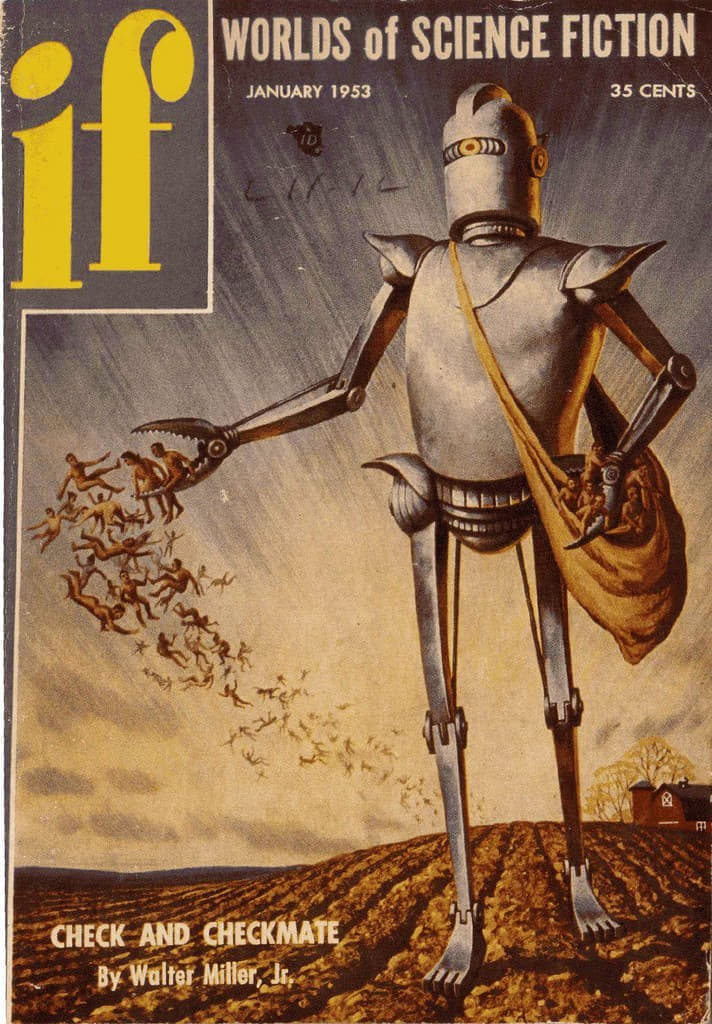
Featured: Cover, If (January 1953).