My Windmill as Aletheia
The latest internationally renowned European philosopher is the Korean-German Byung-Chul Han, whom I have obviously been hearing about for a few years now, given my profession.
About three or four years ago, I got some of his works in PDF format, which, as is often the case with computer files, I skimmed through. But recently, a bookseller friend gave me two of his books: The Scent of Time and In Praise for the Earth. The first is more of the same as the others I have: The Burnout Society; The Palliative Society and What is Power? They are books by a philosophy professor for professors, but with the exception of being written without Western prejudice, quoting everyone from Habermas to Carl Schmitt, from Derrida to Baudrillard. Han lacks the politically correct prejudice of quoting only progressive authors. The marked influence of Heidegger, whom Han quotes ad nauseam, is evident.
Han's writing is a succession of short sentences in the style of Nietzsche. He is sententious and witty. There is no professorial exposition with linked arguments. It makes for entertaining and light reading, meaning that you can move from one chapter to the next without any surprises.
But something very different happens with In Praise for the Earth, an unusual work of philosophy, in which the philosopher is existentially involved with what he says. And for the benefit of readers, the great Barcelona publishing house Herder added beautiful drawings of the flowers discussed in the text (for the Spanish edition).
It is a book in which Han recounts, down to the smallest details, his relationship with flowers and his garden. When he did not have a garden, he would go to the cemetery in Berlin to enjoy the flowers. The meticulous description, le petit nuance, is evident on every page. Obviously, the book is also full of authors, who appear in order of appearance: Barthes, Kant, Scheler, Hölderlin, Hegel, Novalis, Goethe, Benn, Nietzsche, Heidegger, Benjamin, Moustaki, D'Annunzio, Baudrillard, Rilke; and despite all of them, an uncommon wisdom about the relationship with the earth and time weaves through the pages.
Curiously, Han does not shy away from mentioning that he is Catholic and prayed daily: “In Korea, I was baptized in the church with the name Alberto [and, he had to be my namesake!]. The Catholic church was right next to my house. I was born into the faith and sheltered by it. I prayed the rosary every day.”
All this to say that Byung's book inspired me to write about something I have been putting off for years—my windmill.
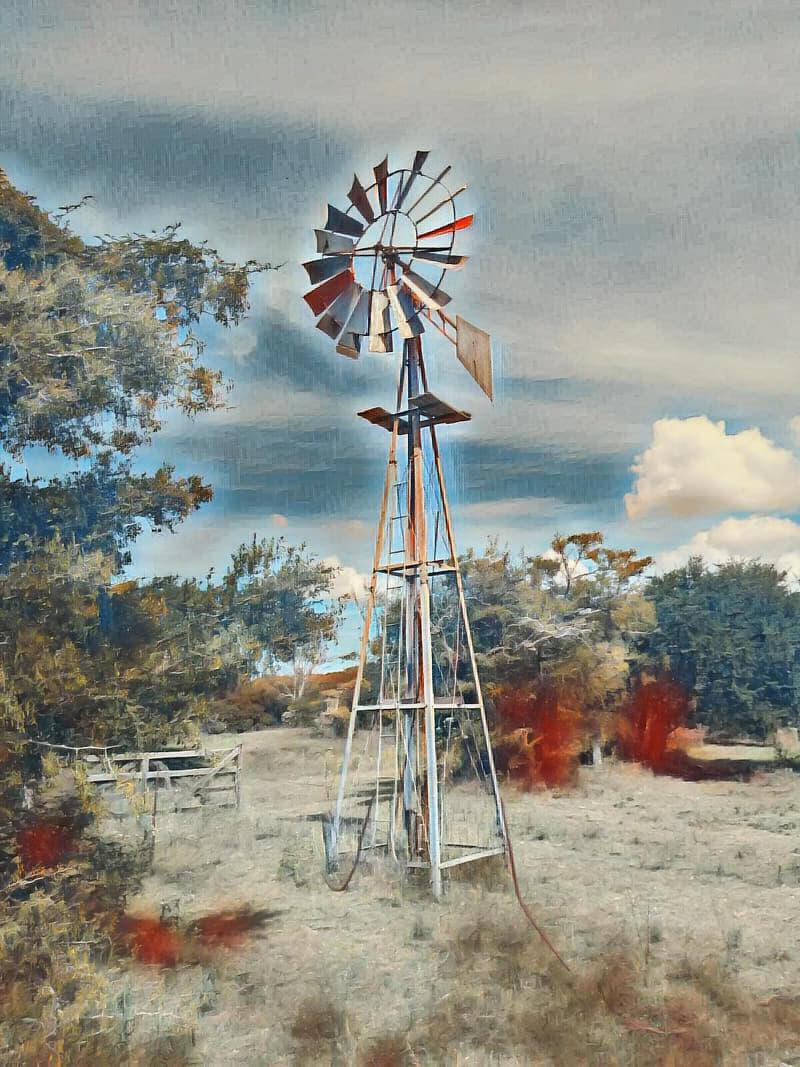
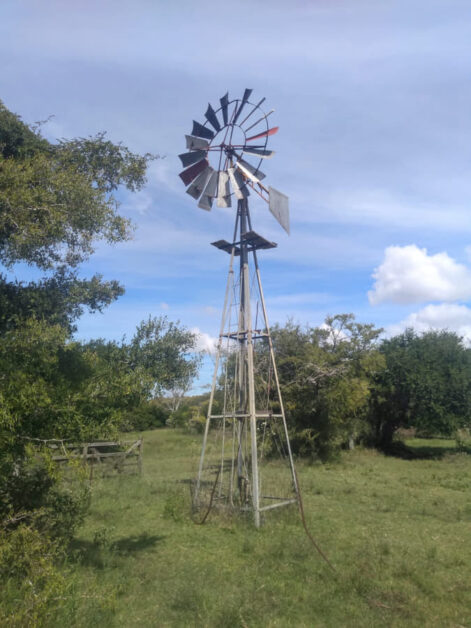
It's old, one of the oldest because it's a “doll” model, meaning one of the first ones that move like a doll's am, up and down. It has sixteen large blades, four per quadrant, and a bronze cylinder that bulges in the middle from use. Every day I have to go and prime it because it usually rests at night. I often find myself watching it as it turns slowly, releasing its stream of water.
The turning of its wheel reminds me of the cyclical nature of time in Greek culture. The circularity of the heavens. The passing of days and seasons. There is also a non-Greek way of drawing water in the countryside, which is when a bucket tied to a rope is pulled from a cistern with a donkey or an old mare. Observing the mill makes me think, because it does not rush me, nor does it show any haste. “What happened, why were you at the mill for so long?” my wife asks. “Nothing, I was thinking,” I reply.
It's true, the windmill is a device, a product of technology, but it doesn't alienate me; on the contrary, it makes me think. I think about the inventor. Who could it have been? How long ago was it? And above all, I think about how it blends into the landscape. It's not something strange, but natural. But is it a device? It is a product of man and not of nature, so what is natural about it? If there is wind, it works; if not, it rests. As with plants, the sun and rain do not bother it. It is a giant compass that guides us to where the rain will come from. In the plains of the great pastures of the pampas, it serves as our guide.
As for its main function, it reveals, lifts the veil, uncovers the water hidden in the bowels of the earth that quenches our thirst, as well as that of animals and plants. The entire animal and plant kingdoms are grateful to it. Speaking Heideggerian, it fulfills the function of aletheia, of truth, which is nothing other than the unveiling of the being of things. As old Balmes said, truth is the reality of things, or as Perón said, the only truth is reality (like Byung, I have no prejudices).
We see how the mill puts truth into action; that is, it is a work of art that brings out the truth of water.
From my room, I watch it every day, and it always signals to me with its monotonous wheel. Depending on its speed, it tells me whether it is pumping water or dry. In the latter case, I have to go and visit it, to prime it.
A certain feeling of sadness comes from a mill that has stopped. A sleeping giant that is at the end of its life.
Like the Oracle of Delphi, who spoke only to indicate, the mill, in its constant turning, tells me that we must think and rethink issues and matters, but not as a riddle that keeps us stuck in the same place, but rather festina lente, in a hurry with caution. Publish on a topic or issue without delay (that's what the Internet is for) and wait for criticism or suggestions (intersubjective verification) to rewrite the work and thus improve it and get closer to the truth of the matter. As Aristotle teaches in his Metaphysics, speaking of truth: “Although each individual contributes little or nothing to it, taken together they produce a certain magnitude” (993 b 4).
Now it's broken because it lost a blade, and it's calling me to fix it, but since I can't climb up, I have to wait for someone younger and more handsome to climb up and replace it. Not everyone is willing to do it; the miller's trade is dying out. Electric pumps have marginalized it.
Sometimes I think it's just an old man's ramblings, but the wind is also old, yet it still blows, and this is my hope—someone will come along who will keep it running, since its strength does not depend on itself but on the wind.
Mill and wind is a προσ τι, a relationship, the least substantial category of all, because what is the essence of a relationship? The intimate connection between two entities, like the pencil is related to the notebook.
Wind and mill, mill and wind show us three of the quaternities Heidegger speaks of: sky, earth, men, and gods. Only the gods are missing. Since there are no gods but God, King and Lord of all creation, the mill leads me to think of the One who can do all things and knows all things.
Applying the festina lente, I am obliged and pleased to incorporate the meditation of a great Argentine thinker, Luis María Bandieri, when he tells us: "The Guanaco mill, incorporated into the landscape like a stake firmly planted in the pampa. In whose large trough one could take a dip in the summer. With its monotonous wind music, adapted to the sweet breath of life. The current energy-producing windmills, on the other hand, mar the fields where they stand, with their titanic arms reaching out to dislodge the guardian gods." Beautiful and profound!