Mystery Bouffe And The Start Of Soviet Censorship
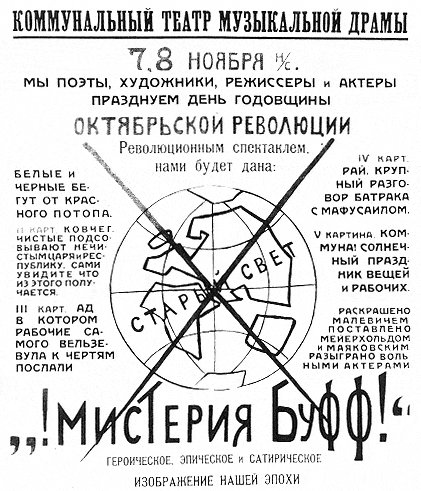
Despite being a revolutionary and futuristic masterpiece by Mayakovsky, Meyerhold and Malevich, Mystery Bouffe was the first victim of Soviet censorship.
On a warm
day one hundred years ago a small group of friends heard the first-ever play by
a Soviet dramatist. Poet Vladimir Mayakovsky was reading Mystery Bouffe
to a group that included the Commissar of Enlightenment, Anatoly Lunacharsky,
and the famous theater director, Vsevolod Meyerhold.
The play
was an aggressive piece of Bolshevik propaganda, opening at the Petrograd
Conservatoire in 1918 for three performances, with stage decorations and
costumes designed by Kazimir Malevich. This first piece of Soviet theater
seemed to be pure brilliance, with three giant radical artists celebrating
the Revolution's first anniversary. But it didn’t turn out well.
The creative process was all but sabotaged, and the audiences indifferent.
Lenin called it “hooligan communism.” But why such hostility to a
show that seemed so in line with the times?
Things started ominously. A few days after the October Revolution,
Lunacharsky as the Commissar of Enlightenment convened a meeting to discuss
revolutionary approaches to art in the new era. Hundreds of artists were
invited, but only five showed up, among which were Mayakovsky and Meyerhold.
Why such a low turn out? These were still deeply uncertain times, and even
though all theaters were under Lunacharsky’s control, many artists were not
sure about throwing their lot in with the Bolsheviks. But these five did.
Meyerhold’s biographer, Edward Braun, called this “a hazardous act of faith.”

Mystery Bouffe is by any standards a strange play, written in
Mayakovsky’s trademark energetic and tumbling verse. The story is the Biblical
parable of Noah’s ark transplanted into the industrial age. The flood is the
Revolution, cleansing the world of the bourgeoisie. The ‘new common man’ leads
the proletariat to a mechanized paradise, where tools and even food obey
humans.
The play’s cast was huge, with over 70 characters acting in a declaratory
and rhetorical style. The conservative Actor’s Union labeled
it “futuristic,” which according to Mayakovsky’s biographers Ann and
Samuel Charters, is the “word they gave to everything they didn’t understand.”
We are certainly very far away from the living rooms of Chekhov, Mayakovsky
says as much in the Prologue. Other
theater gives you:
“Uncle Vanya
And Auntie Manya
Parked on a sofa as they chatter
But we don’t care
About uncles or aunts:
you can find them at home - or anywhere!”
He did not want the play to imitate observable reality. This was also
Malevich’s approach to the design, as he said: “I saw my task not as the
creation of associations with the reality existing beyond the stage, but as the
creation of a new reality.”
The play opened with actors coming onstage and ripping up posters of popular
performances of that time. It was a declaration of war on Imperial-era theater.
The Petrograd Conservatoire was less than cooperative, and they refused to
sell copies of the script. The doors to rehearsal rooms were boarded shut.
Nails for the set were kept under lock and key. Actors were very suspicious of
the project, and most refused to be involved. An advertisement was put in the
paper: “Comrades! It is your duty to celebrate the great day of the
Revolution with a revolutionary show.” In the end
they had to use students, and Mayakovsky had to play several key roles himself.
Tellingly, most critics did not think the play worthy to be reviewed. Later,
however, theater director Vladimir Solovyov wrote that,
“it didn't get across to the audience. The witty satirical passages…[were
greeted] with stony silence.”
An outdoor performance was canceled, and the Futurists were banned from
participating in forthcoming May Day celebrations. Bolsheviks worried that this
style would put off the proletariat.
In retrospect, the experience suffered by this show anticipated the
subsequent careers of Mayakovsky, Malevich and
Meyerhold. Within 12 years of Mystery Bouffe
they'd all be dead, and not from old age. Mayakovsky’s suicide in 1930 was no
doubt largely due to mental health issues and his complicated relationship with
Lilya Brick. But his constant struggles with the authorities had a huge impact
on his inability to live and create.
Malevich’s artwork was banned and confiscated for being abstract and
“bourgeois,” and he was imprisoned in 1930 where he developed cancer. He
dabbled in figurative art in the early 1930s, but then died in 1935.
Meyerhold
suffered the most: his performances were banned, his theater was closed, he was
tortured, murdered and rewritten out of history. What began with the locked
rehearsal rooms of 1918, ended in the inner chamber of Lubyanka prison in 1940.
Indeed, the optimism of the Revolution gave way to paranoia, censorship and murder in the 1930s. This is mostly attributed to Stalin’s personality and his insistence on promoting the stifling official ideology of Soviet Realism. This certainly played a huge role, but perhaps the truth is more subversive. The immediate reaction to Mystery Bouffe in 1918 was not unlike later arguments against the Avant-garde art in the purges; that it would not be immediately accessible to the common man and was therefore on the side of the bourgeoisie.
As Lunacharsky said of Mystery Bouffe, it was “incomprehensible to the new world.” The history of the play shows that Bolshevism and art had a troubled relationship from the very beginning. Even when they seemed to be toeing the ideological line, these artists were too independent and radical even in the supposedly experimental and revolutionary atmosphere of a hundred years ago.
Courtesy of Russia Beyond.
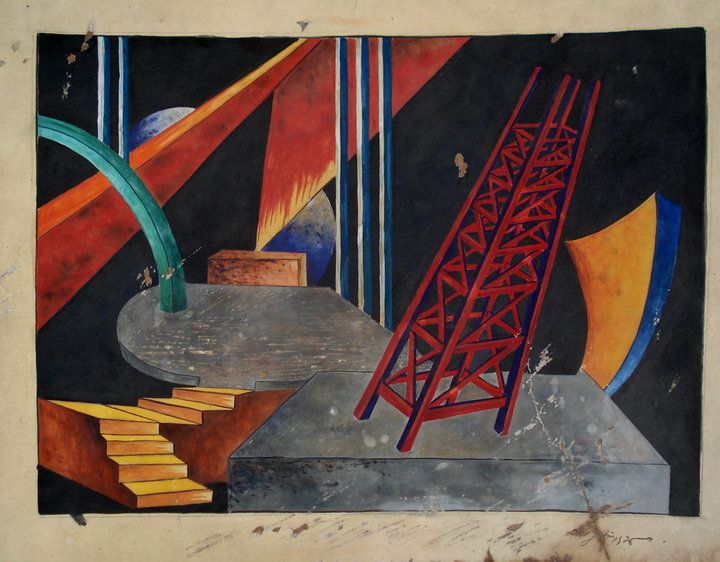
The photo shows a sketch for Mayakovsky's Mystery-Bouffe at the Rustaveli Theatre, 1924, by Irakli Gamrekeli.