Notre-Dame de Senlis
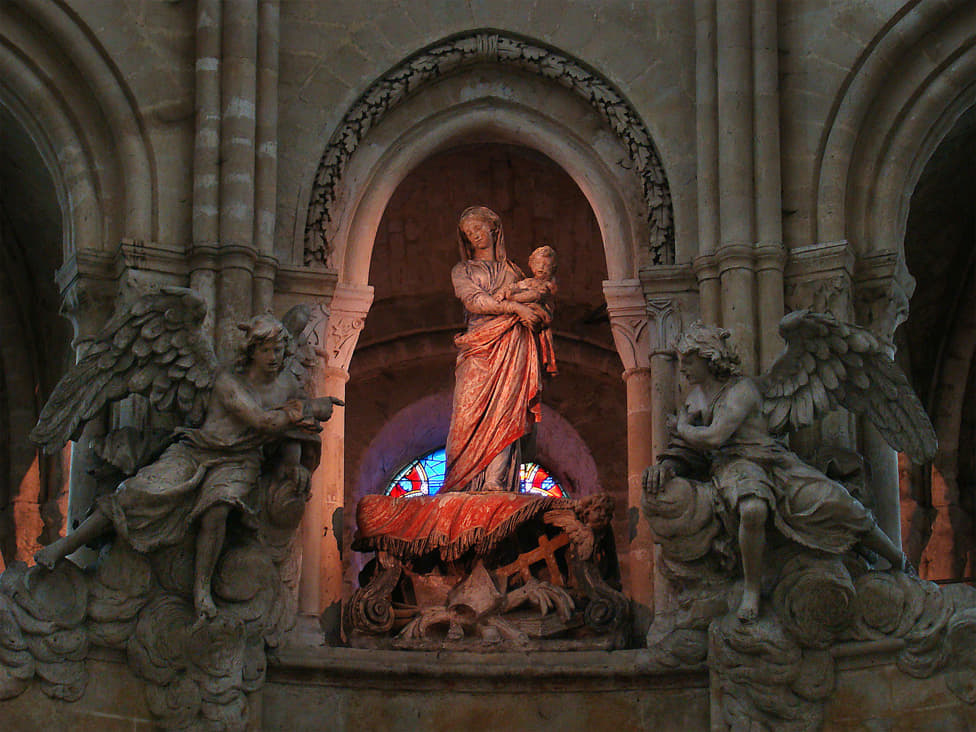
In the heart of the Oise region, nestled against the remnants of an ancient Gallo-Roman wall and in the shadow of a royal castle, stands the Cathédrale Notre-Dame de Senlis. Often overshadowed by its more colossal Gothic counterparts in Paris, Amiens, and Beauvais, this relatively modest cathedral is, in its own right, a monument of immense historical and artistic significance. Its construction, spanning from the 12th to the 16th centuries, chronicles the evolution of Gothic architecture itself, while its deep connections to the French monarchy and its pioneering artistic innovations cement its place as a crucial landmark in French history.
The Genesis of a Gothic Masterpiece
The history of Notre-Dame de Senlis is deeply intertwined with the history of the city itself. The first religious structure on the site is believed to date back to the late 4th or early 5th century, built within the city's Roman defensive perimeter. This early cathedral, serving as the seat of a bishop, was part of a larger episcopal group that included a cloister, baptistery, and the bishop's palace. The presence of these structures points to Senlis's importance as an early center of Christian authority in the region.
However, it was during the 12th century, a period considered a "golden age" for Senlis, that the foundations for the present cathedral were laid. The close proximity of the Capetian kings, who had a royal palace in Senlis, and the strong personality of Bishop Pierre (who served from 1134 to 1151), were the primary catalysts for the grand project. Construction began around 1151 on the site of older sanctuaries. Unlike the construction of many great cathedrals, the funding for Notre-Dame de Senlis came primarily from the efforts of the bishops themselves. The diocese of Senlis was one of the smallest in the kingdom, with modest revenues, and the contributions of the king and the canons were minimal. This financial constraint explains the relatively modest scale of the sanctuary, a defining characteristic that sets it apart from the soaring giants of French Gothic.
Remarkably, construction began simultaneously at both the eastern and western ends. By 1160, the central portal of the western façade was complete, and by 1167, both the choir and the western façade were finished. The nave was connected to the choir in 1175, and the vaulted structure was nearly complete by around 1180. On June 16, 1191, the cathedral was consecrated by Guillaume aux Blanches Mains, the Archbishop of Reims, marking the culmination of roughly forty years of dedicated effort.
A Pioneering Artistic Vision: The Portal of the Virgin
The crowning artistic achievement of the 12th-century construction is undoubtedly the western portal, constructed between 1165 and 1170. It is renowned for being the first monumental portal in France to feature the theme of the Coronation of the Virgin. In the central tympanum, Mary is depicted crowned and enthroned alongside Christ, a powerful theological statement on her status as Queen of Heaven. This scene, flanked by the Dormition and Assumption of the Virgin, would go on to become one of the most popular subjects for Gothic cathedral portals across France. Until 2018, restoration work revealed that this portal is the only one in France to have retained such a significant amount of its original 12th-century polychromy, making it an invaluable treasure of medieval art. Its presence made Notre-Dame de Senlis a “royal” cathedral in a spiritual sense, establishing a new artistic paradigm for the veneration of the Blessed Virgin Mary.
Centuries of Transformation: The Evolution of Styles
The history of Notre-Dame de Senlis is not one of static perfection but of continuous adaptation. The mid-13th century brought significant alterations. Around 1240, the cathedral was endowed with a new, soaring spire on its southern tower. At 78 meters, this two-storey spire was one of the tallest in France and is now one of the rare, complete 13th-century steeples still standing. This addition marked a shift toward the more delicate Rayonnant Gothic style. It was also during this period that a transept was built, a feature that further altered the original design and left the nave shorter than the choir, an unusual feature for a Gothic cathedral.
The 16th century brought the most profound transformation. In June 1504, a lightning strike sparked a devastating fire that ravaged the cathedral for two days. The timber framework was destroyed, the vaults collapsed, and two-thirds of the nave had to be rebuilt. This catastrophe, however, became an opportunity for renewal. Architects Gilles Hazart and the renowned Martin Chambiges were commissioned to rebuild, bringing the cathedral in line with the latest Flamboyant Gothic style. The nave was raised by nearly six meters, the aisles were doubled, and the side facades were adorned with exuberant Flamboyant decoration. The transept, rebuilt entirely by Chambiges and his son Pierre from 1530 onwards, is considered a masterpiece of the late Gothic, featuring magnificent large rose windows and intricate pendentive keystones. This phase highlighted the increasingly politicized nature of ecclesiastical architecture, with kings Louis XII and Francis I providing crucial financial support, and their imagery and emblems were incorporated into the cathedral's new design.
From Revolution to Restoration
The French Revolution was a period of profound upheaval for Notre-Dame de Senlis. In 1793, the cathedral was vandalized; the heads of the statues on the western portal were destroyed, and the building's furniture, including the choir stalls and screens, was sold off. The episcopal seat was abolished in 1801 under the Concordat, and ownership of the building was transferred to the city of Senlis, where it serves as a parish church to this day. The cathedral's importance was recognized in the first list of French historical monuments in 1840. In the 19th and 20th centuries, significant restoration campaigns were undertaken, culminating in the completion of the interior restoration in 1986 and the spire's restoration in 1993. A major project to restore the 12th-century portal and protect its ancient colors was launched in the 21st century, ensuring its preservation for future generations.
Conclusion
The Cathédrale Notre-Dame de Senlis is far more than a smaller version of its more famous Gothic cousins. It is a richly layered historical document, a "bible in stone" that encapsulates the artistic, religious, and political currents of French history. From its pioneering 12th-century portal to its resilient 16th-century reconstruction, the cathedral bears the marks of its time. It is a testament to the enduring faith of a small diocese, the close relationship between the French crown and the Church, and the tireless dedication of architects and artisans over centuries. As a rare example of a cathedral that includes elements of early, Rayonnant, and Flamboyant Gothic styles, Notre-Dame de Senlis offers an unparalleled lesson in the evolution of Gothic architecture. It stands proudly in its historic city, a quiet but potent symbol of France's enduring cultural and spiritual heritage.