Pre-Democracy
There was an election in March for governor of Chiba Prefecture. It wasn’t much of a contest. The incumbent, Kumagai Toshihito, won with more than eighty-five percent of the vote.
There was one interesting thing about the election, though: who didn’t win. The other three candidates were Ogura Masayuki, Tachibana Takashi, and Kurokawa Atsuhiko. Ogura ran on the Japan Communist Party (JCP) ticket. The JCP, readers may recall from their history books, was an illegal party during the war. The American Occupation released JCP members from the jails en masse to act as agents provocateurs, applying pressure to Japanese politicians and thereby strengthening the hand of GHQ. The JCP was reasonably influential for several decades into the postwar, but their influence waned as younger people with no memory of wartime or Occupation politics began to vote. Today, the JCP is rumored to be in dire trouble financially, as its supporters are overwhelmingly elderly people who continue to think of politics in terms of Communists versus the military. In a humorous irony, young people in Japan today tend to think that the JCP is a conservative party, because, as one young person put it recently, “They have been saying the same thing since forever.” Ogura’s presence in the Chiba election was anachronistic, a relic from a bygone era.
Tachibana Takashi is the leader of a party called NHK Kara Kokumin O Mamoru To. I have to admit, I like Tachibana’s style. He’s a troublemaker extraordinaire. The name of his party means, “The Protect the People from NHK Party.” Their slogan is “NHK wo bukkowassss!” which means, “Demolish NHK!” NHK is the state-run television and radio network in Japan. It was an enthusiastic accomplice to the Americans during the Occupation. It has a reputation, one it has worked hard to earn and which it richly deserves, of being an establishment mouthpiece. It is a shameless fountainhead of fake news. It is also a shakedown organization. Everyone who lives in Japan and who has a television set is expected to pay annual fees to NHK. Many people resent having to pay for propaganda. Tachibana is the voice of popular reason against the crowd of liberal elites and their “democracy.” Tachibana and his anti-NHK party are still in the minority, but they make a good showing in elections. Tachibana got nearly 5% of the vote in the Chiba gubernatorial election, not at all bad for a fringe candidate whose only real policy is poking the lying political class in the eye.
Standing up to the liberal elites is dangerous business, of course. On March 14, 2025, Tachibana was attacked in the streets of Tokyo by a man wielding a kind of pruning knife. Tachibana had jumped in the middle of a contentious election in Hyogo prefecture, where the mainstream media, including NHK, had tried toppling the populist governor, Saito Motohiko, with a flood of fake news. Tachibana exposed the media and political corruption behind the prefectural coup d’etat. There was a lot more to the story than the corrupt media had been reporting. Tachibana did a real public service by dragging the truth about politics and the media into the light. The media, of course, responded with more fake news, portraying Tachibana as a monster. Those who still watch and believe NHK are already mentally fragile. One such person decided to act on the fake news by taking a blade to one of Tachibana’s speeches. Democracy is always murder in the end.
The third defeated candidate, Kurokawa Atsuhiko, dyes his hair a fiery red. He is with the Tsubasa no To, which is even more confrontational and contentious than Tachibana’s crew. Tsubasa no To adopt the position that democracy in Japan is a sham and requires heavy-duty smelling salts, in the form of rough political theater, to expose. They show up at other candidates’ rallies and heckle and taunt. The police get called. There are scuffles in the crowd. Tsubasa no To’s offices have been raided by prosecutors. The party is roundly condemned by commentators and politicians across the political spectrum as “antithetical to democracy” and “hostile to free speech.” Kurokawa didn’t even get one percent of the vote in the Chiba election, a mere eleven thousand or so compared to the 1.4 million votes the incumbent, Kumagai, received. But of all the candidates running, I think Kurokawa, the saboteur, was by far the most important. Democracy in Japan is a sham. Japan is controlled by the Nichibei Godo Iinkai, a Joint Japan-US Commission at which Japan’s Washington overlords give out orders for the Nagatacho bureaucrats to implement. Politicians are Washington’s playthings, subservient also to Blackrock and Big Pharma. Many regular people know it, and their number is growing daily. People may not vote in droves for Tsubasa no To, but Tsubasa no To is, I think, the most necessary political party in Japan in eighty years.
Calling out the farce of democracy has become an increasingly popular pastime in Japan. In 2024 there was an election for governor of Tokyo. The two main candidates were Koike Yuriko, the incumbent, and Ren Ho, a former member of the Japanese Diet. Koike, a professional pol who runs Tokyo the way all big cities are run, that is, corruptly, won handily. But, as with the Chiba election, the real story was with who didn’t win.
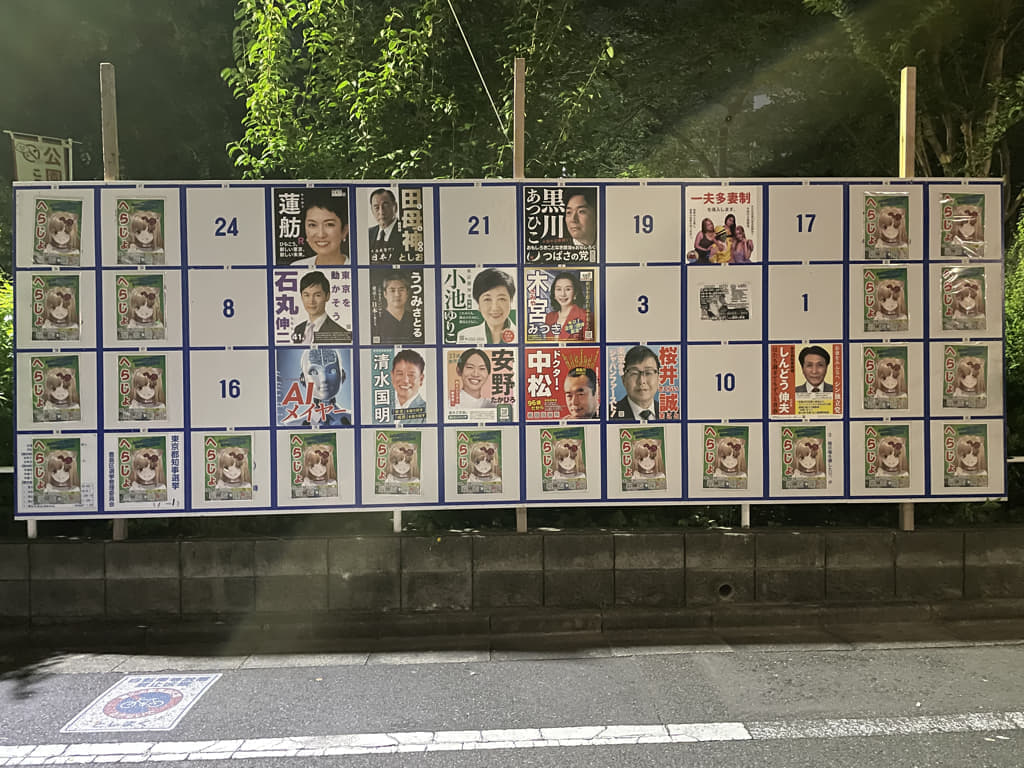
In Japan, special billboards are set up at predetermined locations prior to an election. The billboards, which stand at about eye level, are wooden, painted white on one side, and separated into numbered rectangles. Candidates for the election draw lots to get assigned a number, which designates the numbered rectangle where each candidate may place his or her poster on the board. Because these billboards are put up all around every district where an election will be held, they are seen by just about everyone who walks or drives in that area. In the case of the Tokyo gubernatorial election in 2024, apart from Koike and Ren Ho there were just a handful of candidates who were interested in either winning the election or advancing a particular political platform. Most of the rest of the candidates–there were fifty-six of them–used the election as a pretense to put up PR posters on the white billboards. Some of the posters had buxom images of fetching young women. Some were photos of pets. Some were crayon drawings by the “candidate’s” grandkids. It all devolved into a campy send-up of a political race. It was, to be honest, the most fun and enlightening election I have ever witnessed. I loved every minute of it.
Commentators in Japan predictably wrung their hands over this hacking of the political process. Democracy is in peril, many cried. How dare people not take seriously their sacred obligations to participate in the democratic process? But I was heartened to see the election’s nose being twisted. Democracy is a joke in Japan, it is true. Politicians work for Washington and Wall St. What is alive and well here is pre-democracy. Discovering that gave me courage and hope. Pre-democracy, not democracy, is where the health of any society is found.
It probably won’t do much good to look up “pre-democracy,” because I made it up for this essay. What I mean by “pre-democracy” is the social sensibility that does almost all the political work before an election is ever held or even conceived of. Democratic countries boast of having rule of law, of being a place where majority rule decides and minority rights are respected. But this is democracy’s greatest farce, even in places like Japan and America where democracy is a code for systemic political corruption. Democracy is parasitic on the social order, it does not create or cultivate or curate social order in any way. When Japanese voters turned the 2024 Tokyo gubernatorial election into a mockery of the political system, they were making a clarion statement about the moral standards they themselves hold dear. Pre-democracy, the unwritten and often unspoken rules and traditions that keep society humming, is how we humans really govern ourselves.
Our elected leaders, many of us know, are criminals, members of a gang that can steal money from us legally and put us in prisons that we pay for if we refuse. Those leaders can send us to die for Ukraine and other globalist slaughterhouses while they themselves rake in contributions from the very companies making the artillery shells that we are forced to use to kill strangers. In Japan the leaders can’t do this just yet, but they are trying mightily to start. Regular people know it is wrong to steal, wrong to kill, wrong to tell lies. Politicians make a career out of these things. Democracy is the general insult that we, the regular people, have chosen and sanctioned all of this criminality and these criminals. Pre-democracy is the horse sense that regular people have that tells them that the whole arrangement ought to be blown to smithereens.
Speaking of corrupt politicians, another backstory to the 2024 Tokyo election was the ongoing money scandals inside the ruling party, the Liberal Democratic Party (LDP). LDP politicians had been caught taking campaign event ticket monies–very thinly-veiled bribes–and not reporting the income to the authorities. It turns out that many of the donors were foreigners, including Chinese communists. What exactly Chinese communists were doing making secret donations to Japanese politicians remains unexplained, but Japanese people are not stupid and it is obvious what is going on. Japanese politicians gleefully cooperate with the Washington thugs still occupying this country eight decades after the end of World War II. So it’s not as though Japanese politicians had any particular objection to corruption on moral grounds. In the 2024 election, the electorate lampooned the process. If you want us to vote in meaningless elections, the people seemed to be saying, then we are going to have some fun with what is already a gag.
So, too, with Tsubasa no To, a party which I wish to encourage in any way I can. Yes, I am sure it is very annoying to have Tsubasa no To show up at a campaign rally and make a commotion while candidates are trying to speak. But the entire system is corrupt, and there is no sense playing along by going through the motions of stump speeches and patriotic bunting and “elections.” Pre-democracy, that is, the order we keep in society among ourselves, without (and despite) interference from the government, is all we need. Politics is a vaudeville act playing out unnaturally on the stage of normal, everyday society.
At the same time, there are dark clouds gathering in Japan. Pre-democracy’s enemy is not democracy, but total democracy. “The personal is the political” has been the slogan of those who have dismantled civilizations around the world for the past fifty years. In Japan two years ago the American satrap, Rahm Emanuel, foisted an LGBT law on us, ramming the bill through the Diet to the point that the prime minister at the time, Kishida Fumio (who makes King Herod look like a paragon of political independence), had to subvert parliamentary procedure to get the satrap’s law passed. There is no need for any LGBT law in Japan. Pre-democracy has taken care of that kind of thing for a millennium and more. There are various kinds of people in the world and we in Japan, like we in the American South used to do when I was a kid, mind our own business. We keep things copacetic with liberal doses of “tatemae,” or, essentially, fake smiling, the Japanese equivalent of saying, “Well, bless your heart.” We don’t need any law or any government to teach us how to celebrate diversity. We do just fine by separating the personal from the political. Not everyone and everything needs to be a martyr or a cause. But the democrats who run the government here insist that society be destroyed so that ideology may reign, that pre-democracy yield to democracy in the name of total democracy.
This is precisely when I, and many, many other like-minded sane people in Japan, start to kick holes in the democratic facade. Most people tolerate “democracy” to a certain extent. It is useful to make-believe together that even the nobles get properly handled, that the ladder of law has no top and no bottom. But when the farce becomes too much, we turn on the actors and their silly little play. We pre-democrats, we ordinary people, love watching democratic newscasters lament most solemnly the demise of democracy, the lack of respect for elections. We enjoy every moment when a man uses campaign posters to promote his personal YouTube brand. It is a scream when an adult actress plasters the streets of Tokyo with X-rated flyers in the name of “democracy” and celebrating diversity. We get a real thrill out of seeing the NHK party vow to blast NHK (the Japanese Pravda) to kingdom come, out of listening to Tsubasa no To ruffians heckle and jeer the serious politicians into silence. Pre-democracy is how we live our lives, and we don’t much like anyone, pundit or politician or uppity professor, telling us what we ought to do and how we ought to do it. Pre-democracy is normal human society. Democracy, which always becomes total democracy when questioned, seeks to control, and eventually to destroy, pre-democracy. In Tokyo in the summer of 2024, I got to watch what happens when regular people get pushed too far and start to push back. It is wonderful, truly wonderful, to watch pundits and politicians cry about democracy. May it continue forever.
And may pre-democracy flourish for forever and a day. Let us protect it at all costs. It is our human society, our planetary birthright, our greatest treasure as human beings–our ability to live in peace with one another by figuring things out on the ground, pre-politically, apart from the outright joke of campaigns, politicians, parliaments, committees, and elections.