Psychologies, Not Religions: On Catholicism and Protestantism as Mental Types
“For [Christ] is our peace, he who made both one and broke down the dividing wall of enmity.” (cf. Eph 2:14)
Introduction: A Real Problem
Everyone should be Catholic. I say “should” here not as a moral imperative, as in one should say please and thank you, or that one should wash their hands before eating, or that one should enroll in Apocatastasis Institute.
Rather, one should be Catholic in the sense that one should get wet jumping in a river, and - as in giving directions in New York - if one takes Park Avenue south, one should come to Union Square and the start of Broadway. It’s not as if if one jumps into a river they will not get wet, neither that Union Square might abscond from time to time to Queens, and thus that somehow Broadway might not begin at Union Square. One should be Catholic in the indicative sense, not the imperative or subjunctive senses. A sparrow should fly; the weather should be hot in August; cigarette burns should hurt; all men should be Catholic. All men should be in a state of grace, living a sacramental life of charity as all crickets should sing at night. It is only natural.
But most people are not such. Even taking the Vatican’s theologically correct - though absurdly generous and self-serving - metric that anyone who ever was baptized in an R.C. church is counted as a Catholic for the rest of their life (unless they write a notarized letter of apostasy to their local Ordinary), most people are not Catholic. And indeed, amongst that inflated number, the actual practitioners of that faith system - let’s say people who go to church once a month - are, in fact, much less indeed.
Now, often have I marveled at souls not Christian in any sense of the word who verb the principles of Christ better than do those nominal devotees of the faith. Necessarily running up against all sorts of unusual souls in my unusual work, this unusual author regularly comes across people, intelligent and naturally virtuous, who have consciously chosen other spiritual and philosophical traditions than that of Christ’s.
I’m much too much the fanatic. Whilst it is clear as clear can be that many Catholics are quite happy having their parish be inexpensive social clubs on a good day, ego-stroking centers on a bad, and tax write-offs on both, enough of that old time religion has rubbed off on my besotted self that I must admit there’s always a twinge deep down inside when non-Catholics cross my way. Everyone should be Catholic, after all.
And queer thing this, said the bearded lady to the Methodist warlord, your author is too hostile to strict law and too fond of nominalism to hardly be considered a Catholic himself, at least how the canonists reckon such things (and all Catholics are lawyers).
In my sectarian days we spoke of something called “The Crisis.” This was the catch-all term for all the woes which beset the Church post-Vatican II. This was a correct term, and we were right to use it.
However, one of the unsung parts of The Crisis is that a fair number of people wanting to be Catholic, and very Catholic at that, in fact hold heterodox ideas. These people are oddly enough the ones who most loudly proclaim, in sincerity and humility, that they are “loyal to the Magisterium.” Often these skins are the opposite of whom you would put down for heterodox, though heterodox they be when it comes to councils and canons, sacraments and saints. God help us, these dear people believe the last century of these things is a la carte as soon as people on the other end of things fudge the life issues. The devil will snag you on one end of the seesaw as soon as the other, and twice on Sunday.
Part of my consistent notice these last years that I am not a Catholic is to spark the question whether you, super devout reader, if such you be, are also in fact not Catholic. Perhaps we all need to do some reading, some soul searching, and some talking. You’ll have me be honest if you’ll have me for anything.
But, you know, if you’d not have me down for a job reference or an A.A. sponsor, you’d at least say I darken the door of a church b’times. I still keep up on the rosary and I think I have - and use - the only Latin-language edition of The Liturgy Of The Hours in the world, and all those singles I slip into the basket do add up to $52 in a year, and that’s a lot of money to a working man, you know; that all has to count for something.
Arrah, what can you do? One can’t really have internalized any serious worldview except that deep down one wishes that everyone else also held that idea and practice. When it comes to faith systems this totalitarian dream is not egoism, as it might be in politics or business, or war for that matter, but a kind of melancholy yearning. And so, pagan I, I am melancholy when I come across non-Catholics. Everyone should be Catholic.
Definitions & Schema
Before we take one more bless’d step, we need to define our terms. Remember, I have not made my thesis yet. Some of the terms below will not make initial sence; they will later in this paper, and upon your third and forth time rereading this.
First of all, while my coming Hellenic-Hebraic observation of Christians in relation to the larger society applies throughout the West at this point, the dynamics I note about “Novus Ordo” Catholics and “traditional” sectarians is particular to these States united. When it comes to Catholics in America, and those who believe they are such, there is a uniquely protestant mentality which uniquely afflicts, and is uniquely overlooked, by both communities in this country.
Christian—all your church sorts, of whatever flattering nouns and adjectives protestant—A protestant is any Christian not in an apostolic/canonical Church, or one who internally thinks in an unbound Hebraic fashion as explained below. One does not need to belong to a formally capital ‘p’ group to be a protestant; many’s the weekly Mass-goer is of this persuasion. As always, my practice of not capitalizing the ‘p’ is not a passive-aggressive jab. It is simply in conformity with the historical usage of that word.
E/evangelical - The word “evangelical” is tricky. Much like the word “cult,” evangelical has a different meaning historically when compared to how it is presently used in these States united. For most of history, evangelical meant what we presently call “Lutheran.”
However, the modern American Evangelical movement is an unrelated creature which would have Herr Doktor Luther scratching his head. Rodeo preachers and praise bands were not a thing in the Sixteenth Century. I have honored this distinction by lower-casing “Lutheran” evangelicals, and capitalizing the modern sect.
“Novus Ordo” Catholics - It is with prejudice I use this term, and that only for the sake of communication. The “Novus Ordo” is, in fact, synonymous with the Latin Rite of the Catholic Church. By “Novus Ordo” Catholics I mean those Christians in visible, mental, and legal unity with the actual pope, himself a cleric who lives in the actual brick and mortar city called Rome, wherein he runs a giant religio-legal entity called the Catholic Church, this Church which is the guardian and apostle of the primordial religion of mankind going back to the Protoevangelium “traditional” “Catholics” - Neither traditional nor Catholic in any sociological, historical, nor legal sense, these are those Christians who have made the Donotist, Eastern Orthodox, and protestant error of setting up a previous epoch in Church history whereby to measure all present Church developments. Their ecclesiology is, I suppose, “traditional,” but hardly in the way they mean. Please see my article Painted Into A Corner for more on this matter.
Why do I consistently give “traditional” “Catholics” an hard time? Because they have so much to offer, but they deliver so little. Take my tone as that of an exasperated uncle, not an enemy. They waste the few resources they have on obscurantism, intestine divisions, and generally pissing on each other. When they start taking themselves seriously, I’ll let off some.
Incomprehensible
So, what gives? Catholicism is supposed to be the primordial religion of humanity; it is “katholikos,” universal, all encompassing, for all of - not just mankind - all of creation (i.e., people, animals, plants, rocks). Each Monday at Vespers we sing how the Father sent Christ, “to bring all things into one in him, in the heavens and on earth” (cf. Eph.1:10). Again St. Paul tells us in Colossians, “For in [Christ] all the fullness was pleased to dwell, and through him to reconcile all things for him, making peace by the blood of his cross.” Yet these all-encompassing sentiments hardly have any lived proof in this auld world of ours. After all, just sticking with people, you’d want a hefty percentage of mankind on your team before you opened your trap and claimed your religion is humanity’s basic operating system.
Man alive, even in the civil sphere, the Democratic Party moves heaven and earth every election to make sure that each cemetery inmate, migrating blackamoor, and institutionalized Alzheimer's grandpa can vote at least dozens of times, and still these upstanding Democrats can barely shoehorn their people into office with fifty-plus-one percent of the vote. Sacred or profane, Rome would need an awful lot of those Dominion machines to plausibly get numbers anywhere near where they could use “universal” in any accurate sense.
There are all sorts of reasons why the Catholic faith is not in fact “katholikos,” demographically-speaking. After all, this is supposed to be the telos of the Church, to make disciples of all men. Sure, there are accidents of history which explain this shortfall, and there’s certainly the chronic poor witness of Christians; providence must have something to do with this too.
But perhaps there is something else at play. After all, after twenty centuries of evangelization we have to take account not just of the Church’s failure to make all the CCP Chinamen and rock-kissing Arabs into disciples, and of course all those proverbial tribesmen who never heard of Jesus.
Especially for our discussion here, we want to account for the failure of Christianity to maintain its bastions in Western Europe and the Americas. Yes, it is this development, the sometimes slow, sometimes rapid, falling away from Catholicism these last five-hundred years which we focus on here. I’m especially interested in the rapid de-Christianization of the West since the Second World War, and the idea of Christianity becoming increasingly incomprehensible to Western man.
There’s all sorts of reasons for this. The World Wars are grossly underestimated, at least in North American considerations, in the damage they did to mass religious faith. The necessarily shoddy clerical formation from those horrible decades, and the attendant theological distortions, criminality, and generally un-pastoral damage those erratic and hapless generations innocently and culpably wrought on the lay faithful account for some of this.
More than anything, even more than the point about psychology which this paper extrapolates, the rise of telephonic media explains the irresistible momentum of secularism in these latter days. Moving images have an obviously retarding effect on the imaginative areas of the mind and soul, and—hearing the little atheist in me snicker—it is the imaginative faculty, so well developed by the previous dispensations of memorization and reading, which have greatly atrophied. Concepts like God, sin, grace, and redemption are abstract things, and it stands to reason that if one’s imaginative powers have gone to seed over decades of screen-watching, that belief in these things necessarily wanes in proportion to telephonic usage.
But people have regularly written on these causes of unbelief. People have written a damn sight less on my psychological thesis here.
A False Solution
This consciousness is nothing new for me. I remember as a boy of nine or ten watching what I’m sure were Seventh Day Adventists on public access television. They were smartly dressed middle aged men with stern faces, and they would discuss faith and morals and the state of the land each week. As I played Sonic The Hedgehog on an adjacent TV, my elementary school self learned that it was faithless academics who set everything askew.
And I remember a few years later listening to my rather whitebread parents adduce Madalyn Murray O’Hare’s disappearance and murder as divine retribution for her earlier school prayer infamy. If there was only prayer in school, they said, surely things would be better. (I can’t say there wasn’t a twinge of approval in this, and it strikes me as altogether strange such a topic would have been brought up to one so young.)
Go on some years and I remember being at one very cold March For Life in Washington and seeing a man literally standing on a plastic milk crate. He enlightened one and all that it was not the inevitable conclusion of, not Liberalism nor Planned Parenthood, neither the DNC nor the Sexual Revolution, but… the New Mass that consigned all those babbies to dumpstered oblivion. Go figure.
Faithless academics, prayerless schools, the new Liturgy, an idea of how to resist meaningless Modernity, or at least to protest it, was coming together for me.
What began to form over these impressionable years was a logical solution to the thousand sorrows stemming from secularism. This solution, if solution it be, was simple enough: do more religious things; be more ardent; don’t be quiet; the more hard core, the better.
Having seized upon this silver bullet, I set about making an ass of myself. This is the one gear I’ve been known to grind through thick and thin, but I adduce two especially cringe-worthy memories to sketch my mood at this hour.
While I’m beat red at the thought of it now, at the time of the Roy Moore Commandments controversy (2003) I recall my 13 year old self emailing my pastor about his cowardice and people-pleasing, pompously shaming him, “at this critical moment in America’s history.” So help me, Michael Savage’s phrase, “jack-hammering the Commandments” made its way into the missive. For good effect I threw in an half-dozen things which I thought were heresies uttered from the pulpit - they certainly were not - which I contentedly used to copper-fastened my solemn judgment. All these years later, I wonder if the parson even knew there was a Roy Moore controversy going on.
A few years later but just as adamant, my Egyptology professor began passing around ancient artifacts in class. A wooden comb, a clay cartouche, a fragment from some pyramid, bits and pieces from long gone centuries began circulating through the room. You can imagine my dread when a statue of some god or other was introduced. An idol! I could have nothing to do with it; I would not even touch it. Perhaps I ducked out to the bathroom, who knows, but I didn’t fondle the thing.
This intransigent season of my life would continue for another decade. I’ve detailed this personal and professional saga in An Excess Of Love (Apocatastasis Press, 2024) The problem was, and is, very real indeed; as the years wore on, however, the solution I had fastened on to the mass meaninglessness of secularism began to wear thin for me.
On one hand the community I had affiliated with addressed in word and in action so many facets of the Problem. Yet, there was something missing. This mindset might have been logically correct, yet it was completely marginal. That marginality might work for Adventists and Jehovah’s Witnesses and other happily-isolated factions, but I knew too much about historical Christianity to know such an “Us-Versus-The-World” attitude has always been a dead end in history, sacred and profane.
Thesis: Eureka!
Unqueried, you know, people will often announce why or who or what it is that soured them on Christ and his Church. I can’t say such people are incomprehensible to me. Never have I particularly felt at home in the Catholic Church - what we called the “Novus Ordo” in my sectarian days - and, muscha, it wasn’t long into those sectarian days of mine when I realized that I was equally uncomfortable in the “traditional” “Catholic” milieu.
On the one hand, the Catholic Church seems to have jettisoned a great deal of its identifying markers; their faithful seem almost oblivious to the schemes and dreams of The World, combinations which the gospel could stop dead in their tracks were it applied. On the other hand, the “traditionalist” sect was hyper-focused on these very things to the negligence of Christian Fundamentals 101. You may read my book An Excess Of Love on the former conundrum; Pearls Before Swine (Apocatastasis Press, 2024) on the latter. From the frying pan into the fire, what gives?
Well, fast-forward two books and twenty years later. The other night it struck me: religions have a psychological dimension which the laity and lower clergy are ignorant of. Joe Blow 501(c)(3) Christian believes Christianity is a “religion,” a collection of explicit beliefs and practices one consents to, or not.
Joe Blow is us. We have taken root and branch the Enlightenment’s definition of religion to heart. As none other than Dennis Diderot writes in his Encyclopedia, “Religion is the specific system of belief and the worship that takes place in one country or another, in one sect or another, in one era or another, etc.” No, Mister Blow, no Monsieur Diderot, Christianity is not a “religion.” It is an error to say Christianity is a religion because it limits the gospel simply to a collection of intellectual and moral propositions, not an incarnational, truly totalitarian way of life.
More deeply, more to the point, however, religions describe psychological types. If one adheres to Islam, they are announcing the way their mind works; the same with the secular North American; the same with the chocolate head-hunters of Fiji and jabbering Hottentots of Africa. All cults are the representation of the common psychology of their adepts; they are all projections of the interior worlds of their disciples.
The reason that Christianity has become irrelevant in the West is because the distortions of the last five- and six-hundred years have increasingly forced the religion onto a narrower and narrower band of psychological thinking. One reason Christianity is less comprehensible to the public - an objective metric given the demographic surge of the “nones” - is because both Christian traditions in the West, Catholic and protestant, are speaking to the same psychological type, what I will call the “Hebraic” soul.
By monopolizing this one personality type, both schools of Western Christianity have completely neglected the other, more numerous sort of person, what I will call the “Hellenic.”
If it was raining soup, to pirate Behan, the 501(c) church bastards would be outside with forks. They’re clueless. As it happens, the psychological type the church sorts are exclusively dialed into, the Hebraic, has been on the wane these last five-hundred years, whilst the other sort, the Hellenic, is in the ascendency.
Further, getting into the weeds some, the late schism between Catholics and “traditionalists” in these States united is more influenced by protestantism, particularly Evangelicalism, than either is aware of. Both Catholicism and protestantism are in fact psychologically the same Hebraic creature in America.
Eureka! Now I know why I never fit in. If you’ve felt similar, now you know why. We have Hellenic psychologies in a religion which is presently split between two strains of Hebraic sentiments, albeit with the Catholic higher authorities trying to restore the pre-Reformation balance. American Catholics of whatever flattering-adjective are one and all protestants speaking at cross ends.
Jewish Bones & Greek Flesh
Now this isn’t the prettiest sketch, but I’m not the prettiest man ever made. It’ll serve our purposes, though.
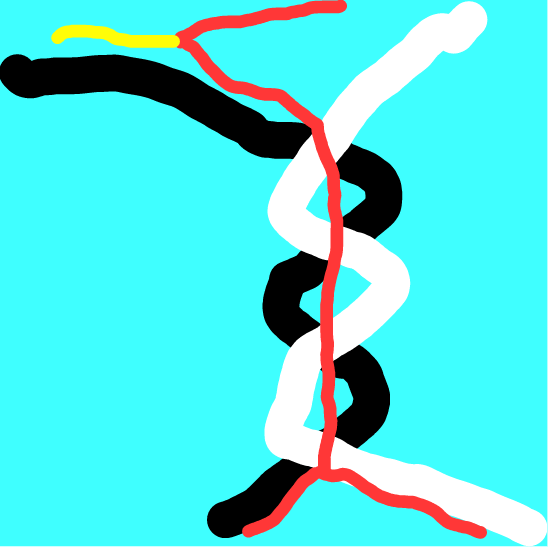
The black line is the Hebraic psychology; the white is the Hellenic. The orange is that type of Christianity which developed around the Mediterranean Sea in the First Millenium. (What Catholics will insist was all Catholicism pre-Schism, and what Orthodox will insist was all Orthodox pre-Schism, I play safe by calling “Mediterranean.”)
Let’s say the three lines intersect at the bottom in the person and age of Augustine (4th C). Where they spool around each other in the middle, that is the thousand-year Medieval period. Where they depart at the top is the Reformation (although one can see this relationship breaking down in the Renaissance, and even in some ways at the time of the Black Death).
Notice how the Catholic Church bends as far as it can during the Tridentine period to accommodate the protestant-Hebraic energy which was having its high water mark in the 16th and 17th Centuries; notice how it whipsaws at Vatican II towards reclaiming its Hellenic heritage. The yellow line is the “traditional” Catholic sect. Only grasping the geographically- and historically-limited Tridentine period (c.1600-1950) in Europe as the totality of Catholicism, creatures of the dialectic we, the Hellenic reclamation of Vatican II is only intelligible by “traditionalists” as being “Liberal.”
Another way we can lay things out is like this:
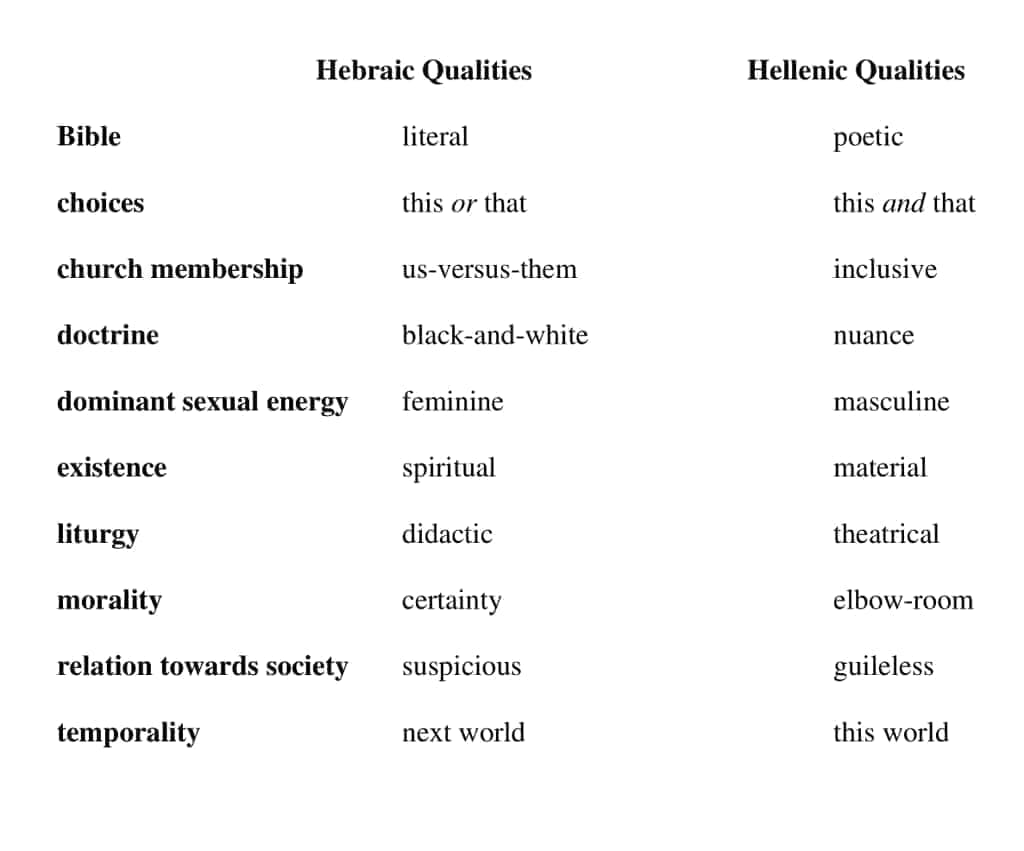
Again I say, ancient Christianity is the symphonic marriage of these two poles. Nothing better illustrates this than the holy Liturgy, which is the story of the holy Bible structured in the form of a Greek play, complete with antiphons, players, and a chorus.
Still another way we can understand the symphonia of Pre-Modern Christianity is as a body. We ought to see historical Christianity as having bones and flesh. The bones are the Hebraic morality and mythology, all that black-and-white Bible stuff; fleshing this out is Hellenic thinking, which gives us catechisms and councils, art and principles (not laws). The flesh hangs on the body as the Hellenic psychology hangs on the Hebraic in Christianity.
Of Dancing Buddies & Crashing Cars
A few words on historiography, sexual energies, and Catholicism are apropos at this point.
Broadly speaking, this is the same distinction of types we hear made between engineers and artists. And if we were to dig deeply into the same division in ancient Christianity we would see the Catholic-protestant fissure a thousand years before the Reformation in the initial merger of the Hebraic-Greco strains (c.5th Century), and indeed, nearly another thousand years before that in the Hellenization of the Hebrews during what protestant scholars called the “Intertestamental Period” (c. Malachi-St. John The Baptist) These two streams came into more and more perfect harmony from the late-Classical world through the Renaissance, until they broke apart like a dissipating tornado in the Reformation. What remains of popular Christianity in the West is solidly Hebraic; those from whom the presently-swelling “nones” are drawn are almost all Hellenic.
It must be distinctly understood that authentic Christianity is always to maintain a balance between the Hebraic and the Hellenic psychologies. Let us not make the tired Modern error of choosing this or that. Catholicism is this and that. There is, in fact, no better encapsulation of the distinction between Catholic and protestant psychologies than this “or/and” observation. Again, protestantism is this OR that, Catholicism is this AND that. Yes, the Hebraic and Hellenic forces in Christianity are both necessary; there is no Catholicism except both are there in proper relationship one to another.
It is not at all fair to blame the Reformation solely for the psychological split we have inherited. It is true that the 16th Century divorce, by splitting the millenium-long Hebraic and Hellenic marriage, set in motion energies which would doom now-solely Hebraic Catholic and protestant Christianities to irrelevance, and unmoored Hellenism to becoming the antichrist world order we see before us, but this was unimaginable to the Reformers and Counter-Reformers at the time.
Western Christianity of whatever flavor has been under sometimes intellectual, sometimes legal, sometimes bloody attack for a solid three centuries. It is only natural that the type of Hebraic soul, naturally paranoid and hostile to outsiders, would develop a pronounced “bunker mentality” in what little rags they have left of Christendom.
The Psycho-Sexuality Of Hebraic & Hellenic Souls
The Semitic spirit is feminine, the Hellenic masculine. You balk at this. You tell me I have it reversed. Surely Semites, with their beards and their harems and their logical talmuds, represent the masculine in religion; surely Hellenes, with their Grecian curves and their drugged oracles and their dialectic, represent the feminine in religion.
No, mon ami, it is you who have it flipped. An easy flub to make it is though. The Semitic soul is feminine in its textual gotchas, it is feminine in its certainty sans reason, it is feminine in its judgment. It is the Hellenic mind which is masculine in its broadness, its subtlety, and its symphonia. In the best Catholic tradition the both are embraced in a marvelous whole, with due guidance of the chaotic feminine Semitic tendency given by broadsighted and steady Hellenic hands.
I need only adduce the strange Hebraic (i.e., Rabbinic, Islamic, and protestant) hostility to the humble foreskin as the surest proof of the fundamental feminine energy of the Semetic soul. The purpose of circumcision - as hopeless in its telos as it is obvious - is to tame the male’s sexuality through nervous diminution, and to stunt his naturally robust, assertive psychology through this calculated neonatal trauma.
When it comes to Mediterranean Christianities, occasionally the Judaic-feminine strain in that faith system becomes dominant. The Iconoclast Controversy of the 7th C. and the Reformation of the 16th C. are two examples of this. Islam is the biggest and most successful example of the Hebraic-feminine strain of Christianity reasserting itself.
This Jewish-Greek balance is not my assertion; it is the witness of a thousand years. From Pentecost until Nicea one sees these two distinct strains existing around each other amidst preaching and persecutions and all the growing pains which attended that marvelous and chaotic period. From Nicea until - just for a mile post - Charlemagne, we see the Hebraic and Hellenic sorts being ordered into what would continue for the next thousand years.
How did this ordering come about? The monasteries. You see, super religious people are often super holy. They can give all their money to bums and not think twice about it; they can stand praying on pillars for thirty years as all the teeth fall from their head; they can look you dead in the eye and not flinch as you de-nail and flay them for Christ. These types are obviously Hebraic. They are the sorts that make prophets and patriarchs, Maccabees and martyrs.
Well, funnily enough, such stout Hebraic types are often super divisive too. The energy they contain is explosive. If it’s not kept on a tight leash it will have horrible consequences. The same energy which gave us the Benedictine movement also gave us the Reformation. It was the exact same personality type. When Hebraic souls were put in a monastic halter, they outlasted the Vikings and won a continent for Christ; when nascent secularism found less and less of these people under vows and out in the marketplace, these same unhaltered sorts became protestants and unwittingly destroyed Christendom.
Fast-forward a few centuries and we see it was this same type who replaced Christ with commerce and became the roaring Liberals of the Enlightenment. The same people who were Maccabees and monks, protestant agitators and Jesuit missionaries, became the lawyers and merchants - priests of the new order - who would put their breast to the mouth of a cannon for (commercial) freedom, who now put their energies into political parties as they once put them into religious orders. Make no mistake, in each instance of history you see the same Hebraic psychology again and again. It is very much those sorts of people who move history one way or another. No more can they do.
The Hebraic energy is tremendously powerful; it is also tremendously chaotic. It is on the grounds of this observation that I say the Hebraic energy is feminine. The female spirit must be tightly controlled, that it not destroy itself and everything around it. The pagans knew this in their recurring trope of the destroying mother goddesses; the Christians knew this in their Jezabels and Herodiases and Eudoxias. There is a reason all sane societies were and are highly patriarchal.
As the woman must be the lifelong charge of her father, husband, or abbess - that she not waste her energies and destroy herself and her neighborhood - the Hebraic soul ought always be channeled into religious life, that it not dissipate itself in pointless schisms and controversies.
In fact, the Reformation is precisely the historical testimony of what happens when the mighty feminine/Hebraic energy is not controlled. The same energy which can be harnessed to raise a family of five or ten to honorable manhood, the same energy which can be directed to cheerfully pour itself out in a lifetime of thankless parochial teaching or cloistered celestial petition, can just as soon waste a decade or four on Tinder and Only Fans.
Control the feminine-Hebrew spirit and you make saints and build civilizations; let loose the feminine-Hebrew spirit and you’ll cry into your beer at a life frittered away.
So, What?
Why does any of this matter? It matters because Christ wants all men to be saved and to come to the knowledge of the truth; that that truth is expressly taught by the holy Catholic Church, and that for grace to most effectively work in the soul, one is ordinarily to be joined to the holy Church by holy Baptism; and that by accounting for the vast majority of people who have Hellenic psychology, this salvation will more easily be comprehended and embraced. As it happens the Hellenic psychology is almost completely ignored by Christians in America. Until the 501(c)(3) Christians of whatever flatteringly-titled denomination get this - and Catholics are as denominated as protestants at this point - their parishes will continue being the dying clubs they are.
Time was, missionaries would be sawn in half by naked Germans or have their fingers gnawed off by merciless Indian savages, and they weighed these horrors a small thing to spread the gospel of Christ. Well, MacSweeny’s dead and Cork’s asleep, and you’d not say your 501(c)(3) church rats have that sort of fire in their bellies. No, there doesn’t seem to be one skin in ten thousand who cares about this jabber about getting souls to Christ by making the gospel more comprehensible to other psychological types than the minority Hebraic, but still and all.
Going Deeper
What I want to establish in this essay is that Christians in these States united are not cognizable by the general society because, given the distortions of history these last five centuries, we have become overly Hebraic whilst the society, itself unmoored from the Premodern Christian symphonia of Jewish and Greek psychologies, is increasingly Hellenic.
More nitty gritty, I assert that the “traditionalist” schism amongst Latin Catholics since Vatican II is largely the result of Churchmen “getting” this dynamic, and trying to re-incorporate the Hellenic spirit, whilst the laity and lower clergy do not know their ass from their elbow.
Thus, these lay and clerical bumpkins have written off Vatican II’s titanic work of undoing the Reformation’s Hebraic-Hellenic divorce as merely being “Liberal.” To be deep in history, as Newman said, is to cease to be protestant, and that includes “traditional,” “orthodox,” and “conservative” Catholic protestants.
Leveling & Othering
I have said both the Latin Rite and the traditional sect are protestant in different ways. Protestantism is two things if it is anything: leveling and othering.
What do we mean in saying the “Novus Ordo” is protestant? This appellation can best be seen in its leveling aesthetics. The Latin Rite is protestant in the banality of the present holy Liturgy; its lack of decorum, its use of contemporary art, and its folksiness. Again, it is not my place to comment on if this is good or bad.
It is enough to note this. It is also enough to note Hellenic souls are deeply moved by art and pageantry, and that the “low church” ethos of American Catholicism leaves these people out in the aesthetic cold. No mother’s son can deny that it is the beauty and solemnity and pomp of the Latin Mass which is the “traditionalists’” greatest recruiting tool, not any doctrinal stance nor their dubious orthodoxy. Pageantry speaks to the Hellenic soul, and it has not been speaking in the Novus Ordo.
Now, all moral judgements aside, what do we mean in saying the “traditionalist” sect is protestant? American “traditional” “Catholicism” is protestant insofar as it is sentimentally protestant. This sentiment is best seen in their othering; their separation from the holy Church, from their (asserted) coreligionists, and from the general society.
Just as the internal and invisible is often more dynamic than the external, so here. As all red-blooded men find out, it is not the blue-haired, tatted up, nose-ringed girl, but the buttoned-up, prim and proper, quiet mot who is notorious for being - keeping things family friendly - the most freaky-deeky in bed. Likewise, the “traditional” “Catholics’” protestantism is much more interesting than their superficially protestant “Novus Ordo” co-religionists. Always watch the squeaky clean sorts, they have more going on than meets the eye.
The “traditionalist” sectarians are sentimentally protestant in their othering; in their us-against-the world, black-and-white mien. They are suspicious in the way the world grown old learned to be suspicious in the 16th Century. The trads are suspicious with the suspicion of the Schmalkaldic War and Foxe’s Book of Martyrs and getting a wedding invite on St. Bartholomew’s Day makes one. They are suspicious that Churchmen are ever and anon up to no good.
They additionally make the protestant (and Donatist, Orthodox, and Old “Catholic”) error of separating the structural and spiritual aspects of the Church. For “traditional” “Catholics,” just like all their protestant brethren, the Church is an historical amalgam of beliefs and practices against which any present clerical teaching may be discarded at the slightest perceived discrepancy.
Finally, this sect is protestant in it being primarily a lay movement. Groups like the SSPX have actually tried to reenter the Church several times in the last fifty years only to have their laity and lower clergy rise in insurgency. This is precisely what infamously scuppered the Orthodox reunion at the Council Of Florence in the 15th Century, and it has been the sad history of protestant reunions with Rome down the centuries.
Likewise, the Society’s biggest revolt to date - and, God knows, like all protestant groups, the SSPX has had no shortage of internal breakaways - was around 2015 when they were about to become Catholic once more. I had a rare front row to the SSPX-Resistance farce at the time, and I’m telling you it was a lay-led fracas from start to finish.
Mediterranean Christianities, by which I mean those Christianities which in later years use the flattering titles “Orthodox” and “Catholic,” might be said to have a religion of Hebraic bones and Hellenic flesh. I suppose this is what that happy feast of Ss. Peter & Paul means. May they never part ways. This is to say, atop a black-and-white Semetic theology and mythology rests a fair padding of Greco-Roman thinking. There are apostolic Christianites which have dominant, or even exclusive, Semitic tendencies such as the Church of The East (“Nestorians”), and certain of the Oriental Orthodox groups.
Let’s define these strains. For the Hebraic think about its textualism, its us-versus-them outlook, and the inevitable reappearance of Mosaic customs in Hebraic Christianities like American protestantism and Islam. The Greco strain is one of dialogue, intellect, and symphonia. Mediterranean Christianties require both movements, and between the Orthodox and Catholics, the Catholics are the more Hellenic. Now occasionally the Hellenic tendency gets out of control too. We see this singly in the Renaissance, and in the regular outbreaks of variously-titled gnosticisms through the ages. And if the sadsome Reformation is the result of the Hebraic spirit unmoored, the madness of our times - need I list a thousand schemes and abominations?—is clearly the result of the Hellenic psychology out of line.
The actual Church drinks deeply from the aesthetical and liturgical mood of evangelicalism (in the American sense of that word); the wide splay of flatteringly-adjectived Catholic denominations (sic), everything from the Adoremus Bulletin and FSSP sorts, to the SSPX - which, contrary to its devotees’ fancy, is less badass and has something of the middling Anglican mien to it - through to your SSPV and sedeplenist yoes, and everyone in between, are psychologically protestant.
The Reformation is not just the start of Modernity, it is the very soul of the era. Everything since then has simply been an unspooling of principles latched upon at that time. It is not my purpose in this essay to establish if this is good or bad; neither will I attempt the fool’s errand of trying to get a Catholic to admit their protestant. If American papists can’t “get” why their parish’s 501(c)(3) corporate whore status is a delict, they can’t comprehend the more nuanced points of this paper.
The point to all this history and sociology jabber is that “traditionalists” have taken a period in Church history (c.1600-1950), which was itself a departure from the larger story of Catholicism, and set up this extraordinary epoch as the standard against which to measure all present appraisals.
The Missing Ingredient
Be Americans formal protestants of the capital P variety, or their protestantized Catholic brethren of the “Novus Ordo” or “traditional” variety, there is one area those of Hebraic psychology are tone deaf to: culture. If the Left can’t meme, protestants can’t culture. What calls itself Christianity in this country, being completely psychologically protestant and therefore Jewish, will never be able to reach the vast majority of “normal” people who have Hellenic psychologies. As long as this obtains, the religious “nones” will continue to grow.
Life lived now is the strong suit of the Hellenic mind. It is, in a most disordered fashion, a reality which The World grasps. This disposition, however, is not bad in se if it is properly yoked to the gospel, as it once was. Remember, authentic Catholicism (i.e., mixed Hebrew and Hellenic psychologies) is BOTH/AND not EITHER/OR. It was the recovery of this Hellenic appreciation of life lived now, under grace, which backstopped Lumen Gentium and Gaudium Et Spes. Alas, the poor protestantized American Catholics too often dismiss these corrections as “humanistic,” in the wicked sense of the word, not realizing there is a real Christian Humanistic tradition which was interrupted by the Reformation and the parade of crisis which followed. We must recover this humanistic, Hellenic tradition.
Conclusion
To understand the remarkable retreat of Western Christianity over the last five centuries, and particularly since WWII, we need to cease thinking of Catholicism primarily as a religion. We need to understand it more as the integration of two psychological types, the Hebraic and the Hellenic.
Further, to properly digest the late “Novus Ordo”-“traditionalist” schism, we need to chuck the tired tropes of liberals vs. conservatives and the subversion of alien groups; we need to see our time and clime in the big picture, that we are the play things of historical energies much older and deeper than we imagine.
The Tridentine period in Catholic history was an aberration. I do not say it was good or bad; I say it was a break from Latin praxis. In order to address the protestant crisis, protestantism itself being Judaic-feminine, the Church had to embrace its Judaic-feminine strain too. Think about catechisms and the cut-and-dry way those texts present the faith; think about the precise and uniform liturgy, neurotic in its rubrics; again think about the us-and-them dialectic, all of this is Semetic. The Second Vatican Council was an attempt to restore Catholicism to its pre-Reformation Hellenic-Judaic balance. It was an attempt to restore masculine sanity to the Ecclesia.
Yes, to be deep in history is to cease to be protestant. If I am correct, if both American “Novus Ordo” and “traditional” “Catholics” are in fact representative of two different protestant sentiments, then maybe we all ought to hit the books that much more. When we have freed ourselves from the historically-conditioned excessive Hebraic spirit, when we embrace the realignment attempted by the Second Vatican Council, we will stand on a stronger footing to win heretofore alienated Hellenic souls for Christ.
Featured: The Virgin and Child with Saint Anthony the Great and Saint George, by Pisanello; painted ca. 1445.