RAF Fairford and the Flydubai Incident: Some Questions
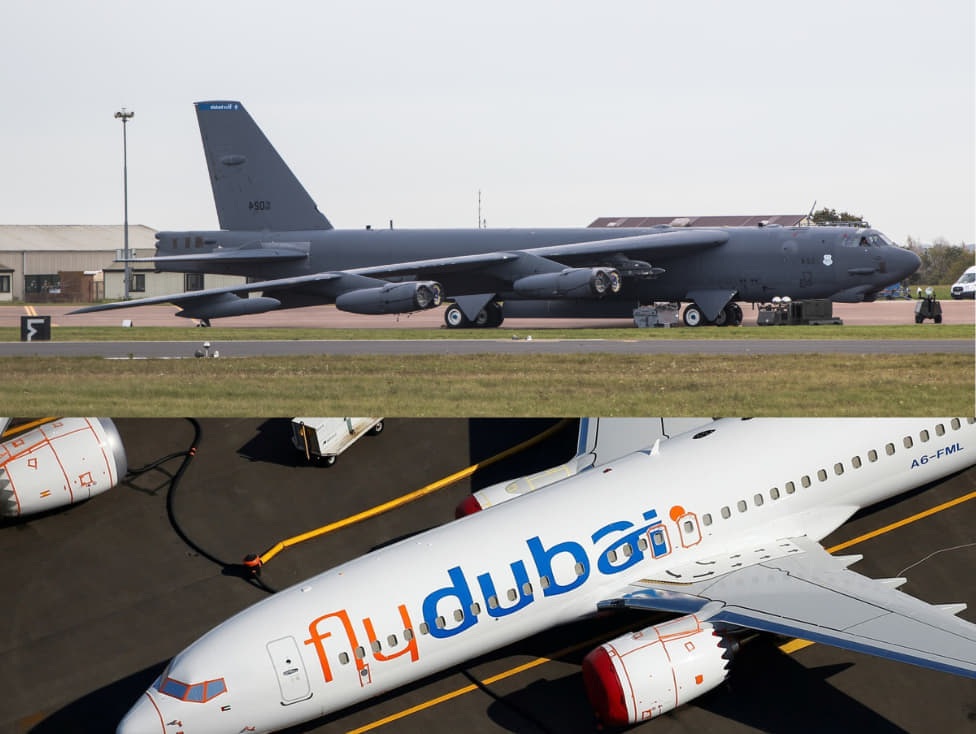
False flags incoming?
When a passenger jet bound for Tel Aviv plunged over Saudi airspace, and when a farmer on a tractor in the English countryside discovered suspicious vehicles near an airbase, a familiar political script was accelerating into motion.
Within a single week in late September 2026, two bizarre incidents—both officially classified as "security events"—dominated global headlines. On one side, aboard Flydubai Flight FZ1073, a co-pilot reportedly from Oman attacked the Indian captain with a weapon at 30,000 feet. On the other, outside RAF Fairford in the United Kingdom, five young British men were arrested near a base hosting American B-1 bombers, then quickly released.
The official narrative swiftly wove both into a single framework: the terrorist threat posed by Iran and its proxies. Yet online observers and independent commentators have raised a host of questions that officials have not—or will not—answer. These questions point toward a more troubling possibility: that these incidents are being used to build public support for an attack on Iran, driven by the Israeli election scheduled for October 27 and by a prime minister mired in corruption cases, trailing in the polls, yet long skilled at using war to prolong his political life.
FZ1073: Too Many Inexplicable "Coincidences"
The official version is clean: a Flydubai co-pilot—an Omani national—attacked Indian captain Smit Machchhar with a knife on a flight from Dubai to Tel Aviv, attempting to hijack the plane. The wounded captain, with "his last ounce of strength," opened the locked cockpit door. Passengers rushed in and subdued the attacker. Another Flydubai pilot who happened to be traveling as a passenger then took the controls and landed the plane safely in Tabuk, Saudi Arabia.
Netanyahu quickly cast the Indian captain as a "true hero," saying he "saved 174 lives." The White House, too, joined the narrative, with Trump describing the co-pilot as "either a terrorist or mentally deranged."
But it is precisely this too-perfect hero narrative that has triggered systematic skepticism among online observers.
Question One: How was an Omani allowed to fly into Israel?
Israeli Transport Minister Miri Regev immediately ordered all Flydubai flights into Israel halted after the incident, citing what she called a "clear breach of protocol." Under Israeli rules, airlines operating routes to Israel must have pilots from countries with formal diplomatic relations with Israel. Oman is not among them. Israel has no formal diplomatic ties with Oman, and Omani citizens require a visa to enter Israel.
So how did this Omani co-pilot pass Israeli aviation security screening? The explanation offered in reports is the possibility of "dual nationality"—he may also hold a passport from another country Israel recognizes. But that explanation itself raises deeper questions: If Israel's security screening system is so easily circumvented through dual nationality, has the concern about "Iranian proxy infiltration" been overstated? If it was not dual nationality, then how did Flydubai allow an Omani citizen to crew an Israel route without Israel's knowledge?
Question Two: Where did the knife come from?
Initial reports said the co-pilot "smuggled" a small knife aboard, possibly from the aircraft's cutlery. But subsequent investigative information pointed to a different tool: the "crash axe" standard in cockpits—a fire axe for emergency window-breaking or forcible entry. Netanyahu himself confirmed the use of an axe.
This correction is not inherently unusual—early reporting is often inaccurate. But the key point is this: If the attack used a tool that was already in the cockpit, then the "weapon smuggling" element of the terrorist infiltration narrative disappears. A legally accessible tool inside the cockpit, used to attack a colleague, is an entirely different security threat model from "a terrorist carrying a weapon aboard."
Question Three: How was the cockpit door opened?
This is the most technical and most puzzling point for aviation security analysts. Modern commercial cockpit doors are designed to be locked from the inside during flight and cannot be opened from the outside. This was a core measure of global aviation security reform after 9/11.
The official account: the wounded Captain Machchhar, stabbed and lying in a pool of blood, pressed the door-release mechanism with "his last ounce of strength." The narrative is deeply moving—a dying hero saves everyone. But the technical question is: If the captain was so severely wounded that he could not fly the plane, how did he retain enough consciousness and physical strength to operate the door lock? What was the attacker doing at that moment? Why did he not stop the captain from opening the door?
Online analysts point out that this "hero opens the door" detail is functionally crucial to the narrative—it explains why passengers could enter the cockpit, why the attacker was subdued, why the plane did not crash. But it also creates a technical "miracle" that must be believed.
Fairford: A "Performative" Terror Plot?
Almost simultaneously with the Flydubai incident, the events outside RAF Fairford unraveled even faster.
Five young British men were arrested near the base. Initial reports suggested a terrorist plot linked to Iran, targeting the American B-1 bombers stationed there—the very aircraft central to U.S. strike options against Iran.
But details quickly leaked, undermining the "serious terrorist threat" framework: no improvised explosive devices (IEDs), no concrete attack plan, suspects described as "incompetent"—they allegedly drove vans disguised as company vehicles but parked them conspicuously; when discovered, they fled on foot into fields and were arrested. Within less than 48 hours, all five were released pending further investigation.
The British prime minister said after the incident that there were "strong indications" of Iranian involvement but declined to provide specific evidence.
Online commentators described the Fairford episode as a "narrative exercise": ambiguous enough to generate fear, but with evidence too thin to hold up in court. Its function was not to describe a real threat but to plant the script of "Iran attacking the West" in the public consciousness.
The Bigger Picture: Netanyahu's Election and the Iran Narrative
The timing of both incidents—just weeks before Israel's October 27 election—is an unavoidable backdrop when analyzing any "anti-Iran narrative."
Netanyahu is facing the most dangerous moment of his political career. The October 7, 2023, Hamas surprise attack occurred "on his watch" and is widely seen as the worst security failure in Israeli history. Corruption cases (Case 1000, 2000, 4000) are still being tried; he is the first sitting prime minister in Israeli history to stand trial. Polls suggest his Likud party could lose about a third of its Knesset seats, with the main challenger—former military chief Gadi Eisenkot's centrist party—rising.
Netanyahu's campaign strategy, as analysts have noted, is the script he has used repeatedly for decades: cast himself as the only man who can protect Israel in a hostile region, portray opponents as "weak leftists," warn voters that if rivals win, they will govern with Arab parties and compromise on security.
In this script, an "Iran-planned terror attack"—whether against a plane bound for Tel Aviv or against American bombers in Britain—is perfect election material. It proves the Iranian threat is real and imminent, and that Israel needs a "strong leader who will not surrender."
Iran's response points to the opposite narrative: Iranian security sources claim Israel is planning "terror operations" against planes and airports specifically to frame Iran and create a pretext for attack. This allegation cannot be independently verified, but it precisely captures the core suspicion of online observers: when a security incident happens just before an election, serves a political leader's narrative needs, and involves confrontation with Iran, questioning its authenticity is not "conspiracy theory" but basic political prudence.
The Unanswered Questions Matter More Than the Answers
These incidents may ultimately prove to be "real"—the FZ1073 co-pilot may indeed have tried to hijack the plane; the Fairford suspects may indeed have had some intent. But "authenticity" is not the core concern of these online doubts.
The core concern is: When official narratives align so perfectly with political interests, where is the mechanism for independent verification?
The FZ1073 "hero captain" story has a perfect moral arc: Indian hero, Omani terrorist, grateful Israeli passengers. It has a perfect political function: reminding Israelis before the election that the enemy is at the gate, and that Netanyahu's hard line is necessary.
The Fairford episode has perfect ambiguity: real enough to make news, thin enough to vanish in court, but loud enough to leave an echo of "Iranian attack" in the public mind.
How did an Omani fly into Israel? Knife or axe? How was the door opened? Why were five suspects released within 48 hours? The answers may never be fully disclosed. But in the weeks before the election, they have already served a more important function: making the "Iran threat" narrative so pervasive that questioning it becomes a form of "disloyalty."
This may be the most disturbing common thread between the two "bizarre incidents."