Rahab's Faith
The children of Israel as they enter into the Promised Land, Canaan, have a few major challenges ahead of them. Their great leader Moses has died and there are a lot of people in Canaan who do not like, or want the Israelites anywhere near them. The entire generation that set out from Egypt 40 years earlier have all died, except two young men; Joshua and Caleb.
These
two men had spied out in advance the Promised Land together for Moses. They had
returned enthusiastically about the prospects of Israel’s new homeland
confirming what God had already told them. The time was now right to enter into
Canaan. The Israelites now under the leadership of Joshua are camped along the
Jordan River directly opposite the city of Jericho.
Wisely
Joshua did not get his army ready and just attack. Just as Moses had done years
before, Joshua sent spies ahead to gather military information about what lay
on the other side of the Jordan and Jericho. The two spies head off and the
first person they meet is a woman called Rahab. Was it by sheer chance they
meet her out of all the thousands of people they could have met? Was it by
sheer chance she would meet two very culturally different men? Rahab’s whole
life and her future would soon be changed through this encounter.
What
do we know about Rahab? It’s not a name that many women are called today. Many
women are called after Mary, Ruth, Hannah, Lydia, Rachel, Rebecca, Sarah,
Martha, Elizabeth, All biblical names. But no Rahab. That gives you a clue. Not
many men are called Judas either.
The
first thing we are told about her is in the very first verse; she is introduced
as a prostitute named Rahab. I wonder what she looked like and what she dressed
like. She was an immoral woman who had No concept of sexual purity.
She
lived in a sex obsessed pagan society that was fanatically devoted to
everything that God hates. This culture like Sodom and Gomorrah was on the
verge of God’s judgement. Their generational descent into the abyss of moral
and spiritual corruption had been intentional, and now it was irreversible.
It
appears that Rahab has always been a willing participant plying her trade. Now
that God had called for the complete destruction of the entire culture because
of their extreme wickedness, why shouldn’t Rahab also receive the just desserts
of her own deliberate sin? Good
question.
Rahab
as we would say was; the dregs of society. She made her living catering to the
most depraved insatiable sexual appetites. It’s hard to imagine how someone
like her could ever be changed. Her house was not in some back alley of the
city, but perched on the famous walls. She was in a prime location of her red-light
district. We could safely assume that her trade was a financial success given
the location.
Jericho
was part of the Amorite kingdom which was a totally depraved and violent pagan
culture. In fact, their culture was so depraved with witchcraft and child
sacrifice going back to the time of Abraham that their evil lifestyle was the
very reason God granted Abraham and his heirs rights to their land, driving
them of it. So, the spies enter into the
city of Jericho to check it out. A bit like a Mission Impossible Team. Looking
for a place to spy out the land they came across Rahab. The location of her
house seems to have been the ideal spot.
The
Israelite spies did not seek to take advantage of her for immoral purposes.
Perhaps this being what won her trust over in the first place. They were not
here to use and abuse her unlike the other men who came through the doors of
her house. These men were different, they were sober and serious. Presumably, they treated her with dignity and
respect while they were staying with her. Maybe they told Rahab something about
their God and the ways in which he had saved, lead and provided for them.
Amazingly she was spiritually open to the way God was working through these two
spies.
Everyone in Jericho already knew that the
Israelite nation was now camped across the river a short distance away. They
had heard about the Hebrews escape from Egypt now they were seeing them with
their very own eyes. And they were frightened. Rahab now finds herself where
she could make a fair bit of money if she turned in these two spies. But she
didn’t. She hid them. She misdirected the officials and saved the lives of the
two spies, even though this put her at considerable risk of losing her own
life.
At
this point for someone who lived their life through wicked, corrupt ways it
seems alien that someone like her would turn down the chance to make a lot of
money, and put her own life at risk. Not only is this sudden change in her
attitude unexpected, it runs counter to every instinct that normally would
motivate a woman like Rahab.
What
could possibly bring such a dramatic change in a person’s life, and in such
circumstances. God. God is the answer.
Suddenly
God touches her life in some amazing way. Over the years of her tough hardened
life; had she come to realise that her life should not be like this. The lies,
the perverted sex, the booze, the cheating, the brawling.
Is
this the level I am at? I cannot do this anymore. I need a clean break. But
how? There comes appoint in a person’s life where this awakening; this light
comes on. Everybody is different. For some it’s like a Damascus Road
experience, for others it’s more of an Emmaus Road experience, gradual. Either
way something changes. With her new-found faith undeveloped as it was, we see
immediately that it bears the fruit of action. The bible tells us; ‘faith
without deeds is dead’. Rahab did something; she took the spies in, making
herself vulnerable. With this act she was putting her faith into action. She
not only hid them, she embraced their cause, entrusting her whole future to their
God, and our God.
There
is absolutely nothing but faith in God, that could have made such a dramatic,
sudden change in the character of such a woman. She had heard of the mighty
acts and wonders he performed with the Hebrews. Now she had met real flesh and
blood people, spies, who knew him and worshipped him. She was prepared to
follow them and their God.
What
about you today? Have you sat maybe for years in the pews of a church, hearing
Sunday by Sunday the stories of God’s mighty acts and his miracles? Listening
carefully to the scriptures, and the prayers and the sermon. But that’s as far
as it goes. The trust, the stepping out in faith needed; is still absent. After
it was clear that the king’s messengers were gone for the night, Rahab went
back up to the roof to speak with the spies. It’s really quite amazing what she
says to them; ‘ I know that the Lord has given this land to you and that a
great Fear of you has fallen on us, so that all who live in this country are
melting because of you.’
What
was it that caused her in particular to trust in God? It was fear. Fear of God.
Is it a bad thing to be frightened of God? No, it’s not. Our affluent western
societies across the globe generally speaking have no fear of anything. No fear
of the police, the courts, getting caught, libelling or slandering anyone. People
generally have no fear.
A
life sentence for murder is around 8 years in prison or less. You hire a
barrister or better still you get the state to pay for a barrister to get you
off. There is no fear of doing wrong. Knife crime in London is out of control.
Years
ago, in the UK you would never have heard of a child being suspended from
school; now it’s a daily occurrence. Most people have no fear of God. Afterall What’s
he going to do? I; am my own authority. My rights trump everyone else. I must
be allowed to do what I want to do. And the state will back me up. Right or
wrong.
But
they forget one thing; there will be a day of judgment for every human being
who lives on this planet. That judgement will be carried out by the living God
of Israel. This is what Jesus Christ says 1500 years later, after the battle of
Jericho; ‘I tell you that men will have to give account on the day of judgement
for every careless word they have spoken. For by your words you will be
acquitted, and by your words you will be condemned.’
We
all know what happened next. God intervened in a way that made clear to
everyone in Canaan that he was fighting for Israel. He demolished the massive
walls of Jericho without any military means whatsoever. On the 7th
day the Israelites marched around the city 7 times, blew a ram’s horn, and
shouted. Instantly the wall of the city fell down flat. All except one part of
the wall.
Rahab
and her house were spared. In chapter 6 we are told the two spies went into the
ruins and brought out Rahab, her father, her mother, her entire family and left
them outside the camp of Israel. They received the protection they had been
promised.
Rahab
is a beautiful example of the transforming power of faith in God. Although she
had few spiritual advantages and little knowledge of the truth, her heart was
drawn to God. She risked her life, turning her back on a way of life that did
not honour God, and walked away from everything but her closest family members.
But they too came into the community of God. We never hear of Rahab again in
the Old Testament. But her name comes up in the New Testament. Her name is
mentioned 3 times in Hebrews and the book of James where she is held up as an Example
of faith, for both men and women. Rahab’s faith was anything but dead.
But
the most amazing occurrence of Rahab’s name, though in the NT is the very first
time it appears. It appears on the very first page, in the very first
paragraph, of the first gospel, Matthew.
Matthew
begins his account of Christ’s life with a lengthy genealogy tracing the entire
lineage of Jesus from the time of Abraham.
There
in the list of Jesus’ ancestors’, we unexpectedly come across Rahab’s name. ‘Salmon
the father of Boaz, whose mother was Rahab, Boaz the father of Obed, whose
mother was Ruth, Obed the father of Jesse, and Jesse the father of King David’.
It
is highly unusual for women to be named in Hebrew genealogies at all. Yet in
the Bible, the greatest manifesto of human rights ever written, Matthew
mentions 5 women all of them notable for various reasons; Tamar, Rahab, Ruth,
Bathsheba, and Mary the mother of Jesus. Three of them knew what it was like to
be an outcast, stigmatised because of who they were. Yet God is able to work
all things together for good. Rahab was saved by God spiritually as well as
physically not because of her good acts like protecting the spies.
She did not earn God’s favour by any good deeds. She is not a lesson in how to better ourselves through self-improvement. She is a reminder that God by his grace can save even the worst of offenders and turn a habitual sinner into a saint. Proving there is hope for everyone.
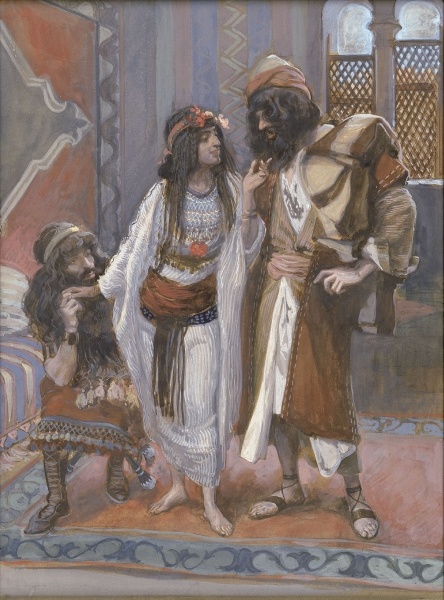
The photo shows, "The Harlot of Jericho and the Two Spies," by James Tissot, painted ca. 1896 to 1802.