The Return of the Kissinger Era?
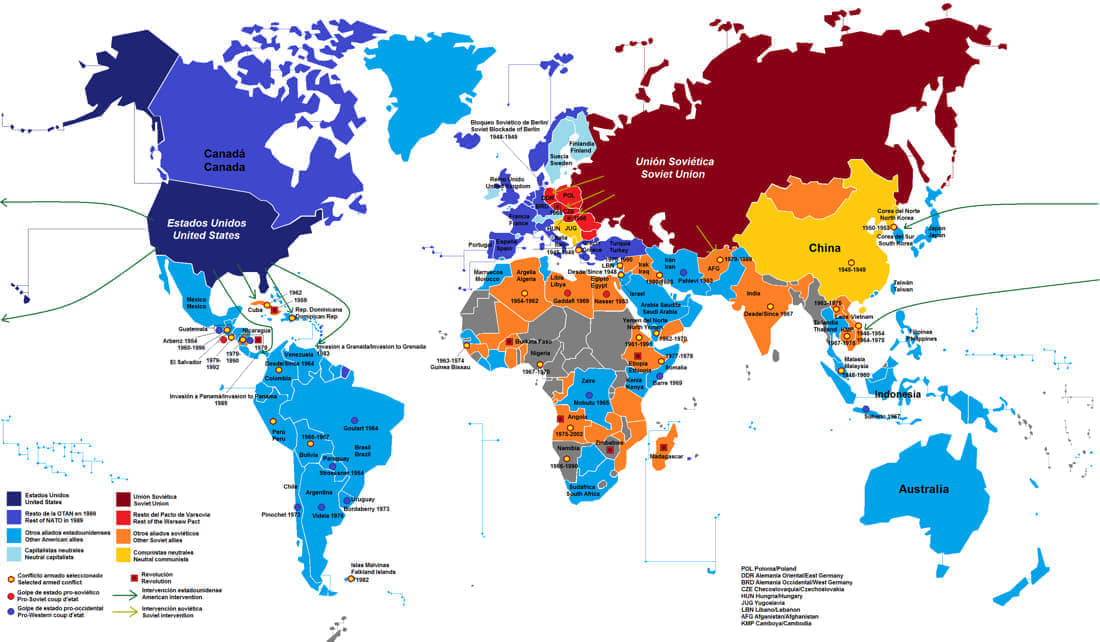
Despite large presence of nuclear weapons, the world of the Cold War, although extremely dangerous, was stable and orderly and, therefore, favoured predictability. Ultimately, the state-centred and territorial control paradigm that served from the Westphalian state to the rationalization of international relations, while keeping its centrality, has seen a flood new pressures and dynamics.
Globalization dynamized the logic of the international relations since the establishment and continuation of the two systems, which in practice coexisted during the majority of the Cold War era and which underwent a partial transformation during it. The first was the construction of the bipolar system based on the US-USSR, built on military balance and nuclear deterrence. And the second component, was the political and economic one, called liberal, and controlled by the main Western democracies.
This latter was converted into a hegemonic tool, which incorporates the Western value system (which is what was needed to build it), and the market economy; universal models that point to the end of history as understood as being a succession of conflicts. Democracy—and its emphasis on freedom as the first of values –was converted, in this way, into the battering-ram that had to crush the rest of the cultures at some point with the change of value system that was implicit, setting up a multidimensional crux that does not appear to be any less disaggregated in global terms.
This net of components, formed by different elements, such as population, economy, military power, technology, diplomacy is one of infinite aggregations (population, technology, military, diplomacy…), thus making complex its understanding and evaluation. As an example, China can surpass the US economically, but is yet far from having political, cultural, technological and military power comparable to a global level. This does not allow for the affirmation that the world is in a new bipolarity, but it can be declared as the loss of prominence of the West. In price parity, following the World Bank data in 2023, China's GDP is 34,643 billion dollars (18.76 percent of the world's GDP), US is 27.36 (14.8 percent), the EU is 27,125 billion (14.68 percent), and Russia is 6,452 (3.49 percent); the remainder of the world adds up to 184,653. Furthermore, Europe is faced with a great technological, political, economic challenges.
As well, the sum, at least in price parity, of the economies of China, the US and the EU is less than 50 percent (48.24 percent) of the global GDP. For example, the countries that took part in the Bandung Conference in 1955 (Afghanistan, Burma [today Myanmar], Cambodia, Ceylon [now Sri Lanka], the People's Republic of China, Cyprus, Egypt, Ethiopian, Gold Coast [now Ghana], India, Indonesia, Iran, Iraq, Japan, Jordan, Laos, Lebanon, Liberia, Libya, Nepal, Pakistan, Philippines, Saudi Arabia, Syria, Sudan, Thailand, Turkey, North Vietnam, South Vietnam, Yemen) represented a mere 8 percent of the world's GDP.
It may also be concluded that the US hegemonic era, set up after WWII, has certainly not offered a universal and symmetrical justice, but it has provided precise order and stability for the rise of nations, that is, for the increase of relative power and prosperity, especially for some client states. But multipolarity is not necessarily symptomatic of a more peaceful order, nor an era of happiness, nor a stable result. Ultimately, the West is defined as a culture, but in practical and general terms, its space is geographically covered by a system of economic pacts and military alliances with shared technologies. The transatlantic connection is key to cohesion; it provides a key role to the US, with a plural, often ancillary, Europe.
The problem is that both manufacturing and technological development have been externalised. It is clear that what is needed is a strong reindustrialization and technology boost, and competitiveness (the latter without killing the consumers’/ users’ rights and their purchasing capacities).
This is a call to a more effective use of power, to a more limited and contained management of it, and also to a greater contribution from Europe (enlarged to the framework of EPC, European Political Cooperation) to global governance, in its relationship with US.
The demand of the US for a major European contribution to security was historically formulated by Washington, but also logical in the sense for Europeans themselves, that the loss of the internal fronts must be accompanied by a robust external shielding. On the other hand, an alliance with US specifies stability, predictability or reliability, but those concepts now appear uncertain.
The changes in global order pivots over the space encompassed by the Arctic, Iran and Central Asia—with Siberia more habitable due to seemingly unstoppable climate change.
It is common to refer to the term “geopolitics” in the singular, thus seeking to underline the scientific and deterministic nature of the results. But geopolitics varies according to the chosen reference, the conceptions and logic of the formulation, timing and sequencing of its projection. In fact, there are many geopolitics, ranging from the Arctic to Central Asia, from Europe to the Asia Pacific, from Indian to Chinese geopolitics, or that of the “Global South.” They are all interlocked, showing the different compositions of the geopolitical areas. And they all vary, furthermore, according to the time frame or the ideological or intellectual reference adopted.
A multipolar world necessarily incorporates multiple geopolitical schemes. The shock of wars, such as that in Ukraine, has disrupted quite a few of them (e.g., Western, European security), and recalled that a war is essentially a brutal re-definition of geopolitical relations and interests, accelerated by the conflicts. This suggests an increase in global conflict, in a world that, after the peace dividends provided by the fall of the USSR-led system, since 2015, shows an increase in military spending (initially, slow; now, after the war in Ukraine, a frenzy).
If realized, Russian-built revisionism and re-establishment of its own security buffer zone (geographical, military and political terms) would entail a significant structural change in the framework of international relations, which could lead to the stagnation of the globalization process. This, in turn, would impact the world economy—especially on the supply side—in addition to the rupture of the framework of international economic relations that has shaped the continents since WWII.
Three decades ago, the US economy accounted for 28 percent of the world economy and China's only 2 percent. In 1988, the per capita income of Americans was twenty-five times bigger that of China, while today it is only four times higher; or, in other words, the Chinese economy was at that time more than thirteen times smaller than the American one.
The economic binomial formed by China and the US—whose beginnings date back to the Nixon era and was consolidated with China's entry into the WTO in 2001—has generated mutual benefits, with Beijing being the most favoured party due to its lower relative power; the limits of their co-evolution were probably crossed in 2013. That is why their confrontation is not only economic but fundamentally technological, since technology and innovation determine the future and allow for a paradigm shift, and as consequence political (not yet for a military one). China competes with the US and satisfies the financial needs of third parties by covering the spaces that Washington does not cover more or abandons, and not by fighting with it. China's presence alters the established order both globally and regionally. But the political weight of this actor is not yet, formally or factually, recognized within the current institutional and relations framework. Thus, the quasi-full return of Beijing into the international arena and its revisionist and illiberal approach has caused the alteration of the status quo at a global level. China and the US had —till today— a relationship of interdependence, complementarity and mutual benefit (basically, China provided cheap labour and capital and the US the markets and technology; but these needs and contributions have evolved), which has made possible their progressive economic coupling and integration since 1972. The visibility of the magnitude of this project collides with US policies (in reality, as said, China fills the gaps resulting from the withdrawals of Washington)— and erodes it by the so-called peaceful rise, which are the deep roots of the confrontation.
The Pacific has replaced the Mediterranean as the central axis of trade and exchange, becoming an area of intense traffic. It is important to remember the existence of nodal hubs such as the Strait of Malacca and important traffic lines. The merchant fleets of the coastal countries have multiplied their power in the last ten years; a large part of world trade passes through the Strait of Malacca.
The development of the region, with the consequent increase in US interests, has contributed to its greater visibility, which in turn means a greater weight for its west coast, including the Hawaiian archipelago. The result has been a change in the partition of US force, which has gone from 50-50 between Europe and Asia to, as of now, 40-60, and a redeployment of forces has been carried out, giving greater weight to the southern portion of the Indo-Pacific (for years without US presence). Taiwan is the keystone to Chinese containment, which is materialized through the islands chain strategy, which include the Philippines as well. This prevents China from having control of its Pacific environment, which is essential for Beijing, already being a continental power, to deploy on the sea and acquire the status of a superpower.
The effects of the trade war are noticeable: in 2022, trade volumes on the transpacific route, between East Asia and the US, fell by 6.5 percent, from 30 million TEU in 2021 to 28 million TEU in 2022. And that while those on the Asia-Europe route, for their part, fell by 4.9 percent.
As consequence of Western sanctions, Russian trade with the West has fallen while increasing with China. Therefore, Moscow and Beijing look to set up a strategic depth and avoid a possible encirclement. Both actors, before the war in Ukraine, did not maintain a particularly intense commercial relationship, in consideration that almost the entire Russian distribution system of its raw material, the only riches of the country, was oriented towards the West. After the curtain of the sanctions, China worked to redirect these infrastructures by developing determined and relevant efforts in this regard. But this needs time, resources and physical and technical efforts. The agreement with Russia, the “limitless” strategic alliance signed in February 2022, that is, shortly before the invasion of Ukraine, represents a reverse reissue of the semi (or pseudo) alliance that it maintained with the US, sponsored by Kissinger after Nixon’s famous visit and which protected China at that time from the USSR; a return to the model of relations that was maintained in Stalin’s time, but, this time, led from Beijing, and with Moscow as junior partner. In any case, in its relationship with Russia, China protects itself from the north, while looking to having a free hand in the south, and Taiwan and the China Sea, trying to escape the siege imposed by the aforementioned Pacific island chain.
Beijing is not “pro-Russian” but pragmatically “pro-Chinese,” maintaining cartelized relations—like setting up a possible anti-Western bloc that would include other actors such as Iran—that is, circumstantial, based on non-contradictory interests, while ignoring the obvious divergences among its partners. China needs Russian natural resources and the geographical advantages it has. And Russia needs access to Chinese technology, industry and markets to replace the European supply chain. That is why the support it has provided to the invasion is far from being as complete as was predicted in the limitless strategic partnership. Russia has been and continues to be the cornerstone of the balance in Central Asia. Not in vain has it been controlling a territory that is part of the post-Soviet space for almost three hundred years. China has obvious interests in this; and these begin at the border of Xinjiang. That is why China is trying to integrate Central Asia economically and prevent it from being contaminated by the instability of the environment. Not in vain is it here where the Silk Road reaches its full meaning.
Thus, Russia's withdrawal as a consequence of the war in Ukraine, together with the exit, culminating with Afghanistan, of the US from the region, generated an additional vacuum that continues to be filled by China. First in economic terms, by replacing Russia as the first partner of the countries in the region, which is part of what is regarded as “the near abroad;” and then in political and symbolic terms, as a consequence of a reissue of the (alleged) peaceful rise at a local level.
Chinese access to energy resources affects Russian interest in controlling this sector in the area. And, as if that were not enough, the success of its ambitious “Belt and Road Initiative” program may result in the strategic involvement of Russia—which is its hinterland—and thus Russia would become more dependent on China.
The invasion in 2022, but above all, the ongoing climate change, have ended the exceptional isolation of the Arctic, integrating it definitively into the global space. China's presence in the North Pole region is also due to its revisionist policy, as this is a geopolitical space in transformation and from which a rising global power cannot withdraw. In addition, its presence contributes to improving its capacity to mediate in other regions.
China acts in the Arctic with the same principles and political logic as it does in other territories. This, at a local level, translates into the creation of networks of cooperation and economic influence. There is a political strategy for the area defined as the “Polar Silk Road;” with such a name it is meant to signify that it is part of the global Chinese project.
Russia and China share a border and a past full of disagreements. Siberia is the natural hinterland of an overpopulated China—and it is even more visible due to global warming; this is why this relationship is perceived as being of a temporary nature, but, nevertheless, prioritized by China. Thus, the opportunity for Beijing is undeniable, but it also proves the temporary nature and limits of the relationship between the two. China's natural hinterland coincides precisely with the world's heartland and it largely coincides with the core of the area of Russian interests. This means the balance of power on a global scale, but one that would favour Russia, which, paradoxically, and despite its intrinsic weakness, could play the role of arbiter, sitting between divergent offers (China and USA); and this will depend on the ability of the Moscow leadership.
The aforementioned loss of weight of Russia in its natural hinterland, in the space between the strip of Iran and Central Asia and the Arctic, accentuated by its technological and economic dependence on China, would result in the strategic involvement of Beijing and could end as a threat to its existence as a State. However, the struggle that is being decided in the international arena is between the US and China, with Europe as a third (reduced) party.
There are many issues affecting the Indo-Pacific. China's role in Asia, Japanese normalisation, the Korean crossroads, the resurgence of Russia, the rebirth of India, the role of Australia, Indonesia, Vietnam, the Philippines are all an unstable ensemble, largely due to the presence of ideological conflicts that have existed, since the Cold War, and which still exist.
Undoubtably China and India are the protagonists of the Asian century, but they have not even perceived each other as positive neighbours until recently. They maintain an unbalanced economic relation (e.g., China exported no less than $110 billion to India in 2022, while it imported $15.3 billion and keeps its forces on the Himalayan border). This is why New Delhi considers the rise of China—and its support for Pakistan, its eternal enemy, with which it maintains a strategic alliance—as an existential and strategic challenge. But it does not know how to manage this relation/ challenge. Further, India, cannot align itself with the West without remembering its colonial past, and this explains the reluctance of enlarging the range and depth of the ‘Quartet’ and/or joining AUKUS, and at the same time the increased participation with military partners in all of the Indo-Pacific basin. In this context, India has opted for the Indo-Pacific, but maintaining ambiguity with respect to China and without closing its doors to either Russia or Iran. We are dealing with a country that aligns itself based on the issues discussed. With such a course of action, Delhi, despite many pressures, seeks its own strategic autonomy. India —the most overpopulated country in the world, like China, abstained from condemning Russia— is a possible leader of the “Global South;” in fact, it has displaced Brazil from such a role. India unites quite a few geopolitical contradictions because it is a geopolitical rival of China and therefore has competing interests with the US, to which it is close; and yet, it cannot break with China with which it maintains crucial relations. It also has a strong and historic relationship with Russia, which is key to its strategic autonomy.
These contradictions are even internal, as it is poorly integrated and has intraregional trade that barely reaches 5 percent of the total volume. Its economy (around 7.5 percent of the world GDP) is still two and a half times smaller than China's.
Furthermore, and in pursuit of its strategic autonomy, in the second decade of the new millennium, India has become one of the main importers of weapons in the world, diversifying the spectrum of countries of origin. Its main suppliers of weapons during the period 2016-2020 were Russia (49 percent), France (18 percent) and Israel (13 percent). For its part, the US never stops pressuring India, without major achievements till now, to radicalize relations with Beijing.
In turn, China, during the years of its “peaceful rise” had postponed the development of its military capabilities so that it would not be visible. But once it had reached a certain stage, it could no longer conceal such an increase, which became evident in the Indo-Pacific, which contains multiple disputes. In this situation, also due to the conformation of the Indo-Pacific, the naval rearmament has taken place while new alliances are being forged. The Chinese “string of pearls,” a strategy for the protection of these lines that serves to designate a chain of maritime and political support and surround India. This encirclement incorporates military components and is also carried out in an area that has been its traditional zone of influence and leadership due to its political weight, size and centrality in this space to which it even gives its name.
Kissinger had no interest in the area located at the bottom of the region formed along the lines between London, Berlin and Paris. From this perspective, the Mediterranean, Africa and South America, at the heart of the heartland, are located in the global semi-periphery. Thus, the Gulf countries (the only real power of the Islamic world) will be inevitably called upon by globalization to a process of rationalisation, and the Mediterranean will deepen on its periphery due to the incoming open navigation of the Arctic.
Technology can be a disruptive factor in bringing about a rapid paradigm shift. Furthermore, the Cold War credited the fact that the comparison between states can be derived from this context. The rivalry between the US and China is worsened by the technological rather than economic struggle. The sum of the capital of Google [Alphabet], Amazon and Apple, the three firsts of the great technological companies, exceeds the PIB of France and Germany jointly. The sum of the capitals of the 10 first Big Tech companies—in Europe—would exceed the PIB of 130 countries; and the sum of the 30 main ones—in which only one is European—to 160 nations (out the 193 states part of the UN). This does not only mention the power of states in general but also, and it is no less, about the ability to comply with the norms and standards that should be regulated in the international context which is strategically relevant. And, obviously, it also obliges one to consider Big Tech as international actors and, with it, to establish new international mechanisms of cooperation and concertation which has promoted the appearance of a so-called technological diplomacy. And it is the social networks, in the 21st century, which are a key tool of strategic communication and (dis)information, with influencers with the ability to move or influence hundreds of thousands of people with their opinions.
Identity conflicts are the way in which globalization progresses. The convergence that globalization brings is a process of rationalization and, therefore, of suppression of differences. Ethnicity, language, religion and culture are labels, and thus elements of identity definition that become frameworks for conflicts. That is, they act as polarization mechanisms promoting the alignment of the population, and they serve to mobilize large groups because they take the neutral facts of a people—language, territory, culture, tradition and history—and turn them into manipulable narratives.
Jihadism, for example, as syncretic interpretation of a syncretic religion, follows this logic. It is a reactive and refluxing movement caused by globalization. The strength and coherence of its action is due to the existence of a powerful doctrinal base provided by modern Salafism. The result is a kind of magma in which local or regional organizations find fertile terrain.
In short, when conflicts and wars occurred in one world, they were "reduced" to a clash of wills that was resolved on the battlefield. When they occur between different worlds, they cease to be a clash of wills and become a clash of identities that transcends the will of the parties.
The relationship between State and society is symbiotic. The weakness of society is the cause of the weakness of the State. And in the weakening of the State, if not in its failure, the cause of conflicts is frequently found.
Territory is the main element in the definition of the state, and also if it was officially defined by the Montevideo Convention of 1934. There is no state that does not have territory, including the non-officially recognized ones. Geopolitics studies the relationship between territory and politics. The territory is the physical configuration on which the legal-political structure of the state is erected. Therefore, the control of a territory has traditionally been the subject of conflict because it is the result of substantial naturalness and is linked to the state's own existence; and most of the wars and conflicts, including internal ones, refer to the need to control territories and need of the states to extend their control to all spaces that are capable of being controlled. However, territorial control is not essential, given that there are other forms of it. In any case, the key of the issue is also located in the relation between population and resources (e.g., minerals, agriculture, water). The modification of one of the factors affects the others and creates torsions in their combination. All this coincides with a delocalization of the sources of raw materials, mostly located in the third world, with respect to the location of the centres of production and consumption.
The other element of the population-resources scheme is demography. This could be an important conflictual element to undermine the growth of the centre of gravity of world politics by fighting for natural resources, mixing with cultural or religious constraints. According to the present forecasting, by 2100, the world’s largest country will be India with 1.530 billion inhabitants (with an important deceleration of the demographic growth). Some studies point to the fact that China, with the present trends, would be reduced to 776 million (with massive economic impacts and dramatic political ones); Europe would lose 10 percent of its population, and Japan 40 percent, while Nigeria would reach 550 million.
Globalization is not a unitary process and includes different items, cultural, financial, industrial, technological, knowledge. A new Cold War could temporarily stop some of its forms, but which would continue nevertheless, given its inevitability and because it can never be fully completed, by its very nature.
Thus, it appears difficult to replace the entire international architecture established after WWII. But it also did not evolve at an adequate speed to meet the regulatory needs of global society, and thus needs a robust review. The globalized world, liquid and dominated by fluxes is marked by the ever-close interaction between local facts and global trends. These phenomena, “glocal,” debilitate many states and bring these to collapse.