Saints Melania the Elder and Melania the Younger
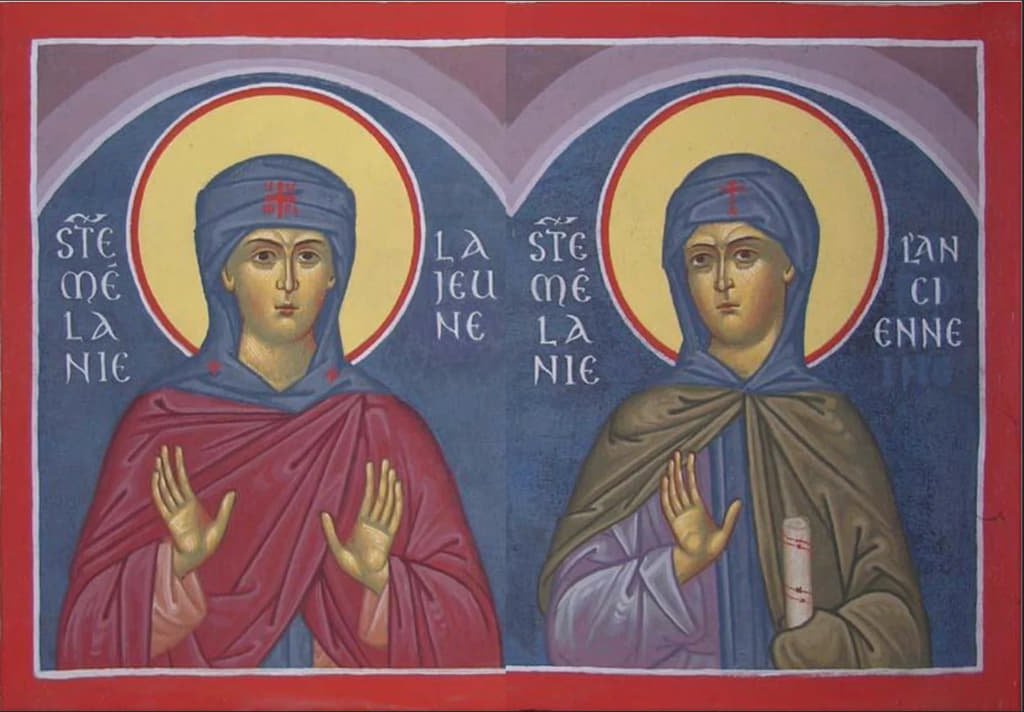
Early Christian history is filled with many pious lives of men and women, who sought out the way of Christ in their own way, and in their endeavors left behind rich spiritual legacies, which never to fail to teach and to move.
We learn of two very holy women, both named “Melania” (an old Graeco-Roman name), and both related. One is known as Saint Melania the Elder and her granddaughter is Saint Melania the Younger. Both underwent pain and loss which was the difficult path that led them to God.
What we know about the elder Melania comes from Lausiac History, the history of ascetics written by Palladius, who was born in the famous city of Galatia (now in Turkey). As we all know, Saint Paul wrote his famous Epistle to the church in this city, around the year 49 AD, and which thus is the earliest Christian historical document.
The various details of Melania’s life that we now know come from Palladius, although a fuller biography can no longer be constructed, given the vicissitudes of time. She was born, around 350 AD, into a Roman senatorial family with ancient and distinguished roots, namely, the gens Antonia. Her paternal grandfather, Antonius Marcellinus, served as consul in 341 AD, one of the highest offices in the Roman state, underscoring the family's elite status. She was of Spanish descent from her mother’s side.
Her family was extremely wealthy, owning vast estates, across several regions, including Italy and Spain. This wealth was typical of the senatorial aristocracy, whose power was largely based on landownership, with close ties to imperial and senatorial circles.
More importantly, Melania’s family was among the early Christian senatorial elite, embracing Christianity at a time when the faith was still consolidating power within Roman society. This religious commitment, combined with their aristocratic status, allowed them to become influential patrons of Christian monasticism and theological scholarship, further enhancing their social and religious significance. They also founded some of the earliest monastic communities in Jerusalem, while their residences, such as the palace on the Caelian Hill, were centers of social and religious activity, hosting bishops, pilgrims, and other dignitaries.
Melania married Valerius Maximus, who belonged to the prestigious gens Valeria, a patrician family with a history of holding top offices; he was likely the praetorian prefecture in the early 360s. The couple had three sons.
When she was twenty-two years of age, Valerius died suddenly. Melania was devastated. Then, then within months of this tragic event, two of her older sons also died. We no longer know what caused these three sudden deaths. Her sole surviving son’s name was Valerius Publicola.
This tragedy became the impetus for a deep and radical spiritual commitment—she left behind her son in Rome and went on a pilgrimage, first to Egypt and then to Palestine
In Egypt, Melania stayed in the Nitrian Desert, near Alexandria, specifically in the area known today as Wadi Natroun. For six months, she lived in the monastic communities, and used her wealth to support them.
During this time, she became familiar with the ideas of the Desert Fathers. Among them, Abba Macarius significantly shaped her theological views. Macarius, known for his deep insight into the interior spiritual life and his teachings on encountering Christ, exemplified a mystical approach to faith that likely influenced Melania’s own spirituality. His emphasis on grace calming the soul, cultivating purity of heart, and loving all people with an “eye of purity” would have shaped her understanding of Christian love and humility.
The Desert Fathers taught that prayer was not about lengthy speeches but about a simple, heartfelt encounter with God, such as the prayer “Lord, have mercy.” This approach to prayer as a direct, humble communion with God would have informed Melania’s own devotional life and theological outlook.
The Desert Fathers’ rigorous asceticism aimed at purgation of sin and union with God through stages of purgative, illuminative, and unitive spiritual growth. Melania’s exposure to these teachings would have deepened her commitment to ascetic discipline and the pursuit of mystical union with God.
Macarius’s example of humility—enduring false accusations with patience and continuing to serve others—embodied a theology of suffering and forgiveness that likely influenced Melania’s views on Christian virtue and the spiritual life.
By engaging with these ascetic leaders in Egypt, Melania absorbed a theology that valued interior transformation, the presence of God in the soul, and the imitation of Christ through love and humility, along with ascetic discipline and a loving communion with God. This experiential and mystical theology complemented her intellectual engagement with Origen and other theologians, blending monastic spirituality with doctrinal reflection.
During her travels in Egypt, she was in the company of ascetics like Pambo, Arsisius, Sarapion the Great, and Paphnutius of Scete.
But the Roman emperor at this time was Valens, who was an Arian heretic (Arianism considered Christ to be only a prophet and thus not God), and who thus persecuted Nicene Christians, that is, those who upheld the Nicene Creed which affirms the divinity of Christ.
Under Valens' rule, there was significant persecution of Nicene Christians, especially in the eastern provinces such as Egypt. The Arians, supported by Valens, actively harassed Nicene Christians through expulsions from churches, imprisonment, fines, physical abuse, and even executions. Notably, the Nicene bishop Athanasius of Alexandria, a staunch opponent of Arianism, was repeatedly targeted by imperial agents and Arian factions, although Valens at times granted temporary reprieves likely due to political considerations and the esteem Athanasius commanded.
Historical accounts describe harsh measures: Nicene clergy were forcibly removed from their churches, beaten, imprisoned, and some were even killed by drowning or by being burned on ships under the pretense of exile. Appeals by Nicene Christians for relief were often futile since Valens himself endorsed or instigated the oppression. This persecution was part of a broader Arian campaign to suppress Nicene orthodoxy during Valens' reign.
This persecution increased after the death of Athanasius in 373 AD, and consequently a large majority of monks moved from Egypt to Palestine. Melania went with them, where her work was primarily centered around her monastic and ascetic activities in Jerusalem, particularly on the Mount of Olives.
Around 375 AD, on the Mount of Olives in Jerusalem, near the site known as the Eleona, which is associated with the place of the Ascension of Christ, she built a monastery and also a House of Mercy, which was an early center of Christian monasticism in Palestine.
She first built a small cell there for her own ascetic life and then established a monastery for women, which housed about 90 sisters, as well as a separate monastery for men dedicated to her spiritual companion Rufinus of Aquileia. This double monastery was among the first of its kind and became an influential center of ascetic practice and scriptural study. The monastery was organized according to the ascetic principles of Basil of Caesarea, and it maintained connections with prominent ascetics and theologians like Evagrius Ponticus, who corresponded with Melania and her community.
The monastery complex included a chapel (oratory), a bath complex, a cistern, and a martyrium where relics were kept. Archaeological remains such as marble fragments and mosaic-paved basins found below the Eleona have been suggested to be connected to Melania’s foundations. Her women’s monastery was located to the east and south of the Eleona site on the Mount of Olives.
Melania was highly educated and deeply knowledgeable in biblical and theological matters. She reportedly read millions of lines of early Christian writings multiple times, including works by Origen and Basil of Caesarea, which gave her a profound understanding of Christian doctrine.
Her intellectual acumen and family connections allowed her to influence the early doctrinal debates, particularly tipping the scales in favor of the Nicene Creed against Arianism, thus helping to shape orthodox Christian belief. Her network extended across the Christian world, linking Western and Eastern theological traditions.
Thus, Melania the Elder was acquainted with and influenced by several highly influential thinkers and theologians of her time, particularly within the Christian ascetic and theological circles of the late 4th and early 5th centuries.
We have already mentioned Abba Macarius and other Desert Fathers in Egypt. She was a contemporary and well known to these early Christian ascetics who shaped monasticism in the Egyptian deserts. Initially praised by Jerome, she later became involved in theological disputes with him, especially over Origenism. She was known to Saint Augustine of Hippo, one of the most important Church Fathers. Paulinus of Nola was either her cousin or cousin-in-law, who described her visit to Nola in his letters. Evagrius Ponticus was a key theologian and ascetic with whom she maintained correspondence; he wrote letters to her community and influenced her spiritual thought. Rufinus of Aquileia was her spiritual companion and a scholar whom she supported financially; she founded a monastery in his honor.
Melania was a follower of Origen’s theological tradition and studied his works extensively, promoting his ascetic and interpretive approaches despite controversy. Origen taught the allegorical interpretation of Scripture, the pre-existence of souls, the subordinationism in the Trinity, universal restoration (Apocatastasis), and eternal creation. Origenism led to significant theological disputes known as the Origenist crises in the 4th and 6th centuries. Eventually, many of Origen’s teachings were condemned by Church councils, notably the Second Council of Constantinople in 553 AD, which anathematized Origenism.
Melania the Elder spent her final years in her convent on the Mount of Olives, where she died around the year 410, or 417.
Back in Rome, Valerius Publicola, the son that Melania had left behind in Rome came to marry Caeionia Albina, who was also of aristocratic descent, and belonged to the Ceionii Rufii branch of the Ceionia gens. She was the daughter of Ceionius Rufius Albinus who served as prefect of Rome from A.D. 389-391.
In around 385 AD, Albina gave birth to a daughter, whom Valerius named Melania, after his own mother. In Church history, she would come to be known as Melania the Younger. What we known about her comes from the Life of Melania the Younger, written shortly after Melania's death in 439 AD (likely circa 450 AD). The text exists in both Greek and Latin versions and was likely written in Jerusalem, where Gerontius was a monk and superior at Melania the Younger's monastery on the Mount of Olives.
In time, in the year 399 AD, the younger Melania married into the Valerii Severii branch of the gens Valeria. Her husband’s name was Valerius Plnianus, and he was the son of Valerius Severus, who was prefect of Rome in 382 AD. Both the Valerii branches possessed vast wealth. For example, the well-known palace of the Valerii on Caelian Hill, was a vast complex.
But like her grandmother, the younger Melania would also lose the two children born to her (first a daughter, and then a still-born son). Thereafter, she and her husband took an oath of celibacy. At this time, her grandmother and namesake, returned from Jerusalem to Rome, to protect her granddaughter and her husband from heresy and to encourage them to take up asceticism.
Their journey of faith had begun. Melania and Pinian began selling off their properties and freeing their slaves to fund Christian charitable works. This decision faced opposition from their families, including Pinian's brother Severus, who attempted legal action to stop the sales, but Melania successfully gained imperial support from Emperor Honorius (384—423 AD). She sold her extensive estates and used the proceeds to support churches, monasteries, and the poor, eventually distributing around 120,000 gold coins, a vast amount at the time.
The Western Roman Empire faced drastic decline at this time, and Honorius's reign was marked by significant instability and decline. Early in his rule, real power was held by the capable general Stilicho, who acted as regent and military commander. Stilicho married his daughter Maria to Honorius to strengthen ties but was executed in 408, leaving Honorius vulnerable. During his reign, the Western Empire faced multiple crises including barbarian invasions, internal revolts, and territorial losses. Notably, Rome was sacked by the Visigoths under King Alaric I in 410, the first sack in nearly 800 years, symbolizing the empire's weakening power.
Honorius moved the imperial capital from Milan to Ravenna for better defense, but this also isolated the emperor from the rest of Italy, hampering effective military response to threats. His reign is often viewed as one of the least capable and most troubled in Roman history, with the Western Roman Empire nearing collapse by the end of his rule. He died in 423 without an heir, leading to a brief interregnum until the Eastern Emperor Theodosius II installed Valentinian III as the new Western Emperor.
In 410, to escape the Visigothic invasion of Italy, Melania, Pinian, and Melania's mother Albina moved to North Africa, where they met Saint Augustine of Hippo. Augustine influenced them to dedicate much of their wealth to the Church. Later, around 417, the three of them relocated to Jerusalem, where they initially lived in a hospice for pilgrims and later in a hermitage near the Mount of Olives, practicing a life of asceticism and prayer. As noted, it was during this time that Melania the Elder died.
Like her grandmother, the younger Melania founded a women's monastery on the Mount of Olives, where she collected important Christian relics, including the bones of the martyr Saint Stephen and the Forty Martyrs of Sebaste, which were enshrined in the oratory of the women's monastery she founded on the Mount of Olives. This chapel housing the relics became a focal point of veneration within her monastic community. Her efforts were part of a broader trend in the early 5th century of seeking relics such as those of the True Cross and martyrs' body parts to enhance the spiritual prestige and religious significance of Christian sites and communities in the Holy Land. Melania's relic collection was integral to her monastic patronage and ascetic projects in Jerusalem, reinforcing the sacred character of the monasteries she built and supported.
Although she declined the role of abbess out of humility, she maintained spiritual leadership and instructed the nuns of her monastery in vigilance, prayer, obedience, and purity.
She and Pinian next built a men's monastery on the Mount of Ascension, which was completed with the help of a benefactor. This monastery became a center for continuous prayer by its inhabitants, and Pinian took charge of it.
Melania's charitable work extended beyond building monasteries; she and her husband continued to sell their estates to support churches, hospitals, widows, orphans, and the indigent throughout Palestine and other regions. In Jerusalem, she distributed gold to the poor and lived a life dedicated to poverty and prayer.
Additionally, Melania was involved in the theological debates of her time, opposing Nestorianism and converting many to Nicene Christianity. Nestorianism emphasized a radical distinction between the divine and human natures of Jesus Christ, effectively teaching that Christ consisted of two separate persons—one divine (the Logos) and one human (Jesus)—who are loosely united rather than fully integrated into one person. Nestorianism was condemned as heresy by the Council of Ephesus in 431 and the Council of Chalcedon in 451, which affirmed the Nicene belief in Christ as one person with two natures united as one.
Pinian died in 432. After his death, Melania continued her religious devotion and charitable work.
Because of her deep spiritual faith, she was an effective evangelizer, winning back people from heresy and converting pagans. For example, she baptized her own uncle, Rufius Antonius Agrypnius Volusianus, often referred to simply as Volusianus. He was a pagan diplomat at the court of Emperor Valentinian and was converted to Christianity through Melania's efforts shortly before his death in January 437.
She is credited with several miracles during her lifetime, primarily related to healing and divine intervention through her prayers. One notable miracle involved Melania healing a woman who was near death during childbirth. Melania prayed for her and placed a miraculous belt around her waist; the woman was healed, and her stillborn infant was revived. She also saved a city from destruction by supplying ransom to barbarians who threatened to lay waste to it, demonstrating a form of miraculous deliverance through her charity and intervention.
These accounts highlight Melania’s role as a healer, intercessor, and spiritual leader whose faith was manifested in tangible miracles and charitable works during her life.
Melania erected a shrine of the Apostles (the Apostoleion) at her monastery on the Mount of Olives around 430 AD. This shrine was closely associated with a cave believed to be where Jesus and the Apostles celebrated the Last Supper. Melania's husband and mother were buried there, and it seems that Melania herself was buried at this site as well. She died on December 31, 439, in Jerusalem.
Her monastery still exists, although it was rebuilt later in the 6th century as the Monastery of Megali Panagia or the Great Panagia. It includes Melania’s cell and chains that she used in her ascetic practice. Her tomb is also found here. Local tradition holds that an underground tunnel once connected this monastery to the Church of the Holy Sepulchre, where Melania would pray at night.
Both the Elder and Younger Melanias were wealthy Roman aristocrats who renounced worldly life to pursue Christian asceticism, founding monastic communities and influencing early Christian spirituality and monasticism. Melania the Elder paved the way as a pioneering Desert Mother, and Melania the Younger continued her legacy in the next generation, with renewed fervor for asceticism and charity.
Featured: Detail of Saints Melania the Elder and Younger, from the Monastery of saint Anthony the Great, Yaroslav, Russia.