The Schabas Precedent: How Israel Derailed a UN War Crimes Investigation
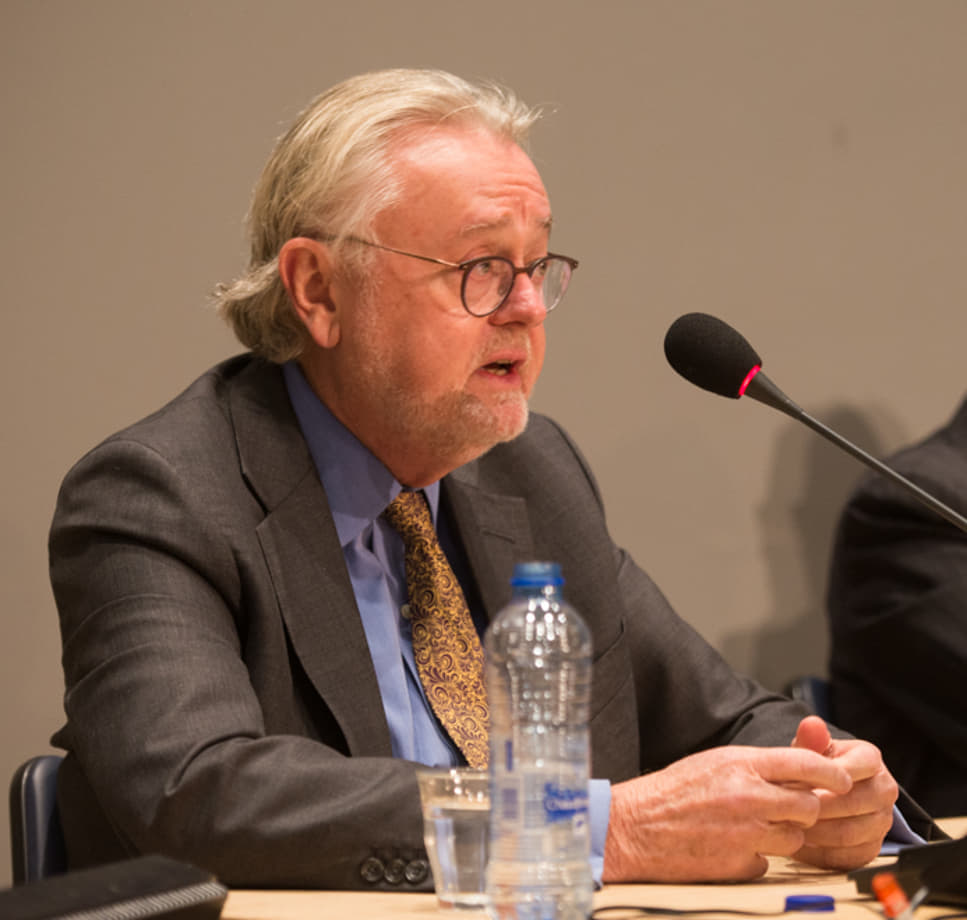
Before Karim Khan, there was William Schabas. A feature investigation into the silencing of international justice.
I. The Man They Could Not Accept
When the United Nations Human Rights Council appointed William Schabas to lead the commission investigating the 2014 Gaza conflict, the reaction from Israel was swift and venomous. Israel's UN Ambassador Ron Prosor likened the appointment to "choosing Count Dracula to run a blood bank."
The comparison was revealing—not for what it said about Schabas, but for what it revealed about Israel's strategy. Schabas was no vampire. He was one of the world's most respected international law scholars: a Canadian professor of international law at Middlesex University and Leiden University, a member of the advisory board of the Israel Law Review, and a former commissioner on the UN's Sierra Leone Truth and Reconciliation Commission. His expertise in international criminal and human rights law was beyond question.
Yet within months of his appointment, Schabas was forced to resign. His crime? Not a conflict of interest—as Israel claimed—but a record of speaking out about Israeli policy that made him unacceptable to a government determined to avoid international scrutiny.
The Schabas affair has become a template for how political pressure can be wielded to derail international justice. It is a case study in what happens when a powerful state decides that the messenger is more important than the message—and that the best way to avoid accountability for war crimes is to ensure no credible investigator can ever deliver the verdict.
II. The Investigation Israel Wanted to Stop
To understand why Israel targeted Schabas so relentlessly, one must first understand what the commission was tasked to investigate. The 50-day conflict between Israel and Hamas in the summer of 2014 had been catastrophic. According to UN figures, more than 2,200 Palestinians died, at least 70 percent of them civilians. Approximately 1,000 of the dead were children. On the Israeli side, 73 people died—all but six were soldiers.
The commission's final report, submitted after Schabas's resignation, would document a level of destruction that the chair, Mary McGowan Davis, described as "unprecedented" with consequences that "will affect generations to come.” The statistics were staggering: more than 6,000 Israeli airstrikes, approximately 50,000 tank and artillery shells fired into one of the most densely populated territories on earth. Some 18,000 homes were destroyed or badly damaged. More than 100,000 Palestinians were displaced.
But it was not just the scale—it was the pattern. The commission documented that at least 142 families lost three or more members in a single attack on a residential building, resulting in 742 deaths. Homes were struck in the middle of the night or as families gathered for the Iftar meal during Ramadan. Approximately 551 children died that summer.
The commission's findings pointed to a deeply troubling pattern: "The fact that Israel did not revise its practice of air-strikes, even after their dire effects on civilians became apparent, raises the question of whether this was part of a broader policy which was at least tacitly approved at the highest level of government.”
The investigation also documented the targeting of civilian infrastructure. On July 30, 2014, Israeli tank shells hit the UNRWA Elementary Girls School in Jabalia, which was being used as a shelter for displaced Palestinians. At least 20 people were killed and more than 100 injured. UNRWA had repeatedly notified the Israeli Defense Forces of the shelter's location to avoid attack.
The commission expressed particular concern about Israel's "extensive use of weapons with a wide kill and injury radius" in densely populated areas, warning that such use was "highly likely to kill combatants and civilians indiscriminately.”
When the report was finally released in June 2015, its conclusion was damning: "The information we gathered points to serious violations of international humanitarian law and international human rights law by Israel and Palestinian armed groups, in some cases amounting to war crimes.”
III. The Pretext for Removal
Israel's official objection to Schabas was narrow: he had provided a paid legal opinion to the Palestine Liberation Organization in 2012 regarding UN status. For this minor consultancy, for which he was paid approximately $1,300, Israel demanded his removal.
Schabas offered to step aside to prevent the "malicious attacks" from distracting the inquiry. But the accusation of a conflict of interest was transparently a pretext. Schabas's views on Israel were already a matter of public record long before he accepted the post. He had famously remarked that Israeli Prime Minister Benjamin Netanyahu would be his "favorite" choice as a defendant at the International Criminal Court. He had questioned why the ICC was not prosecuting the "president of Israel for Gaza" (Shimon Peres).
The Israeli government's statement rejecting the investigation as a "kangaroo court" made clear that the real objection was not to Schabas's consultancy work but to his broader record. Israel's Foreign Ministry declared that it would not cooperate with the "Schabas committee" because it was "not a fact-finding panel but an investigation whose results are pre-determined.”
Even Amnesty International, which was no friend of Hamas, rejected the Israeli government's attempts to paint the commission as "fundamentally biased because of one technical legal opinion." The human rights organization saw the campaign against Schabas as part of a "sustained pattern of Israeli non-cooperation with UN mechanisms.”
IV. The Bludgeon of "Bias"
The accusation of "bias" has become Israel's most effective weapon against international scrutiny. It is deployed with surgical precision: identify the most credible investigator, attack their integrity, and if that doesn't work, attack their independence. The goal is not to prove bias—it is to create the perception of it, to muddy the waters enough that any findings can be dismissed as politically motivated.
Israel's argument is that the UN Human Rights Council is institutionally biased, passing more resolutions against Israel than against Iran, Syria, and North Korea combined. There is a surface logic to this claim. But the Schabas case demonstrates how this broader critique can be weaponized to target individual investigators, regardless of their qualifications or impartiality.
Schabas himself recognized this dynamic. Even if "Spiderman" headed the probe, he said, Israel would have attacked him. His point was that no one would ever be acceptable—not because of any actual bias, but because Israel's strategy is to discredit any investigation before it can begin.
The timing was telling. Israel announced it would not cooperate with the UN investigation before Schabas's consultancy work was even raised as an issue. The "conflict of interest" claim emerged only later, after it became clear that Schabas was not going to be intimidated by the initial attacks. It was a case of finding a pretext to match a predetermined outcome.
V. The Destruction of the Investigation
The Schabas resignation achieved exactly what Israel wanted. It allowed Prime Minister Benjamin Netanyahu to call for the entire inquiry to be "shelved.”
"After the resignation of the commission chairman, who was biased against Israel, the report that was written at the behest of the UN Human Rights Council—an anti-Israeli body that has nothing to do with human rights—should be shelved," Netanyahu declared.
The strategy was cynical but effective. By forcing out the chair, Israel could claim the entire process was tainted. The fact that Schabas had resigned voluntarily—and that his replacement, Mary McGowan Davis, would produce a report that was even more damning—was beside the point. The damage was done. The investigation had been delegitimized in the eyes of the Israeli public and its allies.
Even before the final report was issued, Netanyahu was dismissive. In June 2015, he told his cabinet that reading the upcoming report "would be a waste of time.” The UN Human Rights Council, he insisted, was a "hostile body, not objective regarding Israel." Israel would "act everywhere and as necessary in order to contend with false claims and anti-Israel initiatives.”
The Israeli government also refused to cooperate with the commission's investigation, accusing it of "pre-determined" findings. Hamas, for its part, accused Israel of preventing the commission from reaching Gaza to investigate the "consequences of the war crimes on the ground.” The commission was forced to conduct its work from Jordan, gathering witness testimony remotely.
VI. The Consequences of Silencing Justice
The Schabas affair has had lasting consequences—not just for the investigation of the 2014 Gaza conflict, but for the broader project of international accountability.
First, it demonstrated the vulnerability of international human rights mechanisms to political pressure. If a UN commission can be derailed by attacking the chair, what hope is there for impartial investigations of powerful states? The precedent is dangerous: any state with sufficient diplomatic influence can potentially neutralize an uncomfortable investigation by targeting its leadership.
Second, it sent a chilling message to human rights lawyers and international law experts. Schabas, despite his exceptional credentials and long record of human rights work, was subjected to a smear campaign and death threats. The message was clear: if you speak out on Israel, you will be targeted. Your reputation will be destroyed, your career will be damaged, and your personal safety may be threatened.
Third, it undermined the legitimacy of the UN Human Rights Council itself. By allowing Schabas to be forced out, the Council demonstrated its vulnerability to political pressure. The irony is that Israel's campaign against the Council has been the single most effective force in delegitimizing the body—not because the Council is biased, but because Israel's relentless attacks have made it impossible for the Council to function credibly.
The same weapon was used to silence Fatou Bensouda and now Karim Khan.
VII. The Uncomfortable Questions
The Schabas affair raises questions that Israel and its allies have never adequately answered.
If the investigation was truly biased, why did Schabas's replacement produce a report that was just as critical? Mary McGowan Davis, who succeeded Schabas as chair, was not the target of the same vitriol. Yet her commission reached the same conclusions: that serious violations of international law had occurred, and that they "in some cases amount to war crimes.”
If the UN Human Rights Council is irredeemably biased, why does Israel continue to engage with it selectively? Israel has refused to cooperate with some UN investigations while agreeing to others. It cooperated, for example, with a UN investigation into attacks on UN facilities during the Gaza war—a decision that suggests the objection is not to the institution itself but to investigations that might produce uncomfortable findings.
If Israel has nothing to hide, why did it refuse to cooperate with the commission of inquiry? The Israeli government insisted that its military acted "in accordance with international law" and that the fighting was aimed at stopping Hamas rocket fire. Yet it refused to provide evidence to support this claim, instead dismissing the entire process as a witch hunt.
VIII. A Pattern of Impunity
The Schabas case is not an isolated incident. It is part of a broader pattern in which Israel and its allies target critics of Israeli policy with accusations of anti-Semitism, bias, or political motivation. The goal is to create a chilling effect: anyone who speaks out against Israeli policy risks being labeled a bigot, a terrorist sympathizer, or an enemy of the state.
This strategy has been remarkably effective. The accusation of bias has become a catch-all defense against any uncomfortable scrutiny. Whether the issue is settlements, military operations, or human rights violations, Israel's response is to attack the messenger rather than address the message.
The Schabas affair also reveals the double standard at the heart of this strategy. When a UN investigator has any connection to the Palestinian side, it is evidence of fatal bias. But when a UN investigator has no connection to the Palestinian side, that is also evidence of bias—because the UN itself is biased. The logic is circular: any investigation that produces findings critical of Israel is, by definition, biased.
IX. The Legacy of the Schabas Affair
More than a decade after Schabas's resignation, his case remains a cautionary tale about the limits of international justice. The commission he was forced to leave produced a damning report that documented war crimes. But the report had no teeth. No one was prosecuted. No one was held accountable. The victims and their families received no justice.
Schabas himself has continued to speak out. In recent years, he has stated that the UN Commission of Inquiry has concluded that Israel is committing genocide in Gaza. The fact that he continues to make such statements—even after the campaign against him—is a testament to his integrity. But it also underscores the persistence of the abuses he was appointed to investigate.
The Schabas affair is a reminder that international justice is fragile—and that states with power and influence can often escape accountability. The question is not whether Israel is guilty of war crimes. The commission's report, and the pattern of conduct it documented, suggests that the answer is clear. The question is whether the international community has the will to enforce its own laws.
X. Conclusion: The Price of Principle
William Schabas was forced to resign not because he was biased, but because he was credible. A less qualified investigator might have survived the attacks. A more pliable investigator might have been acceptable. But Schabas—with his impeccable credentials, his long record of human rights work, and his willingness to speak truth to power—was exactly the kind of person Israel could not allow to lead the investigation.
The price of Schabas's principle was his reputation, his safety, and his position. The price of the international community's silence has been the erosion of international law and the perpetuation of impunity. The victims of the 2014 Gaza conflict—the families killed in their homes, the children who died in UN schools, the thousands of civilians who lost everything—received no justice.
The Schabas precedent remains a stain on the international human rights system. It demonstrates that political pressure can neuter even the most credible investigations. It shows that the accusation of "bias" has become a weapon to silence critics. And it confirms the uncomfortable truth that international justice depends not on the strength of the law, but on the willingness of powerful states to submit to it.
*****
William Schabas is a professor of international law at Middlesex University and Leiden University and a former commissioner on the UN Sierra Leone Truth and Reconciliation Commission.
Mary McGowan Davis, who replaced Schabas as chair, served as a judge on the Supreme Court of New York and presented the commission's final report to the UN Human Rights Council in June 2015.