The Systematic Destruction of Palestinian Agriculture: A Deliberate Strategy of Deprivation
Introduction
The agricultural sector has long been the backbone of the Palestinian economy and a cornerstone of its cultural identity, providing sustenance, livelihood, and a deep connection to the land. However, this vital foundation is being systematically dismantled. Through a multifaceted campaign involving the direct destruction of farmland, crippling restrictions on access and movement, and violent attacks on farmers, Israeli policies and military actions have brought Palestinian agriculture to the brink of collapse. This is not a series of isolated incidents or unfortunate byproducts of conflict, but rather a coordinated strategy that undermines food sovereignty, cripples economic resilience, and ultimately serves to dispossess Palestinians of their land and livelihood. The devastating impact on Gaza’s agricultural capacity, with over 90% of its land damaged or inaccessible, and the relentless pressure on West Bank farmers, constitute a severe violation of human rights and international law, creating a man-made crisis of hunger and despair.
The Physical Annihilation of Agricultural Land
The most visible and brutal aspect of this campaign is the physical destruction of cultivated land. This occurs primarily through the use of bulldozers and deliberate military bombardment.
In the Gaza Strip, the scale of destruction is catastrophic. According to the UN Food and Agriculture Organization (FAO) and numerous Palestinian ministries, Israeli military operations have damaged or rendered inaccessible over 90% of Gaza's agricultural land. This includes the systematic bulldozing of vast orchards of olive, citrus, and date palms, and the destruction of greenhouses and fields. For instance, during the 2014 war, the Israeli military completely razed the agricultural district of Al-Zanna, known as Gaza's "food basket," along with countless other farms. This pattern has repeated in every subsequent escalation, most severely in the ongoing operations, where satellite imagery shows entire agricultural landscapes scarred by tracks from armored bulldozers and cratered by bombs.
In the West Bank, destruction often serves the expansion of illegal Israeli settlements and the accompanying infrastructure. Farmland is regularly bulldozed to make way for settlements, settler-only bypass roads, and the controversial separation barrier. The village of Wadi al-Seeq, for example, has seen hundreds of dunums of its pastoral land confiscated and cleared for this purpose. The rationale often provided is "security," but the outcome is consistently the transfer of fertile Palestinian land to Israeli control, permanently severing farmers from their primary source of income and food.
The Strangulation of Access and Movement
Beyond outright destruction, a complex system of permits, checkpoints, and blockades systematically denies Palestinian farmers access to their own fields, effectively strangling agricultural productivity.
In the West Bank, farmers whose land lies in Area C (under full Israeli military control) or, most cruelly, behind the separation barrier, face an impossible bureaucratic nightmare. They must apply for permits from the Israeli military to access their own land. These permits are often denied arbitrarily or delayed until the critical planting or harvest season has passed. Checkpoints and agricultural gates in the barrier open only at specific, limited times, forcing farmers to waste hours each day waiting. This not only reduces productivity but also increases costs, making their produce less competitive. For farmers in the "seam zone" between the barrier and the 1949 armistice line, getting water, fertilizer, and equipment to their land is a daily struggle, leading many to abandon their farms altogether.
In Gaza, the 16-year blockade constitutes a form of agricultural warfare. The import of essential inputs like fertilizers, pesticides, high-yield seeds, and veterinary medicines is heavily restricted or banned by Israel, citing "dual-use" concerns that these items could be repurposed by militant groups. The fishing zone, a crucial source of protein, has been repeatedly reduced and is often enforced with live fire. The blockade prevents the export of most agricultural goods, destroying any possibility of a sustainable economy. This deliberate restriction of basic necessities for farming has crippled Gaza's ability to feed itself, creating a state of near-total dependency on international aid.
Violent Attacks on Farmers and Their Produce
Palestinian farmers and their crops are not just passive victims of policy; they are active targets of violence. This violence comes from both state actors and state-backed settlers.
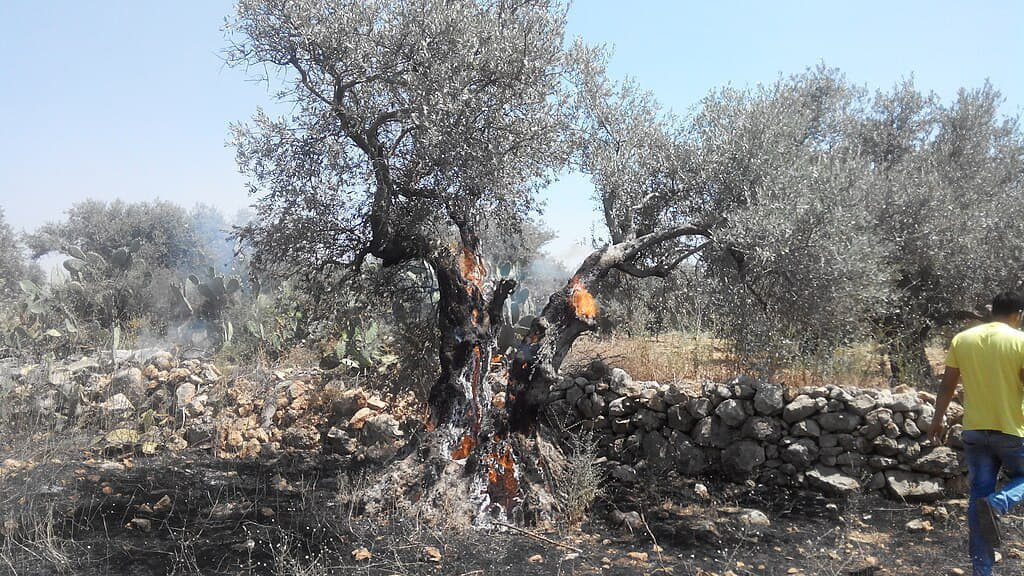
In the West Bank, settler violence against Palestinian farmers is rampant and rarely prosecuted. During the annual olive harvest—a central cultural and economic event—farmers are routinely attacked, their trees vandalized, burned, or uprooted. In 2023, the UN recorded hundreds of such incidents. In the South Hebron Hills, shepherds are frequently assaulted and their livestock stolen or killed by settlers from nearby outposts. The Israeli military often acts as a passive observer or, in some documented cases, provides security for the settlers during these attacks. This environment of intimidation is designed to terrorize Palestinians into leaving their land, thereby making it available for settlement expansion.
In Gaza, farmers working their fields near the unilaterally declared "buffer zone" along the perimeter fence face constant danger. Israeli soldiers routinely fire live ammunition, tank shells, and drones at anyone venturing within hundreds of meters of the fence, including farmers tending to their crops. According to the Palestinian Ministry of Agriculture and human rights groups like Al Mezan, dozens of farmers and farmworkers have been killed and many more injured in these areas over the years. This practice effectively annexes large swathes of Gaza's most fertile land to Israel, rendering it a no-go zone for Palestinians and further constricting the already besieged strip's food production capacity.
A Strategy of Domination and Dispossession
The consistency and comprehensiveness of these actions point to a strategy that extends beyond mere security concerns. The destruction of Palestinian agriculture serves several strategic Israeli objectives:
- Territorial Expansion: By destroying orchards and preventing farmers from accessing their land, Israel creates "facts on the ground." Abandoned land is often declared "state land" or "firing zones" and later annexed for settlement expansion. This is a slow-motion process of land confiscation.
- Undermining Economic Viability: A weak Palestinian economy is less able to support political independence. By targeting agriculture—a major employer and source of GDP—Israel cripples the potential for a sustainable Palestinian state, ensuring economic dependence and weakening political resistance.
- Demographic Control: Making life unbearable through food insecurity and economic despair is a powerful tool for encouraging emigration. This aligns with the goals of hard-line factions that seek to minimize the Palestinian presence in the land.
- Collective Punishment: In Gaza particularly, the destruction of agriculture and the imposition of a blockade are forms of collective punishment against the entire population for the actions of Hamas, a policy condemned under international humanitarian law.
International law is unequivocal on these matters. The Fourth Geneva Convention prohibits the destruction of property not rendered absolutely necessary by military operations and obliges an occupying power to ensure the food and well-being of the occupied population. The deliberate targeting of civilian infrastructure, including farms and greenhouses, and the imposition of a blockade that causes starvation, are potential war crimes.
Conclusion
The evidence is overwhelming and undeniable. From the bulldozed groves of Gaza to the permit-restricted fields of the West Bank, Israeli actions constitute a systematic and deliberate assault on Palestinian agriculture. This is not a secondary effect of conflict but a primary tool of control, dispossession, and domination. The result is a profound human tragedy: a man-made famine in Gaza, the crushing of centuries-old farming traditions, and the deliberate creation of a people deprived of their right to feed themselves and their children.
To remain silent in the face of this systematic destruction is to be complicit in a strategy that uses hunger as a weapon and land theft as policy. The international community has a legal and moral obligation to move beyond statements of concern. It must demand an immediate end to the blockade of Gaza, the dismantling of the permit regime in the West Bank, and accountability for the destruction of farmland and the violence against farmers. Supporting Palestinian agriculture is not just about food security; it is about defending the very right of a people to exist on their land with dignity and self-determination.