The Apology Of Aristides Of Athens
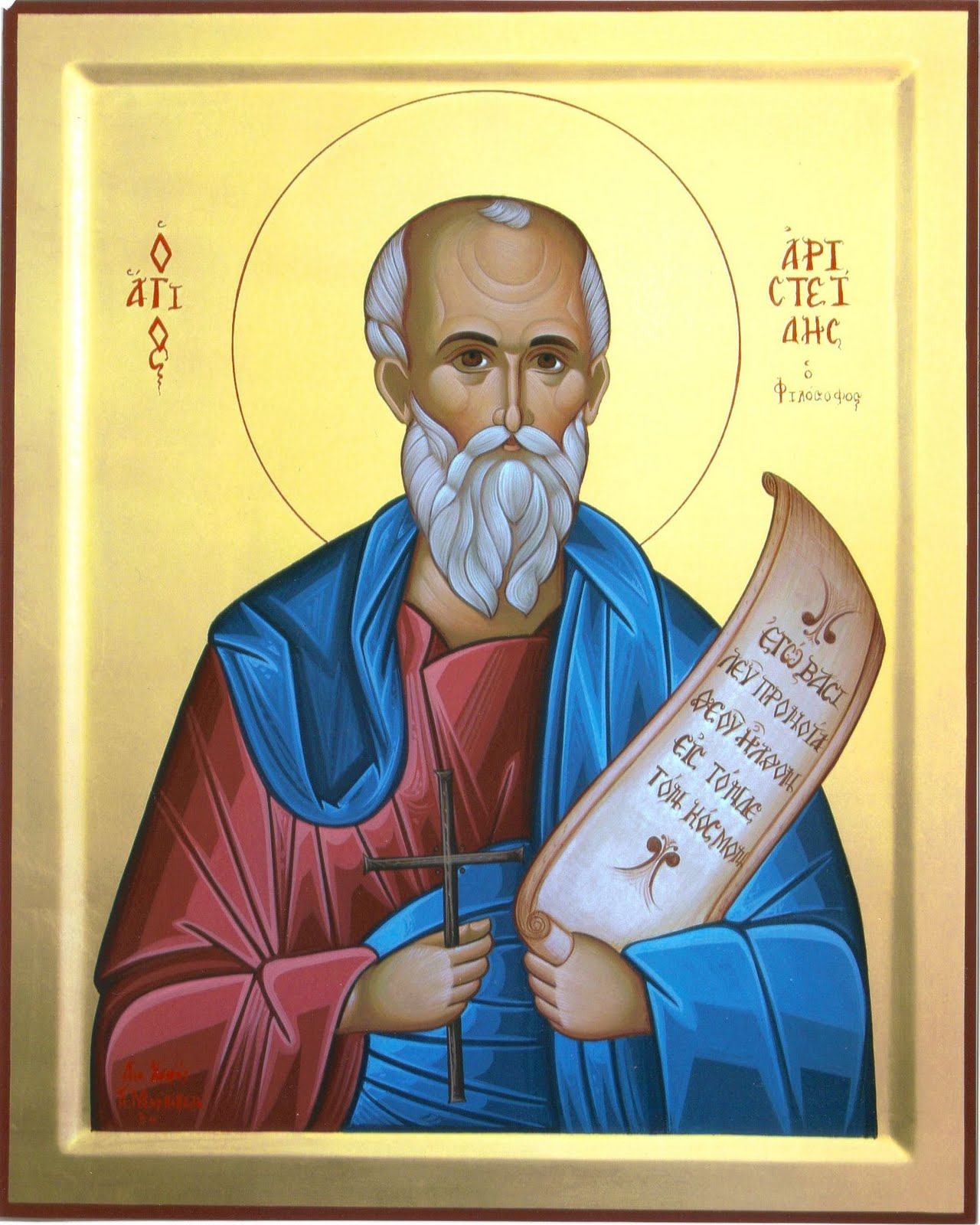
[This is the 1891 translation, by D.M. Kay, B.Sc, B.D, of the Syriac
recension].
Here follows the defence which Aristides the philosopher made before Hadrian
the King on behalf of reverence for God.
. . . All-powerful Caesar Titus Hadrianus Antoninus, venerable and merciful,
from Marcianus Aristides, an Athenian philosopher.
I. I, O King, by the grace of God came into this world; and when I had
considered the heaven and the earth and the seas, and had surveyed the sun and
the rest of creation, I marvelled at the beauty of the world. And I perceived
that the world and all that is therein are moved by the power of another; and I
understood that he who moves them is God, who is hidden in them, and veiled by
them. And it is manifest that that which causes motion is more powerful than
that which is moved. But that I should make search concerning this same mover
of all, as to what is his nature (for it seems to me, he is indeed unsearchable
in his nature), and that I should argue as to the constancy of his government,
so as to grasp it fully,--this is a vain effort for me; for it is not possible
that a man should fully comprehend it. I say, however, concerning this mover of
the world, that he is God of all, who made all things for the sake of mankind.
And it seems to me that this is reasonable, that one should fear God and should
not oppress man.
I say, then, that God is not born, not made, an ever-abiding nature without
beginning and without end, immortal, perfect, and incomprehensible. Now when I
say that he is "perfect," this means that there is not in him any
defect, and he is not in need of anything but all things are in need of him.
And when I say that he is "without beginning," this means that
everything which has beginning has also an end, and that which has an end may
be brought to an end. He has no name, for everything which has a name is
kindred to things created. Form he has none, nor yet any union of members; for
whatsoever possesses these is kindred to things fashioned. He is neither male
nor female. The heavens do not limit him, but the heavens and all things,
visible and invisible, receive their bounds from him. Adversary he has none,
for there exists not any stronger than he. Wrath and indignation he possesses
not, for there is nothing which is able to stand against him. Ignorance and
forgetfulness are not in his nature, for he is altogether wisdom and
understanding; and in Him stands fast all that exists. He requires not
sacrifice and libation, nor even one of things visible; He requires not aught
from any, but all living creatures stand in need of him.
II. Since, then, we have addressed you concerning God, so far as our
discourse can bear upon him, let us now come to the race of men, that we may
know which of them participate in the truth of which we have spoken, and which
of them go astray from it.
This is clear to you, O King, that there are four classes of men in this
world: Barbarians and Greeks, Jews and Christians. The Barbarians, indeed,
trace the origin of their kind of religion from Kronos and from Rhea and their
other gods; the Greeks, however, from Helenos, who is said to be sprung from
Zeus. And by Helenos there were born Aiolos and Xuthos; and there were others
descended from Inachos and Phoroneus, and lastly from the Egyptian Danaos and
from Kadmos and from Dionysos.
The Jews, again, trace the origin of their race from Abraham, who begat
Isaac, of whom was born Jacob. And he begat twelve sons who migrated from Syria
to Egypt; and there they were called the nation of the Hebrews, by him who made
their laws; and at length they were named Jews.
The Christians, then, trace the beginning of their religion from Jesus the
Messiah; and he is named the Son of God Most High. And it is said that God came
down from heaven, and from a Hebrew virgin assumed and clothed himself with
flesh; and the Son of God lived in a daughter of man. This is taught in the
gospel, as it is called, which a short time was preached among them; and you
also if you will read therein, may perceive the power which belongs to it. This
Jesus, then, was born of the race of the Hebrews; and he had twelve disciples
in order that the purpose of his incarnation might in time be accomplished. But
he himself was pierced by the Jews, and he died and was buried; and they say
that after three days he rose and ascended to heaven. Thereupon these twelve
disciples went forth throughout the known parts of the world, and kept showing
his greatness with all modesty and uprightness. And hence also those of the
present day who believe that preaching are called Christians, and they are become
famous.
So then there are, as I said above, four classes of men: Barbarians and
Greeks, Jews and Christians.
Moreover, the wind is obedient to God, and fire to the angels; the waters
also to the demons and the earth to the sons of men. [Possibly inserted by
mistake into one of the early MSS.]
III. Let us begin, then, with the Barbarians, and go on to the rest of the
nations one after another, that we may see which of them hold the truth as to
God and which of them hold error.
The Barbarians, then, as they did not apprehend God, went astray among the
elements, and began to worship things created instead of their Creator; and for
this end they made images and shut them up in shrines, and lo! they worship
them, guarding them the while with much care, lest their gods be stolen by
robbers. And the Barbarians did not observe that that which acts as guard is
greater than that which is guarded, and that every one who creates is greater
than that which is created. If it be, then, that their gods are too feeble to
see to their own safety, how will they take thought for the safety of men?
Great then is the error into which the Barbarians wandered in worshipping
lifeless images which can do nothing to help them. And I am led to wonder, O
King, at their philosophers, how that even they went astray, and gave the name
of gods to images which were made in honour of the elements; and that their
sages did not perceive that the elements also are dissoluble and perishable.
For if a small part of an element is dissolved or destroyed, the whole of it
may be dissolved and destroyed. If then the elements themselves are dissolved
and destroyed and forced to be subject to another that is more stubborn than
they, and if they are not in their nature gods, why, for sooth, do they call
the images which are made in their honour, God? Great, then, is the error which
the philosophers among them have brought upon their followers.
IV. Let us turn now, O King, to the elements in themselves, that we may make
clear in regard to them, that they are not gods, but a created thing, liable to
ruin and change, which is of the same nature as man; whereas God is
imperishable and unvarying, and invisible, while yet He sees, and overrules,
and transforms all things.
Those then who believe concerning the earth that it is a god have hitherto
deceived themselves, since it is furrowed and set with plants and trenched; and
it takes in the filthy refuse of men and beasts and cattle. And at times it
becomes unfruitful, for if it be burnt to ashes it becomes devoid of life, for
nothing germinates from an earthen jar. And besides if water be collected upon
it, it is dissolved together with its products. And lo! it is trodden under
foot of men and beast, and receives the blood of the slain; and it is dug open,
and filled with the dead, and becomes a tomb for corpses. But it is impossible
that a nature, which is holy and worthy and blessed and immortal, should allow
of any one of these things. And hence it appears to us that the earth is not a
god but a creation of God.
V. In the same way, again, those erred who believed the waters to be gods.
For the waters were created for the use of man, and are put under his rule in
many ways. For they suffer change and admit impurity, and are destroyed and
lose their nature while they are boiled into many substances. And they take
colours which do not belong. to them; they are also congealed by frost and are
mingled and permeated with the filth of men and beasts, and with the blood of
the slain. And being checked by skilled workmen through the restraint of
aqueducts, they flow and are diverted against their inclination, and come into
gardens and other places in order that they may be collected and issue forth as
a means of fertility for man, and that they may cleanse away every impurity and
fulfil the service man requires from them. Wherefore it is impossible that the
waters should be a god, but they are a work of God and a part of the world.
In like manner also they who believed that fire is a god erred to no slight
extent. For it, too, was created for the service of men, and is subject to them
in many ways:--in the preparation of meats, and as a means of casting metals,
and for other ends whereof your Majesty is aware. At the same time it is
quenched and extinguished in many ways.
Again they also erred who believed the motion of the winds to be a god. For
it is well known to us that those winds are under the dominion of another, at
times their motion increases, and at times it fails and ceases at the command
of him who controls them. For they were created by God for the sake of men, in
order to supply the necessity of trees and fruits and seeds; and to bring over
the sea ships which convey for men necessaries and goods from places where they
are found to places where they are not found; and to govern the quarters of the
world. And as for itself, at times it increases and again abates; and in one
place brings help and in another causes disaster at the bidding of him who
rules it. And mankind too are able by known means to confine and keep it in
check in order that it may fulfil for them the service they require from it.
And of itself it has not any authority at all. And hence it is impossible that
the winds should be called gods, but rather a thing made by God.
VI. So also they erred who believed that the sun is a god. For we see that
it is moved by the compulsion of another, and revolves and makes its journey,
and proceeds from sign to sign, rising and setting every day, so as to give
warmth for the growth of plants and trees, and to bring forth into the air
wherewith it (sunlight) is mingled every growing thing which is upon the earth.
And to it there belongs by comparison a part in common with the rest of the
stars in its course; and though it is one in its nature it is associated with
many parts for the supply of the needs of men; and that not according to its
own will but rather according to the will of him who rules it. And hence it is
impossible that the sun should be a god, but the work of God; and in like
manner also the moon and the stars.
VII. And those who believed of the men of the past, that some of them were
gods, they too were much mistaken. For as you yourself allow, O King, man is
constituted of the four elements and of a soul and a spirit (and hence he is
called a microcosm), and without any one of these parts he could not consist.
He has a beginning and an end, and he is born and dies. But God, as I said, has
none of these things in his nature, but is uncreated and imperishable. And
hence it is not possible that we should set up man to be of the nature of
God:--man, to whom at times when he looks for joy, there comes trouble, and
when he looks for laughter there comes to him weeping,--who is wrathful and
covetous and envious, with other defects as well. And he is destroyed in many
ways by the elements and also by the animals.
And hence, O King, we are bound to recognize the error of the Barbarians,
that thereby, since they did not find traces of the true God, they fell aside
from the truth, and went after the desire of their imagination, serving the
perishable elements and lifeless images, and through their error not
apprehending what the true God is.
VIII. Let us turn further to the Greeks also, that we may know what opinion
they hold as to the true God. The Greeks, then, because they are more subtle
than the Barbarians, have gone further astray than the Barbarians; inasmuch as
they have introduced many fictitious gods, and have set up some of them as
males and some as females; and in that some of their gods were found who were
adulterers, and did murder, and were deluded, and envious, and wrathful and
passionate, and parricides, and thieves, and robbers. And some of them, they
say, were crippled and limped, and some were sorcerers, and some actually went
mad, and some played on lyres, and some were given to roaming on the hills, and
some even died, and some were struck dead by lightning, and some were made
servants even to men, and some escaped by flight, and some were kidnapped by
men, and some, indeed, were lamented and deplored by men. And some, they say,
went down to Sheol, and some were grievously wounded, and some transformed
themselves into the likeness of animals to seduce the race of mortal women, and
some polluted themselves by lying with males And some, they say, were wedded to
their mothers and their sisters and their daughters. And they say of their gods
that they committed adultery with the daughters of men; and of these there was
born a certain race which also was mortal. And they say that some of the females
disputed about beauty, and appeared before men for judgment. Thus, O King, have
the Greeks put forward foulness, and absurdity, and folly about their gods and
about themselves, in that they have called those that are of such a nature,
gods, who are no gods. And hence mankind has received incitements to commit
adultery and fornication, and to steal and to practise all that is offensive
and hated and abhorred. For if they who are called their gods practised all
these things which are written above, how much more should men practise
them--men, who believe that their gods themselves practised them. And owing to
the foulness of this error there have happened to mankind harassing wars, and
great famines, and bitter captivity, and complete desolation. And lo! it was by
reason of this alone that they suffered and that all these things came upon
them; and while they endured those things they did not perceive in their mind
that for their error those things came upon them.
IX. Let us proceed further to their account of their gods that we may
carefully demonstrate all that is said above. First of all, the Greeks bring
forward as a god Kronos, that is to say Chiun (Saturn). And his worshippers
sacrifice their children to him, and they burn some of them alive in his honour.
And they say that he took to him among his wives Rhea, and begat many children
by her. By her too he begat Dios, who is called Zeus. And at length he (Kronos)
went mad, and through fear of an oracle that had been made known to him, he
began to devour his sons. And from him Zeus was stolen away without his
knowledge; and at length Zeus bound him, and mutilated the signs of his
manhood, and flung them into the sea. And hence, as they say in fable, there
was engendered Aphrodite, who is called Astarte. And he (Zeus) cast out Kronos
fettered into darkness. Great then is the error and ignominy which the Greeks
have brought forward about the first of their gods, in that they have said all
this about him, O King. It is impossible that a god should be bound or
mutilated; and if it be otherwise, he is indeed miserable.
And after Kronos they bring forward another god Zeus. And they say of him that
he assumed the sovereignty, and was king over all the gods. And they say that
he changed himself into a beast and other shapes in order to seduce mortal
women, and to raise up by them children for himself. Once, they say, he changed
himself into a bull through love of Europe and Pasiphae. And again he changed
himself into the likeness of gold through love of Danae, and to a swan through
love of Leda, and to a man through love of Antiope, and to lightning through
love of Luna, and so by these he begat many children. For by Antiope, they say,
that he begat Zethus and Amphion, and by Luna Dionysos, by Alcmena Hercules,
and by Leto, Apollo and Artemis, and by Danae Perseus, and by Leda, Castor and
Polydeuces, and Helene and Paludus, and by Mnemosyne he begat nine daughters
whom they styled the Muses, and by Europe, Minos and Rhadamanthos and Sarpedon.
And lastly, he changed himself into the likeness of an eagle through his
passion for Ganydemos (Ganymede) the shepherd.
By reason of these tales, O King, much evil has arisen among men, who to
this day are imitators of their gods, and practise adultery and defile
themselves with their mothers and their sisters, and by lying with males, and
some make bold to slay even their parents. For if he who is said to be the
chief and king of their gods do these things how much more should his
worshippers imitate him? And great is the folly which the Greeks have brought
forward in their narrative concerning him. For it is impossible that a god
should practise adultery or fornication or come near to lie with males, or kill
his parents; and if it be otherwise, he is much worse than a destructive demon.
X. Again they bring forward as another god Hephaistos. And they say of him,
that he is lame, and a cap is set on his head, and he holds in his hands
firetongs and a hammer; and he follows the craft of iron working, that thereby
he may procure the necessaries of his livelihood. Is then this god so very
needy? But it cannot be that a god should be needy or lame, else he is very worthless.
And further they bring in another god and call him Hermes. And they say that
he is a thief, a lover of avarice, and greedy for gain, and a magician, and
mutilated and an athlete, and an interpreter of language. But it is impossible
that a god should be a magician or avaricious, or maimed, or craving for what
is not his, or an athlete. And, if it be otherwise, he is found to be useless.
And after him they bring forward as another god Asklepios. And they say that
he is a physician and prepares drugs and plaster that he may supply the
necessaries of his livelihood. Is then this god in want? And at length he was
struck with lightning by Dios on account of Tyndareos of Lacedaemon, and so he
died. If then Asklepios were a god, and, when he was struck with lightning, was
unable to help himself, how should he be able to give help to others? But that
a divine nature should be in want or be destroyed by lightning is impossible.
And, again, they bring forward another as a god, and they call him Ares. And
they say that he is a warrior, and jealous, and covets sheep and things which
are not his. And he makes gain by his arms. And they say that at length he
committed adultery with Aphrodite, and was caught by the little boy Eros and by
Hephaistos the husband of Aphrodite. But it is impossible that a god should be
a warrior or bound or an adulterer.
And, again, they say of Dionysos that he forsooth! is a god, who arranges
carousals by night, and teaches drunkenness, and carries off women who do not
belong to him. And at length, they say, he went mad and dismissed his
handmaidens and fled into the desert; and during his madness he ate serpents.
And at last he was killed by Titanos. If then Dionysos were a god, and when he
was being killed was unable to help himself, how is it possible that he should
help others?
Herakles next they bring forward and say that he is a god, who hates
detestable things, a tyrant, and warrior and a destroyer of plagues. And of him
also they say that at length he became mad and killed his own children, and
east himself into a fire and died. If then Herakles is a god, and in all these
calamities was unable to rescue himself, how should others ask help from him?
But it is impossible that a god should be mad, or drunken or a slayer of his
children, or consumed by fire.
XI. And after him they bring forward another god and call him Apollon. And
they say that he is jealous and inconstant, and at times he holds the bow and
quiver, and again the lyre and plectron. And he utters oracles for men that he
may receive rewards from them. Is then this god in need of rewards? But it is
an insult that all these things should be found with a god.
And after him they bring forward as a goddess Artemis, the sister of Apollo;
and they say that she was a huntress and that she herself used to carry a bow
and bolts, and to roam about upon the mountains, leading the hounds to hunt
stags or wild bears of the field. But it is disgraceful that a virgin maid
should roam alone upon the hills or hunt in the chase for animals. Wherefore it
is impossible that Artemis should be a goddess.
Again, they say of Aphrodite that she indeed is a goddess. And at times she
dwells with their gods, but at other times she is a neighbour to men. And once
she had Ares as a lover, and again Adonis who is Tammuz. Once also, Aphrodite
was wailing and weeping for the death of Tammuz, and they my that she went down
to Sheol that she might redeem Adonis from Persephone, who is the daughter of
Sheol (Hades). If then Aphrodite is a goddess and was unable to help her lover
at his death, how will she find it possible to help others? And this cannot be
listened to, that a divine nature should come to weeping and wailing and
adultery.
And. again. they say of Tammuz that he is a god. And he is, forsooth! a
hunter and an adulterer. And they say that he was killed by a wound from a wild
boar, without being able to help himself. And if he could not help himself, how
can he take thought for the human race? But that a god should be an adulterer
or a hunter or should die by violence is impossible.
Again, they say of Rhea that she is the mother of their gods. And they say
that she had once a lover Atys, and that she used to delight in depraved men.
And at last she raised a lamentation and mourned for Atys her lover. If then
the mother of their gods was unable to help her lover and deliver him from
death, how can she help others? So, it is disgraceful that a goddess should
lament and weep and take delight in depraved men.
Again, they introduce Kore and say that she is a goddess, and she was stolen
away by Pluto, and could not help herself. If then she is a goddess and was
unable to help herself how will she find means to help others? For a god who is
stolen away is very powerless.
All this, then, O King, have the Greeks brought forward concerning their
gods, and they have invented and declared it concerning them. And hence all men
received an impulse to work all profanity and all defilements; and hereby the
whole earth was corrupted.
XII. The Egyptians, moreover, because they are more base and stupid than
every people that is on the earth, have themselves erred more than all. For the
deities (or religion) of the Barbarians and the Greeks did not suffice for
them, but they introduced some also of the nature of the animals, and said
thereof that they were gods, and likewise of creeping things which are found on
the dry land and in the waters. And of plants and herbs they said that some of
them were gods. And they were corrupted by every kind of delusion and
defilement more than every people that is on the earth. For from ancient times
they worshipped Isis, and they say that she is a goddess whose husband was
Osiris her brother. And when Osiris was killed by Typhon his brother, Isis fled
with Horos her son to Byblus in Syria, and was there for a certain time till
her son was grown. And he contended with Typhon his uncle, and killed him. And
then Isis returned and went about with Horos her son and sought for the dead
body of Osiris her lord, bitterly lamenting his death. If then Isis be a
goddess, and could not help Osiris her brother and lord, how can she help
another? But it is impossible that a divine nature should be afraid, and flee
for safety, or should weep and wail; or else it is very miserable.
And of Osiris also they say that he is a serviceable god. And he was killed
by Typhon and was unable to help himself. But it is well known that this cannot
be asserted of divinity. And further, they say of his brother Typhon that he is
a god, who killed his brother and was killed by his brother's son and by his
bride, being unable to help himself. And how, pray, is he a god who does not
save himself?
As the Egyptians, then, were more stupid than the rest of the nations, these
and such like gods did not suffice for them. Nay, but they even apply the name
of gods to animals in which there is no soul at all. For some of them worship
the sheep and others the calf; and some the pig and others the shad fish; and
some the crocodile and the hawk and the fish and the ibis and the vulture and the
eagle and the raven. Some of them worship the cat, and others the turbot-fish,
some the dog, some the adder, and some the asp, and others the lion; and others
the garlic and onions and thorns, and others the tiger and other such things.
And the poor creatures do not see that all these things are nothing, although
they daily witness their gods being eaten and consumed by men and also by their
fellows; while some of them are cremated, and some die and decay and become
dust, without their observing that they perish in many ways. So the Egyptians
have not observed that such things which are not equal to their own
deliverance, are not gods. And if, forsooth, they are weak in the case of their
own deliverance, whence have they power to help in the case of deliverance of
their worshippers? Great then is the error into which the Egyptians
wandered;--greater, indeed, than that of any people which is upon the face of
the earth.
XIII. But it is a marvel, O King, with regard to the Greeks, who surpass all
other peoples in their manner of life and reasoning, how they have gone astray
after dead idols and lifeless images. And yet they see their gods in the hands
of their artificers being sawn out, and planed and docked, and hacked short,
and charred, and ornamented, and being altered by them in every kind of way.
And when they grow old, and are worn away through lapse of time, and when they
are molten and crushed to powder, how, I wonder, did they not perceive
concerning them, that they are not gods? And as for those who did not find
deliverance for themselves, how can they serve the distress of men?
But even the writers and philosophers among them have wrongly alleged that
the gods are such as are made in honour of God Almighty. And they err in
seeking to liken (them) to God whom man has not at any time seen nor can see
unto what He is like. Herein, too (they err) in asserting of deity that any
such thing as deficiency can be present to it; as when they say that He
receives sacrifice and requires burnt-offering and libation and immolations of
men, and temples. But God is not in need, and none of these things is necessary
to Him; and it is clear that men err in these things they imagine.
Further their writers and their philosophers represent and declare that the
nature of all their gods is one. And they have not apprehended God our Lord who
while He is one, is in all. They err therefore. For if the body of a man while
it is many in its parts is not in dread, one member of another, but, since it
is a united body, wholly agrees with itself; even so also God is one in His
nature. A single essence is proper to Him, since He is uniform in His nature
and His essence; and He is not afraid of Himself. If then the nature of the
gods is one, it is not proper that a god should either pursue or slay or harm a
god. If then gods be pursued and wounded by gods, and some be kidnapped and
some struck dead by lightning, it is obvious that the nature of their gods is
not one. And hence it is known, O King, that it is a mistake when they reckon and
bring the natures of their gods under a single nature. If then it becomes us to
admire a god which is seen and does not see, how much more praiseworthy is it
that one should believe in a nature which is invisible and all-seeing? And if
further it is fitting that one should approve the handiworks of a craftsman,
how much more is it fitting that one should glorify the Creator of the
craftsman?
For behold! when the Greeks made laws, they did not perceive that by their
laws they condemn their gods. For if their laws are righteous, their gods are
unrighteous, since they transgressed the law in killing one another, and
practising sorcery, and committing adultery, and in robbing and stealing, and
in lying with males, and by their other practises as well. For if their gods
were right in doing all these things as they are described, then the laws of
the Greeks are unrighteous in not being made according to the will of their
gods. And in that case the whole world is gone astray.
For the narratives about their gods are some of them myths, and some of them
nature-poems (lit: natural--phusikai), and some of them hymns and
elegies. The hymns indeed and elegies are empty words and noise. But these
nature-poems, even if they be made as they say, still those are not gods who do
such things and suffer and endure such things. And those myths are shallow
tales with no depth whatever in them.
XIV. Let us come now, O King, to the history of the Jews also, and see what
opinion they have as to God. The Jews then say that God is one, the Creator of
all, and omnipotent; and that it is not right that any other should be
worshipped except this God alone. And herein they appear to approach the truth
more than all the nations, especially in that they worship God and not His
works. And they imitate God by the philanthropy which prevails among them; for
they have compassion on the poor, and they release the captives, and bury the
dead, and do such things as these, which are acceptable before God and
well-pleasing also to men,--which (customs) they have received from their
forefathers.
Nevertheless, they too erred from true knowledge. And in their imagination
they conceive that it is God they serve; whereas by their mode of observance it
is to the angels and not to God that their service is rendered:--as when they
celebrate sabbaths and the beginning of the months, and feasts of unleavened
bread, and a great fast; and fasting and circumcision and the purification of
meats, which things, however, they do not observe perfectly.
XV. But the Christians, O King, while they went about and made search, have
found the truth; and as we learned from their writings, they have come nearer
to truth and genuine knowledge than the rest of the nations. For they know and
trust in God, the Creator of heaven and of earth, in whom and from whom are all
things, to whom there is no other god as companion, from whom they received
commandments which they engraved upon their minds and observe in hope and
expectation of the world which is to come. Wherefore they do not commit
adultery nor fornication, nor bear false witness, nor embezzle what is held in
pledge, nor covet what is not theirs. They honour father and mother, and show
kindness to those near to them; and whenever they are judges, they judge
uprightly. They do not worship idols (made) in the image of man; and whatsoever
they would not that others should do unto them, they do not to others; and of
the food which is consecrated to idols they do not eat, for they are pure. And
their oppressors they appease (lit: comfort) and make them their friends; they
do good to their enemies; and their women, O King, are pure as virgins, and
their daughters are modest; and their men keep themselves from every unlawful
union and from all uncleanness, in the hope of a recompense to come in the
other world. Further, if one or other of them have bondmen and bondwomen or
children, through love towards them they persuade them to become Christians,
and when they have done so, they call them brethren without distinction. They
do not worship strange gods, and they go their way in all modesty and
cheerfulness. Falsehood is not found among them; and they love one another, and
from widows they do not turn away their esteem; and they deliver the orphan
from him who treats him harshly. And he, who has, gives to him who has not,
without boasting. And when they see a stranger, they take him in to their homes
and rejoice over him as a very brother; for they do not call them brethren
after the flesh, but brethren after the spirit and in God. And whenever one of
their poor passes from the world, each one of them according to his ability
gives heed to him and carefully sees to his burial. And if they hear that one
of their number is imprisoned or afflicted on account of the name of their
Messiah, all of them anxiously minister to his necessity, and if it is possible
to redeem him they set him free. And if there is among them any that is poor
and needy, and if they have no spare food, they fast two or three days in order
to supply to the needy their lack of food. They observe the precepts of their
Messiah with much care, living justly and soberly as the Lord their God
commanded them. Every morning and every hour they give thanks and praise to God
for His loving-kindnesses toward them; and for their food and their drink they
offer thanksgiving to Him. And if any righteous man among them passes from the
world, they rejoice and offer thanks to God; and they escort his body as if he
were setting out from one place to another near. And when a child has been born
to one of them, they give thanks to God; and if moreover it happen to die in
childhood, they give thanks to God the more, as for one who has passed through
the world without sins. And further if they see that any one of them dies in
his ungodliness or in his sins, for him they grieve bitterly, and sorrow as for
one who goes to meet his doom.
XVI. Such, O King, is the commandment of the law of the Christians, and such
is their manner of life. As men who know God, they ask from Him petitions which
are fitting for Him to grant and for them to receive. And, thus, they employ
their whole lifetime. And since they know the loving-kindnesses of God toward
them, behold! for their sake the glorious things which are in the world flow
forth to view. And verily, they are those who found the truth when they went
about and made search for it; and from what we considered, we learned that they
alone come near to a knowledge of the truth. And they do not proclaim in the
ears of the multitude the kind deeds they do, but are careful that no one
should notice them; and they conceal their giving just as he who finds a
treasure and conceals it. And they strive to be righteous as those who expect
to behold their Messiah, and to receive from Him with great glory the promises
made concerning them. And as for their words and their precepts, O King, and
their glorying in their worship, and the hope of earning according to the work
of each one of them their recompense which they look for in another world, you
may learn about these from their writings. It is enough for us to have shortly
informed your Majesty concerning the conduct and the truth of the Christians.
For great indeed, and wonderful is their doctrine to him who will search into
it and reflect upon it. And verily, this is a new people, and there is
something divine (lit: "a divine admixture") in the midst of them.
Take, then, their writings, and read therein, and lo! you will find that I
have not put forth these things on my own authority, nor spoken thus as their
advocate; but since I read in their writings I was fully assured of these
things as also of things which are to come. And for this reason, I was
constrained to declare the truth to such as care for it and seek the world to
come. And to me there is no doubt but that the earth abides through the
supplication of the Christians. But the rest of the nations err and cause error
in wallowing before the elements of the world, since beyond these their mental
vision will not pass. And they search about as if in darkness because they will
not recognize the truth; and like drunken men they reel and jostle one another
and fall.
XVII. Thus far, O King, I have spoken; for concerning that which remains, as
is said above, there are found in their other writings things which are hard to
utter and difficult for one to narrate, which are not only spoken in words but
also wrought out in deeds.
Now the Greeks, O King, as they follow base practises in intercourse with males,
and a mother and a sister and a daughter, impute their monstrous impurity in
turn to the Christians. But the Christians are just and good, and the truth is
set before their eyes, and their spirit is long-suffering; and, therefore,
though they know the error of these (the Greeks), and are persecuted by them,
they bear and endure it; and for the most part they have compassion on them, as
men who are destitute of knowledge. And on their side, they offer prayer that
these may repent of their error; and when it happens that one of them has
repented, he is ashamed before the Christians of the works which were done by
him; and he makes confession to God, saying, I did these things in ignorance.
And he purifies his heart, and his sins are forgiven him, because he committed
them in ignorance in the former time, when he used to blaspheme and speak evil
of the true knowledge of the Christians. And assuredly the race of the
Christians is more blessed than all the men who are upon the face of the earth.
Henceforth let the tongues of those who utter vanity and harass the
Christians be silent; and hereafter let them speak the truth. For it is of
serious consequence to them that they should worship the true God rather than
worship a senseless sound. And verily whatever is spoken in the mouth of the
Christians is of God; and their doctrine is the gateway of light. Wherefore let
all who are without the knowledge of God draw near thereto; and they will
receive incorruptible words, which are from all time and from eternity. So
shall they appear before the awful judgment which through Jesus the Messiah is
destined to come upon the whole human race.
The Apology of Aristides the Philosopher is finished.
Courtesy, Early Christian Writings.
The photo shows an icon of St. Aristides of Athens.