The Council Of Trent - Some Thoughts
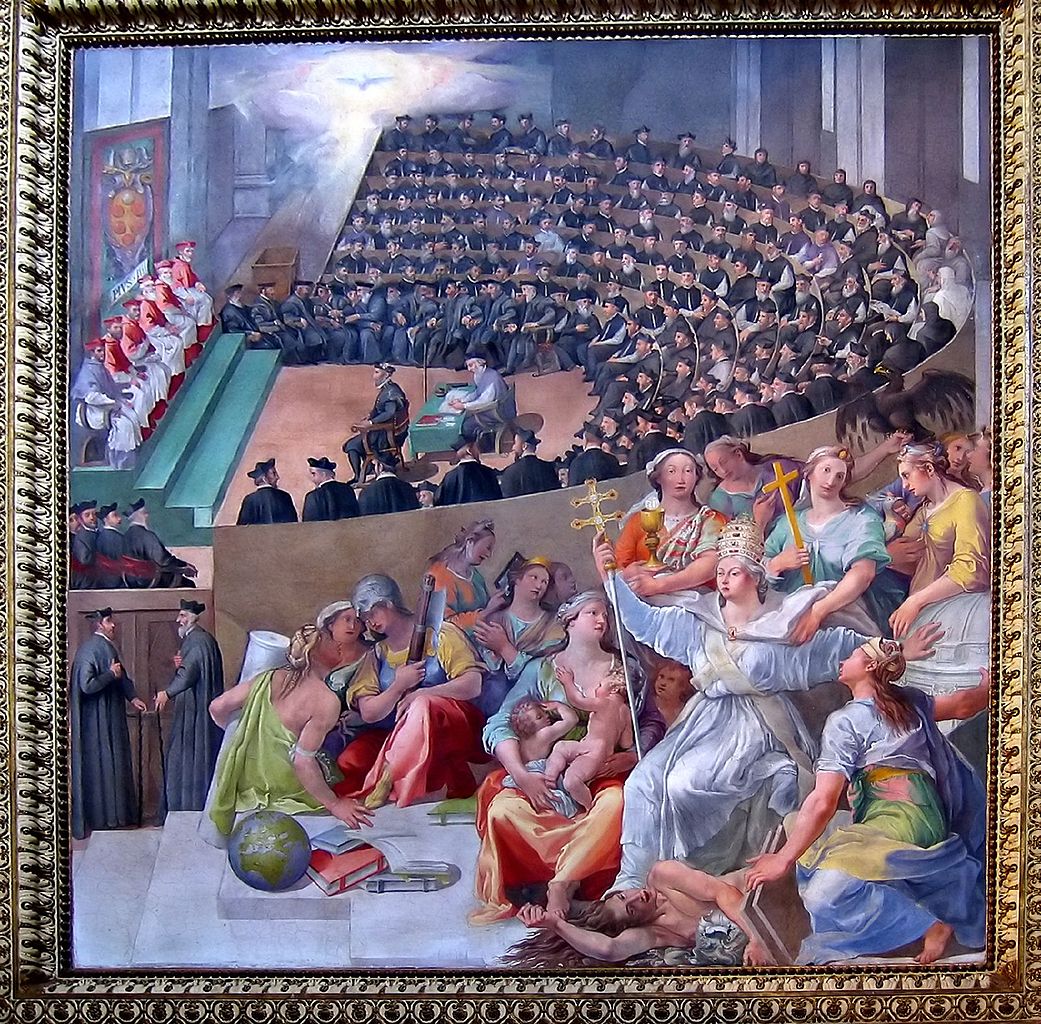
The importance of the Council of Trent lies in its being two things at the
same time: 1) the heart and soul of the Catholic Reformation (the authentic
reform of the Church); and 2) the definitive moment of the Counter Reformation
(the reaction against the Protestant Revolt): “By almost universal agreement,
the counter-attack of the Church to the movement that is known as the
Protestant Reformation begins seriously with the Council of Trent.”
Besides these important issues the Council met to address, there were
serious problems that plagued it before, during, and after its sessions. These
will come to light in the following brief sketch.
For many years before the Council actually met, there had been talk of an ecumenical synod to reform the Church and to react to the challenge put to her by Luther.
Reform-minded Catholics strongly desired such a council, as did others with a more pragmatic agenda, especially the Emperor (Charles V), who had to address the civil strife caused by Luther’s revolt within the Empire and the Spanish Netherlands.
As early as 1520, only three years after the close of the Fifth Lateran Council, there was a call for such a council, but Pope Leo X was afraid of what might come of it, especially in light of the conciliarist tendencies that were still lingering.
The threat was a real one: The Protestants agitated for conciliarism during the Council, and, even after its conclusion (1563), the Catholic Emperor Ferdinand I, who succeeded his brother Charles as emperor, advanced a conciliarist line.
Pope Paul III (1534-1549), a reform-minded Pontiff, was willing to risk
the dangers, and summoned a council to meet in Mantua. Emperor Charles V
resisted, as he wanted the council within the confines of the Empire. A
compromise was made in selecting Trent, which, while an Italian city, belonged
to the Empire. Charles resided much of the time at Innsbruck, a day’s ride to
the south.
Although the Council was summoned in 1542, it did not convene until 1545.
Even then, it was off to a very slow start. Those who were in attendance at
first were exclusively Italians. Then the Spaniards showed up. French and
German bishops were in sporadic attendance throughout the history of the
Council, depending on the present mood of their sovereigns.
The Council met on and off for eighteen years: 1545 to 1563. That it was off more than on can be seen by the dates of the sessions, which spanned over three periods: 1545-1547, 1551-1552, and 1562-1563.
The Council met for only four of those eighteen years. The reason behind the frequent prorogations of the Council was most often disagreement between the pope and the emperor over such things as location of the Council, the subjects it was to take up, the pope’s policies toward Charles’ war with France, and the war itself.
There was also a typhus epidemic that broke out in Trent, leading to a brief convocation in Bologna. Francis I, the Valois king of France, showed himself to be even less cooperative, opposing the Council at first, forbidding the publishing of the bull of convocation in his Kingdom, and refusing for a while to allow French bishops to attend its sessions.
Francis feared not only the loss of the Gallican Church’s independence, but also whatever might favor Hapsburg hegemony in European politics. Indeed, France’s allying herself against the Empire with the Protestant Schmalkaldic League showed that she put her own national interests over those of the Church.
For his part, Charles, a good Catholic, was too pragmatic in his pursuit of peace with Protestants within the Empire. At many points during the Council, he pushed for a deferring of the doctrinal questions in favor of discussing reform, naively thinking that the Council could show the Protestants that the Church was reforming herself, thus rendering the dogmatic disagreements non-issues.
We see that there were two issues the Council met to address: reform and
heresy. In the immediate background, though, were the issues of conciliarism
(condemned shortly before at Lateran V, but still lingering) and nationalism.
The complex interplay of these four issues was to impact the life of the
Council until its very end.
In light of the events he had to deal with, Charles’ pragmatic considerations are not as reprehensible as they may seem. They were not governed by sheer pacifism. Not only did he have to deal with the treachery of an anti-Hapsburg Valois policy, but, all the while, the Turks were at the Gate threatening the security of all Christendom.
The Italians present, by far the majority of Fathers – never to be equaled or outnumbered by all the other national groups combined – were of a much more realistic awareness of the depth of the doctrinal divide. Luther had transgressed orthodoxy. Not only was the Church in need of internal reform; heresy must be condemned.
But how to accomplish both of these ends? Paul III preferred that
doctrinal questions be addressed first, then the Council could take up reform.
Charles V wanted it the other way. In a compromise between the emperor’s
preferences and the pope’s, issues of doctrine and of reform were addressed
simultaneously.
Having briefly summarized the intrigues and politics that complicated the
work of the Council, and what, in broad outline, that work was, we now detail
some of the issues the Council addressed. We will do so session by session,
skipping those whose work was limited to the administrative functions such as
convocation, indiction, resumption, translation, prorogation, or the granting
of safe passage to heretics.
The fourth session of the Council defined the Canon of Holy Scripture
contrary to the Protestant rejection of the deutero-canonical books. It also
established the authenticity of the Latin Vulgate of St. Jerome, anathematizing
anyone who would reject it. (It did not, as Palmer claims – pg. 85 – say that
the Vulgate was “the only version
of the Bible on which authoritative teaching could be based.”)
The fifth session issued the Decree on Original sin. This condemned Lutheran and Calvinist “total depravity,” the doctrine that exaggerated the effects of Original Sin.
At the same time, the Decree avoided anything savoring of Pelagianism, Protestantism’s heretical opposite in the doctrine of grace. The Decree established the true doctrine of Original Sin concerning its existence, extent, effects, and remedies. This session also addressed two reform issues touching upon 1) the education of clerics in theology and the liberal arts and 2) the office of preaching and that of “questors,” i.e., collectors of alms.
The sixth session gives us the celebrated decree on Justification, which did so much to clarify Church teaching in a matter some Catholics were confused about, thinking that there was room for compromise with the Protestants. In the “process of justification,” faith is not the only ingredient, but it is the essential initium salutis.
In addition to faith, the other infused theological virtues are necessary, as is human cooperation with God’s movement. Those in sin can, by the actual grace of God, cooperate with His loving designs.
Grace is not simply an external garment (still less is it snow on dung!), but an interior beautification of the soul, an intrinsic change that makes the Christian a new creature. Once in the state of Grace (justification), man can truly merit an eternal reward because he has the principle of supernatural life in him. In a series of canons, the various heresies of Luther and Calvin on these points are explicitly anathematized.
The reform issues taken up by this session included episcopal and priestly
residence (the duty of the bishop to reside in his diocese and the priest
charged with cure of souls to reside in his parish), restrictions on bishops
performing pontifical functions outside their dioceses, and the prohibition of
regulars from residing outside their religious houses.
The seventh session considered the doctrinal issue of the sacraments in general and two of them specifically: Baptism and Confirmation. There are seven sacraments, all of which were founded by Jesus Christ.
They work ex opere operato, effecting what they signify, and are not mere symbols of grace. The form and matter of Baptism and Confirmation, their effects and relative necessity, as well as the proper minister are carefully laid down. Canons with anathemas attached to them censure the Protestant errors in sacramental doctrine.
The reform issues addressed included several items concerning benefices,
clerical life, promotion to orders, repair of churches, and the timely filling
of vacant sees.
After several prorogations, delays, and upon the beginning of a new pontificate, the thirteenth session resumed the work of the Council on the Sacraments, treating only of the Eucharist. Lutheran “consubstantiation” is condemned, while transubstantiation is upheld.
The real presence of Jesus Christ, which abides after the Mass (ergo allowing for reposition of the Blessed Sacrament) was also affirmed, as was the divine institution of this august sacrament, Its excellence over the other sacraments, Its power to give grace, the dispositions necessary for Its reception, and the veneration to be showed It. Contrary errors were anathematized.
The reform issues addressed included the bishops’ involvement in civil
criminal cases, ecclesiastical exemption from the civil arm, and the
degradation of clerics for severe crimes.
The fourteenth session continued with the sacraments, laying down the Church’s doctrine on Penance and Extreme Unction. As for the former, it was defined that Our Lord established Penance when he said “Receive ye the Holy Ghost, whose sins you shall forgive, they are forgiven them, and whose sins you shall retain, they are retained” (John 20:22).
Regarding the latter, St. James’ text is shown to speak of Anointing: “Is any man sick among you ? Let him bring in the priests of the Church, and let them pray over him, anointing him with oil in the name of the Lord: and the prayer of faith shall save the sick man; and the Lord shall raise him up; and if he be in sins, they shall be forgiven him” (James 5:14-15). The necessity, effects, form and matter, and minister of each sacrament are taught, while contrary errors are anathematized.
The reform decree of this session treated episcopal oversight of clerics,
their promotion to orders, and their suspension for various crimes. Financial
endowments, rights of patronage, and benefices were also addressed.
The twenty-first session treated of communion under both species and the
communion of infants. The Council taught the principle of Eucharistic
concomitance, that “Christ whole and entire, and a true Sacrament are received
under either species,” so the faithful need not receive from the Chalice.
Infants need not receive Holy Communion at all. The reform decree in this
session treated benefices and the establishing of new parishes.
The twenty-second session set down the true doctrine concerning the Holy
Sacrifice of the Mass against the novelties of the Protestants. Included in
this doctrine is “that the Sacrifice of the Mass is propitiatory both for the
living and the dead.” The reform decree addressed the use and protection of
church property, among other things.
The twenty-third session defined, against the heretics, what is the truth
concerning the sacrament of Holy Orders, which is “a true and proper
sacrament,” distinguishing the three sacramental orders from the minor orders
and subdiaconate, and affirming that the former of divine institution. Contrary
errors were condemned in the canons. The reform decree included minute
prescriptions on who can be admitted to Orders.
The twenty-fourth session treated of the sacrament of Matrimony. A short
section established its true sacramental nature, while a much longer section
minutely reformed the administration of the sacrament.
The twenty-fifth and last session treated the dogmatic topics of purgatory
relics, saints, sacred images, and indulgences. The reform issues concerned
religious, regulations on the granting of indulgences, the establishing of the
index of forbidden books, feast and fast days, and the reform of the breviary
and missal. It also called for a catechism to be issued.
J.P. Kirsch succinctly summarizes the importance of the Council of Trent: “The Ecumenical Council of Trent has proved to be of the greatest importance for the development of the inner life of the Church.
No council has ever had to accomplish its task under more serious difficulties, none has had so many questions of the greatest importance to decide. The assembly proved to the world that notwithstanding repeated apostasy in church life there still existed in it an abundance of religious force and of loyal championship of the unchanging principles of Christianity.
Although unfortunately the council, through no fault of the fathers assembled, was not able to heal the religious differences of western Europe, yet the infallible Divine truth was clearly proclaimed in opposition to the false doctrines of the day, and in this way a firm foundation was laid for the overthrow of heresy and the carrying out of genuine internal reform in the Church.”
This article appears courtesy of Catholicism.org.
The photo shows, "The Council of Trent," by Pasquale Cati, painted in 1588.