The Glory That Was Lithuania
In the
Middle Ages, Moscow was by no means the only center of gravity in the Russian
lands. For several centuries, the Grand Duchy of Lithuania had designs on its
own unified Russia.
Today,
Lithuania is a small country on the north-eastern fringe of the European Union.
However, 600 years ago it was one of the largest and most powerful states in
Europe.
Having
been destroyed by the Mongols, Russia was fertile soil for Lithuanian
expansion. Through dynastic marriages, military campaigns, and outright
annexation, Lithuania subjugated vast swathes of the variegated Russian
principalities – so much so that it threatened Moscow’s status as the
center of Russian unification.
When, in the early 13th century, the East Baltic pagan tribes suffered
the horrors of the Northern Crusades, it seemed that the Lithuanians would
share the sad fate of other Baltic tribes crushed by the Teutonic Knights.
Surprisingly, however, the
Lithuanian tribes managed to consolidate and not only halt the German
onslaught, but inflict some punishing counterattacks on the aggressors. In
1236, at the Battle of Saule, they almost completely destroyed the Livonian
Brothers of the Sword, a Catholic military order operating in the territories
of modern Latvia and Estonia. Interestingly, 200 soldiers from Pskov, then an
ally of the order, perished along with the swordsmen.
From the west (today’s Kaliningrad
Region), the Teutonic Order subdued the Prussian tribes on its way to the
Lithuanian lands. The Teutons annexed the remains of the so-called Sword
Brethren, forming the Livonian Order, and set about clamping the Lithuanians in
a pincer movement from both sides.
The Lithuanian rulers realized that
they couldn’t survive in isolation. Fortunately for them (but not for the
Russians), in 1237 the Mongols invaded the Russian principalities, which
largely solved Lithuania’s problems.
The Mongol invasion devastated the Russian principalities of
north-eastern Rus and weakened the western Russian principalities, which
Lithuania sought to exploit.
Its expansion into the Russian
lands was not all through fire and sword, however. In fact, the annexation was
largely peaceful, for in the powerful Lithuania the Russian rulers saw the
chance of protection from the Mongols. The Lithuanians in turn received much-needed
support in the struggle against the Teutonic Knights, and they too were
threatened by the marauding Mongols.
The Lithuanian princes did not
encroach on the rights of the local nobility, establishing relations with
regional rulers under a vassalage system. In case of military exigency, they
could rely on local armed contingents.
In the mid-13th century, Lithuania
annexed the so-called “Black Russia,” the territory of modern western Belarus,
renaming itself the Grand Duchy of Lithuania.
The Grand Duchy reached its maximum
extent in the 14th century under Princes Gediminas and Algirdas. The Lithuanian
state included vast territories that today lie inside Belarus, Ukraine, and
south-west Russia.
Now the Grand Duchy of Lithuania had to reckon not only with its old
enemy the Teutons, but also the Mongols, the Poles, the Hungarians, as well as
the Muscovites. Moscow and the Lithuanian territories were separated by no more
than 200 kilometers.
The Grand Duchy of Lithuania was
only Lithuanian in name. 90% of its population was made up of the ancestors of
modern Russians, Belarusians, and Ukrainians. Maintaining the integrity of such
a patchwork state was not an easy task, and its rulers had to skillfully
navigate between different groups of subjects.
A central pillar of the state was
tolerance. Although officially pagan, not only did it not violate the rights of
the Orthodox population, it actively supported them. In 1316, the Lithuanians
even sought to set up its own metropolitan see in Novogrodok (modern Novogrudok
in Belarus), and established direct contacts with the Patriarch of
Constantinople.
Much later, in the 16th century,
the ambassador of the Holy Roman Empire, Sigismund Herberstein, wrote about the
Lithuanian capital, then called Vilna: “There are considerably more Russian
churches than ones of the Catholic faith.”
The Lithuanian princes first
established a protectorate, before finally annexing Kiev in the 1360s,
recognizing it as the “mother of Russian cities.” Ruthenian supplanted
Lithuanian as the official language, and remained so until the late 17th
century.
Lithuania pulled out all the stops
to demonstrate to the Russian principalities and its main rival in the east,
the Grand Duchy of Moscow, that it was the political and spiritual center of
unification for the Russian lands.
For a long time, the Lithuanian princes maneuvered between the Catholic
and Orthodox worlds without taking sides.
For instance, Grand Duke
Mindaugas was baptized into Catholicism and crowned “king of Lithuania” by
Pope Innocent IV. However, after his death in 1263, Lithuania returned once
more to the fold of paganism, which, incidentally, did not prevent Mindaugas’
son Vaisvilkas, who succeeded his father, from being a fanatical adherent of
Orthodoxy.
However, this state of affairs
could not continue indefinitely. As the last pagan state of Europe, the Grand
Duchy of Lithuania could not be regarded as an equal by the Christian
sovereigns of Europe. It also played into the hands of the Teutonic Order,
which could legitimately wage unending holy war against Lithuanian paganism.The
situation was resolved by Lithuania’s political and cultural convergence with
Poland, with whom it had fought against the Teutons. In 1387, the Grand Duke of
Lithuania, Jogaila, who was concurrently King of Poland under the name
Wladyslaw II Jagiello, converted Lithuania to Catholicism.
From that moment on, the Grand
Duchy’s encouragement of Orthodoxy ceased, and the Catholic faith took root.
Hence, Lithuania could no longer lay claim to the title of unifier of the
Russian lands.
The union of Lithuania and Poland as one state in the 16th century exerted tremendous political, cultural, and religious pressure on the Grand Duchy’s Orthodox population, namely the Belarusian and Ukrainian people. Over the coming centuries, they would be a bone of contention between the Polish and Russian civilizations. It remains a live issue to this day.
This article appears courtesy of Russia Beyond.
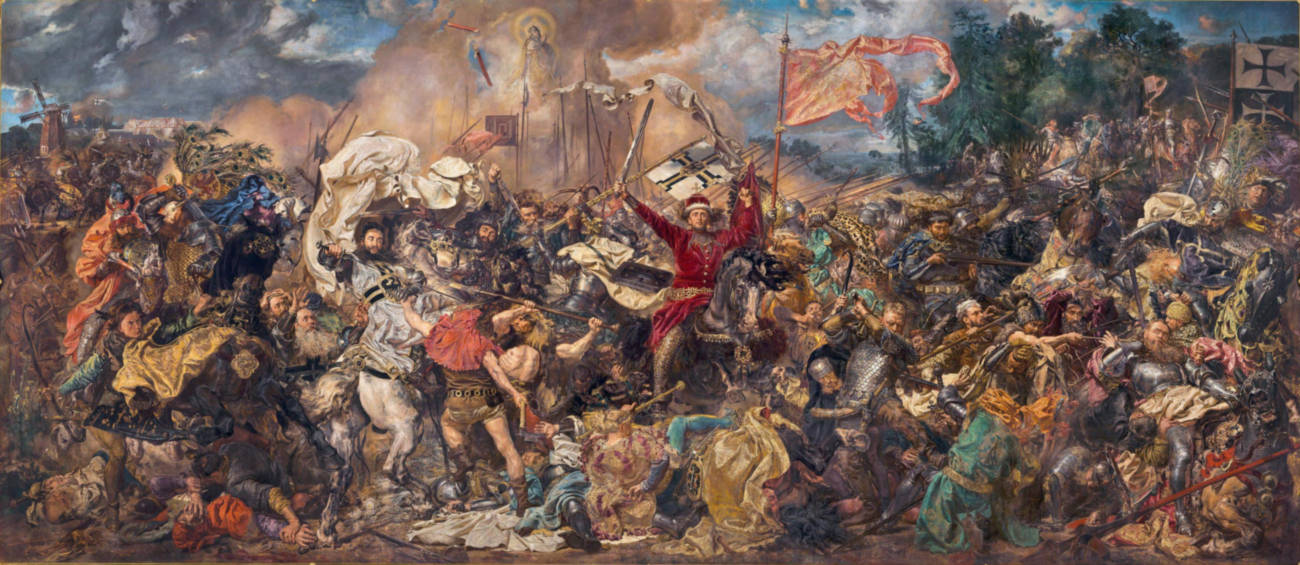
The photo shows, "The Battle of Grunwald," by Jan Matejko, painted in 1878.