The Mary Garden: A Theological and Horticultural Devotion
Introduction
In the quiet corner of a medieval cloister, a monk might have paused not only to weed a bed of lilies but to pray. For him, the white petals were not merely botanical features; they were palpable signs of the Virgin Mary’s purity. The violet spoke of her humility, the rose of her heavenly queenship, and the marigold—calendula officinalis—gleamed like a gold coin offered to the Mother of God. This was no ordinary garden. It was a Mary Garden: a deliberate planting of flowers, herbs, and shrubs whose names, shapes, or legends evoked the life, virtues, and sorrows of the Blessed Virgin.
The Mary Garden is a unique and almost forgotten treasure of Catholic horticultural spirituality. It is neither a prescribed liturgical space nor a formal shrine, but rather a living hortus conclusus (enclosed garden) where botany becomes a form of silent preaching, and where every bloom is a miniature sacrament of Marian devotion. From its origins in the monasteries of early medieval Europe to its twentieth-century revival in America and its re-emergence in twenty-first-century cathedral close, the Mary Garden offers a fascinating case study in how popular piety, liturgical memory, and gardening practice can weave together a rich tapestry of faith.
This essay traces the theological and historical development of the Mary Garden from the seventh century to the present day. It examines the medieval roots of floral Mariology, the near-extinction of the tradition after the Reformation, its remarkable revival in the mid-twentieth century, and notable examples of Mary gardens across the ages. Ultimately, it argues that the Mary Garden is not a sentimental relic but a deeply theological landscape—one that embodies the Incarnational principle that material creation, rightly cultivated and contemplated, can lead the soul to God and to His Mother.
Part I: Theological Foundations – Why Flowers for Mary?
To understand the Mary Garden, one must first appreciate the theological logic that connects the Virgin Mary to the floral world. This logic rests on three pillars: typology, legendary piety, and liturgical sensibility.
Typology is the reading of the Old Testament as prefiguring New Testament realities. Just as the Church Fathers saw the burning bush (Exodus 3:2) as a type of Mary’s virginal motherhood—a bush that burns but is not consumed, so God took flesh without destroying her virginity—they also read the Song of Songs as a Marian tapestry of garden imagery. The beloved is called “a garden locked, a fountain sealed” (Song of Solomon 4:12). The Venerable Bede (d. 735) wrote of finding roses and lilies in Mary’s empty tomb, interpreting the white lily as a figure of her incorrupt body and the rose as her charity. These exegetical seeds, sown in patristic soil, blossomed into a rich symbolic language.
Legendary piety contributed names based on stories. When the Angel Gabriel appeared to Mary, tradition held that the first lilies sprung from the ground where his feet touched. When Mary fled to Egypt, rosemary flowers turned from white to blue from contact with her cloak. These pious tales—neither Scripture nor dogma—functioned as imaginationis meditatio, helping ordinary Christians see biblical events reflected in the everyday world of fields and gardens.
Liturgical sensibility provided the calendar. Medieval Christians celebrated numerous Marian feasts (Purification, Annunciation, Assumption, Nativity of Mary), and flowers that bloomed near those dates often acquired Marian associations. The snowdrop, appearing around Candlemas (February 2), was called “Candlemas bells.” The Assumption lily (Lilium candidum) traditionally flowers in August, near the Feast of the Assumption.
Thus, the Mary Garden emerged not from a single papal decree but from centuries of devotional accretion—an ecclesia docens of leaves and petals.
Part II: Medieval Beginnings (7th–15th Century)
The earliest recorded Mary garden is traditionally attributed to St. Fiacre (d. 670), an Irish monk who traveled to France seeking solitude. In what is now Seine-et-Marne, he built an oratory, a hospice for the poor, and a garden. According to his vita, he planted around the chapel a collection of medicinal and symbolic flowers, many of which he dedicated to the Mother of God. While the term “Mary garden” was not used, the practice was unmistakable: a holy enclosure where cultivation and contemplation were one. Fiacre became the patron saint of gardeners, and his garden became a prototype.
The first documentary mention of “S. Mary’s garden” by name appears much later, in a fifteenth-century accounting roll from Norwich Priory in England. The sacristan recorded the purchase of plants “for S. Mary’s garden” – a simple line that proves the concept had become standardized enough to require a proper name. Archaeobotanical studies of medieval monastic sites (Westminster, St. Gall, Cluny) have revealed the presence of flowers such as violets (Viola odorata), daisies (Bellis perennis), roses (Rosa gallica), and lilies—all strongly associated with Marian symbolism.
What did a medieval Mary garden look like? It was not a separate “rose garden” but often a dedicated bed or corner within the larger monastery garden, sometimes near the Lady Chapel or a statue of the Virgin. It would be enclosed by a low hedge, perhaps of boxwood (Buxus sempervirens)—itself a Marian plant (Boxthorn or “Mary’s thorn”). A small fountain or well might provide water, recalling the fons signatus of the Song of Songs. The plants were chosen for three functions: medicine, liturgy, and symbolism. For example, lady’s mantle (Alchemilla vulgaris) held dew on its scalloped leaves, symbolic of Mary’s tears; marigold (“Mary’s gold”) was used in broths for the sick; rosemary (“Mary’s cloak”) was strewn on church floors for feasts.
One crucial point: medieval people did not think they were merely “renaming” plants. They believed the plant’s very essence—its medicinal virtue, its seasonal rhythm, its form and color—revealed something of Mary’s grace. This was a sacramental worldview: creation was a book of symbols, and the gardener was a reader of divine signatures.
Part III: The Mary Garden in Medieval Art
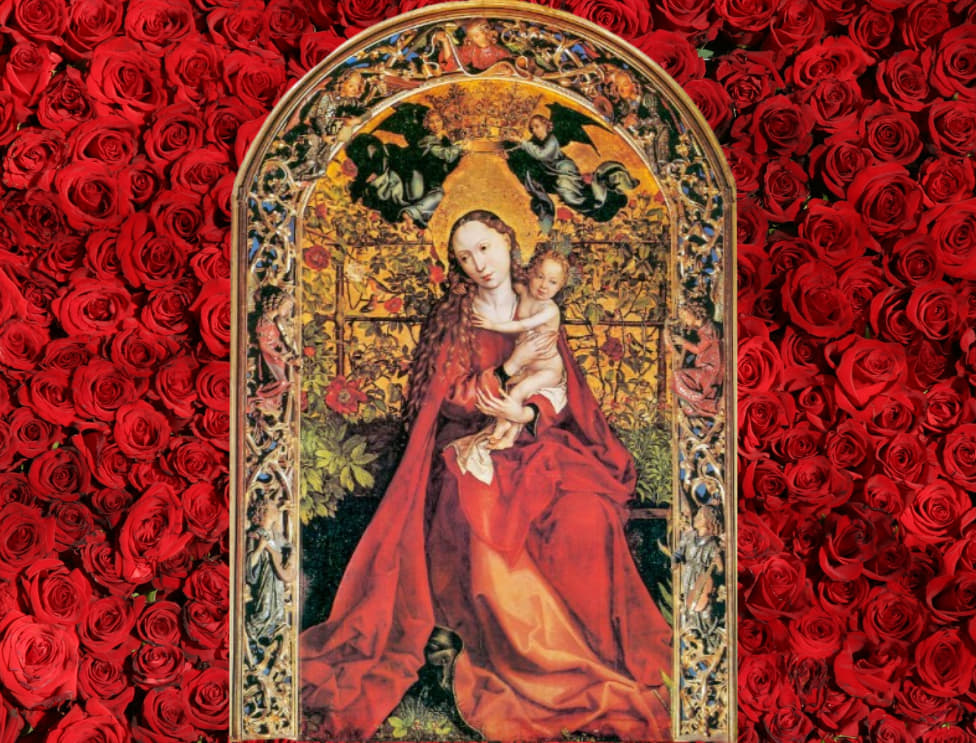
Before the Reformation, the Mary garden was so culturally pervasive that it entered the visual arts. A genre of painting known as the Madonna in the Hortus Conclusus flourished in the fifteenth century. Stefano da Verona’s Madonna in the Garden (c. 1390s) shows the Virgin seated among irises (the “sword lily,” symbol of her Sorrows), lilies (purity), strawberries (earthly fruitfulness and heavenly righteousness), and daisies (innocence). The enclosed garden, with its high walls and locked gate, visually quotes the Song of Songs and asserts Mary’s perpetual virginity. These paintings were not mere decoration: they were catechetical tools for an illiterate population, teaching that Mary is the New Eve in the Garden of Paradise restored.
In manuscript illuminations, especially Books of Hours, one often finds the Annunciation scene set in a tiny enclosed garden blooming with columbine (the “dove flower,” symbolizing the Holy Spirit), violets, and roses. The viewer was invited to imagine not only the biblical event but also its sensory environment: the smell of crushed thyme, the sight of dew on petals, the sound of bees. The Mary garden thus collapsed time, making the believer a contemporary of the Annunciation.
Part IV: Decline and Near Extinction (16th–19th Century)
The Reformation dealt a severe blow to Marian devotion in Northern Europe. In England, the Dissolution of the Monasteries (1536–1541) destroyed the monastic gardens that had preserved the tradition. Mary gardens were uprooted or repurposed. Worse, the pious plant names—Our Lady’s Bedstraw, Lady’s Smock, Mary’s Tears—were systematically replaced by Linnaean or functional common names as scientific botany rose in the seventeenth and eighteenth centuries. The rationalist spirit disdained “superstitious” folk names. By 1800, a gardener might grow Galium verum (yellow bedstraw) without any memory that it was once called “Our Lady’s Bedstraw” because it was said to have lined the manger in Bethlehem.
In Catholic countries (Italy, Spain, France, southern Germany), the tradition survived in attenuated form, often reduced to a single statue of Mary surrounded by potted plants in a domestic courtyard or a parish grotto. But the rich symbolic system of a dedicated Mary garden faded from memory. By the nineteenth century, even many devout Catholics had never heard of a Mary garden.
Part V: The Twentieth-Century Revival
The revival began quietly in 1932, at St. Joseph’s Church in Woods Hole, Massachusetts. Frances Crane Lillie, a well-traveled laywoman, had encountered references to medieval Mary gardens during visits to English country parishes. With the permission of her pastor, she designed and planted a small garden dedicated to the Virgin, using historical plant lists she had compiled from old herbals and monastic records. Her garden—still extant and maintained today—became the “mother garden” of the modern revival.
Lillie’s work inspired two Philadelphia men: John S. Stokes Jr. and Edward A. G. McTague. In 1951, they founded Mary’s Gardens, a research and apostolic organization devoted to recovering the medieval tradition. They scoured medieval manuscripts, herbaria, and paintings for Marian plant names; corresponded with botanists, historians, and gardeners around the world; and began publishing lists of “Mary’s flowers” with instructions for planting.
Stokes and McTague faced a peculiar challenge. Many plants had lost their Marian names entirely. For example, the Vinca minor (periwinkle) was once “Virgin’s flower” or “Mary’s violet” because it bloomed around Candlemas. The Aquilegia (columbine) was “Our Lady’s slipper” or “dove flower.” They painstakingly reconstructed a symbolic vocabulary, sometimes proposing new names based on traditional legends. By 1960, Mary’s Gardens had distributed thousands of plant lists and garden plans to parishes, schools, and individuals in over 40 countries.
The revival was not merely antiquarian. Stokes and McTague argued that the Mary garden answered a modern spiritual hunger for tangible, earth-rooted devotion. In an age of abstraction and technology, the garden offered a place where the senses—smell, touch, sight—could be healed and elevated. They saw it as a form of “green catechesis.”
Part VI: Notable Mary Gardens – Medieval to Present
Medieval Period
- Garden of St. Fiacre (France, 7th century) – The archetype. Though no longer surviving in its original form, the site at Breuil (near Meaux) has been replanted in modern times as a pilgrimage garden. Its theological significance lies in the fusion of monastic labor, hospitality, and floral devotion.
- Norwich Priory Mary Garden (England, 15th century) – Known only from a single accounting entry, yet that entry proves that by the late Middle Ages, “S. Mary’s garden” was a recognized feature of a major Benedictine house. The garden likely occupied a cloister garth near the Lady Chapel.
Twentieth-Century Revival (1932–2000)
- St. Joseph’s Mary Garden, Woods Hole, Massachusetts (1932) – The revival’s fountainhead. Still maintained by parish volunteers, it features a central statue of the Virgin and a seasonally rotating display of over sixty Marian plants, from snowdrops (Candlemas) to chrysanthemums (Our Lady’s flower for autumn). It remains a quiet pilgrimage destination.
- The Marian Library Garden, University of Dayton, Ohio – Not a single garden but an archival and living collection. The University of Dayton holds the John S. Stokes and Mary’s Gardens archival papers, including detailed correspondence, plant lists, and photographs from the 1950s–1990s. A demonstration Mary garden is maintained on campus for educational purposes.
- Knock Shrine Mary Garden (Ireland) – The first Mary garden at a major international Marian shrine. Planted in the 1990s after correspondence with Mary’s Gardens, it contains 73 species of Marian-dedicated plants laid out in a cruciform pattern. Visitors can walk the garden as a rosary meditation.
- Cotabato High Schools (Philippines) – An example of the international reach of the revival. In the 1960s, Mary’s Gardens helped Catholic schools in the Philippines plant Mary gardens as part of religious education, adapting tropical species (such as Plumeria, known as “frangipani” or “Mary’s flower of the tropics”).
Contemporary (21st Century)
- Ely Cathedral Mary Garden (England, 2024) – A stunning recent example, planted adjacent to the Lady Chapel of this historic Anglican (formerly Catholic) cathedral. The design deliberately echoes a medieval monastic garden: raised beds enclosed by woven hazel fencing, with a colour scheme of white and blue (symbolizing Mary’s purity and her title “Stella Maris,” Star of the Sea). The garden was consecrated in a service that included prayers for gardeners and blessings of seeds. It demonstrates that the Mary garden tradition has crossed denominational boundaries into high-church Anglicanism.
- The National Shrine of the Immaculate Conception, Washington, D.C. – While primarily known for its massive basilica, the shrine maintains a ¾-acre circular Mary Garden with a central fountain and statue of the Virgin of Lourdes. The garden is explicitly designed as a space for rest and prayer, with benches, flowering trees, and a path that allows meditative walking. It is one of the largest public Mary gardens in the United States.
- Countless parish and domestic gardens – In the twenty-first century, the revival has become grassroots. A search for “Mary garden” on social media reveals hundreds of small projects: a statue of the Immaculate Heart tucked into a suburban flower bed, a “rosary garden” with ten rose bushes for the Hail Marys, a window box of marigolds on a city apartment. These humble gardens, often undocumented, are the true inheritors of St. Fiacre’s vision.
Part VII: Theological Reflections – The Garden as Catechism and Prayer
What theological work does a Mary garden perform? At least three movements.
First, incarnational catechesis. The garden teaches that God’s grace works through matter. Soil, seed, sun, and rain cooperate to produce beauty; Mary cooperated with the Holy Spirit to produce the Savior. A child who plants a marigold “for Mary” learns that faith is not just in the mind but in the hands.
Second, temporal sanctification. The garden follows the liturgical year. Snowdrops for Candlemas, violets for Lent, lilies for Easter, roses for Pentecost, marigolds for Assumption. The gardener becomes attuned to the rhythm of salvation history, seeing each season as an icon of a Marian mystery.
Third, the recovery of symbol. In a desacralized world, the Mary garden restores the ability to see things as more than themselves. A rosemary bush is not merely a culinary herb; it is a reminder of the Flight into Egypt. The columbine’s five dove-like petals speak of the Holy Spirit overshadowing Mary. This is not superstition but sacramental imagination—the same faculty that allows us to see bread and wine as the Body and Blood of Christ.
Conclusion
From the seventh-century hermitage of St. Fiacre to the twenty-first-century close of Ely Cathedral, the Mary garden has proven remarkably resilient. It survived the Reformation only to be nearly erased by scientific rationalism, yet it was lovingly reconstructed in the twentieth century by a handful of dedicated researchers and gardeners. Today, it flourishes in unexpected places: a rooftop in Havana, a high school in the Philippines, a window box in a Montreal apartment.
The Mary garden matters because it reminds us that theology is not only written in books—it is planted in the earth. Every gardener who kneels to weed a bed of “Our Lady’s Tears” (lily of the valley) participates in an ancient tradition that sees creation as a grammar of grace. In a noisy world, the garden offers silence, beauty, and the quiet testimony of flowers that have been called by Mary’s name for over a thousand years. To walk in a Mary garden is to walk, for a moment, in the hortus conclusus of faith itself, where every bloom whispers Ave Maria.