The Middle Corridor: Central Asia Bypassing Russia
Introduction
For three decades, the overland trade between Asia and Europe has flowed overwhelmingly through a single artery: the Northern Corridor, a vast rail network spanning Russia from the Chinese border to the European Union. The logic of geography was simple, the infrastructure was built, and the politics, for most of the post-Soviet era, were tolerable. That logic collapsed in February 2022. The invasion of Ukraine transformed Russia from a transit partner into a sanctioned, unreliable, and politically toxic chokepoint. In the space created by that rupture, a disparate collection of Central Asian states, South Caucasus transit countries, and European institutions has accelerated the development of an alternative: the Trans-Caspian International Transport Route, known more commonly as the Middle Corridor.
The Middle Corridor is not a new idea. It has existed on paper since at least 2013, when the railway administrations of Kazakhstan, Azerbaijan, and Georgia signed a coordination agreement. What is new is the urgency. Cargo volumes along the route have grown from roughly 800,000 tons in 2019 to over 4 million tons annually in recent years, with a 30 percent increase recorded in the first nine months of 2026 alone. Container traffic from China westward rose by 64 percent over the same period. The European Union has committed up to 2 billion euros through its Connectivity Agenda Platform, launched in June 2026, to modernize ports, railways, and border crossings along the route. Kazakhstan has announced plans to invest approximately $10 billion in railway, port, and terminal infrastructure by 2030.
Yet the gap between ambition and reality remains vast. The Middle Corridor handles roughly 6 percent of the Northern Corridor’s annual capacity. It is a multimodal patchwork of rail lines, Caspian ferries, and Black Sea shipping that requires cargo to cross multiple borders, change modes of transport, and navigate customs regimes of a half-dozen countries. The Caspian Sea itself is shrinking. The Georgian port of Anaklia, the corridor’s most critical piece of infrastructure, remains unbuilt amid political dysfunction and unclear financing. And the return flow of cargo from Europe to Asia is barely a fifth of the westward volume, leaving operators to absorb the cost of empty containers.
This essay investigates the Middle Corridor as a case study in geopolitical infrastructure: a route that exists because of politics, struggles because of economics, and faces an uncertain future shaped by forces—climate change, great-power competition, and the stubborn gravity of established trade patterns—that no single state can control. It asks a straightforward question: can Central Asian nations, with European backing, build a viable trade artery that bypasses Russia? The evidence suggests the answer is a qualified and precarious maybe, with a window of opportunity that may be narrower than its proponents believe.
The Architecture of Escape
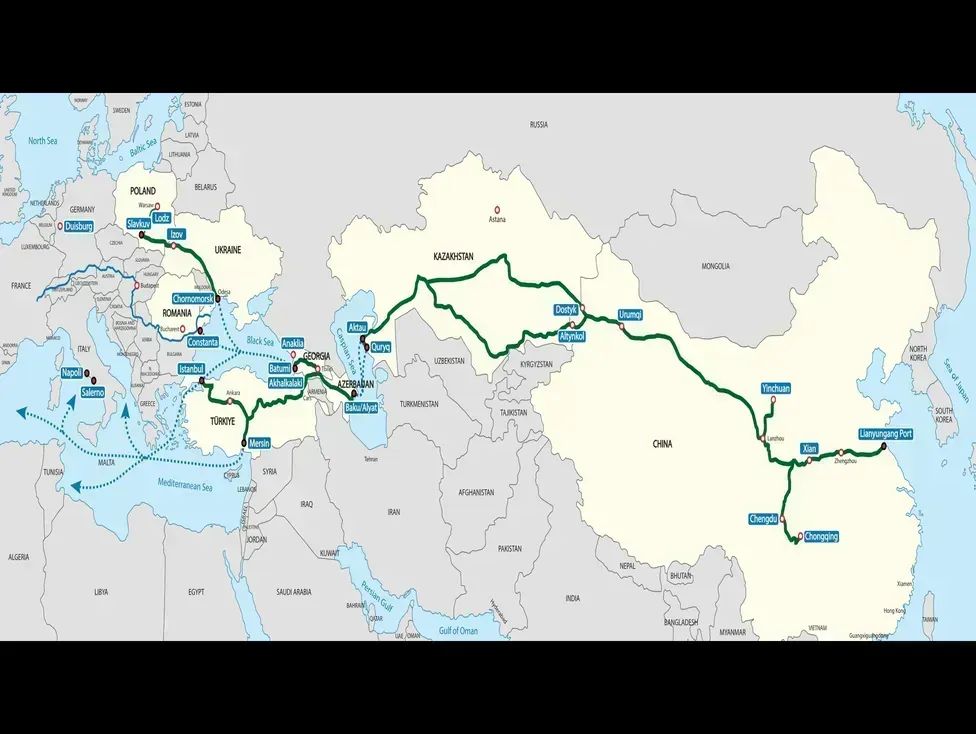
The Middle Corridor’s geography is its defining feature and its defining constraint. The route begins at the Chinese-Kazakh border, crosses Kazakhstan by rail to the Caspian ports of Aktau and Kuryk, traverses the Caspian Sea by ferry to Azerbaijan’s Baku, continues by rail through Georgia to Turkey or the Black Sea, and from there reaches European markets via Turkish rail networks or Black Sea shipping to Romania and Bulgaria. The total length exceeds 4,250 kilometers, with the longest segment running through Kazakh territory. Every kilometer of that route was chosen not because it is the shortest or cheapest path between China and Europe, but because it avoids Russian territory.
The corridor’s institutional architecture has matured rapidly since 2022. The Trans-Caspian International Transport Route Association, originally a coordination committee formed in 2014, has become the primary vehicle for operational cooperation among the railway administrations of Kazakhstan, Azerbaijan, and Georgia. In June 2026, the European Union launched its Connectivity Agenda Platform in Brussels, bringing together the five Central Asian states, the South Caucasus republics, Turkey, and international financial institutions to coordinate investment and policy along the route. The European Commission pledged to mobilize 20 billion euros in public and private financing, with an initial 80 million euros allocated to projects worth over 2 billion euros. The World Bank has estimated that easing transport bottlenecks along the corridor could spur growth and create millions of jobs across the nine countries it traverses.
For Central Asian states, particularly Kazakhstan and Uzbekistan, the corridor represents more than a trade route. It is a instrument of economic sovereignty. Since independence, these landlocked nations have depended on Russian territory for access to European markets. The Northern Corridor carried the overwhelming majority of their exports—oil, metals, grain, and increasingly, manufactured goods from China. That dependence gave Moscow leverage, both economic and political. The Middle Corridor offers an alternative, however imperfect, that reduces that leverage and opens direct links to European buyers and investors.
Kazakhstan has been the most aggressive proponent. President Kassym-Jomart Tokayev has set a target of increasing cargo volumes along the corridor to 10 million tons annually, up from the current 4.1 million. Kazakhstan Railways (KTZ) is building 900 kilometers of new track in 2026, including a third railway crossing at the Chinese border that will increase capacity from 55 million to 100 million tons per year by 2030. The national carrier has invested over $100 million in six new cargo vessels for Caspian crossings and is preparing an initial public offering in 2026 to raise capital for further modernization. German logistics firm Rhenus Group has partnered with KTZ and the Port of Aktau to build a trimodal container terminal with at least 150,000 TEU of annual capacity, and plans a network of fourteen terminals along the route.
Azerbaijan has invested in its Caspian shipping fleet, which now comprises 56 vessels including tankers, ferries, and dry cargo ships, and has signed a bilateral agreement with Kazakhstan on corridor development. Uzbekistan, which is not a direct transit country but a major potential source of cargo, has proposed regular feeder services between Turkmenbashi and Baku to connect its exports to the corridor, and the European Investment Bank has opened a regional representation in Tashkent with a project pipeline approaching 3 billion euros.
The European Union’s motivations are geopolitical as much as commercial. Since 2022, Brussels has pursued a strategy of reducing dependence on Russian transport routes while deepening ties with Central Asia. The Middle Corridor is the physical manifestation of that strategy. EU Enlargement Commissioner Marta Kos stated that the corridor could increase trade flows fivefold by 2040 and reduce transport times between Asia and Europe from around 45 days to approximately 15 days through improved infrastructure and coordination. Whether those projections are realistic is another matter, but the political commitment is real.
The Obstacles That Will Not Move
The Middle Corridor’s growth figures are impressive in percentage terms but modest in absolute terms. The 4.5 million tons carried in 2024 represent less than 5 percent of the 100 million tons that flowed through the Northern Corridor annually before the war. Even with the 30 percent growth recorded in 2026, the corridor remains a boutique route, not a replacement artery. The reasons are structural and stubborn.
The first obstacle is the Caspian Sea itself. The corridor requires cargo to be transferred from rail to ferry at Aktau or Kuryk, shipped across a body of water that is entirely enclosed and subject to the jurisdictions of five littoral states, and then transferred back to rail at Baku. This multimodal transfer adds time, cost, and complexity that a pure rail route through Russia does not impose. The ferries themselves are a bottleneck. According to the Azerbaijan Caspian Shipping Company, the falling sea level has already reduced rail tank car ferry transport by 22 percent and wagon transport by 10 percent on the Baku-Kuryk route.
The second obstacle is the shrinking of the Caspian. The sea’s level has been dropping by an average of up to 30 centimeters per year since 2020, driven by Russia’s damming of the Volga River—which provides roughly 80 percent of the sea’s inflow—and by rising temperatures that accelerate evaporation. If the trend continues, Kazakhstan’s ports of Aktau and Kuryk could face a projected sea level drop of up to 6.5 meters by 2045, leaving current berths landlocked and requiring a transition to offshore deep-water terminals or constant, costly dredging. This is not a hypothetical future risk; it is already affecting operations. The corridor’s viability as a maritime route is being undermined by forces largely outside the control of the states that depend on it.
The third obstacle is Georgia. Until a planned route through Armenia—the so-called TRIPP corridor connecting Azerbaijan to Turkey via Nakhchivan—becomes operational, Georgia is the Middle Corridor’s sole gateway to Europe. Its existing ports of Poti and Batumi are approaching capacity, and the government has shown little willingness to expand them. The new deep-sea port at Anaklia, identified by both the World Bank and the EU’s Trans-European Transport Network plan as a central priority, has seen its 2026 funding slashed from 150 million lari to 50 million lari. The project’s history is a case study in governance failure: a Western-led consortium was canceled in 2020, a Chinese-Singaporean contractor was selected but then apparently lost interest, and as of March 2026 the Georgian transport department maintained that no final decision had been made. Whether the obstacle is insufficient demand, Chinese disinterest, or Russian pressure, the result is the same: the corridor’s most critical infrastructure remains unbuilt.
The fourth obstacle is the imbalance of trade flows. In the first eight months of 2026, approximately 80 percent of containers on the Middle Corridor moved westward from China and Central Asia toward Europe, while only 20 percent traveled in the opposite direction. This four-to-one ratio means that operators must absorb the cost of repositioning empty containers, eroding the corridor’s already thin cost competitiveness. Attracting European export cargo—automotive products, machinery, chemicals—has proven difficult because European shippers have established supply chains through Russia or sea routes and see little reason to switch to a more complex, slower, and less reliable alternative. The corridor is, in effect, a one-way street, and one-way streets are expensive to maintain.
The fifth obstacle is the persistence of Russian and Chinese alternatives. Russia has not abandoned its ambition to remain a transit hub. It has revived plans for the Trans-Altai railway, a route that would connect Siberia to western China while bypassing both Mongolia and Kazakhstan, and has sought to position itself as a partner in new corridor projects. China, for its part, is pursuing a diversified strategy. While it supports the Middle Corridor as one option among many, it is simultaneously developing the China-Kyrgyzstan-Uzbekistan railway, which will provide a shorter route to the Caspian and potentially reduce dependence on Kazakh territory. Beijing’s interest in the Middle Corridor is instrumental, not ideological: it wants multiple routes to Europe, not necessarily this one.
The Geopolitics of a Half-Built Bridge
The Middle Corridor’s significance cannot be measured solely in tonnage. It is a political project as much as an economic one, and its political value may prove more durable than its commercial viability. For the Central Asian states, the corridor is a hedge against Russian coercion. It gives them an alternative outlet for exports, a basis for closer relations with the European Union, and a claim to strategic relevance in the competition between great powers. For the EU, it is a instrument of influence in a region that has become a theater of geopolitical contestation. For China, it is a backup route that reduces vulnerability to sanctions or disruptions along the Northern Corridor.
Yet the corridor’s political value is constrained by its economic weakness. A route that cannot attract return cargo, that depends on a shrinking sea, and whose most important port remains unbuilt is not a reliable alternative to anything. It is a supplement, a pressure valve, and a symbol. The World Bank’s optimistic projection that the corridor could create millions of jobs and spur growth across nine countries assumes that the infrastructure bottlenecks will be resolved and that demand will materialize. Neither assumption is guaranteed.
The window of opportunity may be narrower than the corridor’s proponents believe. The Carnegie Endowment’s analysis argues that for Central Asian states, the Middle Corridor offers “not a permanent pathway to European markets, but a window of opportunity that should be leveraged strategically”. That window is defined by the continuation of Western sanctions on Russia, the persistence of European political will, and the absence of a negotiated settlement in Ukraine that might restore the Northern Corridor’s attractiveness. If any of those conditions change, the urgency driving investment in the Middle Corridor could dissipate.
There is also the question of Russian reaction. So far, Moscow has responded with measured indifference. A senior Russian parliamentarian described the Azerbaijan-Kazakhstan agreement on corridor development as their “sovereign right” and acknowledged that while it is “less profitable for us,” Russia cannot force other states to route trade through its territory. That restraint may reflect confidence that the corridor cannot succeed without Russian participation, or it may reflect a tactical decision to avoid antagonizing partners whose loyalty is already uncertain. If the corridor begins to seriously erode Russian transit revenue—which analysts estimate could run into the billions of dollars annually if the route reaches full capacity—Moscow’s posture could harden. Russia has many tools of coercion short of military force: energy pricing, border delays, regulatory harassment, and support for political actors hostile to corridor development.
Conclusion
The Middle Corridor is the most ambitious attempt in the post-Soviet era to redraw the economic map of Eurasia. It represents a genuine attempt by Central Asian states to escape the gravitational pull of Russian transit dependence, backed by European capital and Chinese demand. Its growth since 2022 has been real, its institutional framework has strengthened, and the volume of investment committed to its infrastructure is substantial.
But the corridor is not yet a viable alternative to the Northern Route, and it may never become one. It is too long, too multimodal, too dependent on a shrinking sea, and too imbalanced in its trade flows. The Georgian port that would anchor its western end remains a hole in the ground. The return cargo that would make it economically sustainable has not materialized. The climate change that is lowering the Caspian will not reverse.
What the Middle Corridor offers, then, is not escape but leverage. It gives Central Asian states a bargaining chip in their relations with Moscow, a basis for deeper engagement with Brussels, and a claim on Chinese investment. It is a bridge that is half-built, and the question is not whether it will ever fully replace the Northern Corridor—it will not—but whether it can become functional enough to serve as a credible alternative when the Northern Corridor is unavailable. On current evidence, that is a close-run thing. The corridor’s future depends less on the volume of cargo it carries today than on the willingness of European governments, Chinese shippers, and Central Asian leaders to keep investing in a route whose economic logic remains, for now, subordinate to its geopolitical appeal. The window is open. How long it stays open is another question entirely.