The Minab Massacre: Trump's War Crime
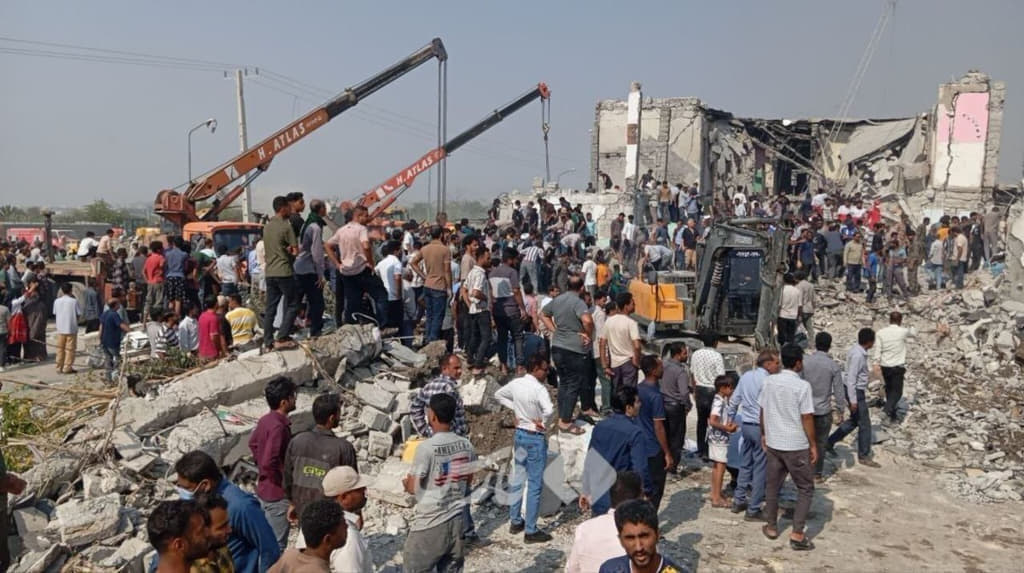
On the morning of March 1, 2026, the world awoke to reports of a horror unfolding in the southern Iranian city of Minab. In the aftermath of a large-scale military operation by the United States and Israel against Iran, a girls‘ school lay in ruins. As rescue workers picked through the debris, the initial trickle of casualties became a flood. The final toll was staggering: at least 165 schoolgirls were confirmed dead, with dozens more wounded . The “Minab Massacre” instantly became a rallying cry, but beyond the geopolitics and the condemnations, it presents a stark and clear-cut case under international law. What follows is a legal argument that the strike on the Minab school constitutes a war crime and should be prosecuted as such by the appropriate international bodies.
The Factual Foundation: What We Know
To build a legal case, one must first establish the facts. In the hours and days following the attack, a consistent picture emerged from Iranian officials, international media, and independent analysis.
- The Target: The strike hit the "Shajareh Tayyebeh girls’ school" in Minab, Hormozgan province . Eyewitness accounts and footage verified by outlets like the BBC described a scene of utter devastation, with classrooms destroyed and children's belongings scattered among the rubble . The school was a civilian object, protected from direct attack.
- The Casualties: The human cost is the core of the crime. While early reports varied, the搜救工作 (search and rescue operation) concluded with a final, confirmed death toll of 165 people, all of whom were at the school . Iranian media and officials reported that the dead were exclusively students, painting a picture of an attack on a civilian gathering .
- The Proximity to a Military Objective: This is the most critical fact for the legal defense, but it fails to excuse the attack. Official reports and verified footage confirmed that the school was located approximately 600 meters from a base belonging to Iran’s Islamic Revolutionary Guard Corps (IRGC) . This proximity is the argument proponents of the strike would use to claim it was a legitimate target or an unavoidable accident.
- The Nature of the Attack: Crucially, the attack was not a single errant missile. According to an official cited by the BBC, the school was "targeted by three missile attacks" . This suggests a deliberate, repeated aim at that specific location, rather than a one-off misfire.
- The Perpetrator: The joint military operation, dubbed "Operation Epic Fury," was publicly claimed by the United States and Israel . While the specific branch of the military that launched the missile may be unknown, the operation was a coordinated action, placing responsibility at the highest levels of the US and Israeli governments. A CENTCOM spokesperson acknowledged reports of civilian harm and stated they were "looking into them," which is an admission of potential involvement, not a denial .
The Legal Framework: Defining the Crime
The legal definition of war crimes is codified in numerous international treaties and has become part of customary international law, binding on all nations. The most authoritative modern statement is found in the Rome Statute of the International Criminal Court (ICC) . Under Article 8 of the Rome Statute, several prohibitions are directly relevant to the Minab strike .
1. Direct Attacks on Civilians and Civilian Objects
The most fundamental principle of international humanitarian law is the principle of distinction: parties to a conflict must distinguish between combatants and civilians, and between military objectives and civilian objects. Article 8(2)(b) of the Rome Statute explicitly defines as a war crime:
- (i) Intentionally directing attacks against the civilian population as such or against individual civilians not taking direct part in hostilities.
- (ii) Intentionally directing attacks against civilian objects, that is, objects which are not military objectives.
- (ix) Intentionally directing attacks against buildings dedicated to… education… provided they are not military objectives .
A school is the quintessential civilian object. Its purpose is education, and its occupants—schoolgirls—are the epitome of civilians protected from direct attack. By striking the Minab school, the attacking forces prima facie violated these core provisions.
2. The Crime of Disproportionate Attack (Proportionality)
Even if a military target exists in the vicinity, an attack is illegal if it causes harm to civilians that is "clearly excessive" compared to the anticipated military advantage. This is the principle of proportionality. Article 8(2)(b)(iv) criminalizes:
- (iv) Intentionally launching an attack in the knowledge that such attack will cause incidental loss of life or injury to civilians or damage to civilian objects… which would be clearly excessive in relation to the concrete and direct overall military advantage anticipated .
This is where the prosecution's case would be strongest. The IRGC base 600 meters away might be a legitimate military objective. However, the anticipated military advantage of striking that specific area must be weighed against the known risk to civilians. The attackers would have had access to intelligence and targeting technology. They would have known, or should have known, that a girls' school was in session nearby. To strike that location—and to do so with three separate missiles—demonstrates a flagrant disregard for civilian life.
The death of 165 schoolgirls is a catastrophic level of civilian harm. What "concrete and direct military advantage" could possibly justify such a loss? Even if the base housed high-value commanders (as some strikes did, reportedly killing 40 commanders elsewhere ), the "clearly excessive" threshold was met the moment the first missile struck a classroom. The fact that the attack was repeated three times obliterates any argument of a tragic accident .
Building the Prosecution's Case: Proving Mens Rea
A successful prosecution must prove not only that the actus reus (the criminal act) occurred, but also the mens rea (the criminal intent). The prosecution would need to show that the attack was either intentional or reckless.
- Intent: The fact that the school was hit by three separate missiles strongly suggests that the coordinates of that specific building were part of the target set . If so, this is a case of "intentionally directing attacks" against a civilian object, a direct war crime under Article 8(2)(b)(i) and (ix) .
- Recklessness (Dolus Eventualis): Even if the intended target was the IRGC base, a commander who authorizes an attack on a high-risk target in such close proximity to a known school acts with recklessness. By proceeding with the attack despite the near-certainty of massive civilian casualties, the perpetrator accepts the civilian deaths as a means to an end. This meets the threshold of "intentionally launching an attack… in the knowledge that such attack will cause incidental loss of life… which would be clearly excessive" .
The public statements of leaders can also serve as evidence of intent or the context of the crime. President Trump’s stated goal to "raze their missile industry to the ground" and his encouragement of regime change, coupled with Prime Minister Netanyahu's similar rhetoric, created an environment where minimizing civilian harm may have been deprioritized in favor of achieving maximum military and political impact .
Challenges and Pathways to Prosecution
While the legal argument for a war crime is strong, the path to prosecution is fraught with political and procedural obstacles.
Jurisdictional Hurdles at the ICC
The ICC is the primary court for prosecuting such crimes. However, neither the United States nor Israel is a State Party to the Rome Statute. For the ICC to assert jurisdiction, one of the following must occur:
- UN Security Council Referral: The Security Council could refer the situation in Iran to the ICC Prosecutor. However, this is politically impossible, as the United States, a permanent member with veto power, would immediately block such a move.
- State Party Referral or Proprio Motu Investigation: The ICC Prosecutor can open an investigation proprio motu (on their own initiative) or upon a referral from a State Party . Iran is a State Party, having acceded to the Rome Statute. Therefore, Iran can formally refer the situation on its own territory to the ICC Prosecutor . This is the most likely legal pathway. The Office of the Prosecutor (OTP) would then conduct a preliminary examination to determine if the criteria for opening a full investigation—jurisdiction, admissibility (complementarity), and the interests of justice—are met . The gravity of the crime, with over 150 victims, would easily meet the admissibility threshold.
The Principle of Complementarity
The ICC operates on the principle of complementarity, meaning it only steps in if national courts are unwilling or unable to genuinely prosecute. Iran has already condemned the attack and could initiate its own prosecutions in absentia against the political and military leaders it deems responsible. If Iran does so genuinely, the ICC would likely defer to the national proceedings. If Iran’s efforts are deemed a sham, or if it fails to act, the ICC could deem the case admissible.
Evidentiary Challenges
Prosecutors would need to prove the chain of command—who planned the strikes, who approved the target lists, and who ultimately gave the order to launch the missiles that hit Minab. Trump is the Commander-in-Chief and must be held responsible. This would require access to military intelligence, satellite imagery, and communications intercepts that are unlikely to be voluntarily surrendered by the US or Israel . Prosecutors would have to rely on open-source intelligence (OSINT), satellite imagery from commercial providers, geolocated social media videos, and testimony from survivors and defectors, building a mosaic of evidence to prove the attack's nature and origin .
Conclusion: A Crime That Cannot Be Ignored
The strike on the Minab school was not an accident of war; it was a catastrophe of law. The facts on the ground—a civilian object, filled with children, struck multiple times—paint a picture that fits squarely within the legal definition of a war crime under the Rome Statute . Whether viewed as a direct attack on civilians or a disproportionate attack that showed wanton disregard for human life, the legal threshold for criminality has been met.
The international community, polarized as it is, faces a test. The ICC, despite the political pressures and jurisdictional limitations, has a clear pathway forward if Iran triggers the process. The memory of 165 schoolgirls, killed not on a battlefield but at their desks, demands more than statements of concern. It demands accountability. The legal argument for prosecution is sound; what remains to be seen is whether the world has the will to transform that argument into justice.