The Reality of Adam and Eve
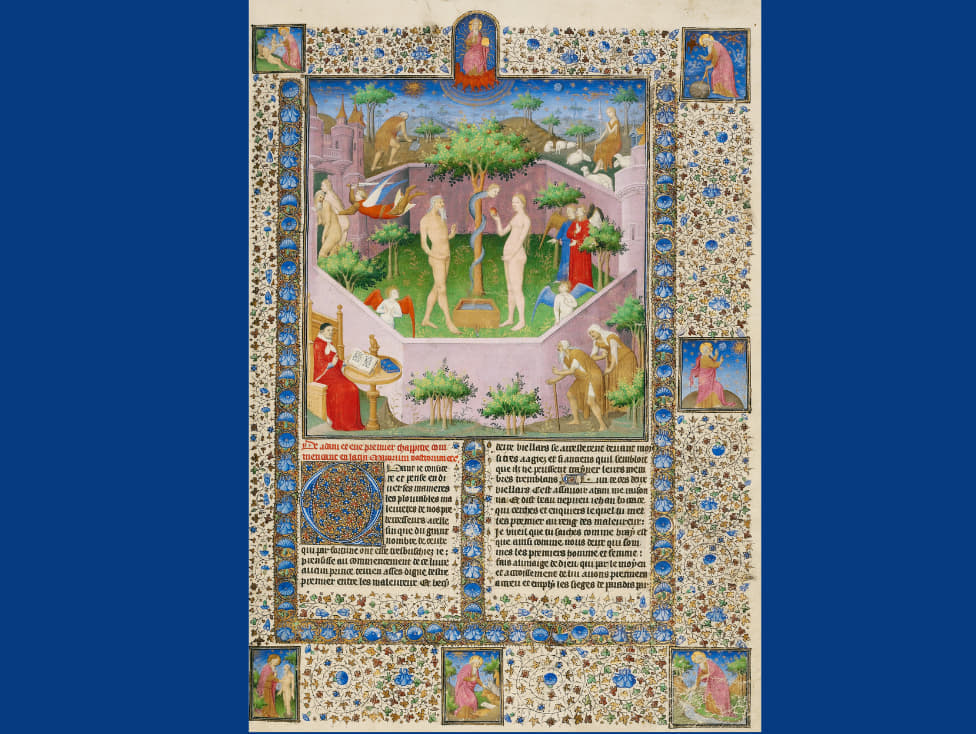
No speculative question has more obsessed the human mind than that of the origin of the human species. When, where, and how did the first true humans come into being? Direct confrontation surrounds proposed answers to these questions because two seemingly conflicting worldviews propose opposing responses. Historically, Scripture-based belief systems propose a literal single mating pair of two first true humans from whom we all descend: Adam and Eve. Radically opposed to this belief appears to be natural science’s theory of evolution, wherein no single mating pair of first true humans seems possible. The Darwinian scientific mindset is framed in terms of evolving populations, never entailing a bottleneck of just two individuals.
So, which is right? Scripture or the scientific theory of evolution? Many see these starkly opposed alternatives as being the only choices available on the intellectual spectrum.
In the past, attempts have been made to reconcile these seemingly opposed viewpoints by combining elements of both in a fashion that allows simultaneously for sound revealed theology and good science. Still, inevitably, it seems that such compromises fail to take adequate account of all the factors involved. This difficulty arises because the problem of human origins is like a complex mathematical equation in which three variables must find a simultaneous solution that is internally coherent. In the case of human origins, the challenge is to integrate essential truths from theology, philosophy, and natural science all at once in a coherent fashion. Many proposed solutions successfully address one or two of these criteria, but inevitably fail to integrate successfully all three with internal consistency.
What follows here is a blending of all three intellectual disciplines so as to retain internal coherence while explaining human origins. The first section of this essay will show how these three approaches can be correctly integrated to demonstrate how a literal Adam and Eve are scientifically possible. The second section of this essay will offer proof that Adam, as the first true human progenitor of all mankind—with his mate, Eve—must have, in fact and in truth, actually existed.
The Proof that Adam and Eve are Scientifically Possible
As indicated above, most natural scientists tend to reject the possibility of a single mating pair of first true humans as the progenitors of the entire human race. A significant milestone in the history of this viewpoint was the study by geneticist Francisco Ayala published in Science (1995), fittingly entitled: “The Myth of Eve: Molecular Biology and Human Origins.”
Ayala essentially maintained that present-day genetic diversity could not have evolved from a single mating pair of first humans because there were thirty-two ancient lineages of the HLA-DRB1 gene dating from some six million years ago and that, since a single mating pair could pass along only four such alleles, a bottleneck of just two human parents for all mankind was scientifically impossible. Later studies found methodological errors in Ayala’s study weakening the force of his claims. For example, a 2007 paper by Jenny von Salomé, et al., suggests a more recent appearance of many HLA-DRB1 alleles.
Evangelical geneticist Dennis Venema reflects the typical viewpoint against a literal Adam and Eve. He maintains:
Even though many of these methods are independent of each other, all methods employed to date agree that the human lineage has not dipped below several thousand individuals for the last three million years or more—long before our lineage was even remotely close to what we would call “human. (As cited in a 2018 article in Science and Culture Today)
The Kemp “Interbreeding Solution”
Given the allegedly-problematic genetics of a literal Adam and Eve, philosopher Kenneth W. Kemp, writing in the American Catholic Philosophical Quarterly (2011), proposed an alternative solution in the form of an interbreeding hypothesis, that is, that present genetic diversity in genes might be explained through interbreeding between Adam and Eve’s true human descendants and their subhuman “relatives” in the same biological population.
Kemp’s hypothesis meets the theological requirements that Adam and Eve must be the first true human beings and that all true humans who have ever lived must be their biological descendants. In any such scenario, the possession of intellectual abilities by true men would enable them to out-compete their subhuman “cousins,” thereby explaining why such nearly identical subhumans are no longer extant. Indeed, such an interbreeding hypothesis might meet the goal of explaining present genetic diversity from an initial single mating pair of true human beings.
Unfortunately, claiming that this is the essential solution to the genetic diversity problem produces yet another daunting possible objection. Namely, if human-subhuman mating is central to the divine plan for expansion of the human race, then God would be making one of the most objectionable sexual perversions—bestiality—to be the very core of mankind’s procreative activity!
God, who is the very Author of natural law, certainly cannot intend that human reproduction and expansion of the human race must be essentially dependent upon such a basic violation of natural law ethics.
Perhaps, some true humans did mate with subhuman hominins in the same population group—assuming that Adam and Eve belonged to such a group. Just because certain sexual acts are sinful and perverse has never stopped human beings from engaging in them! Whether such random perversions might have occurred in sufficient numbers to explain present genetic diversity remains debatable. Indeed, whether such sexual unions would even succeed in procreating more true humans might also be in question.
Adam and Eve’s Genuine Possibility without Interbreeding
Most geneticists and paleoanthropologists have tended to make the mistake of assuming that Adam and Eve appear relatively recently in prehistory. Say, only 150,000 years ago, as in the case of Mitochondrial Eve, or even 6,000 years ago in the judgment of many biblical literalists. This error makes such scientists think there is far too much genetic diversity in modern man to be explained by a single mating pair, Adam and Eve, since they maintain that there is simply not enough time for mutations to produce present genetic diversity.
Fortunately, the “interbreeding hypothesis” is not only ethically-problematic, but sound science now shows that it appears to be entirely unnecessary in order to explain present genetic diversity.
That is because mathematician Ola Hössjer and biologist Ann Gauger have published a peer-reviewed study in the scientific journal, BIO-Complexity, Vol. 2019, showing a realistic model for getting present genetic diversity from just a single mating pair of first true humans—provided that pair lived at least 500,000 years ago.
Philosophically, true human beings are not merely highly-developed sentient organisms. The presence of genuine intellectual activity—as opposed to mere sentient activity—is the sign of the presence of the human spiritual soul. Full development of this philosophical doctrine exceeds the scope of this essay, but has been published by me elsewhere.
Since mere biological matter cannot produce a human spiritual soul, the first spiritual-souled human being is also instantly and qualitatively superior to all forms of evolutionary life existing prior to its appearance. Now we must look for signs of this instantly qualitatively-superior kind of hominin’s first appearance.
When you combine 1) correct philosophical recognition of man's instant very ancient spiritual-souled first appearance with 2) correct scientific analysis of the genetic diversity now possible from a single very ancient mating pair of first true humans, Adam and Eve become scientifically possible.
Arguably, one such evidence of the human intellectual soul’s first appearance in hominin history could be found in the gradual development of bifacially-symmetrical Acheulean stone hand axes during the last million years. An explanation and photographs of such symmetrical artifacts can be seen a peer-reviewed PloS One scientific paper. Published in 2017, it explains:
Therefore, we can conclude that, by 700ka, Acheulean toolmakers already possessed considerable abilities to shape stone into symmetric shapes, whatever the causes of this symmetry may have been.
While some sentient estimations of symmetry appear in the abilities of irrational animals, the seemingly geometrical grasp of spatial dimensions manifested in later seemingly-artistic and non-utilitarian forms of hand axes appear to evince signs of genuine intellectual activity, especially since researchers have found later hand axes which appear to be too large for merely utilitarian purposes. Here is an example of a clearly artistic Acheulean hand axe, which manifests intellectual abilities in its hominin maker.

While this beautiful hand axe clearly requires artistic intellectual abilities by its maker, unfortunately, it may well date far, far more recently, than 400,000 years ago—much too recently for the half million years ago required to allow time for a single mating pair of first true humans to be the progenitors of modern humans, given the genetic diversity that must be explained. And while earlier, less perfect forms of symmetrical hand axes that are more than half a million years old do exist, it is not fully clear that they must demand makers with intellectual and spiritual souls, who alone would be the first true human beings, namely, Adam and Eve.
“Controlled” Use of Fire
Another possible sign of early true human existence may present itself to us when we examine how early hominins used fire.
Most researchers appear to use the term, “controlled,” in reference to fire-use, for those instances wherein early hominins actually started fires by striking iron pyrites (fool’s gold) against a sharp flint. But, such instances are often dated more recently than 400,000 years ago. This time frame may not be sufficiently early in time to allow for present genetic diversity to arise from a single mating pair of first parents, Adam and Eve—as discussed above.
But, this interpretation of “controlled” use of fire—as demanding the ability actually to start fires—may be more restrictive than what is sufficient in order to show intellectual activity. A Proceedings of the National Academy of Sciences peer-reviewed research article on Acheulean strata of Wonderwerk Cave, South Africa, presents what appears to be fairly complex fire-use by hominins some one million years ago. It appears that they actually moved fire from outside this cave to some “thirty meters” inside it.
Writing in 2012, the authors explain:
Thus, our data … demonstrate a very close association between hominin occupation and the presence of fire deep inside Wonderwerk Cave during the Early Acheulean. This association strongly suggests that hominins at this site had knowledge of fire 1.0 Ma.
The authors of this paper attest to the high quality of their findings:
…we provide unambiguous evidence in the form of burned bone and ashed plant remains that burning events took place in Wonderwerk Cave during the early Acheulean occupation, approximately 1.0 Ma. To the best of our knowledge, this is the earliest secure evidence for burning in an archaeological context.
Fire deep inside a cave precludes causation by wild fires. It requires somehow controlling and moving wild fire from outside to some thirty meters deep inside this cave—very likely in order to provide warmth and light and to cook food. The fact that the evidence shows multiple “burning events” implies repeated actions showing at least some grasp of the relationship of specific means to specific ends. In fact, most modern humans would find it somewhat challenging to determine exactly how one could carry fire safely some thirty meters to the place where it was to be used inside the cave!
But, is true intellectual understanding manifested here? Is this indisputable philosophical evidence of a genuinely-human spiritual soul’s proper acts and presence? If this is so, then this would date true man back to at least around one million years ago.
Here there is need for some caution.
First, the epistemic status of paleoanthropological investigations themselves is not anywhere near as certain as most of the rest of natural science. (More on this later)
Second, and more relevant to philosophical judgments about the exact nature of these early hominins, there are inherent challenges in estimating what exact type of knowledge they possessed: Was it purely sentient, or, was it both sentient and intellectual?
Unless unequivocal signs of intellect are present, there is always the possibility that what is observed may be explainable in terms of sense knowledge alone—meaning that the hominins in question might lack an intellectual soul and simply be irrational animals, like the rest of the animal kingdom.
Philosopher and theologian, Austin M. Woodbury, S.M., points out that there are four formal effects of true intellect: speech, progress, knowledge of relations, and knowledge of immaterial objects. (Natural Philosophy, Treatise Three, Psychology, Bk. 3, Ch. 40, Art. 7: Sydney: Aquinas Academy, unpublished manuscript, 1951, pp. 432-65)
First, with respect to the power of speech, in nature, brute animals do not invent and use conventional signs—as do human beings in the development of spoken and written language. Many were initially excited about lower primates possibly being able to “talk,” using signs that humans taught them—but it later was shown that these subhuman animals were merely imitating signs taught to them and associating images in order to get sensible rewards. They exhibited no true intellectual powers whatever. So, too, we have no evidence of language knowledge or use by these early cave inhabitants.
Second, while true humans are moved to make constant progress because of their intellectual appetite for the unlimited good, animals fail to make anything but accidental improvements. Whether inside of cave fire-use is clearly a deliberately innovative improvement may not be fully demonstrable.
The third sign of intellect, formal knowledge of relations, might be manifest in grasping the utility of moving fire into a cave for heat, light, and cooking. The question here is whether this entails intellectual understanding of the means (moving fire) as a means to an end (warmth, light, cooking) understood precisely as an end to be attained. Or, was it merely a fortuitous perception and association of a succession of sensible events, which was repeated because it was found to give sensible rewards?
Finally, the fourth and final formal sign of true intellect is knowledge of immaterial things. Unfortunately, there is no sign as to whether these cave dwellers developed such things as science, exercise of free choice, or an understanding of morality and religion.
It is possible that these cave-dwelling hominins possessed true speech, deliberately made progress by understanding the cause-effect relationship of moving the fire into the cave for light, heat, and cooking, or had some sort of religious values. But the lack of clear proof for any of these abilities by these particular early cave dwellers precludes assurance that these hominins were true human beings with intellectual and spiritual souls.
In point of fact, the central focus of philosophical proofs for the spiritual nature of our own human intellects is found in self-reflective examination of our abilities to form intellectual concepts, make judgments, engage in logical reasoning, and immediately experience our own free choices. But, since we are not those “cave men,” we cannot put ourselves into their place in order to be certain that they possessed these same spiritual experiences and faculties. In a word, we are not they. Therefore, we have no direct evidence of their possible intellectual experiences and spiritual nature.
Perhaps, one can say that the innovation of moving fire deep into caves for the abovementioned purposes does strongly suggest that these hominins were early true human beings. Of course, it must be granted that even strong probability is not certitude. Nonetheless, it does leave open the scientific possibility that these early hominins were, indeed, early true human beings. In that case, humanity’s actual beginning might be able to be traced back, perhaps, a million years or more.
How Adam and Eve are Scientifically Possible
The following explanation of how present genetic diversity can arise from a single mating pair of first parents does not address whether Adam and Eve are literally created by God directly from the dirt of the earth or by some possible derivation from pre-existent subhuman hominins. The exact method of our first parents’ actual creation by God belongs more properly to theological speculation. The present focus is simply on whether the present human population can—in a coherently scientific manner—arise from a single mating pair of first true humans created somehow by God in the distant past.
Essentially, you could begin with a single mating pair whose genetics are created by God so perfectly that their immediate descendants can mate with each other without causing defective offspring. Yet, with the passage of enough time—as the population widely expands both in numbers and in geographic distribution, mutations could cause genes with sufficient defects to make mating with close relatives no longer safe. Since it is now possible that well over 500,000 years have passed—perhaps one million years—since the appearance of the first true human beings, mutations have also had more than enough time to account for present genetic diversity.
As for the Neanderthals and Denisovans, given 1) that they appeared around 400,000 years ago—long after the possible first appearance of intellectual activities described above and 2) that they themselves may have manifested intellectual activities, such as burnt artifacts, fire starting materials, and deliberate burial sites with grave goods and careful placement, these later hominins may be viewed as among the true human beings who, like modern mankind, are actual descendants of a literal Adam and Eve.
Indeed, given the signs of fire-use inside caves by early hominins as early as one million years ago, the possibility exists that there were hundreds of thousands of years between our possible first parents and the appearance of the Neanderthals and Denisovans. If true, this might allow ample time for pronounced anatomical differences between the Neanderthals, Denisovans, and Homo sapiens to have developed as well.
Moreover, not all natural science possesses the same epistemic status. Natural science is usually thought of in terms of empirically verifiable hypotheses that can be tested worldwide in any laboratory or field environment.
But paleoanthropology and genetic studies of ancient hominins constitute a very different matter.
First, the paleoanthropologists who publish papers on early humans are examining a relatively limited number of sites around the world, looking at such things as bones, ashes, and soil in ancient caves. While doing so, they attempt to make educated judgments as to what type of hominins were once present and what type of behaviors these hominins exhibited. Such analyses necessarily entail using methods and measurements which themselves entail certain assumptions that may adversely affect the validity of their findings, if incorrect.
Second, genetic findings about hominins who lived hundreds of thousands of years ago entail retrospective calculations using computers programmed to incorporate multiple assumptions, such as constant population size, constant mutation rates, and random breeding among individuals—all of which may badly skew results, should even one of these assumptions happen to be wrong.
Finally, it should be noted that even modern experimental verification of present-day scientific hypotheses depends on the creation of the so-called “critical experiment,” which attempts to eliminate all confounding variables. These experiments themselves are only as certain as the ability of scientists to succeed in anticipating each and every such relevant variable. Since this is often not entirely possible, over time we have witnessed even basic scientific theories and claims having to undergo fundamental revisions—starting with the famous and seemingly obvious-to-the-senses, forever-held “truth” that the sun goes around the earth—which, it eventually turned out, it doesn’t!
Again, it must never be forgotten that the natural scientific claims about human origins are far less scientifically certain than are the presently-held theories about physical nature in general.
Applying all the above evidence and reasoning, it should now be abundantly clear that a literal Adam and Eve are not beyond the range of scientific possibility.
For another explanation of why Adam and Eve are scientifically possible, see my article, “Adam and Eve: Scientifically Possible?”
Proof of Adam and Eve’s Actual Existence
Even if the existence of a literal Adam and Eve is now granted to be scientifically possible, positive proof that Adam and Eve actually did exist is still required. Here follows one such proof.
We start by examining the evidence from which to proceed, specifically, three amazing phenomena that happened at Fatima, Portugal, on 13 October 1917. These phenomena were witnessed by some 70,000 to 100,000 people and are so well documented that virtually no one—including skeptics—denies that something incredibly extraordinary took place there!
Many skeptics try to dismiss these events as products of mass hysteria, deluded expectations, hallucinations, or some such psychologically-deceptive mechanisms. Unfortunately, if these skeptics had a proper clinical understanding of the mechanisms they claim were at play, they would realize they are misapplied with respect to what actually happened.
For example, mass hysteria or deluded expectations would not occur en masse when the tens of thousands present included believers and non-believers, Catholics and atheists, secular government officials and skeptics alike. Moreover, hallucinations may occur in single diseased persons, but not in tens of thousands of people simultaneously.
More importantly, what took place at Fatima that day was not merely a single phenomenon, but three distinct, inexplicable prodigies—wondrous events defying all natural explanation.
It is to be noted also that these events were intimately connected with a message to the world allegedly given by God through the instrumentality of three very young children.
The Prediction Fulfilled
The first incredible prodigy is the prediction fulfilled. Most probably, the actual number of witnesses was about 70,000 people, who had come from all over Portugal to a single place on the same day to see whether a prediction made by these three little children would somehow come true.
These children had been saying that they had been told that something would happen that was going to be so stupendous “that all may believe.” The word, “may,” is important here, since skeptics can always refuse to believe anything. But for those who have eyes to see and ears to hear, the prodigies of Fatima are more than sufficient evidence that the hand of God was present and acting on precisely the predicted day.
Indeed, at exactly the predicted location of the Cova da Iria in Fatima and exactly on the predicted date at about midday by the sun, something so amazing happened—as attested by those tens of thousands of eyewitnesses present—that it appeared to exceed all the laws of nature and became the basis for deep religious belief for many millions of people ever since—just as had been predicted. In fact, the awesomeness of what happened was so powerful that huge numbers of those present thought that it was the end of the world and that they were about to die!
The Solar Phenomena
The second incredible prodigy is the solar phenomena, which seems of central concern to most of those who believe that what happened at Fatima was genuinely miraculous. In fact, this event is so amazing that most people think of it as the sole alleged Fatima miracle, which it definitely is not, since there were two other wondrous marvels that occurred there on that same day, namely, 1) the fulfillment of the prediction itself and 2) the sudden drying of everything which had been rain-soaked all morning long, prior to the solar events.
A story published in the atheistic secular Lisbon paper, O Seculo, on 15 October 1917, was entitled (in English translation) “How the sun danced at noon in Fatima.” Something dramatic happened to what appeared to be the sun with photos showing many thousands of eyewitnesses looking upward in the same direction simultaneously.
Among other things, the solar phenomena entailed the people seeing what looked like the sun turning into a silvery disk, appearing to rotate, and seeming to fall toward the earth—later receding, while the entire scene was filled with a cascade of colors on everything. Many people were so shocked that they thought they were about to die—falling to their knees in the mud, with some calling out their sins publicly, since no priests were available! Many thought it was the end of the world! This was the Fatima solar prodigy—an event so stupendous that even critics today feel compelled to admit that something very extraordinary happened that day at the Cova da Iria in Fatima, Portugal.
As a scientifically-based skeptical explanation, in 2003, Dr. Auguste Meessen, Emeritus Professor of Physics at the Catholic University of Louvain, noted that similar “miracles of the sun” appear to have happened in a number of other religious contexts. And he further claims that some similar observations have been made “without any apparitional context.”
This led him to propose that there is an ocular mechanism whereby looking directly at the sun or even at a very bright light can cause one to see visual phenomena much like those reported at Fatima in 1917. Meessen also maintains that retinal after-images produced following periods of looking at the sun are a probable cause of the observed “dancing” and “looming” effects.
Meessen himself looked directly at the sun and reports seeing it turn into a grey disk with a “ring of fire” around it. But, it is noteworthy that he also stopped looking very quickly, since he considered continued looking at the sun itself to be “imprudent.” Everyone knows that staring at the sun can cause ocular damage. Interestingly though, among the tens of thousands of people who witnessed the solar phenomena at Fatima for ten minutes or so, there are absolutely no reports of anyone having any damage to his eyes!
Meessen suggests that, at Fatima, despite the sun being at its zenith, it may have been possible “… to look into the sun for a rather long time …,” because it had just been raining and residual high humidity might have permitted the sunlight to be “sufficiently attenuated.”
Nonetheless, the instant brightness of the sun is attested to by eyewitnesses. Dr. Manuel Formigão, affirms that “… the clouds were wrenched apart, and the sun at its zenith appeared in all its splendor.” Another witness, Dr. Almeida Garrett writes, “…the sun, a few moments before, had broken through the thick layer of clouds, which hid it and shone clearly and intensely.” According to the actual witnesses, the sun appeared in a perfectly clear sky for some ten minutes or so, while the photographs of the crowds show practically no one protecting his eyes with his hands! They just stand or kneel, looking up in the same direction in the sky in amazement.
The clarity of the photos themselves manifest that they appear to have been taken in full sunlight.
Another criticism of Meessen’s thesis is reports that witnesses from twenty-five to forty miles away from the Cova da Iria and Fatima also saw the unusual solar phenomena. It was reportedly seen from such places as the villages of Alburitel and Pombal, the coastal town of São Pedro de Moel, and the city of Leiria.
An example is offered by Albano Barros, a then twelve-year-old, living near the village of Minde, about eight miles from Fatima. He affirms:
I was watching the sheep, as was my daily task, and suddenly there, in the direction of Fatima, I saw the sun fall from the sky. I thought it was the end of the world.
Barros says, “…in the direction of Fatima,” and not overhead. Several witnesses from a distance make similar observations indicating that they saw the sun “dancing” over Fatima itself, and not overhead in their own locations.
Widespread observation also counters any claims of mass hysteria or group hypnosis or suggestive expectations, since those at a distance were simply not part of those who went to the Cova da Iria to witness any possible miracle.
As to the objection that no direct photographs of the sun taken at Fatima exist, the simple answer is that no one expected a sun prodigy to occur. Specialized equipment to photograph the sun did exist at that time, but no one thought there was any need to bring it!
Still, it is entirely possible that some or all of the mechanisms described by Meessen may have been employed by God as a natural platform on which to erect a genuine miracle—while at the same time adding features which can solely be explained as coming from his divine power and overarching control of nature.
Without attempting here to give a complete analysis of what took place, perhaps, the most overwhelming fact is that tens of thousands of people all turned and looked in the same direction at virtually the same time! Why would so many people so suddenly look in the same direction in evident amazement? It must also be realized that nearly all of the people coming to Fatima had no anticipation that some sort of solar prodigy was about to occur!
A more complete understanding of what took place at Fatima is that, while the eldest of the three visionary children, ten-year-old Lucia, did point to the sky and cried out, “Look at the sun!,” there is no possible way that some 70,000 people could “self-organize” virtually simultaneously so that nearly all would be looking in the same direction at the same time! So immense a crowd would have taken many minutes to all start looking in the same direction.
Rather, it appears that some 70,000 people all looked in the same direction at the same time because they all witnessed something in the apparent behavior of the sun that evoked their mass reaction. Compare this to individuals one-by-one looking at the sun and slowly developing their own subjective experiences, which would never have been temporally coordinated so as to cause massive simultaneous reactions by those present.
Such a massive simultaneous reaction is noted by Dr. Almeida Garrett, professor of natural sciences at the University of Coimbra, when he reports that “… suddenly a clamor was heard from all the people.” That “clamor” was caused by a “terrible” moment in which the sun appeared to fall from the firmament and seemed about to crush the earth!
Again, it seems rather unlikely that the physiological eye-changes caused by looking at the sun as postulated by Meessen would be so perfectly coordinated all at once that tens of thousands of people would simultaneously scream in fear that the world was ending!
Indeed, there does seem to be a definitive difference between, on the one hand, people seeing “interesting” visual phenomena noticed if one is willing to risk looking directly at the sun and, on the other hand, people massively seeing something so frightening and horrendous that they thought they were going to die and that this was the end of the world!
Perhaps, what occurred here might have been—at least in part—some sort of natural phenomena taking place—but in an entirely unnatural manner!
Indeed, if these “miracle of the sun” experiences were merely natural phenomena, then why haven’t we had impressive reports of it happening repeatedly at sporting events, where huge numbers of attendees are all sitting outdoors in the same place—doubtless, many times facing a somewhat softened setting sun? Surely, the atmospheric conditions at Fatima were not that unique—unless, of course, they were deliberately designed that way by God!
Perhaps, further proof that what took place was other than some merely natural mechanism—caused by looking at the sun—is a recent scientific analysis, which concludes that the tens of thousands of witnesses were not in fact even looking in the actual direction of the sun at the time of its alleged “dance!”
The abstract of a study by philosopher Philippe Dalleur is cited in ScientiaetFides online (2021) and concludes that, based upon
… a comparative analysis of eyewitnesses (up to 35 km away), weather data, and photographs… the directly observed source could not have been the sun, and most probably not any physiological, psychological, or meteorological effect.
One summary response to the solar retina theory of Meessen and others is seen here:
Some critics suggest that prolonged sun gazing damages the retinas of observers, leading them to perceive colors and apparent movement. This theory has some scientific grounding. Medical literature includes cases where direct sun observation causes photochemical damage that can result in visual effects. Several researchers, including Auguste Meesen from the Catholic University of Louvain, have attempted to recreate the experience by staring at the sun, and some noticed color changes (though not movement). However, this explanation does not account for several key factors: How did witnesses who weren't looking at the sun report similar phenomena? Why did most observers experience no eye damage, unlike the documented cases of solar retinopathy? And most critically, how could this bodily effect align with the children's prediction made months in advance?
Did Everyone See the Miracle?
Finally, it is evident that not everyone saw the solar phenomena. Many skeptics immediately point out that it was not seen by astronomical observatories, nor by witnesses at any substantial distance, say, hundreds of miles, outside the locale of Fatima. Moreover, they correctly observe that actual physical movements by the sun would have violently damaged the earth itself.
Frankly, while actual spatial movements by the sun clearly did not occur, this is an absurd objection. The genuine nature of the solar miracle is simply that some 70,000 witnesses at Fatima saw the sun “dancing in the sky.” It obviously could not have been actual movements of the sun which is at the center of the solar system—and no reasonable believer claims that it was!
Rather, what is affirmed is that either 1) God created some special objective extra-mental local phenomena that defied the normal apparent-immobility—at any given moment—of the natural sun, or else, 2) the apparent solar behavior at Fatima was some sort of “miracle of perception” or massive visions accomplished in a supernatural manner known fully solely to God himself.
Either the events at Fatima witnessed by tens of thousands of people were objectively real in the extra-mental physical world or not.
If the observations were extra-mentally real, then—since the real sun itself could not have been so changed and moved, this was a genuine miracle exceeding all the natural forces of the physical world.
But, if the observations were not extra-mentally real, an equally impressive miracle of perception must have occurred—some sort of quasi-universal vision caused in many thousands of people all at once. This, again, would be a genuine miracle, since it would be caused by God alone.
It may also well be the case that not everyone at Fatima saw the solar miracle. Skeptics repeatedly claim that “thousands” did not see anything—although sources do not appear to be offered for this claim. Still, it does appear possible that at least some people did not see the “solar dance,” perhaps, because of distraction or their exact location.
On the sole alternative hypothesis, namely, that this was not an extra-mental event, but rather, that the solar phenomenon was some sort of massive “miracle of perception” or supernatural vision, then the possibility that a number of people did not see it would be explained by the simple fact that they did not personally share in this massive vision.
A massive vision would also explain the various differences in what some witnesses reported, since absolutely nothing requires that each person be given the same vision with the same experiential content.
Nonetheless, mere inspection of the photographs taken on the day of the miracle itself show the vast majority of persons whose faces are discernible all seeming to be staring in total amazement in the same direction up into the sky!
If there is any subjective aspect to this nearly-universal amazing experience, does this thereby affirm that Auguste Meessen was correct—that this is merely a natural optical effect of staring at the sun?
Not at all. Meessen’s description of optical effects of staring at the sun does not adequately explain the Fatima solar miracle. This negative conclusion is confirmed for all the reasons articulated earlier in this essay, including the facts that 1) the people suddenly turned to see the sun all at once, seemingly because of something the apparent sun itself was doing, 2) his thesis has not been replicated by thousands of people attending open sports stadiums while the sun is softly setting, and finally, 3) the definitive evidence that there apparently were no reports whatever of ocular damage among the tens of thousands of people staring for some ten or so minutes directly at a sun brilliantly shining in a clear sky, as attested to by many witnesses and the amazing clarity of the 1917 photographs.
Note the clarity of this photograph taken in seemingly bright sunlight during the “miracle of the sun” at Fatima.
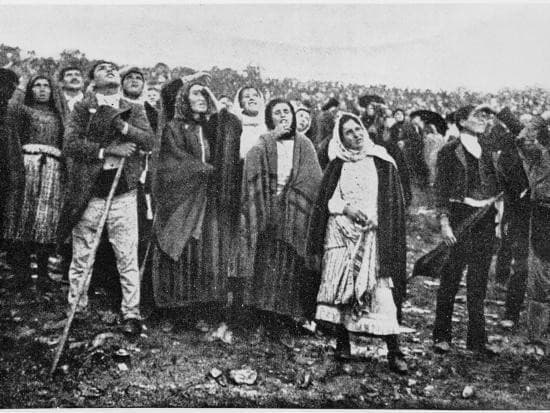
It offers easily verified proof of something very extraordinary taking place. Huge numbers of people appear to be looking upward in the same direction—presumably toward the sun or something most thought was the sun. At the same time, the absence of reports of ocular damage speaks for itself.
Dr. Almeida Garrett, Professor of Natural Sciences at the University of Coimbra, states, "The most astonishing thing was to be able to stare at the solar disc for a long time, brilliant with light and heat, without hurting the eyes or damaging the retina."
At the same time, journalists from very secularist newspapers, such as O Século and Ilustração Portuguesa, consistently reported that the sun appeared as a silvery disk that could be stared at lengthily without pain or causing blindness.
We must recall that even Meessen himself took care not to stare at the sun for long, since he, himself, feared ocular damage!
Interestingly, the well-publicized solar eclipse that recently took place on 12 August 2026 in Western Europe occasioned a newspaper report in The Irish Times of ophthalmologists warning about the dangers of staring at the sun. It cites the following expert:
Dr Mark Cahill, a consultant eye surgeon with a special interest in retinal diseases, said when a person looks at a strong energy source, such as a laser or the sun, they get a lot of heat on the pigment under the retina, just at the centre of the macula.
That heat damages that pigment and then the retina over it can’t work,” he said. “Looking at the sun causes that to happen.
The problem is it’s not painful when you do that. The damage builds up over a number of days and weeks as that energy gets absorbed and causes damage to the pigment and it’s irreversible.
Note well the observation that absence of pain does not prevent irreversible damage. This means that the people at Fatima might, indeed, have been able to stare at the sun for the ten minutes or so that the solar event took place without reporting pain. But, it all the more would ensure that many or most of those looking directly at the sun for so long would have suffered irreversible retinal damage, and possibly even blindness!
The fact that such irreversible damage might not occur immediately would in no way prevent physicians in Portugal from seeing and reporting such mass injuries publicly—as the “damage builds up over a number of days and weeks….”
And, if that were true, one can be certain that today’s skeptics would be shouting from the rooftops about all the later reports of eye damage caused by the foolish people who looked at the sun for too long at Fatima because of three imaginative little children!
Either the people were staring at the actual sun for so long they would have had undeniable eye damage, or else, they were looking at some other very unnatural visual phenomena caused by the predicted miraculous action of God.
The only legitimate conclusion of the above analysis is that either 1) the radically unnatural behavior of the sun at Fatima was a genuinely objective extra-mental miracle, or else, 2) it was still a miracle of perception or a massive vision caused by God himself for some 70,000 people experiencing it all at once.
Another Reason Why the Solar Event is Miraculous
Regardless of the natural or supernatural nature of the solar prodigy, considered in itself, it is manifestly miraculous when viewed in terms of its being a prediction marvelously fulfilled. For four months, the three little children had predicted something unbelievable would happen exactly at the time and place that the solar event actually occurred. And, indeed, that solar event turned out to be so stupendous that many witnesses thought it was the end of the world!
Philosophical reasoning demonstrates that the God of classical theism exists and orders all things according to his infallible providence. No events, such as those occurring at Fatima in 1917, could have taken place without his deliberate intention and permission. Given the nearly impossible improbability of the sequence of the Fatima events—from prediction to evident fulfillment—and how that sequence has impacted the lives of hundreds of millions of believers, it must be solely the product of God’s infallible providence, since no other agent could or would be allowed to govern its execution.
But, God’s omnipotence, providence, and goodness absolutely preclude his willing or allowing mankind to be deceived by such a sequence of incredibly convincing prodigies as happened at Fatima. Put simply, God’s nature precludes him from allowing massive and virtually undetectable deception. This means that, since both the prediction and the solar phenomena must be approved and produced by God alone, these are genuine miracles. And, if they are miracles, the message they contain must express God’s absolute truth for all mankind.
Some may object that God’s existence and goodness cannot be used in a rational proof for Adam’s actual reality, since it is merely a matter of religious belief. But, as indicated above, since the existence of the God of classical theism can be philosophically demonstrated and since, in addition, this can be done in many ways, his goodness and providence and veracity can serve as a rational basis for inferring the miraculous nature of the Fatima miracles—and thus for the truthfulness of the divine message they reveal to the world.
The Sudden Drying of Everything
The third incredible prodigy is the sudden drying of everything. This last wondrous event so defies the laws of nature as to belie any suggestion of intervention either by demons or space aliens.
Before the visual solar display, rain had been soaking the Cova da Iria at Fatima all morning. Photographs show a sea of umbrellas, while the witnesses report having their clothes soaking wet as was the ground itself. People falling to their knees in the mud and water inches deep are described. And yet, immediately after the solar prodigy ended with the sun returning to its normal place in the sky, their clothes were suddenly found to be completely dry!
Skeptics try to explain away this general experience by saying that the rain had become light and the heat of the sun made them feel as if the clothing were drier—causing the illusion of sudden dryness. But, the fact is that the rain had been drenching and even those with large umbrellas were mostly soaked to the skin. One source says that the only ones still dry were those inside shelters.
John M. Haffert, in his 1961 book, Meet the Witnesses, took signed depositions from about 200 eyewitnesses, still living, who had been present at the Fatima miracles—only 27 of which he published because of space limitations in this book. The eyewitnesses consistently affirm having been soaking wet before the solar event and then suddenly totally dry after it ended, just ten minutes later. We must also recall that, in 1917, clothing was generally much heavier and more difficult to dry than today’s synthetic fabrics, since the 1917 clothing was usually made of heavy wool or cotton materials.
One eye witness cited in the book was Dominic Reis, who says, “There was a good three inches of water where I stood, and mud on the ground. …three inches of water on the ground. I was soaking wet.” And yet, after the mere ten minutes or so of the shocking solar experience, the people reported that their clothes and the entire area were completely dry! Reis also describes how, after the sun had receded back into the “right place,”… “The clothes were dry and looked as though they had just come from the laundry.”
Is this possible according to the natural laws of physics? Yes, of course it is. But the incredible amount of energy required in order to produce this sudden total drying of both clothes and ground would have required such heat that all the tens of thousands of witnesses would have been incinerated in the process!
Therefore, producing this effect without harming the people present so violates the laws of physical nature as to transcend the powers both of space aliens and even demons. Solely, the Creator of nature’s physical laws—the God of classical theism alone—is capable of producing such clearly supernatural effects—making this third, and last, Fatima phenomenon a genuine miracle even by the strictest theological definition!
Indeed, it is self-evident that evil demons would “spiritually regurgitate” at the very thought of promoting the message of Fatima, which calls for men to repent for sins, make and offer sacrifices to the Most High God, and do penance!
In Meet the Witnesses, Haffert offers the following general conclusion as to what the eyewitnesses experienced:
In the summary from all the witnesses we know that there was a four-fold wonder:
(1) The crowd looked without the aid of dark glasses or other protection upon a brilliance which they took to be the sun; (2) it emitted rays of brilliant color, which actually colored objects on the earth; (3) it fell toward the crowd; (4) within a few minutes the area which had been wet was dry.
ALL witnessed or experienced some part of this. And it seems evident that the few who did not witness all four elements were distracted.
If one accepts that the God of classical theism must be the sole possible cause of even a single one of these three amazing phenomena that happened at Fatima, Portugal, on 13 October of 1917 (the incredible prediction fulfillment, the stupendous solar phenomena, and the sudden drying of everything), then it follows that the Fatima message itself must be true, since divine goodness, omnipotence, and providence would exclude any possible deception or failure in its execution.
For another examination of the historical evidence pertaining to the events depicted above at Fatima, Portugal, see my article, “Catholicism’s Greatest Modern Proof.”
How the Message of Fatima Relates to Adam’s Reality
But how can we trust three little children to get the story straight about the message conveyed and supported by the prodigious events of Fatima? This can easily be demonstrated. God himself cannot fail to guarantee the accurate content and full truthfulness of any message he so manifestly presents to mankind. This is so simply because 1) such miraculous events and the message they proclaim fall within the omniscient eternal vision and ordering of his divine providence and 2) his divine goodness prevents any possible deception on his part.
Therefore, even should God be employing as his divine instruments three little children, the message they convey on his behalf must be fully accurate and trustworthy, since God himself is in total control of every detail of his message’s content and transmission. He intends to communicate a message to the world and, being God himself, he cannot possibly fail to accomplish his full intention.
Yet, in presenting the divine message to the children at Fatima, the "lady of the Rosary"—as she calls herself when appearing visually to the children—at least three times tells them that believers are to promote devotion to her Immaculate Heart—noting that Jesus wants this to be done.
Since the truth of Fatima as an authentic message from God has now been established, and given that the person in the vision to the children identifies as the “lady of the Rosary” and was told by Jesus Christ himself that we should promote devotion to her “Immaculate Heart,” it is absolutely certain that she can be none other than the Blessed Virgin Mary, the mother of Jesus Christ.
Critical Importance of the Term, “Immaculate”
But, the use of the term, "immaculate," in this request clearly reflects the understanding of both Catholic faithful and theologians that this comes from the Catholic Church's deliberate use of the word, “immaculate,” in the dogma of the Immaculate Conception, defined by Pope Pius IX in 1854—just 63 years before the miraculous events at Fatima. "Immaculate," in the context of the message of Fatima, therefore, refers unequivocally to the doctrine that the Blessed Virgin Mary “…was preserved free from all stain of original sin….” and is "without stain," specifically, without the stain of original sin.
To further document this point, the Catholic Church’s official language of Latin describes devotion to the Immaculate Heart of Mary, using the following phrase to depict the object of that devotion: Cor Immaculatum Mariae. The official language describing the dogma of the Immaculate Conception also uses the same word, “immaculate,” in Latin as a central term: Immaculata Conceptio Beatae Virginis Mariae.
Both titles simply use different cases of the same Latin word: immaculata, which is the negation of the word, macula, meaning “stain.” Hence, “immaculate,” means “without stain.” But, since the meaning of “immaculate” in reference to the Immaculate Conception of the Blessed Virgin Mary had been solemnly defined by the Church in 1854 to mean that she “was preserved from all stain of original sin,” its use by God himself in the context of Fatima has to have the same now historically-defined meaning. Therefore, the message of Fatima specifically and deliberately includes promotion of the Blessed Virgin Mary conceived as free from original sin—thereby clearly affirming the reality of original sin itself as an objectively-real stain, which was never present on Mary’s soul.
But, if there was an original sin, then there must have been an original sinner, who is understood by all to be the one who committed that first sin of all mankind as clearly depicted and named in the Book of Genesis, that is, Adam.
Therefore, the logical implications of the events at Fatima clearly affirm the existence of Adam as the historically-real person who uniquely fulfills the definition and reality of that original sinner.
Therefore, Adam and his wife, Eve, must be—not mere possibilities—but, in literal truth, genuine spiritual-souled human beings who actually lived at the very beginning instant of all human history—the first parents of all true human beings who have ever lived or are still alive today.
Quod erat demonstrandum.