The Sadducees: What Do We Know?
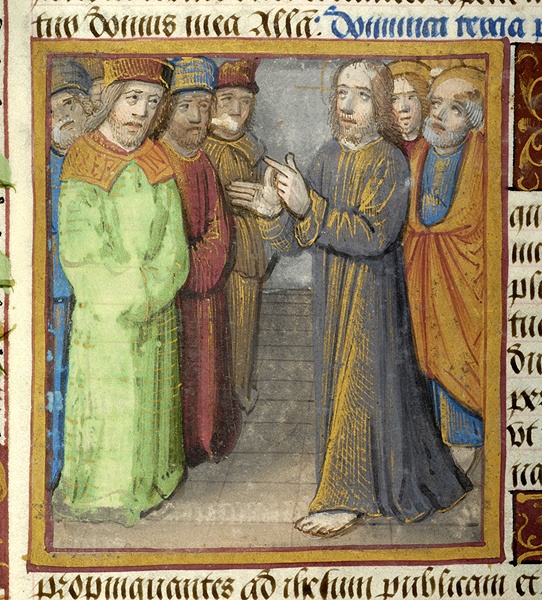
In the famous account of the meeting of Christ with the Sadducees (Luke
20: 27–40), the question is brought up of the resurrection of bodies (in other
words, their "recovery" after death). More importantly, the
representatives of the "party" that was once the majority in the
Sanhedrin, the Sadducees, seek to ask the "Master," the "Rabbi,"
the "Doctor" this fundamental question to which they think they have
the correct answer. They hope to bewilder the man they are addressing, and care
little for the title they use for him. But their hopes are dashed by the answer
they receive: after the Resurrection, men will be like angels.
Our God is the God of the living; there is thus a life after life. But
the conception of the afterlife among Jews, as embodied by the Pharisees and
mocked by the Sadducees, is indeed so simplistic that it can only lend itself
to derision.
On the whole, this controversy illustrates the refusal of history by the
Sadducees, who themselves are an enigma. They were members of the priestly
class, who were in conflict with the Pharisees, and who refused the very idea
of resurrection. That's about all we know about them - aside from the
reference that their name makes to Zadok, high priest under David. They were also
supporters of the Romans, during the time of Christ, who lost control of the
Sanhedrin to their opponents, the Pharisees.
In comparison to the Pharisees, the Sadducees held a very “modern” and
simple doctrine – after death, there is nothing. The soul disappears, there is
no other world, there is no destiny. Man has the free choice between good and
evil in this life. After death, it is all over. Their doctrine denied all “post
mortem” reality. In this they opposed the Pharisees who believed in the
immortality of the soul and the resurrection of the “good” – the “bad,” on the
other hand, fell prey to eternal punishment.
The “theology” of the Sadducees was the work of a group of priests, who
founded the sect, and who were vocal on the theological as well as the
political level. They recognized value only in the Torah, thus dooming the rest
of the Bible to nothingness. And, although a minority, their “lobby,” during
the time of Christ, dominated the priestly caste. Thus, for them, history did
not exist, Providence did not exist, only the chaos of human choices reigned.
Man had before him neither a future, nor hope of resurrection. It can be said,
without caricature, that the Sadducee is the prototype of today’s “average
atheist,” – and he was a priest! For him, the Messiah was the hero of a myth.
Let us return to the controversy with Christ on the subject of the
resurrection of the body, taking into account that for the Sadducees the world
as it is, is nonsense. And, indeed, their position is quite singular,
since all the peoples of the earth, of all times, believed, until the
eighteenth century in Europe, at least, in a transcendence, including at least
one god, or a pantheon, and an afterlife. The memory of a primitive religion is
common to all of humanity. But the Sadducees, for their part, had managed to
eliminate the history of Israel – and they were practically in power!
Nevertheless, the Hebrews believed in the resurrection, since Moses at least
(just like the Egyptians, by the way). Did not God promise to restore the
world?
And the answer Jesus gave took them for a loop – first, that the dead are
indeed resurrection, and two, that the resurrected will be like angels. His
opponents, who knew the concept of “angel” but did not believe it, could not
imagine such a metamorphosis. And the answer also highlights the idle nature of
their question.
We should note that the angel-analogy relates only to the condition of men
and women resurrected, who then will have no carnal relationship because they
will not feel the need. And the Talmud does tell us that in the Otherworld, you
do not drink, you do not eat, all are equal and in harmony. The body of the
resurrected undergoes a metamorphosis.
But why should angels not have carnal relations? Simply
because they are not susceptible to death and thus do not survive by procreation.
(We might suppose that angels also multiple, but that is a different discussion).
Here it seems that Christ
establishes a causal relationship between carnal reproduction and the necessity
of death. In Heaven, one does not die, one does not die any further. The carnal
relation is really a continuation of the original decay. Adam and Eve, after
the fall, lost their garment of Light, and, being naked, they were then covered
with skins of animals and subject to death. But in the hereafter, people, as
began with their first parents, find a body of Light. They participate in the
mystery of the resurrection. And the Resurrection of Christ is the principle of
all resurrection: by resurrecting, he resurrects in the entirety of his being,
body and soul.
Thus, the pool of the Sadducees
is paved over! Risen humanity will participate in the rightful filial dignity
of the risen Christ, in which filiation and rebirth from the dead together proclaim
Him Son of God.
We also notice the Sadducees’
petty notion of sexuality, expressed in a manner that regulates the lot of
widows. For the Sadducees, marriage is nothing but a carnal union, we may say a
bestial one, since it denies all transcendence accessible to mankind. Marriage,
in this case, only a system of filiation; and it is a fact, recognized and
regulated by the Law, that the only husband of the woman is the first deceased
brother. And yet, clinging to the Law, it seems that the Sadducees have not
understood, in their pettiness and narrow mindedness, the full significance of
marriage, nor have they grasped the grandeur of human destiny.
Christ makes Filiation holy by his Divinity, by opening us to the omnipotence of God, and thus reminding us of the promise of history, which includes our very own resurrection.
The photo shows Christ teaching, from a French breviary, dated to ca. 1511.