The Sana'a Manuscripts: Early Koran?
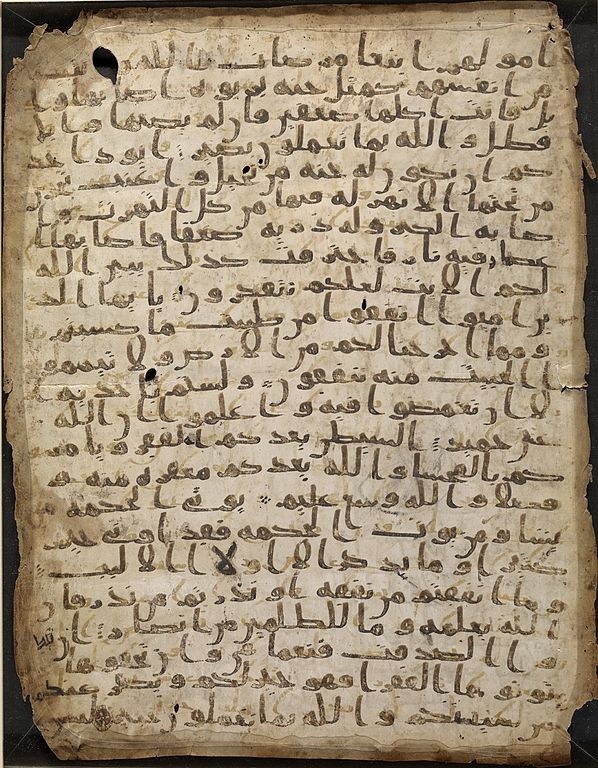
The Sana'a manuscripts were discovered in the Grand Mosque of the city of Sana's, Yemen, in 1972, by construction workers, who gathered up all the old, rotting pages, stuffed them into potato bags, and left them beneath some stairs. Nothing was done until 1981, when Professor Gerd R. Puin, the leading scholar of Arabic orthography and Koranic paleography, undertook a systematic study. In this interview, Professor Puin speaks of the discovery and his study.
He is interviewed here by Professor Dr. Robert M. Kerr, the current head of Inarah, the foremost institute for the study of early Islam. Inarah publishes a yearly collection of work, of which the most recent edition is now available. Dr. Kerr's work has appeared frequently in the pages of the Postil, including his recent article on the true meaning of "Mecca."
This is a truly a fascinating interview...
Unfortunately for English readers, the majority of the important work being done on early Islam is in German and French. Perhaps, in the future, this will be rectified by way of good translations of this important work, which has entirely rewritten the history of the beginnings of Islam.
The featured image shows a leaf from the collection of fragments housed at Stanford University. This is "Sana'a1 Stanford '07," recto, which dates to before 671 AD.