The Slow Genocide: Toxic Debris and the Erasure of Gaza’s Future
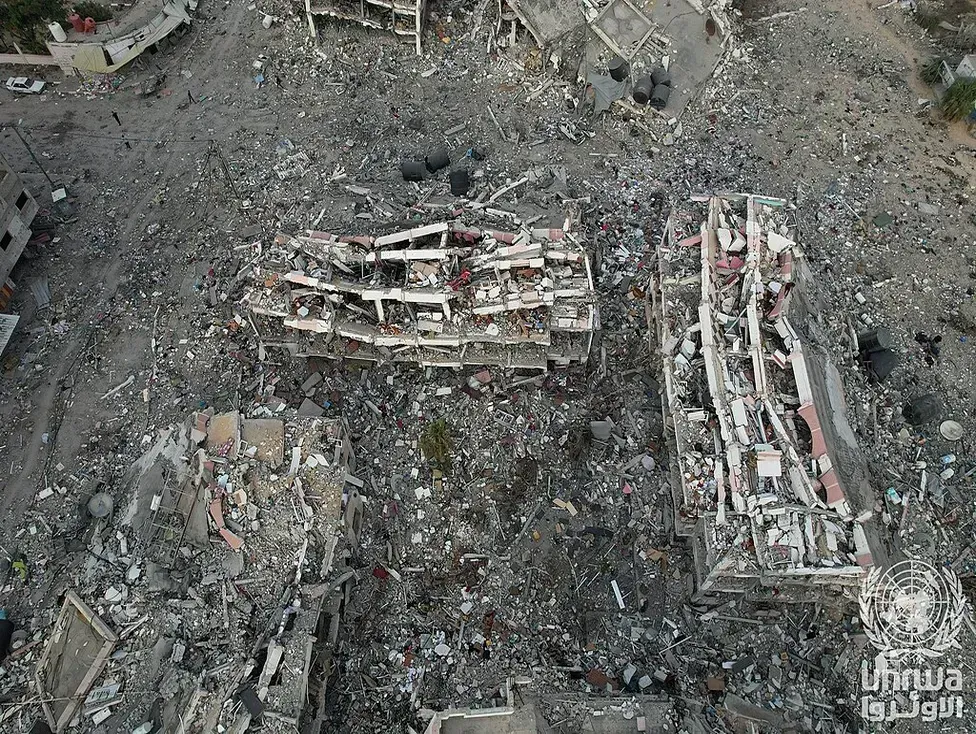
The management of Gaza’s post-war debris is not a neutral humanitarian logistics problem but a continuation of a structural violence that Israel has inflicted upon the Palestinian population. With over 61 million tons of rubble—laced with an estimated 800,000 tons of asbestos, heavy metals, and munitions residue—the failure to report on and safely mitigate this toxic legacy constitutes a policy of "slow genocide." By examining the mechanics of the debris crisis, the deliberate obstruction of remediation access, and the epidemiological time bomb of asbestos-related disease, this essay contends that Israel’s destruction of Gaza’s built environment is inextricably linked to an assault on the biological integrity of its people. The lack of critical reporting on this issue is not an oversight; it is a symptom of a media and political environment that has normalized the rendering of Gaza as uninhabitable.
Introduction: The Rubble as a Weapon
In the aftermath of the intense bombardment that began in October 2023 and continued through the ceasefire of October 2025, the Gaza Strip has been transformed into a landscape of pulverized concrete and toxic dust. The United Nations Development Programme (UNDP) estimates that the enclave is burdened with approximately 61 million tons of debris . To contextualize this figure, it is roughly twenty times the amount of debris generated by all previous conflicts in Gaza since 2008 . Satellite imagery and UN assessments indicate that up to 82% of all structures in the Strip have been damaged or destroyed, including entire residential blocks that have been erased from the map .
While the immediate horror of the death toll—surpassing 74,000 Palestinians—and the physical maiming of tens of thousands more are frequently, albeit insufficiently, reported, the slow-motion catastrophe of the debris itself remains a critical blind spot in international discourse . The rubble of Gaza is not inert material. It is a chemically hazardous matrix containing the pulverized remains of homes, hospitals, and schools, saturated with carcinogenic asbestos fibers, heavy metals from munitions, and industrial pollutants. The failure to address this toxic legacy in a safe and timely manner constitutes a multi-generational respiratory and oncological crisis. This essay posits that the mismanagement and deliberate obstruction of debris remediation by Israel is not merely a failure of post-war planning; it is the continuation of a policy aimed at making Gaza uninhabitable, thereby completing the destruction that the bombs began.
The Toxic Composition of Erasure
The characterization of Gaza’s debris as merely "concrete" is a dangerous misrepresentation. A significant portion of the destroyed structures in Gaza, particularly the densely populated refugee camps, were constructed with materials containing asbestos. Before the war, these structures provided shelter to over two million people. The International Journal of Epidemiology notes that within Gaza’s refugee camps alone, debris totals nearly 4.93 million tons, with 50,000 tons potentially consisting of asbestos-containing materials . More alarmingly, Crocidolite—the most hazardous form of asbestos—has been identified in these structures . The Lancet has reported that the amount of asbestos-contaminated rubble is estimated at around 800,000 tons .
The specific danger of asbestos lies in its latency. Unlike the immediate trauma of a bombing, asbestos-related diseases such as mesothelioma and lung cancer manifest years or decades after exposure . Asbestos fibers, particularly the iron-rich crocidolite fibers, generate reactive oxygen species that directly damage DNA, sustaining genomic instability that drives cancer development . In a normal occupational setting, exposure is regulated. In Gaza, the population is living directly within the source of exposure. The UNDP has noted that 90% of Gaza’s population currently lives in the middle of this rubble . The physical act of clearing debris, or even the natural weathering of the rubble piles by wind and rain, aerosolizes these fibers, creating a pervasive, ambient threat that is inhaled by children playing in the ruins and families sheltering in nearby tents.
Compounding the asbestos risk is the presence of heavy metals and munitions residue. The United Nations Environment Programme (UNEP) estimates that 15% of the debris is of high risk due to contamination with asbestos, industrial waste, and heavy metals . Furthermore, the widespread practice of open burning of plastic waste and tires—driven by fuel blockades—releases polycyclic aromatic hydrocarbons (PAHs), including benzo[a]pyrene, a potent carcinogen . Experimental models suggest that asbestos fibers can act as carriers, concentrating these PAHs directly into airway cells, creating a synergistic carcinogenic effect that is greater than the sum of its parts . No existing cancer-risk model accounts for this complex, population-level co-exposure . This is not a hypothetical risk; it is an ongoing public health emergency.
The Obstruction of Remediation and the Politics of Access
The technical challenges of clearing 61 million tons of hazardous debris are immense, but they are not insurmountable. The UNDP has warned that at the current pace, with only 0.5% of the rubble removed, it would take seven years to clear the debris . However, the primary obstacle is not a lack of engineering capability but a lack of political will and, crucially, access. The UN has stated that it has the funds and capacity to scale up reconstruction operations but lacks the necessary access to carry out these vital tasks .
Israel’s control over the entry of goods and personnel into Gaza has been used to obstruct the very tools needed for safe debris management. The UNDP has highlighted that "we understand the security concerns of the Israeli authorities, but that should not be a reason to refuse access to organisations such as UNDP" . The restriction on access means that specialized equipment for asbestos abatement—such as sealed removal units, personal protective equipment for workers, and air monitoring devices—cannot enter in sufficient quantities. Instead, debris is being cleared, if at all, by desperate civilians and under-resourced municipal teams using manual labor and basic machinery, often without adequate respiratory protection.
This obstruction must be viewed within the broader context of Israel’s stated policies. Human Rights Watch and Amnesty International have documented systematic campaigns of forced displacement and the deliberate destruction of civilian infrastructure, including high-rise buildings, often without plausible military necessity . The Israeli Minister of Defense has been quoted linking the destruction of homes to political demands, effectively admitting to the use of civilian suffering as a bargaining chip . In this light, the failure to facilitate debris removal, or even to allow the entry of air quality monitoring equipment, cannot be seen as bureaucratic negligence. It is consistent with a policy of collective punishment.
The presence of unexploded ordnance (UXO) further complicates remediation. The rubble is seeded with thousands of tons of explosive remnants of war. The UN Special Rapporteur has noted that over 200,000 tons of explosives were dropped on the Strip . The contamination of the debris with these remnants means that any clearing operation is a potentially lethal endeavor. By failing to provide detailed maps of strike zones or to allow specialized UXO clearance teams to operate freely, Israel perpetuates a situation where the simple act of removing rubble can result in death or maiming. The debris thus serves a dual purpose: it physically obstructs recovery, and it actively kills those who attempt to clean it.
The Epidemiological Time Bomb and the Failure of Reporting
The most insidious aspect of the toxic debris crisis is its temporal dimension. The health consequences will not be fully realized for years, but the groundwork for a multi-generational health catastrophe has already been laid. The World Health Organization has documented the collapse of Gaza’s healthcare system; only 19 of 35 hospitals are even partially functional . This means that the very infrastructure needed to diagnose and treat the looming wave of asbestos-related cancers and chronic respiratory diseases has been systematically dismantled.
The lack of reporting on this issue is striking. Major international media outlets have devoted extensive coverage to the immediate political and military dimensions of the conflict, yet the environmental and public health catastrophe embedded in the rubble receives scant attention. This is not merely a failure of journalistic curiosity; it is a failure of framing. The destruction of Gaza is often presented as a tragic byproduct of war, a "humanitarian crisis." By focusing on the immediacy of hunger and displacement, the slower, more insidious violence of toxicity is obscured. The rubble is portrayed as an obstacle to rebuilding, rather than as a weapon of ongoing harm.
The epidemiological evidence from other conflicts is clear. Following the 1995 Great Hanshin Earthquake in Japan, asbestos concentrations in the environment increased for over six months due to the deconstruction of collapsed buildings. One worker engaged in the disposal of rubble subsequently developed mesothelioma, a case acknowledged as work-related . The scale of Gaza’s exposure is exponentially larger. The population is not merely handling the rubble; they are living in it, breathing it, and drinking water contaminated by the leaching of heavy metals from it. The World Health Organization has warned that the environmental contamination could last for decades .
This essay contends that the failure to prioritize and report on the toxic debris crisis is a form of complicity. By treating the rubble as a logistical afterthought, the international community tacitly accepts the slow deaths that will result. The children of Gaza, already traumatized by bombardment and displacement, are now being condemned to a future of chronic illness and premature mortality due to the air they are forced to breathe. This is the essence of a slow genocide: the destruction of a population’s future through the deliberate creation of an environment that is hostile to life itself.
Conclusion: The Rubble is the Crime Scene
The 61 million tons of debris in Gaza are not just the remnants of war; they are the physical evidence of a campaign of destruction that has targeted the very conditions of Palestinian life. The asbestos, the heavy metals, and the munitions residue are not accidental byproducts; they are the fingerprints of a policy that has rendered the territory uninhabitable. The failure to safely manage this debris is not an unfortunate consequence of conflict; it is a continuation of the conflict by other means.
To discuss the reconstruction of Gaza without first addressing the toxic debris is to engage in a dangerous fiction. The international community, and the media that shapes its understanding, must shift its focus from the spectacle of destruction to the slow violence of contamination. The demand must be not only for a ceasefire and the entry of food aid but for the unfettered access of environmental remediation teams, the provision of respiratory protection for the population, and the establishment of a long-term health monitoring system for asbestos-related diseases.
Until the rubble is cleared safely, and until those responsible for its toxic composition are held accountable, the war on Gaza’s civilians will continue. The bombs have stopped falling, but the dust they raised is still settling in the lungs of a generation. The silence surrounding this crisis is not neutral; it is a choice that enables the suffering to continue unchecked. The rubble is the crime scene, and the failure to investigate it is a denial of justice.