The US and China: A “Managed Decoupling”?
Introduction: The Paradox of Managed Rivalry
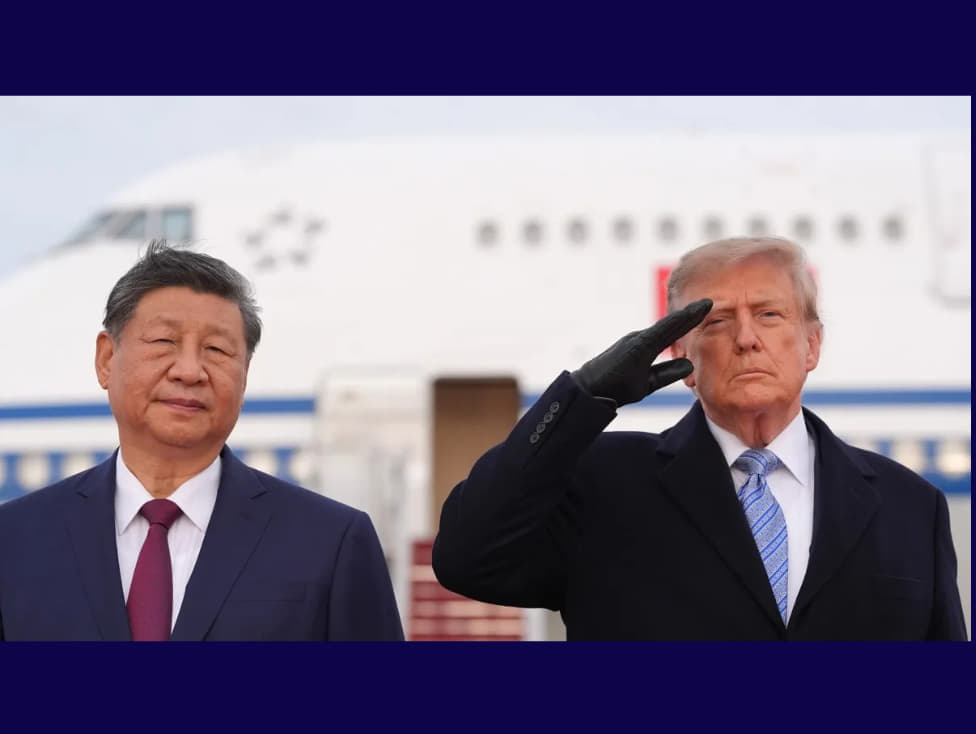
The September 2026 Xi-Trump summit in Washington produced what markets wanted most: the appearance of stability. A two-month trade truce extension, a framework for reciprocal tariff relief on $30 billion in goods, and a new AI dialogue mechanism signaled that both superpowers retain an interest in preventing their competition from spiraling into catastrophe. Yet the summit also exposed the fundamental contradiction at the heart of the relationship. The two sides are attempting to manage a rivalry that is simultaneously deepening in its structural foundations. The real question is not whether Washington and Beijing can agree on tactical pauses, but whether a managed decoupling can survive the inevitable shocks that technology controls, semiconductor supply chains, and Taiwan will generate.
The Architecture of Managed Competition
The current equilibrium rests on a shared recognition that uncontrolled escalation serves neither power’s interests. China has framed this as “constructive strategic stability”—a concept that positions cooperation as the primary track while keeping competition “within bounds.” Washington, for its part, has embraced a transactional model in which discrete deals substitute for comprehensive frameworks. The summit’s modest outcomes reflect this logic: rather than resolving structural disputes, both sides compartmentalized them.
The institutional innovations are real but shallow. The establishment of a US-China AI dialogue, with a communication channel for AI-related incidents, represents a genuine precedent—much as nuclear rivalry once produced crisis-management mechanisms. But the dialogue addresses only the risks of frontier AI, not the underlying competition for technological supremacy. Similarly, the agreement to extend the trade truce and pursue reciprocal tariff reductions on non-sensitive goods provides breathing space for markets without altering the fundamental trajectory toward economic fragmentation.
The Chinese readout of the summit emphasized that the Thucydides Trap—the alleged inevitability of war between a rising and ruling power—can be overcome. This is a doctrinal assertion, not a policy commitment. Beijing’s willingness to stabilize the relationship reflects its confidence that time favors its position in advanced manufacturing, not a relinquishing of its long-term objectives.
The Semiconductor Contradiction
Nowhere is the fragility of managed decoupling more evident than in semiconductors. The Biden administration’s sweeping export controls, designed to deny China access to advanced chips and chipmaking equipment, have been partially relaxed under Trump. In December 2025, the administration announced it would permit sales of Nvidia’s H200 chips to approved Chinese customers under case-by-case review and a 25 percent revenue-sharing arrangement. The stated rationale—that controlled engagement strengthens the American technology ecosystem—reflects a transactional turn rather than a strategic reassessment.
This relaxation is unstable by design. Congress has moved in the opposite direction. The SCALE Act, introduced in April 2026, would establish a rolling technical threshold for chip exports, permitting sales only up to 110 percent of the performance of chips that US adversaries can already manufacture domestically. The MATCH Act, advanced by the House Foreign Affairs Committee, would close loopholes allowing allied firms to sell chipmaking equipment to China and restrict maintenance services at Chinese facilities. The legislative branch is constructing a more restrictive regime even as the executive branch experiments with controlled engagement.
The contradiction is structural, not merely political. The current export control regime already suffers from significant gaps. US countrywide controls cover only the most cutting-edge technology, leaving deep ultraviolet (DUV) lithography—used to produce chips between 40nm and 7nm—widely available to Chinese purchasers. Seventy percent of ASML’s DUV sales in 2024 went to China. Chinese firms are attempting to use DUV to produce 5nm chips through sheer volume and reduced-yield production, while also exploiting entity obfuscation to circumvent entity-specific controls.
The deeper problem is that China is not standing still. Beijing is pouring resources into advanced manufacturing sectors rather than AI data centers, betting that industrial output—not algorithmic supremacy—will determine the long-term balance of power. Chinese leaders speak of “great changes unseen in a century,” but their actions suggest they view AI as one domain among many, not the decisive one. If this assessment is correct, US export controls may slow China’s AI progress without preventing its broader technological ascent.
Taiwan: The Unmanaged Risk
Taiwan remains the most dangerous variable in the managed decoupling equation. The summit’s choreography carefully avoided the issue. The US fact sheet made no mention of Taiwan, and Trump told reporters that he did not spend much time discussing it, claiming Xi “understands very much” his position. Beijing, by contrast, emphasized that Xi urged Washington to oppose “Taiwan independence” and handle the issue prudently.
The gap between these readouts is not incidental. The United States maintains a deliberate ambiguity: it “does not support” Taiwanese independence but stops short of “opposing” it, and it continues to authorize arms sales. Ambassador David Perdue confirmed after the summit that Washington’s policy remains “entirely consistent,” noting that Trump has authorized 50 percent more arms transfers to Taipei than any president since 1979. A further $14 billion defense package remains pending as leverage.
China’s position is that Taiwan is “the most important issue” in the bilateral relationship—one that, if mishandled, can destabilize everything else. The managed competition framework cannot contain this issue because the two sides’ core objectives are incompatible. Washington seeks to preserve Taiwan’s de facto autonomy while deterring Chinese coercion. Beijing seeks to compel reunification while preventing external intervention. No amount of summitry can reconcile these aims.
The military dimension compounds the danger. Both sides have agreed to regular military dialogue and crisis communication channels, but no named working mechanism has been established. The absence of operational guardrails means that a single incident—a naval collision, an aircraft intercept, a cyber operation gone wrong—could escalate rapidly beyond the capacity of diplomatic channels to contain.
The Structural Limits of Stabilization
The managed decoupling framework rests on an assumption that both powers can separate their competitive and cooperative domains. The evidence suggests this separation is becoming harder to sustain.
China’s leverage over critical minerals is a case in point. Beijing controls approximately 70 percent of global rare earth mining and 90 percent of refining and magnet production. The export restrictions imposed in 2025 demonstrated China’s willingness to weaponize this chokehold, and the subsequent supply shocks explain why Trump made no new tariff threats at the Washington summit. Trade stability, in this context, is not a mutual achievement but a Beijing-imposed constraint on American coercion.
The technology war is also accelerating, not abating. Beijing announced sweeping regulations penalizing foreign companies for complying with third-party sanctions just before the summit. Washington’s legislative machinery continues to produce ever-tighter export control bills. Both sides appear to be using the truce to prepare for the next phase of conflict rather than to resolve it.
The AI dialogue itself may prove to be the most consequential innovation—or the most illusory. The two sides agreed to discuss catastrophic risks and establish incident communication channels. But they did not agree to binding restrictions on frontier models, and they remain divided over semiconductor export controls. The dialogue creates a venue for crisis management without addressing the competitive dynamics that generate crises.
Conclusion: A Fragile Equilibrium
The US and China have demonstrated that they can stabilize their relationship tactically. They can extend truces, establish dialogues, and choreograph summits that reassure markets. What they have not demonstrated is that they can stabilize it strategically. The core frictions—technology controls, semiconductor supply chains, and Taiwan—are intensifying rather than abating, and the mechanisms of managed competition are designed to contain crises, not resolve them.
The equilibrium is fragile because it depends on both sides continuing to prefer stability over escalation. That preference could shift rapidly. A major semiconductor breakthrough by China, a Taiwanese political crisis, or a domestic political upheaval in either capital could shatter the framework overnight. The managed decoupling is not a durable settlement but a pause—a recognition that the costs of uncontrolled rupture are too high for either side to bear, for now.
The most honest assessment is that the two superpowers have bought time. What they do with that time will determine whether managed decoupling evolves into something more stable or collapses into the crisis it is designed to prevent. On current evidence, the latter remains a live possibility.