The USA Built Israel's "Torture Boat" the INS Nahshon
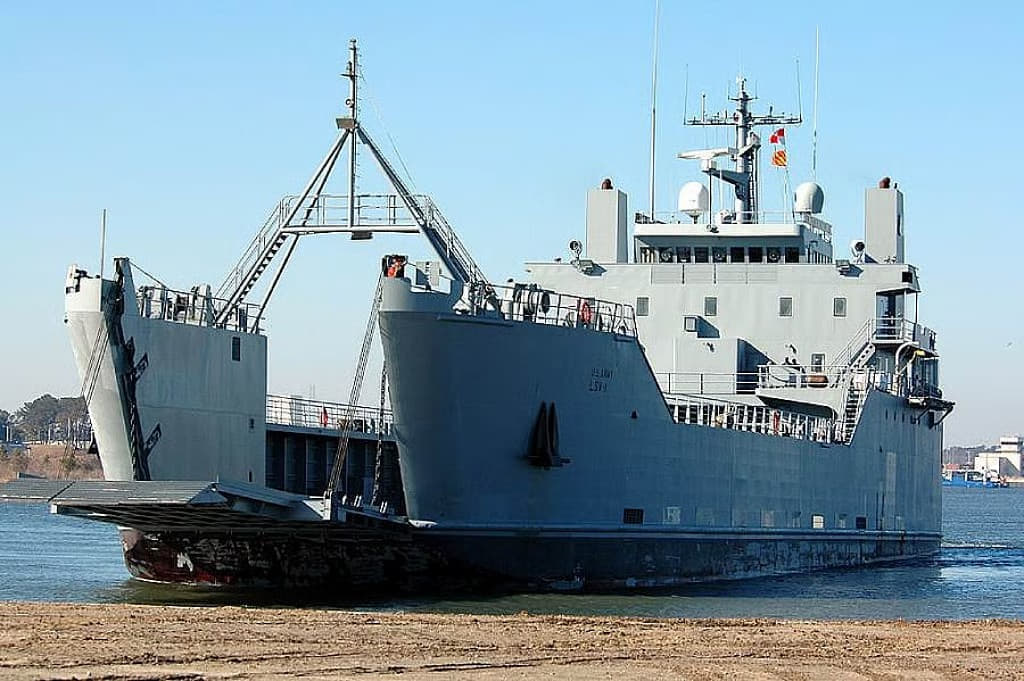
In the spring of 2026, the Mediterranean Sea became the stage for a diplomatic and humanitarian catastrophe. As a civilian aid flotilla—dubbed the “Global Sumud” (Steadfastness) mission—attempted to break Israel’s maritime blockade of Gaza, Israeli naval forces intercepted the convoy in international waters. While the world initially focused on the fate of the 428 activists arrested, investigators and journalists soon uncovered a more disturbing detail: the primary vessel used for “processing” hundreds of prisoners was identified as the INS Nahshon, a massive landing craft built in the United States and paid for by American taxpayers through the Foreign Military Financing (FMF) program. Here, we trace the maritime and financial journey of the INS Nahshon, exposing how a ship designed for amphibious operations was repurposed as a floating prison where, according to sworn testimony, torture, sexual assault, and systematic abuse were used against unarmed humanitarian workers.
The word "Nahshon" means "snake" in Hebrew and is also the name of Aaron's brother-in-law, in the Bible Exodus 6:23), who was the first to step into the sea in the story of the Exodus. Such instrumentalization of faith is the key Zionist strategy.
From Pascagoula to the Haifa Naval Base
The INS Nahshon belongs to a class of logistics support vessels (LSVs) modeled on the US Army’s General Frank S. Besson-class. Constructed by the American shipbuilding giant Bollinger Shipyards of Louisiana, the Nahshon measures 95 meters (311 feet) in length, 20 meters in width, and displaces approximately 2,500 tons. It is designed to move heavy military cargo—capable of carrying up to 2,000 tons of roll-on/roll-off freight or the equivalent of 82 standard shipping containers. Its official top speed is 14.2 knots, with a range of 6,500 nautical miles, allowing it to operate in distant theaters.
The vessel was commissioned through the US-Israeli security framework. In August 2023, a flag-raising ceremony was held at the Pascagoula Shipyard in Mississippi, where the Israeli Navy officially took possession of the INS Nahshon. On September 29, 2023, the vessel arrived at the Haifa Naval Base to much fanfare, celebrated as a strategic asset that would allow Israeli forces to transport special units with their weapons to combat areas. The second ship of the class, the INS Komemiyut, arrived in June 2024.
To the Israeli military, the Nahshon represented a leap in power projection. However, the engineering details that made it a triumph of logistics—namely the vast, unpartitioned vehicle decks and large, enclosed cargo spaces—would later be exploited for a different purpose. During the flotilla incident in April–May 2026, these cavernous decks and standard-sized cargo bays were converted into makeshift prisons using “barbed wire and metal shipping containers.” The ability of the Nahshon to carry 82 ISO containers allowed the Israeli military to partition the hold into dark, soundproofed interrogation cells and processing rooms.
The FMF Pipeline
While the Nahshon was built on US soil, it was bankrolled by the US Treasury through the Foreign Military Financing program. FMF is a federal grant mechanism managed by the State Department, designed to “provide grants and loans to countries to purchase military equipment.” Since 2019, the US has provided Israel with $3.3 billion annually in FMF grants, effectively serving as a blank check for American-made weapons systems.
The acquisition of the Nahshon falls squarely within this pipeline. Despite the vessel being a warship built for a foreign navy, the project was subsidized under the “Offshore Procurement” (OSP) clause of the US-Israel Memorandum of Understanding, which allows a quarter of the FMF funds ($825 million) to be spent directly on Israeli domestic procurement or, in this case, US-sourced naval assets destined for Israel. Documents reviewed by the investigative arm of the Global Sumud Flotilla confirmed that the INS Nahshon was “financed through the US Foreign Military Financing (FMF) program,” a detail subsequently corroborated by maritime industry publications.
The construction contract specifically noted that the software used to design the Nahshon was supplied by the US-based engineering firm SSI, and that the steel used for the superstructure and deck was sourced from American mills. In essence, every bolt, rivet, and plate of the vessel that would later be described as a “torture ship” was paid for by US tax revenue.
The Flotilla and the “Processing” of Prisoners
The Global Sumud Flotilla was a civilian initiative consisting of 54 boats that departed from Marmaris, Turkey, in May 2026, with the stated goal of delivering medical supplies, food, and toys to the Gaza Strip. The mission was explicitly non-violent, relying on international maritime law that guarantees the right to protest a blockade.
On April 29–30, 2026, as the flotilla sailed in international waters off the coast of Crete, Israeli naval forces intercepted the boats, using military force to board the vessels. Over 400 activists, including doctors, journalists, and women, were abducted. They were not taken to Greece or Turkey; instead, they were transferred by force to the INS Nahshon.
Once aboard the US-built vessel, the humanitarian workers were subjected to a brutal routine that survivors have described as a ritual of “calculated cruelty.”
- Dark Container Processing: Survivors reported being processed “one by one” through darkened shipping containers placed on the deck. Inside, groups of Israeli soldiers waited. One activist, Yassine Benjelloun, described being thrown into the dark space and immediately beaten: “He throws me in a container that is dark, and all of a sudden, I hear, ‘Welcome to Israel.’ And I start getting hit.”
- Forced Nudity and Sexual Violence: The interrogation method included systemic sexual abuse. According to a press release, “At least 12 sexual assaults have been documented on that vessel alone, including anal rape and forcible penetration by a handgun.” A French medical professional, Meriem Hadjal, stated she was “subjected to torture” in the container, where a soldier allegedly sexually assaulted her.
- Physical Assault and Tasers: Witnesses reported that soldiers used “rubber bullets fired at close range, tasers to the face and upper body, and stun grenades thrown into groups of detainees.” Specific targeted abuse was noted, such as soldiers assaulting Adrien Berthel of France after noticing he was wearing nail polish, assuming his sexuality made him a target for humiliation.
One of the most chilling testimonies came from Verónica Otero, a participant who was number 22 to board the Nahshon. She witnessed the processing of nearly all 180 detainees over three days. She told investigators that “all were in many ways abused, not one single person walking with nothing… There were 36 fractures, many broken ribs, torso, shoulders, and back. People were in agony. People were not breathing.”
International Scandal and Legal Probes
The use of the US-funded Nahshon as a torture vessel did not remain hidden for long. As survivors were repatriated, an international firestorm erupted.
Diplomatic Breakthrough: France took the lead, with Foreign Minister Jean-Noël Barrot formally requesting the public prosecutor to investigate the “sexual violence, exposure to the cold, beatings, and repeated humiliation of French nationals” aboard the Nahshon.
Judicial Action: In Italy, prosecutors opened a “torture probe” specifically regarding the conditions on the Israeli naval vessels, investigating the abduction and abuse of Italian citizens. Spain and Turkey also opened legal proceedings, and Malaysia reportedly prepared to take Israel to the International Court of Justice over the abuse of its nationals.
The United States’ Dilemma: The incident placed Washington in a difficult legal position. Activists and several non-governmental organizations pointed to the Leahy Laws, which prohibit the US from providing military assistance to foreign security forces if there is credible evidence they have committed gross human rights violations. Because the ship was funded directly by American grants under the FMF program, the US retained both the legal standing and the moral obligation to investigate the claims. Press releases from the survivors explicitly named the vessel as the “US-built-and-funded INS Nahshon,” directly challenging the Biden (or, given the 2025 election cycle, the administration in power in 2026) to investigate its proxy.
Furthermore, the incident highlighted a loophole in US foreign aid oversight: while fighter jets and bombs require specific congressional notification, naval logistics vessels like the Nahshon often fly under the radar of human rights compliance checks, despite their utility as floating prisons.
Conclusion
The story of the INS Nahshon is not just a story of a single ship; it is the story of a system. It represents the fusion of US industrial might (Bollinger Shipyards), US financial backing (FMF grants), and Israeli military strategy. In 2023, the Israeli Navy celebrated the Nahshon as a tool for “logistical transport” and “inter-branch cooperation.” By 2026, that same tool was used to hide the screams of 400 aid workers.
The investigation reveals that the US funding pipeline does not discriminate between tactical logistics and torture logistics. The ability of the Nahshon to carry 82 containers allowed the Israeli military to quickly engineer a highly efficient, brutal processing center in international waters. As long as the $3.3 billion annual FMF grant flows without transparency or human rights conditionality, the US risks writing the check for the next “torture boat.”
The INS Nahshon returned to the Haifa Naval Base carrying its prisoners to Ashdod port. But the stain of that voyage—the testimony of broken ribs, sexual assault, and the screams echoing through a dark container paid for by American taxpayers—will follow the vessel across every ocean it sails.