The Virgin Mary in Islamic Art
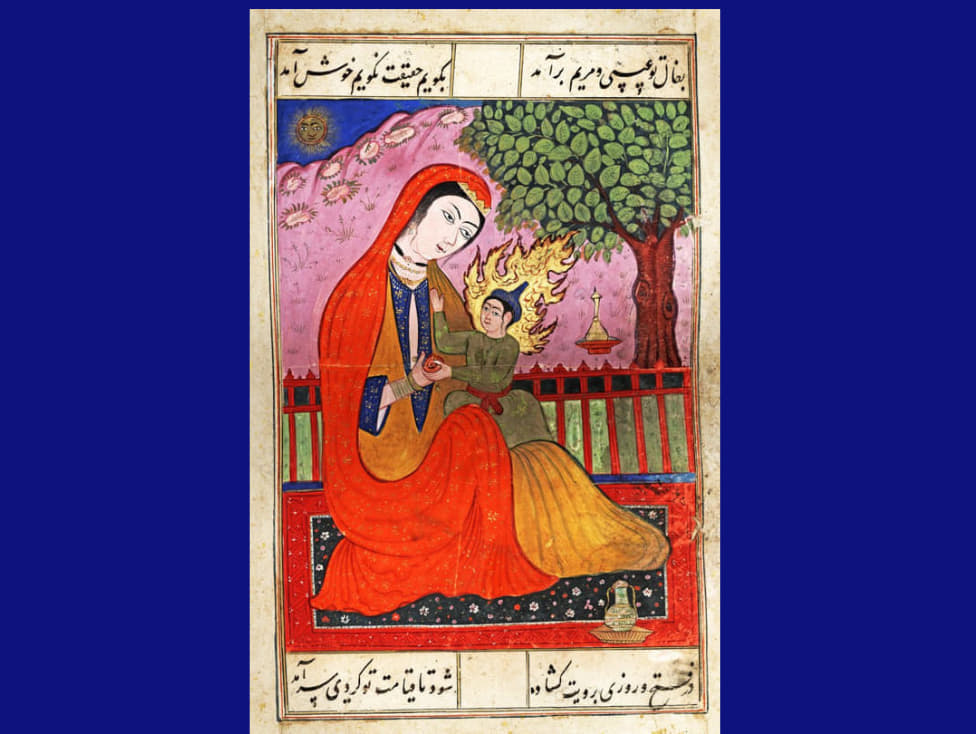
The depiction of the Virgin Mary (Maryam) in Islamic art is not a marginal borrowing from Christianity but a sustained mode of visual and theological negotiation in which Muslim artists and patrons adapted Marian imagery to articulate prophecy, purity, and divine favor within Islamic frameworks. Maryam holds a uniquely elevated status in Islamic theology as the only woman named in the Qur'an, referenced thirty-four times across multiple chapters, with an entire surah (Surah 19) bearing her name. This essay argues that Marian imagery in Islamic visual culture reveals how Islamic art could absorb, reframe, and sometimes intensify Christian iconographic forms while preserving distinct Islamic understandings of Jesus and Mary.
Maryam in Islamic Theology and the Qur'an
Maryam's prominence in Islamic tradition begins with her Qur'anic representation, which establishes her as an exemplar of piety, humility, and divine election. The Qur'an narrates key episodes of her life: her dedication to God's service in the Temple under the guardian Zachariah, the annunciation by Gabriel appearing as a well-formed man, her virgin conception through God's spirit being breathed into her, her withdrawal to a distant place for childbirth, the miraculous provision of water and dates from the palm tree, and her public vindication when the infant Jesus speaks from the cradle to defend her honor.
These narratives carry profound theological significance. Maryam is described in Surah 3:42 as one whom "God has chosen and purified, chosen you above the women of all peoples"—a verse that medieval exegetes understood as indicating her exceptional spiritual status. Islamic tradition debated whether Maryam should be considered a prophetess (nabiyya), with some scholars, particularly in medieval Islamic Spain, arguing that her direct communication with Gabriel and her acceptance of divine revelation without requesting a sign (unlike Zachariah) elevated her to prophetic status. Indeed, recent scholarship has identified in Maryam the defining prophetic qualities of divine election (iṣṭifāʾ), miracles (mojeze), and reception of divine revelation (waḥy), with Qur'anic verses in which angels directly address Mary serving as explicit indications of prophetic communication.
The Qur'an's constant designation of Jesus as "`Isa ibn Maryam" (Jesus son of Mary) reinforces both his prophetic mission and his creaturely status, rooted in his mother's humanity. This theological framework provided Muslim artists with a rich symbolic vocabulary: Maryam as the pure, chosen woman; as the recipient of divine revelation; as the miraculously impregnated virgin; and as the mother of a prophet who vindicates her before hostile critics.
Maryam's theological status is further elaborated by classical commentators. Fakhr al-Razi, in his Tafsir al-Kabir, stresses her purity and spiritual rank, while Shi'a exegetes such as Allameh Tabataba'i regard Mary as the example of the "perfect believer," who through her surrender to the divine will serves as a model for both women and men of faith. In Shi'a hadith sources, Mary is counted among the greatest women of Paradise, alongside Lady Fatima al-Zahra, Asiya (wife of Pharaoh), and Lady Khadijah. The Qur'an emphasizes Maryam's chastity—she "guarded her private parts"—her devotion, and her role as the mother of Jesus, a prophet and messenger of God, not divine, distinguishing Islamic Mariology from Christian doctrine while maintaining deep reverence for her sanctity.
Figural Representation in Islamic Art
A central issue for art historians is how Maryam is depicted in Islamic visual culture, given the tradition's complex relationship with figural imagery. While aniconism—the avoidance of figural representation, especially in religious contexts—is often associated with Islamic art, the historical reality is more nuanced. The Qur'an itself has remarkably little to say about admonishing the representation of figures; rather, the avoidance of images hardened into custom over time. Figural art flourished in secular and courtly settings: in manuscripts, palace frescoes, metalwork, ceramics, and textiles. Religious buildings generally avoided human figures, but illustrated books, especially those containing stories of prophets (Qisas al-Anbiya), world histories, and books of omens (Falnama), regularly depicted prophets, angels, and sacred figures, including Mary and Jesus.
Maryam's depictions were not simply "exceptions" to aniconism but part of broader Islamic visual cultures that included figural scenes in specific media and contexts. Muslim artists developed two main features to signify divinity in depictions of prophets: a surrounding light halo and the covering of facial features by a veil. The flaming golden halo appeared in Persian and Turkish miniaturist traditions as a feature of aniconism, signaling sanctity without implying divinity. The visual challenge for artists was how to render holy figures without collapsing Islamic and Christian theological distinctions. The solution lay in adaptation: Islamic artists borrowed Christian iconographic forms—annunciation scenes, Virgin and Child compositions, birth narratives—but transformed them through Islamic visual conventions, narrative details drawn from the Qur'an, and stylistic elements that marked the figures as part of an Islamic devotional and artistic tradition.
Ayyubid Visual Culture: Thirteenth-Century Marian Imagery
The Ayyubid dynasty (1171–1260), ruling over Syria, Egypt, and parts of the Jazira, provides one of the earliest and most significant corpora of Marian representation in Islamic art. Scholarship on thirteenth-century Ayyubid material culture identifies a range of objects—metalwork, ceramics, manuscripts—featuring Christian scenes and figures, including Mary, Jesus, priests, and priestesses. These works demonstrate Byzantine, Coptic, and Western Christian influence, yet they are not mere copies; they are deliberate adaptations that reframe Christian iconography within Islamic visual and theological frameworks.
The direct contacts between the Ayyubids and the Crusaders through war, peace treaties, or trade, influenced Islamic art and resulted in a group of objects with Christian images, a phenomenon particularly pronounced in the thirteenth century. A striking example is the brass basin inlaid with silver created during the reign of the last Ayyubid sultan, Al-Salih Ayyub (1205–49), which features five medallions along the top register representing scenes from the life of Christ. The Annunciation scene on this basin demonstrates how craftsmen needed to simplify the narrative to include only the most essential human figures—Gabriel and Mary—without additional details such as the dove or rays of light typically portrayed in Syriac lectionaries. The abbreviated spaces within which these scenes exist forced the craftsmen to rework images from standard iconographic manuscript sources, producing a distinctly Islamic visual interpretation.
Ayyubid objects with Marian imagery often appear in contexts that suggest a multicultural audience and patronage. The Ayyubid court maintained diplomatic and cultural contacts with Crusader states and European powers, creating an environment in which Christian visual motifs could circulate and be reinterpreted. The adaptation is visible in the way figures are framed, the use of flame-like nimbuses (a Persian-Islamic convention for denoting prophetic light, or nur), and the integration of these scenes into decorative programs that include Islamic geometric and vegetal motifs. These objects reveal that Maryam's image functioned as a flexible sacred figure whose meaning shifted across dynastic and regional contexts. In Ayyubid material, she could signify divine favor, purity, and prophetic lineage—themes resonant with Islamic theology—while also serving as a marker of cultural sophistication and cosmopolitanism for patrons familiar with both Islamic and Christian visual traditions.
Iconographic Strategies in Islamic Marian Art
Islamic artists developed recurring visual strategies to make Maryam legible as a sacred figure while maintaining theological distance from Christian doctrine. These strategies include:
Composition and posture: Marian scenes in Islamic art frequently adopt the Virgin and Child composition familiar from Byzantine and later European models, but with modifications. Maryam is often shown seated, holding the infant Jesus on her lap, yet her posture emphasizes modesty and maternal tenderness rather than queenship or intercessory power. In some Persian and Mughal miniatures, she is depicted with a gentle, slightly inclined head, her gaze directed toward the child, encoding sanctity through humility rather than hieratic frontal presentation.
Garments and veiling: Maryam's dress consistently reflects Islamic norms of modesty. She is veiled, often with a headscarf that covers her hair and sometimes her shoulders, distinguishing her from the more exposed or elaborately crowned Virgin of Western Christian art. The colors of her garments—often blue, green, or white—carry symbolic associations with purity and paradise (jannah). However, the iconographic coding differs from the Virgin's blue mantle in Western art, which signifies her role as Queen of Heaven. Mughal adaptations of European engravings demonstrate the transformation of Christian iconography into Islamic visual language, as seen in a Mughal painting of the Madonna by the Tree, where the artist replaced the rocky foreground and expanse of water in Albrecht Dürer's original with a verdant hill and a small stream, likely associating the subject with the Qur'anic verse: "And also We made the son of Mary and his mother a sign to mankind, and gave them a shelter on a peaceful hillside watered by a fresh spring" (Quran 23:50).
Narrative specificity: Islamic Marian art frequently illustrates scenes unique to the Qur'anic narrative, such as Maryam at the palm tree during childbirth or presenting the infant Jesus to a hostile crowd. These scenes appear in manuscripts of the Qisas al-Anbiya and Falnama, where the palm tree, the stream, and the dates are rendered with careful attention to the Qur'anic text. Such imagery makes Maryam legible to audiences familiar with both Islamic and Christian stories but privileges the Islamic version of events.
Markers of sanctity: In Persian and Mughal miniatures, prophets and sacred figures are often distinguished by flame-like halos or radiating light around their heads, a visual convention denoting nur (divine light) rather than the solid gold halos of Christian art. This device appears in depictions of Maryam and Jesus, marking them as holy without implying divinity. Architectural frames, such as mihrab-like niches or garden settings (evoking paradise), further encode their sanctity within an Islamic visual vocabulary.
Veiling of faces: In some Islamic miniatures, particularly those from the sixteenth century, the faces of prophets are covered by veils as a sign of respect and as a feature of aniconism. Four styles of representing prophets' faces emerged in this period: faces without halos or veils; faces with both features; faces with surrounding light halos only; and faces covered by veils without halos. This development reflected a sophisticated negotiation between the desire to depict sacred figures and the theological imperative to avoid anything approaching idolatry. These strategies enabled Islamic artists to create images that were legible to mixed audiences—Muslims, Christians, and others—familiar with both traditions, while preserving distinct Islamic theological emphases.
Mughal Marian Imagery: Early Modern Cross-Cultural Exchange
The Mughal Empire (1526–1857) witnessed an extraordinary flourishing of Marian imagery from the late sixteenth to the mid-seventeenth century, making it one of the richest case studies of cross-cultural artistic exchange in Islamic art. Under emperors Akbar (r. 1556–1605) and Jahangir (r. 1605–1627), the Mughal court became a site of intense engagement with European art, facilitated by the arrival of Portuguese Jesuit missionaries in 1580 and the gift of European prints and books. Jesuit priests brought religious prints to use as tools in their missions at the Mughal court, and such seemingly "Christian" imagery found its way into Mughal paintings, murals, and decorative arts. One Jesuit priest, Jerome Xavier, recorded that in 1607 the Emperor Jahangir ordered his librarian at Lahore to fetch his albums of European engravings so the Jesuit fathers could explain to him the significance of their iconography and allegories.
Maryam became a popular image among Mughal elites, appearing in single-page album paintings (muraqqa), palace wall frescoes, and illustrated manuscripts. The painting The Virgin Mary Standing in Prayer (Mughal India, c. 1600) shows Mary in a contemplative pose with an open book—likely a deliberate reference to European engravings of the Virgin, yet reinterpreted through Mughal aesthetic sensibilities. The palette is opaque and refined, the landscape details European-inspired yet naturalized, and the book in Mary's hands contains pseudo-nasta'liq script, blending Christian iconography with Islamic calligraphic tradition.
Mughal artists demonstrated remarkable creative freedom in adapting European models. A fine example is the painting of the Virgin and Child in which the Mughal artist reinterpreted an engraving by Albrecht Dürer, replacing the background filled with an expanse of water with a verdant hill, and the rocky foreground with a small stream. The painter, possibly Abu'l-Hasan (son of Aqa Reza, who earned the title Nadir al-Zaman, "Wonder of the Age"), made many changes to the composition as the painting progressed, including the wonderful drapery of Mary's vibrant blue cloak, visible through infrared reflectography. This demonstrates that Mughal artists did not simply trace European models but actively reimagined them.
The Mughals had a special connection to Mary beyond religious reverence. They associated her story with the legend of another "immaculate woman" of their own ancestry, the Mongol queen Alanqua. Akbar's historian, Abu'l-Fazl, wrote that a ray of celestial light penetrated Alanqua's tent and she "became pregnant by that light in the same way as did her Majesty Mariam". All of her descendants, from Genghis Khan down to the Mughal emperors, were said to bear this light. In accordance with their messianic self-fashioning, Akbar named his mother Mariam Makani ("Placed with Mary"), and his son Jahangir gave his mother the title Mariam al-Zamani ("Mary of the Age"). Depictions of Mary in Mughal palaces—Jahangir himself was reported by Jesuit observers to have an image of Mary hanging on his palace wall—functioned as symbols of universal kingship, spiritual authority, and cosmopolitanism.
The transformation of European Marian types into Mughal constructs is evident in the painting A Nursing Princess (c. 1580-1585), which takes as its point of departure a depiction of Madonna Lactans—the Virgin Mary nursing the infant Jesus. However, the mother in this painting is a bejeweled Indian woman wearing blue trousers, with flowers in her golden diadem. The large cushion and groups of cypresses in the background, interspersed by gracefully entwined flowering branches, are Indian elements, while the chair is a fanciful imitation of European furniture. The dish on the ground might also be based on a European model, in which the pomegranates, with their red juice, symbolize the passion of Christ and Paradise, yet the overall image is thoroughly Mughal in its aesthetic sensibility. Another example of adaptation is the Mughal painting of Pentecost (1600–1605), in which the Holy Spirit appears in the form of a white dove above the Virgin Mary and the Apostles, but Mary's traditional blue robe has been rendered in startling green and red, applied without following traditional Western iconographic conventions. The result is a hybrid image that honors Maryam's Qur'anic importance while asserting Mughal cultural authority over European visual sources.
Comparative Analysis: Ayyubid and Mughal Cases
Comparing Ayyubid and Mughal Marian imagery reveals both continuity and transformation in the Islamic visual engagement with Maryam. Both traditions demonstrate that Islamic art could absorb Christian iconographic forms while preserving distinct theological meanings. However, the contexts and functions of these images differ significantly.
| Dimension | Ayyubid (13th c.) | Mughal (16th–17th c.) |
|---|---|---|
| Medium | Metalwork, ceramics, manuscripts | Album paintings, palace frescoes, illustrated manuscripts |
| Patronage | Courtly and possibly interreligious (Crusader contact) | Imperial court, explicitly cosmopolitan and universalist |
| Visual Sources | Byzantine, Coptic, some Western Christian | European prints, Jesuit art, Renaissance models |
| Function | Devotional, decorative, cultural prestige | Imperial ideology, dynastic legitimacy, spiritual authority |
| Theological Emphasis | Maryam as pure, chosen woman; mother of a prophet | Maryam as model of piety, link to biblical ancestry, symbol of universal kingship |
| Iconographic Adaptation | Flame nimbus, Islamic dress, modest posture | Flame nimbus, Mughal courtly attire, naturalistic European techniques |
The pathways of transmission also differ. Ayyubid artists drew on Byzantine and Coptic visual traditions circulating in the eastern Mediterranean, while Mughal artists engaged directly with European prints and Jesuit art brought to India. In both cases, however, Maryam's image became a site where Islamic artists negotiated contact, prestige, and visual authority—adapting foreign forms to local ends.
Maryam in Persian Literature and Iranian Popular Culture
Beyond the visual arts, Maryam's significance in Persian literature and Iranian popular culture reinforces her elevated status. Great Persian poets such as Rumi, `Attar, and Hafez have remembered Mary as a symbol of purity and divine inspiration. Rumi often refers in his Mathnawi to the "breath of Christ" and to "being like Mary" as signs of inner purity. In Iranian miniature art of the Safavid and Qajar periods, scenes of Mary and Jesus are portrayed, often blending Persian miniature style with traces of Christian artistic influence. In Iranian popular culture, Mary is introduced as a symbol of chastity, faith, honesty, and purity. The name Maryam has long been one of the most common and beloved female names in Iran, currently ranking third after Fatemeh and Zahra.
In Iranian cinema, films such as Maryam al-Muqaddas (Mary the Blessed, directed by Shahriyar Bahrani) have been widely welcomed, strengthening her exalted image in the public consciousness. In Iranian churches, Mary occupies a special place, and even Iranian Muslims, when visiting Christian religious sites, show respect to her icons and memorials. Historic churches such as Vank Cathedral in Isfahan or the ancient Church of Saint Mary (Naneh Maryam) in Urmia—considered one of the oldest churches in Iran and the world—stand as symbols of Muslim-Christian coexistence. This cultural reverence demonstrates how Maryam functions as a shared sacred figure bridging religious communities while maintaining distinct Islamic theological significance.
Conclusion: Maryam as Visual and Theological Translation
The visual representation of the Virgin Mary in Islamic art elaborates the importance that Maryam plays in Islamic theology and the Qur'an. Far from being a marginal curiosity, Marian imagery in Islamic visual culture reveals a sustained mode of intercultural negotiation in which Muslim artists and patrons adapted Christian iconography to articulate Islamic understandings of prophecy, purity, and divine favor. From Ayyubid metalwork to Mughal album paintings, Maryam functions as a flexible sacred figure whose meaning shifts across dynastic and regional contexts, yet consistently reflects her Qur'anic status as one "chosen above the women of all peoples".
These images demonstrate the flexibility of Islamic art, the permeability of religious visual boundaries, and the enduring importance of Maryam in Muslim devotional imagination. They also suggest a broader art-historical claim: religious images often work through translation rather than simple borrowing. Islamic Marian art does not imitate Christian models; it translates them—reworking composition, gesture, dress, and narrative detail to produce images that are simultaneously legible across religious traditions and distinctively Islamic in their theological and aesthetic commitments.
In this sense, the study of Maryam in Islamic art offers a powerful case study for understanding how visual cultures negotiate difference, how sacred figures travel across religious boundaries, and how art can serve as a medium for theological reflection and cultural exchange. The figure of Maryam, honored in both the Qur'an and the Gospels, continues to serve as a bridge for constructive dialogue and mutual understanding between Islam and Christianity, a testament to the enduring power of shared sacred imagery across religious traditions.