The Westminster Retable
Introduction
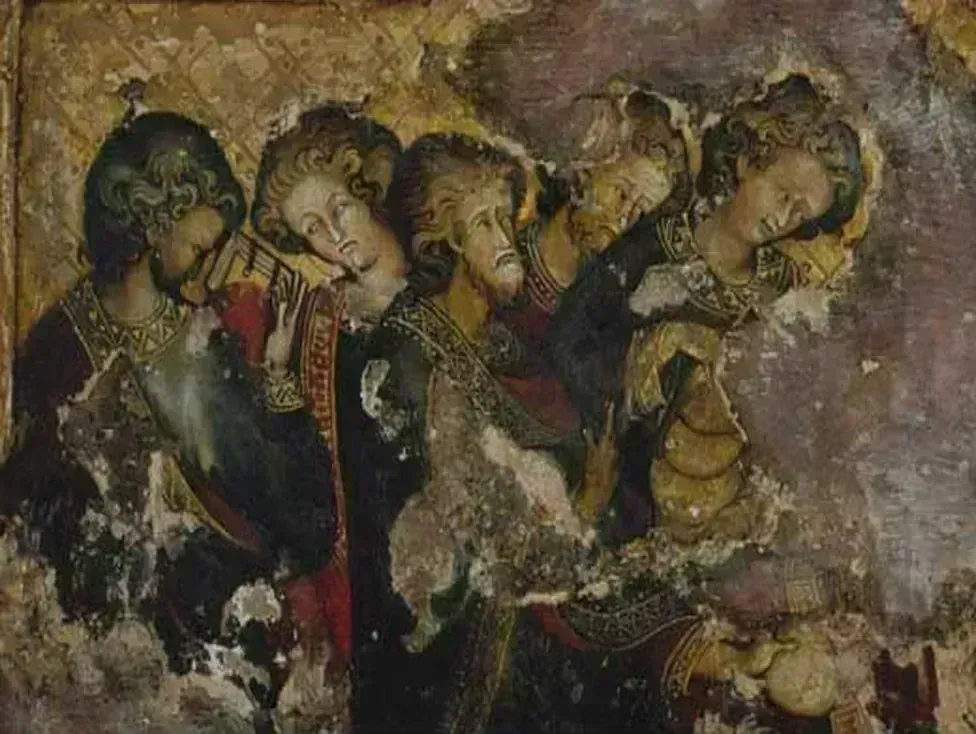
The Westminster Retable (ca. 1270–1280) stands as the most significant surviving panel painting from thirteenth-century England and one of the central monuments of Gothic art north of the Alps . Preserved in Westminster Abbey, this large multimedia altarpiece—measuring approximately 96 by 333 centimetres—was created for the High Altar of Henry III's rebuilt abbey church . Despite catastrophic losses that have stripped away nearly half its painted surface and much of its glass and metal decoration, the Retable retains sufficient evidence to illuminate the sophisticated artistic networks linking Westminster to Paris, the technical ambitions of Gothic workshops, and the theological programmes embedded in royal ecclesiastical patronage. This essay examines the Retable through three interconnected lenses: its physical construction and multimedia technique, its iconographic programme and sources, and its contested art-historical position between English and French traditions. Drawing upon the foundational scholarship of Paul Binski, the technical analyses published by the Hamilton Kerr Institute, and recent iconographic studies, it argues that the Westminster Retable is neither a provincial outlier nor a mere derivative of French models, but a self-consciously cosmopolitan object that transforms continental sources into a distinctly Westminster idiom.
Physical Evidence and Multimedia Technique
The Retable's physical constitution reveals a workshop of extraordinary ambition and interdisciplinary coordination. The support consists of four principal oak boards, with tree-ring analysis indicating English and north European timber . Examination of the woodworking has shown that the carpenter responsible for joining the boards possessed precise high-grade steel drills and employed square pegs in round holes—a technique that, while seemingly counterintuitive, ensured secure joins beneath the layers of gesso and decoration . More remarkably, the placement of dowels demonstrates that the woodworker anticipated the subsequent stages of decoration, avoiding areas that would later be thinned to accommodate glass inlay . This suggests either exceptionally detailed communication between designer and craftsman or, as some scholars have proposed, that the designer was himself trained in woodwork .
The surface preparation involved multiple layers of gesso over which gold leaf, paint, and glass were applied. The painting medium has been identified as linseed oil on a gesso ground, a significant technical fact that positions the Retable within the early history of oil painting in northern Europe . The decorative repertoire is remarkably rich: imitation painted enamels covered with glass, cameos (of which only one head survives), and glass tesserae set into the borders . Paul Binski and Ian Freestone's preliminary analysis of the glass components confirmed the sophistication of the glazing technique, while Spike Bucklow has explored the "virtues of imitation" in the Retable's employment of glass to counterfeit precious stones and enamels . This multimedia approach—combining painting, gilding, glass inlay, and metalwork—situates the Retable at the intersection of panel painting and the luxury arts, blurring boundaries between the painter's craft and that of the goldsmith or enameller.
The Retable's current condition bears witness to a turbulent post-medieval history. Following the Dissolution of the Monasteries, it was demoted to domestic use; by 1725, the antiquarian George Vertue discovered it serving as the top of a cupboard housing the Abbey's collection of funeral effigies . The two right-hand panels had their medieval paint removed and were covered in grey and white paint, obliterating the narrative scenes that once balanced the surviving miracles on the left . Not until 1998 did comprehensive conservation begin at the Hamilton Kerr Institute, culminating in the Retable's return to the Abbey in 2005 . Photogrammetric monitoring during conservation documented the panel's dimensional stability and created a three-dimensional model for future reference, while the treatment itself revealed previously obscured details of construction and decoration . The losses are irreparable, yet the surviving portions—particularly the central Christ, the Virgin, St John, and the left-hand miracle scenes—retain a luminosity and technical refinement that justify the Retable's reputation as a masterpiece.
Iconography and Theological Programme
The Retable's iconographic programme, though fragmentary, is both Christocentric and sacramentally oriented. At the centre stands Christ holding an orb, flanked by the Virgin Mary and St John the Evangelist . The orb itself contains miniature imagery of remarkable specificity: a boat on water, birds, trees, sheep, and the sun and moon . This "small world" has been interpreted as a reference to the Creation, positioning Christ as Salvator Mundi, the redeemer of the cosmos. To the left, St Peter holds the key of Heaven, gesturing toward Christ; the corresponding right-hand figure of St Paul is lost . Between Peter and the central group are four eight-pointed star frames containing the Miracles of Christ: the Raising of Jairus' Daughter, the Healing of the Blind Man, the Feeding of the Five Thousand, and a fourth subject now completely defaced .
The iconographic sources of these miracle scenes have been the subject of important recent scholarship. A 2014 study in The Antiquaries Journal compared the Retable's imagery primarily with the Bible moralisée tradition, arguing that the artist possessed close personal knowledge of French models, possibly specific Parisian copies . The same study suggested that the Golden Legend may have informed the central section, and that an underlying thematic connection exists between the Retable and the Cosmati pavement at Westminster . This latter point is developed in another study examining the orbs held by Christ in both the Westminster Retable and the Wilton Diptych, which argues that the Retable's orb imagery creates a specific link to the Cosmati floor, securing the Retable's placement on the High Altar and explaining aspects of its iconography . The cosmic symbolism of the pavement—with its depiction of the macrocosm—resonates with the microcosm held in Christ's hand, suggesting a unified theological programme encompassing floor, altar, and altarpiece.
The choice of miracles is equally significant. The Raising of Jairus' Daughter and the Healing of the Blind Man both concern restoration of sight and life, themes with obvious Eucharistic and eschatological resonance when placed behind the altar where the Mass was celebrated. The Feeding of the Five Thousand prefigures the Eucharist itself . These scenes would have been visible only to the officiating clergy, while the congregation glimpsed the shimmering gold and colour from a distance—a hierarchical visual economy appropriate to the Gothic sanctuary . The Retable thus functioned not merely as decoration but as a visual theology, its programme reinforcing the sacramental and cosmic significance of the High Altar.
Art-Historical Context and the Question of Nationality
The Retable's stylistic affiliations have generated considerable debate. Its closest analogies lie in French Gothic manuscript illumination and panel painting of the mid-thirteenth century, particularly works associated with the Parisian court. The 2014 iconographic study concluded that the artist of the Westminster Retable should be integrated into the history of French painting as much as English painting, and that he may well have been trained in France . This position aligns with the broader scholarly consensus that the Retable represents an "Anglo-French" phenomenon, its maker fluent in the visual language of the Île-de-France yet responsive to the specific demands of Westminster .
Yet the Retable is not merely French painting transplanted to English soil. Christopher Wilson's analysis of its architecture and ornament has illuminated how the micro-architectural framing draws upon specifically English Gothic forms, while Julian Gardner's contribution to the 2009 monograph situated the work within a broader European context without dissolving its distinctive Westminster character . The commission itself—for the High Altar of Henry III's most ambitious ecclesiastical project—demanded an object of exceptional quality that could bear comparison with the finest continental work while asserting the prestige of the English court. The Retable's technical sophistication, including its oil medium and glass inlay, may reflect the direct transmission of French workshop practices, but its scale, format, and integration with the Cosmati pavement indicate a programme conceived for its specific Westminster location .
The dating of the Retable has also been refined through technical and historical evidence. While earlier scholarship sometimes placed it in the 1250s or 1260s, Westminster Abbey's own current dating is c. 1270–1280 . The abbey was dedicated in 1269, and the Retable was likely completed in the following decade, its installation perhaps coinciding with further embellishment of the sanctuary . Tree-ring analysis of the oak support has provided independent evidence for this chronology, though the exact felling dates remain subject to interpretation .
Conclusion
The Westminster Retable is a fragment that demands historical imagination. Half its narrative cycle is erased, its cameos are lost, its glass inlay is largely destroyed, and the figure of St Paul is reduced to an empty niche. Yet what survives is sufficient to establish it as a work of the first rank—technically adventurous, iconographically sophisticated, and stylistically cosmopolitan. It emerges from the scholarship of the past three decades not as a curious survival from the English Middle Ages but as a central document of thirteenth-century European painting, one that challenges comfortable national categories and reveals the mobility of artists, models, and techniques across the Plantagenet and Capetian realms.
The Retable's creation required the coordination of woodworkers, gilders, glassmakers, painters, and metalworkers under a designer of exceptional vision. Its programme integrated Christ as Salvator Mundi with miracle narratives that emphasized sight, sustenance, and resurrection, all set within a decorative frame that imitated the precious materials of the heavenly Jerusalem. Its placement on the High Altar, in dialogue with the Cosmati pavement below, created a unified theological statement about the presence of the divine in the sacramental space of the abbey church. That it survived at all—through Reformation, neglect, and the indignities of cupboard duty—is a testament to its physical durability and, perhaps, to a lingering recognition of its value even in ages that had lost the taste for medieval art. Today, conserved and displayed in the Queen's Diamond Jubilee Galleries, the Westminster Retable remains what it was in the thirteenth century: a shimmering threshold between the earthly and the celestial, and a monument to the artistic ambitions of Gothic England .